People often stop while writing a message, email, school assignment, or social media post because they are not sure whether to use supposed or suppose.
These two words look very similar, but they have different meanings and grammar roles. Because they sound alike in everyday speech, many English learners and even native speakers mix them up.
People usually search for: supposed or suppose meaning, correct spelling, pronunciation, examples, usage, definition, and grammar difference.
Understanding the difference can help you write more clearly and avoid common mistakes in both formal and informal communication.
In this guide, you’ll learn the meaning, pronunciation, examples, usage, grammar rules, common mistakes, expert tips, and simple explanations in easy English.
Supposed or Suppose – Quick Answer
Direct Answer
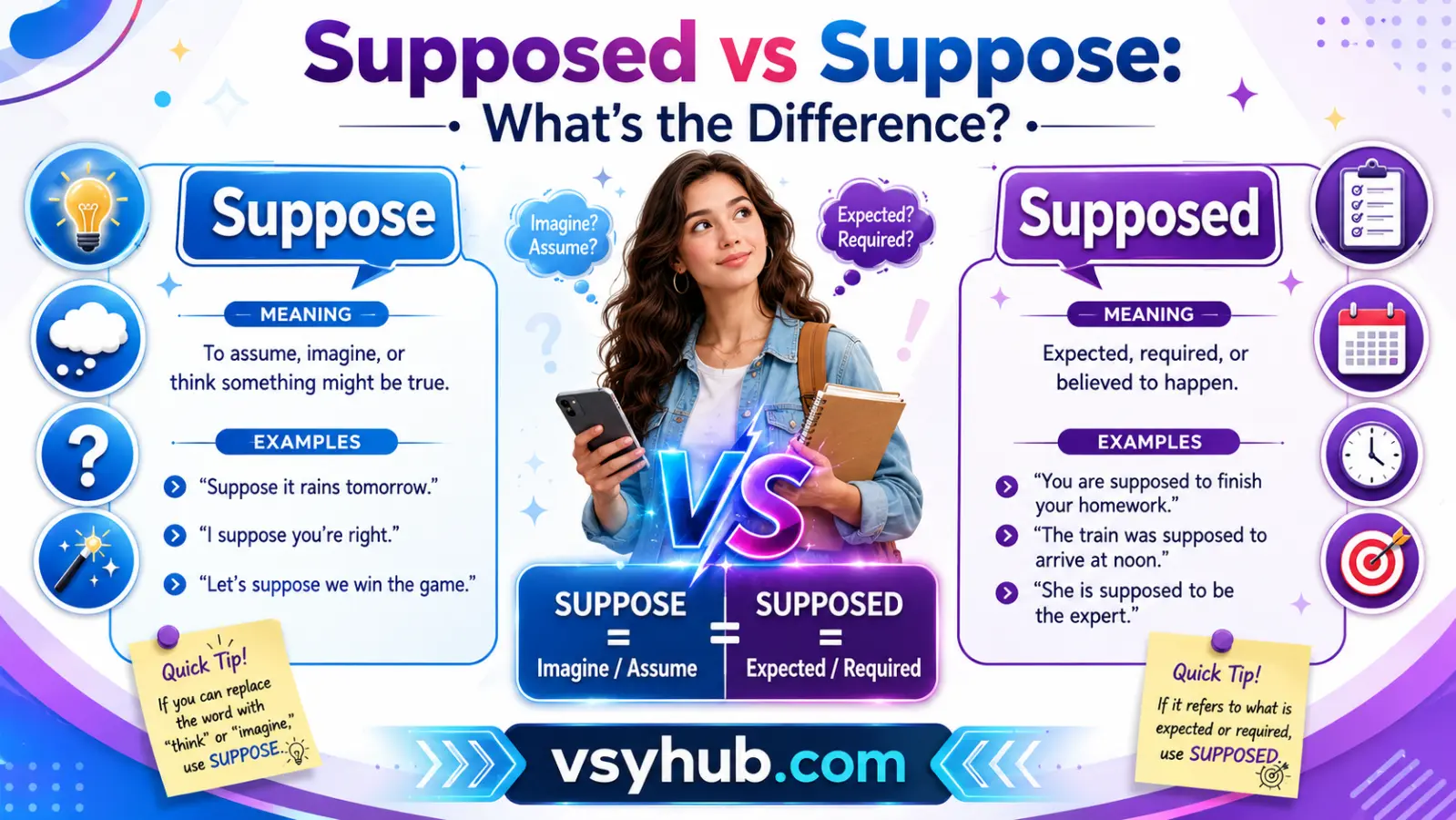
👉 Suppose = to assume, imagine, or think something may be true.
👉 Supposed = the past form of suppose or an adjective meaning expected, required, or believed.
Examples
✅ I suppose it will rain today.
✅ Suppose you won a million dollars. What would you do?
✅ You are supposed to finish your homework.
✅ The train was supposed to arrive at 5 PM.
✅ She is supposed to be an expert.
Simple Rule
👉 If you mean think, assume, or imagine, use suppose.
👉 If you mean expected, required, or intended, use supposed.
Easy Memory Trick
Think of the extra “d” in supposed as standing for duty or direction.
If someone has a duty or expectation, use supposed.
What Does Supposed or Suppose Mean?
Although the words are closely related, they perform different jobs in English grammar.
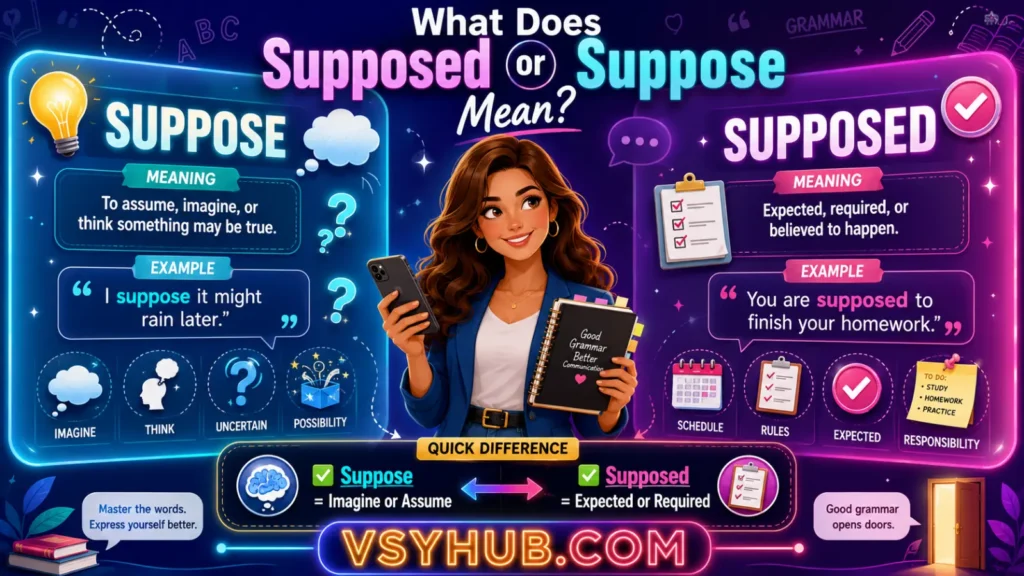
What Does Suppose Mean?
Suppose is a verb.
It means:
- To assume.
- To think something might be true.
- To imagine a situation.
- To consider a possibility.
Examples:
- I suppose you’re right.
- Let’s suppose the project succeeds.
- Suppose we leave early tomorrow.
What Does Supposed Mean?
Supposed can be:
- The past tense of suppose.
- An adjective meaning expected.
- A word showing obligation or responsibility.
Examples:
- You are supposed to wear a uniform.
- The meeting was supposed to start at noon.
- He was supposed to call me.
Synonyms
Suppose
- Assume
- Imagine
- Think
- Believe
- Consider
Supposed
- Expected
- Required
- Intended
- Meant
- Planned
Opposites
Suppose
- Know
- Confirm
- Prove
Supposed
- Unexpected
- Unplanned
- Optional
Related Terms
- Assumption
- Presume
- Expectation
- Obligation
- Requirement
- Belief
- Prediction
Common Variations
- I suppose
- Suppose that
- Supposed to
- Supposedly
- Was supposed to
- Were supposed to
The Origin of Supposed or Suppose
The word suppose comes from the Latin word supponere, which means “to place under” or “to assume.”
It entered English through Old French and gradually developed the meaning of imagining or assuming something.
Later, supposed became the past form of suppose and also developed a separate meaning related to expectations and obligations.
Over time, phrases like “be supposed to” became very common in everyday English. Today, this expression is widely used in schools, workplaces, online communication, and daily conversations.
How to Pronounce Supposed or Suppose
Suppose
Phonetic pronunciation:
suh-POHZ
Syllables:
sup-pose
Supposed
Phonetic pronunciation:
suh-POHZD
Syllables:
sup-posed
Easy Speaking Trick
Say:
- Suppose = ends with “pose”
- Supposed = ends with “pozed”
The final d sound is often very soft in fast speech, which is one reason people confuse these words.
Common Pronunciation Mistakes
❌ suh-pose-ed
✔ suh-pohzd
❌ sup-pose
✔ suh-POHZ
British English vs American English Usage
The usage of suppose and supposed is nearly identical in British and American English.
| Feature | British English | American English | Notes |
|---|---|---|---|
| Spelling | Suppose | Suppose | Same |
| Spelling | Supposed | Supposed | Same |
| Meaning | Same | Same | No difference |
| Grammar | Same | Same | No difference |
| Pronunciation | Slight accent variation | Slight accent variation | Meaning unchanged |
| Formal Usage | Common | Common | Widely accepted |
Which One Should You Use?
Use suppose when talking about assumptions, ideas, or possibilities.
Use supposed when talking about expectations, duties, or plans.
Quick Usage Guide
| Situation | Correct Word |
|---|---|
| Imagining something | Suppose |
| Making an assumption | Suppose |
| Expected action | Supposed |
| Obligation | Supposed |
| Planned event | Supposed |
Examples
- I suppose you’re busy today.
- Suppose we try another method.
- You are supposed to attend the meeting.
- She was supposed to send the report.
In Different Types of Writing
Academic Writing
- Suppose a student scores 100%.
- Students are supposed to follow instructions.
Workplace Writing
- I suppose the deadline remains unchanged.
- Employees are supposed to complete training.
Social Media
- I suppose everyone has an opinion.
- You’re supposed to tag your friends.
Texting
- Suppose we meet later?
- I was supposed to text you earlier.
Common Mistakes With Supposed or Suppose
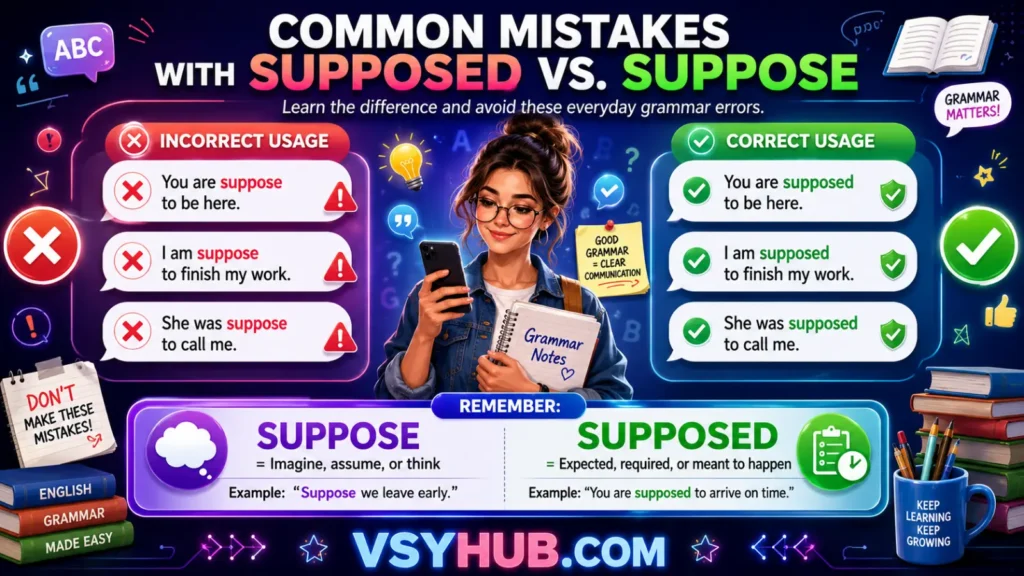
Mistake 1
❌ I am suppose to leave now.
✔ I am supposed to leave now.
Explanation: “Supposed to” is the correct phrase.
Mistake 2
❌ I supposed it will rain.
✔ I suppose it will rain.
Explanation: The present tense requires suppose.
Mistake 3
❌ Suppose to finish your work.
✔ You are supposed to finish your work.
Explanation: “Supposed to” needs a helping verb.
Mistake 4
❌ He is suppose to arrive soon.
✔ He is supposed to arrive soon.
Explanation: The adjective form requires the final “d.”
Mistake 5
❌ I supposed you’re correct.
✔ I suppose you’re correct.
Explanation: Use suppose for a current assumption.
Mistake 6
❌ We suppose to meet tomorrow.
✔ We are supposed to meet tomorrow.
Explanation: Add the helping verb.
Mistake 7
❌ Supposely
✔ Supposedly
Explanation: The correct adverb is supposedly.
Supposed or Suppose in Everyday Examples
Work
- I suppose the client will approve the proposal.
- We are supposed to submit reports every Friday.
School
- Suppose the answer is correct.
- Students are supposed to complete assignments.
Social Media
- I suppose this trend will continue.
- You’re supposed to use the hashtag.
Daily Life
- I suppose we’ll order dinner tonight.
- The package was supposed to arrive yesterday.
Emails
- I suppose we can schedule a meeting next week.
- You are supposed to review the document first.
Text Messages
- I suppose that’s okay.
- I was supposed to call you.
Online Content
- Suppose a website gets one million visitors.
- Users are supposed to follow community rules.
Conversations
- I suppose you’re feeling better.
- He was supposed to join us.
Supposed or Suppose in Different Contexts
In Education
Teachers use suppose when explaining examples and hypothetical situations.
Example:
- Suppose a triangle has three equal sides.
Teachers use supposed when discussing classroom rules.
Example:
- Students are supposed to raise their hands.
In Business
Managers may say:
- I suppose sales will increase next quarter.
Or:
- Employees are supposed to complete safety training.
In Professional Writing
Writers use suppose for assumptions.
They use supposed for responsibilities and expectations.
In Communication
The distinction helps avoid confusion.
Incorrect grammar can make professional communication look less polished.
In Social Media
Many users mistakenly write:
❌ suppose to
Instead of:
✔ supposed to
This is one of the most common grammar mistakes online.
In English Learning
Language learners often confuse the words because they sound similar when spoken quickly.
Learning the grammar pattern helps prevent mistakes.
Supposed or Suppose – Google Trends & Usage Data
The phrase “supposed to” receives significant search interest because many people are unsure whether it should contain the final “d.”
Popular searches include:
- Is it suppose or supposed?
- How do you spell supposed?
- What does supposed mean?
- Suppose vs supposed examples.
- Am I suppose to or supposed to?
- How to use supposed in a sentence?
- Difference between suppose and supposed.
Searches come frequently from the United States, United Kingdom, India, Pakistan, Canada, and Australia.
Voice search users often ask:
- What’s the difference between suppose and supposed?
- How do you pronounce supposed?
- When should I use supposed to?
Comparison Table: Supposed or Suppose
| Feature | Suppose | Supposed |
|---|---|---|
| Word Type | Verb | Adjective/Past Verb |
| Meaning | Assume or imagine | Expected or required |
| Pronunciation | suh-POHZ | suh-POHZD |
| Grammar Role | Action word | Description or expectation |
| Academic Usage | Common | Very common |
| Professional Usage | Common | Very common |
| Internet Usage | Moderate | Extremely common |
| Common Error | Using instead of supposed | Dropping the “d” |
| Example | I suppose so. | You are supposed to go. |
Supposed or Suppose in Professional Life
Correct grammar affects professional communication.
Using the wrong word may create confusion in:
- Business emails.
- Reports.
- Presentations.
- Client communication.
- Workplace documentation.
Examples:
✔ I suppose the project will finish on time.
✔ Team members are supposed to update their progress daily.
Employers often notice writing accuracy, especially in customer-facing roles.
Supposed or Suppose for Students or Beginners
Many beginners struggle because spoken English often hides the final “d” sound.
Why Learners Get Confused
- Similar pronunciation.
- Similar spelling.
- Fast speech.
- Informal texting habits.
Beginner Learning Tips
- Learn the phrase “supposed to” as a fixed expression.
- Remember that duties and expectations use supposed.
- Use suppose only when imagining or assuming.
Easy Shortcut
Ask yourself:
“Am I talking about a responsibility?”
If yes, use supposed.
Signs, Characteristics, or Common Uses Related to Supposed or Suppose
Common Uses of Suppose
- Making assumptions.
- Discussing possibilities.
- Creating examples.
- Teaching concepts.
- Exploring ideas.
Common Uses of Supposed
- Giving instructions.
- Explaining expectations.
- Discussing responsibilities.
- Talking about planned events.
- Describing intended actions.
Common Writing Patterns
- I suppose…
- Let’s suppose…
- Suppose that…
- Be supposed to…
- Was supposed to…
- Were supposed to…
Simple Trick to Remember Supposed or Suppose
Memory Rule
👉 Suppose = Think.
👉 Supposed = Expected.
Think of It This Way
Imagine a teacher says:
“You are supposed to submit your homework.”
The extra d reminds you there is a duty.
If you’re simply thinking or guessing:
“I suppose you’re right.”
No duty exists, so no extra “d.”
Expert Tips Section (Bonus)
Proofreading Trick
Search your document for:
“Suppose to”
Most of the time it should actually be:
“Supposed to”
Grammar Shortcut
Use:
- Suppose = think.
- Supposed = expected.
This simple replacement works in most situations.
Writing Improvement Tip
Read your sentence aloud.
If you can replace the word with think, use suppose.
If you can replace it with expected, use supposed.
Pronunciation Hack
Practice:
- Suppose
- Supposed
- Supposedly
Together to train your ear.
Related Searches People Also Ask (Bonus SEO)
Is it suppose to or supposed to?
The correct phrase is “supposed to.”
What does supposed mean?
It usually means expected, required, or intended.
What does suppose mean?
It means to assume, imagine, or think.
Why do people confuse suppose and supposed?
They sound very similar in spoken English.
Is supposed formal English?
Yes. It is commonly used in both formal and informal communication.
Can suppose start a sentence?
Yes. Example: “Suppose you had unlimited money.”
Is supposed a verb?
It can be the past form of suppose and can also function as an adjective.
Why is supposed so common?
The phrase “be supposed to” is frequently used to express obligations and expectations.
Is suppose used in business writing?
Yes. It is often used for assumptions and scenarios.
Is supposed correct in academic writing?
Absolutely. It is accepted in formal and academic English.
FAQs
What is the difference between supposed and suppose?
Suppose means to assume. Supposed means expected or required.
Is it “I am suppose to” or “I am supposed to”?
“I am supposed to” is correct.
How do you pronounce supposed?
It is pronounced suh-POHZD.
Is supposed grammatically correct?
Yes, when used properly.
Can I use suppose in formal writing?
Yes. It is common in formal English.
Why do people write suppose instead of supposed?
Because the final “d” sound is often difficult to hear.
Is supposed an adjective?
Yes, it can function as an adjective.
What is an example of suppose?
“I suppose the meeting will begin soon.”
What is an example of supposed?
“You are supposed to wear safety equipment.”
Which word is more common?
Supposed is generally more common because of the phrase “be supposed to.”
Final Verdict
The difference is simple:
👉 Suppose means to think, imagine, or assume.
👉 Supposed means expected, intended, or required.
The easiest memory rule is:
Suppose = Think
Supposed = Expected
If you’re talking about a responsibility or expectation, always use supposed.
Conclusion
Understanding the difference between supposed or suppose can instantly improve your English writing and speaking. Although the words look almost identical, they serve different purposes. Suppose is used when you are imagining, assuming, or thinking about something. Supposed is used when something is expected, planned, or required.
Whenever you’re unsure, remember this simple trick: suppose means think, while supposed means expected. That one rule will help you avoid the most common mistake and use both words confidently in school, work, emails, social media, and everyday conversations.