
You may have seen catchup and catch up in emails, social media posts, text messages, or even at work and wondered which one is correct.
Many beginners search for the difference because both look similar but are not always used in the same way.
People usually search for: catchup or catch up meaning, correct spelling, pronunciation, examples, usage, definition, and grammar difference.
In this guide, you’ll learn the meaning, pronunciation, examples, usage, grammar rules, common mistakes, expert tips, and simple explanations in easy English.
Catchup or Catch Up – Quick Answer
The answer depends on how the words are used.
👉 Catch up = A two-word phrasal verb that means to reach the same level as someone or to talk after not seeing someone for a while.
👉 Catchup = A one-word noun that is an informal spelling of catch-up. It usually means a meeting or conversation where people share updates. It is much less common than catch-up.
Examples
✅ I need to catch up on my homework.
Let’s catch up over coffee this weekend.✅
✅ We had a quick catchup after the meeting. (Informal but acceptable.)
We scheduled a catch-up meeting for Monday. (More common and preferred.)✅
Simple Rule
- Use catch up when talking about an action.
- Use catch-up (or sometimes catchup) when talking about a meeting, conversation, or update.
Easy Memory Trick
Think of it this way:
- Doing something? → Catch up
- Naming an event or conversation? → Catch-up
This simple trick helps you choose the correct form almost every time.

What Does Catchup or Catch Up Mean?
Although these forms are closely related, they do different jobs in English grammar.
What Does “Catch Up” Mean?
Catch up is a phrasal verb. It usually means:
- Reach the same level as someone else.
- Finish work that is behind schedule.
- Talk with someone after a long time apart.
- Learn information you have missed.
Examples:
- I need to catch up on my reading.
- She ran faster to catch up with her friends.
- We should catch up sometime next week.
- He watched the recordings to catch up on the lessons.
In daily life, this is by far the most common form.
What Does “Catchup” Mean?
Catchup is an informal noun. It refers to:
- A conversation where people exchange updates.
- A meeting after a long time.
- Bringing someone up to date on recent events.
Examples:
- We had a short catchup before work.
- Thanks for the weekend catchup.
However, many style guides and professional writers still prefer the hyphenated form catch-up instead of catchup.
Catch-Up vs Catchup
Both can be nouns, but catch-up is more widely accepted in formal writing.
Examples:
- We had a weekly catch-up meeting.
- Let’s schedule a project catch-up tomorrow.
In casual texting, people may write catchup, but it appears less often in edited writing.
Synonyms
For catch up:
- Meet again
- Reconnect
- Update
- Reach
- Recover lost time
- Keep pace
For catch-up:
- Update
- Meeting
- Check-in
- Conversation
- Discussion
- Review
Opposites
- Fall behind
- Ignore
- Miss out
- Lose touch
- Disconnect
- Stop communicating
Related Terms
- Keep up
- Stay updated
- Follow up
- Check in
- Reconnect
- Update someone
- Meet again
- Get up to speed
Common Variations
- Catch up with
- Catch up on
- Catch-up meeting
- Catch-up session
- Quick catch-up
- Team catch-up
- Friendly catch-up
- Weekend catchup
These variations are common in workplaces, schools, business communication, and everyday conversations.
The Origin of Catchup or Catch Up
The expression catch up has been part of English for hundreds of years. The verb catch comes from older forms of English and originally meant to seize or reach something. Over time, people began using catch up to describe reaching the same position as someone else.
As English evolved, the phrase gained new meanings. It started to describe finishing delayed work, learning missed information, and reconnecting with friends or family.
The noun catch-up appeared much later. Instead of describing an action, it described the meeting or conversation itself.
Examples include:
- A project catch-up.
- A weekly team catch-up.
- A family catch-up over dinner.
The single-word spelling catchup became popular in casual writing, online messaging, and some modern workplaces. Even so, many dictionaries and professional editors still recommend catch-up for formal writing because it is clearer and more widely recognized.
Today, catch up remains the standard verb, while catch-up is the preferred noun in most professional and academic contexts.
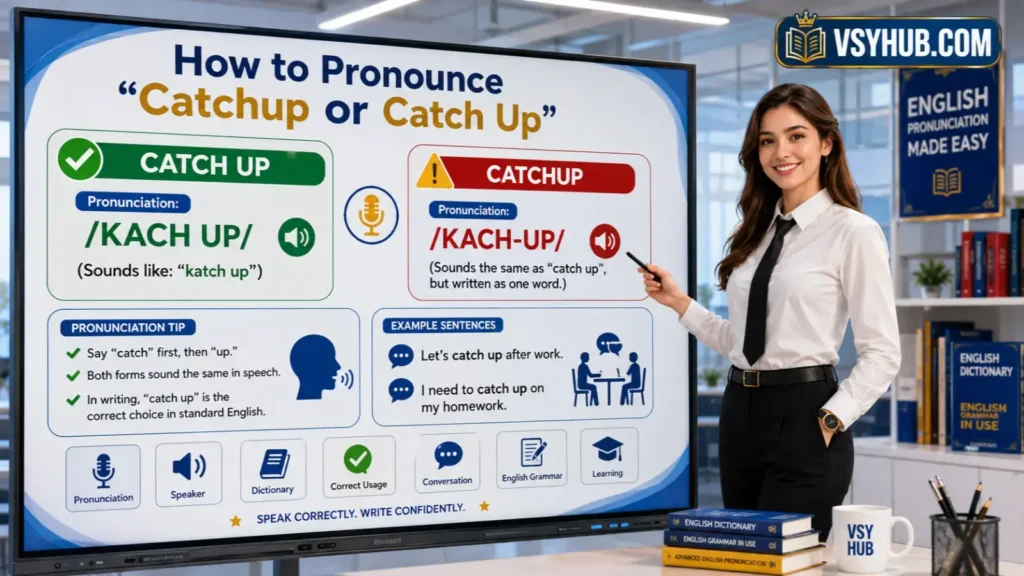
How to Pronounce Catchup or Catch Up
Both forms are pronounced almost the same.
Catch Up
Pronunciation: KATCH up
Phonetic: /kætʃ ʌp/
Catchup
Pronunciation: KATCH-up
Phonetic: /ˈkætʃ.ʌp/
Syllables
- Catch = 1 syllable
- Up = 1 syllable
Together they make two syllables.
Easy Speaking Trick
Say the words separately:
Catch + Up
Then say them faster:
Catch up
The pronunciation stays natural and smooth.
Common Pronunciation Mistakes
❌ Saying “cache up.”
✔ Say catch clearly with the ch sound.
❌ Stressing the second word too much.
✔ Put slightly more stress on catch.
❌ Dropping the tch sound.
✔ Keep the ending clear: catch.
Practice:
- Catch up on work.
- Catch up with friends.
- Quick catch-up meeting.
Repeating these sentences aloud helps improve natural pronunciation.
British English vs American English Usage
Both British English and American English use catch up in exactly the same way. There is no spelling difference for the verb.
The main difference appears with the noun. Both varieties commonly prefer catch-up with a hyphen in formal writing, while catchup appears more often in informal writing, company messages, blogs, and social media.
| Feature | British English | American English | Notes |
|---|---|---|---|
| Verb form | Catch up | Catch up | Same usage |
| Noun form | Catch-up preferred | Catch-up preferred | Most style guides recommend the hyphen |
| Informal noun | Catchup sometimes used | Catchup sometimes used | Common in casual writing |
| Pronunciation | Nearly identical | Nearly identical | Very small accent differences |
| Grammar | Same | Same | No grammar difference |
| Professional writing | Catch-up preferred | Catch-up preferred | Best choice for business and academic writing |
Overall, English speakers around the world understand all three forms—catch up, catch-up, and catchup. For the clearest and most professional writing, remember this simple rule:
- Catch up = Verb (action)
- Catch-up = Noun (meeting or update)
- Catchup = Informal noun, less common than catch-up
Which One Should You Use?
The correct choice depends on how you’re using the words in a sentence. Most of the time, people need catch up because it describes an action. If you’re talking about a meeting or conversation, catch-up is usually the best choice. Although catchup is sometimes accepted as a noun, it is less common in formal writing.
Use Catch Up When It Is an Action
Choose catch up if someone is doing something.
Examples:
- I need to catch up on my homework.
- She stayed late to catch up on work.
- Let’s catch up next weekend.
- He ran faster to catch up with the group.
Use Catch-Up When It Is a Thing
Choose catch-up when referring to a meeting, conversation, or update.
Examples:
- We had a team catch-up this morning.
- Our weekly catch-up lasted 30 minutes.
- The manager scheduled a project catch-up.
When Can You Use Catchup?
Catchup is an informal spelling used mainly in casual writing.
Examples:
- Thanks for the quick catchup.
- We had a nice catchup yesterday.
In business reports, school assignments, and professional emails, catch-up is still the safer choice.
Quick Usage Guide
- Formal writing: ✅ Catch up / Catch-up
- Business communication: ✅ Catch up / Catch-up
- Academic writing: ✅ Catch up / Catch-up
- Text messages: ✅ Catch up / Catch-up / Catchup
- Social media: ✅ All three may appear, but catch up and catch-up are more common.
Mini Usage Table
| Situation | Best Choice | Example |
|---|---|---|
| Action | Catch up | I need to catch up on my studies. |
| Meeting | Catch-up | We had a project catch-up. |
| Friendly chat | Catch up | Let’s catch up soon. |
| Informal noun | Catchup | Thanks for the catchup. |
| Business email | Catch-up | Please join the weekly catch-up meeting. |
Common Mistakes With Catchup or Catch Up
Many English learners mix these forms because they look almost identical. Here are the most common mistakes and how to avoid them.
Mistake 1: Using “Catchup” as a Verb
❌ I need to catchup on my work.
✔ I need to catch up on my work.
Why?
Catch up is the verb. It should stay as two separate words.
Beginner Tip:
If someone is doing something, write catch up.
Mistake 2: Writing “Catch Up Meeting”
❌ We have a catch up meeting tomorrow.
✔ We have a catch-up meeting tomorrow.
Why?
When the noun describes another noun, it is usually hyphenated.
Beginner Tip:
Meeting names often use catch-up.
Mistake 3: Forgetting the Hyphen
❌ Weekly catch up session
✔ Weekly catch-up session
Why?
The hyphen joins the words into one describing phrase.
Beginner Tip:
If it comes before another noun, use the hyphen.
Mistake 4: Using Catch-Up as a Verb
❌ I will catch-up with you later.
✔ I will catch up with you later.
Why?
Verbs do not take a hyphen here.
Beginner Tip:
Actions stay as catch up.
Mistake 5: Assuming Catchup Is Always Wrong
❌ Catchup is never correct.
✔ Catchup is acceptable in informal writing but is less common than catch-up.
Why?
Language changes over time. Some dictionaries include catchup, but many editors still prefer catch-up.
Beginner Tip:
For school or work, choose catch-up.
Mistake 6: Confusing “Catch Up On” and “Catch Up With”
❌ I need to catch up with my homework.
✔ I need to catch up on my homework.
✔ I need to catch up with my friend.
Why?
- Catch up on = complete unfinished work or learn missed information.
- Catch up with = meet or reach a person.
Beginner Tip:
Remember:
- On → Tasks
- With → People
Catchup or Catch Up in Everyday Examples
At Work
- I need to catch up on yesterday’s emails.
- We have a weekly catch-up meeting every Monday.
- Let’s catch up after lunch.
- Our morning catch-up helped everyone stay informed.
At School
- She stayed after class to catch up on missed lessons.
- Students can catch up by watching the recorded lecture.
- The teacher arranged a quick catch-up before the exam.
On Social Media
- We should catch up soon!
- Thanks for the birthday catch-up call.
- It’s been years. Let’s catch up this weekend.
In Daily Life
- I finally caught up on my favorite TV show.
- They met for a family catch-up over dinner.
- We need to catch up after such a long time.
In Emails
Example 1
Hi Sarah,
Can we catch up tomorrow afternoon to discuss the new project?
Thanks!
Example 2
Hello Team,
Our weekly catch-up meeting will begin at 10:00 a.m.
Regards,
In Text Messages
- Want to catch up tonight?
- Long time no see! Let’s catch up.
- Thanks for the quick catchup earlier.
In Online Content
- How to catch up on missed classes.
- Five ways to catch up on unfinished work.
- Why regular team catch-ups improve communication.
Catchup or Catch Up in Different Contexts
Education
Students often use catch up when talking about unfinished homework, missed classes, or exam preparation.
Examples:
- I need to catch up on math.
- She stayed after school to catch up.
Business
Companies regularly hold catch-up meetings to review progress and solve problems.
Examples:
- We have a weekly catch-up every Friday.
- Let’s catch up before the client presentation.
Workplace Communication
Managers use the phrase to encourage regular updates.
Examples:
- Let’s catch up this afternoon.
- We’ll have a project catch-up next week.
Grammar Learning
English learners study this phrase because it changes depending on its grammar role.
- Catch up = verb
- Catch-up = noun
- Catchup = informal noun
Understanding this difference helps improve writing accuracy.
Social Media
People often invite friends to reconnect using catch up.
Examples:
- We really need to catch up!
- Great catch-up today.
Writing and Communication
Good writers choose the correct form based on grammar, making their writing clearer and more professional.
Productivity
People frequently use catch up when talking about unfinished work or delayed tasks.
Examples:
- I’m using Saturday to catch up on paperwork.
- She spent the evening catching up on reading.
Catchup or Catch Up – Google Trends & Usage Data
The phrase catch up is searched far more often than catchup because it is the standard verb used in everyday English. Many people search for it after seeing different spellings in emails, workplace chats, school assignments, or social media posts.
Common reasons people search include:
- Which spelling is correct?
- Is catchup one word or two?
- Should I write catch-up meeting?
- How do I use catch up in a sentence?
- What is the difference between catch up, catch-up, and catchup?
Interest in this topic is strong in countries where English is widely spoken or learned, including the United States, United Kingdom, India, Pakistan, Canada, and Australia.
Popular long-tail searches include:
- Is it catch up or catchup?
- How do you spell catch-up meeting?
- Catch up meaning in English.
- Catch up examples in sentences.
- Difference between catch up and catch-up.
- Can I write catchup in business emails?
- How do you pronounce catch up?
People also use voice search with questions like:
- “When should I use catch up?”
- “Is catchup one word?”
- “How do you write catch-up correctly?”
These searches show that learners want clear, practical guidance they can use in everyday writing and conversation.
Comparison Table: Catchup or Catch Up
| Feature | Catch Up | Catch-Up | Catchup |
|---|---|---|---|
| Grammar Role | Verb | Noun/Adjective | Informal Noun |
| Meaning | Perform an action | Meeting or update | Meeting or update |
| Correctness | ✅ Standard | ✅ Standard | ✅ Informal |
| Formal Writing | Yes | Yes | Less preferred |
| Academic Writing | Yes | Yes | Rare |
| Business Usage | Very common | Very common | Sometimes |
| Social Media | Very common | Common | Common |
| Pronunciation | KATCH up | KATCH-up | KATCH-up |
| Common Mistake | Writing as one word | Forgetting the hyphen | Using it as a verb |
| Best Use | Actions | Meetings or updates | Casual conversations |
Catchup or Catch Up in Professional Life
Using the correct form of catch up, catch-up, or catchup makes your communication clearer and more professional. Small grammar choices can leave a positive impression in workplaces, schools, and business settings.
Workplace Communication
Managers and team members often use catch up to arrange discussions or review progress.
Examples:
- Let’s catch up tomorrow about the new project.
- We scheduled a weekly catch-up to discuss team goals.
- I’ll catch up on the client emails this afternoon.
Professional Writing
Using the right form helps your emails and reports look polished.
Good examples:
- Please join the weekly catch-up meeting.
- I need to catch up on last week’s reports.
- Thanks for the helpful catch-up this morning.
Business Communication
Businesses regularly use the phrase when discussing projects, customers, or deadlines.
Examples:
- Our monthly catch-up keeps everyone informed.
- We’ll catch up with the client after lunch.
- The manager arranged a project catch-up before the launch.
Using the correct form shows strong writing skills and helps avoid confusion.
Catchup or Catch Up for Students or Beginners
Many English learners struggle because these forms look almost identical.
Common beginner questions include:
- Is it one word or two?
- When do I need a hyphen?
- Which form is correct in school assignments?
- Can I write catchup?
Easy Learning Tips
- If someone is doing something, write catch up.
- If you’re naming a meeting or conversation, write catch-up.
- Save catchup for informal situations only.
Beginner Shortcut
Ask yourself this question:
“Is this an action or a thing?”
- Action → Catch up
- Thing → Catch-up
This simple question solves most grammar problems.
Signs, Characteristics, or Common Uses Related to Catchup or Catch Up
You’ll commonly see these expressions in many everyday situations.
Common Uses
- Catching up on homework
- Catching up on work
- Catching up on news
- Catching up with friends
- Catch-up meetings
- Catch-up sessions
- Family catch-ups
- Team catch-ups
Common Writing Patterns
- Catch up on work
- Catch up on reading
- Catch up with friends
- Catch up with family
- Weekly catch-up meeting
- Quick catch-up call
Online Usage Patterns
People often use these phrases in:
- Social media posts
- WhatsApp messages
- Facebook comments
- LinkedIn posts
- Workplace chats
- School discussions
- Online learning platforms
Industries That Frequently Use It
- Education
- Business
- Marketing
- Customer Service
- Healthcare
- Technology
- Finance
- Project Management
Simple Trick to Remember Catchup or Catch Up
The easiest way to remember the difference is to think about action versus name.
Easy Memory Rule
Catch up = You do it.
Catch-up = You name it.
Think of It This Way
Imagine you’re running toward your friend.
You’re catching up.
Now imagine both of you sit down for coffee.
You’re having a catch-up.
The action comes first.
The meeting has a name.
Memory Shortcut
Doing = Two Words
Naming = Hyphen
This rule works in almost every situation.
Expert Tips Section
Professional writers use a few simple habits to avoid mistakes.
Proofreading Tip
If the words follow a helping verb like need, want, will, or should, you almost always need catch up.
Examples:
- I need to catch up.
- We should catch up soon.
Grammar Shortcut
If the phrase comes before another noun, use the hyphen.
Examples:
- Catch-up meeting
- Catch-up session
- Catch-up call
Writing Improvement Tip
When writing business emails, prefer catch-up instead of catchup because it is accepted by more style guides.
Speaking Tip
Say the phrase naturally instead of emphasizing each word separately.
Learning Method
Practice five sentences every day using:
- catch up
- catch-up
Repeating real examples helps you remember the correct grammar much faster.
Related Searches People Also Ask
Is it catch up or catchup?
Catch up is the standard verb. Catchup is an informal noun, while catch-up is preferred in formal writing.
How do you spell catch-up meeting?
The correct spelling is catch-up meeting because it functions as a compound modifier.
What does catch up mean?
It means to reach the same level, finish delayed work, or reconnect with someone.
Can catchup be one word?
Yes, but mainly as an informal noun. Most professional writers still choose catch-up.
Is catch up a phrasal verb?
Yes. It combines the verb catch with the adverb up.
How do you pronounce catch up?
It is pronounced KATCH up.
What is the difference between catch up and catch-up?
Catch up is an action.
Catch-up is a meeting or conversation.
Can I use catchup in business writing?
You can, but catch-up is usually a better choice for formal communication.
Is catch up common in everyday English?
Yes. Native speakers use it every day at work, school, and in casual conversations.
What does catch up with someone mean?
It means meeting someone after a long time or reaching the same position as another person.
FAQs
Is “catch up” always two words?
As a verb, yes. It should be written as catch up.
Is “catch-up” correct?
Yes. It is the preferred noun in formal English.
Is “catchup” wrong?
No. It is accepted as an informal noun but is less common than catch-up.
Which form should I use in school?
Use catch up for actions and catch-up for meetings or updates.
Can I write “catchup meeting”?
It is better to write catch-up meeting.
How can I remember the difference?
Remember this simple rule:
Action = Catch up
Meeting = Catch-up
Is there a difference in British and American English?
No. Both varieties use these forms in nearly the same way.
Which spelling is best for professional emails?
Use catch up for verbs and catch-up for nouns.
Final Verdict
The confusion between catchup and catch up is easy to solve once you know their grammar roles.
- Catch up is the correct verb for actions.
- Catch-up is the preferred noun for meetings or updates.
- Catchup is an informal noun that appears mainly in casual writing.
Easiest Memory Rule
Doing something? → Catch up
Naming something? → Catch-up
If you remember this one rule, you’ll choose the correct form with confidence.
Conclusion
Understanding the difference between catchup and catch up helps you write more naturally and speak with confidence. Although the words look similar, they have different jobs in English. Use catch up whenever you’re talking about an action, and use catch-up when referring to a meeting, conversation, or update. While catchup is acceptable in informal writing, catch-up remains the better choice for professional, academic, and business communication.
One final memory trick: Actions stay apart, names stick together with a hyphen. Keep that in mind, and you’ll rarely make this mistake again.

Aria Foster is a comparison and language writer who specializes in spelling differences, word meanings, grammar guides, and easy-to-understand language explanations. She creates clear, reader-friendly content that helps people understand commonly confused words and expressions.