Have you ever been studying chemistry and wondered, “Is CCl4 polar or nonpolar?”
Many students search for this question before exams, while others see it in school assignments, online classes, science forums, or educational videos.
People usually search for is CCl4 polar or nonpolar meaning, definition, explanation, pronunciation, examples, and why it behaves this way.
Understanding molecular polarity is important because it helps explain how substances dissolve, react, and interact with other chemicals.
In this guide, you’ll learn the meaning, pronunciation, examples, usage, common mistakes, expert tips, and simple explanations in easy English.
Is CCl4 Polar or Nonpolar? – Quick Answer
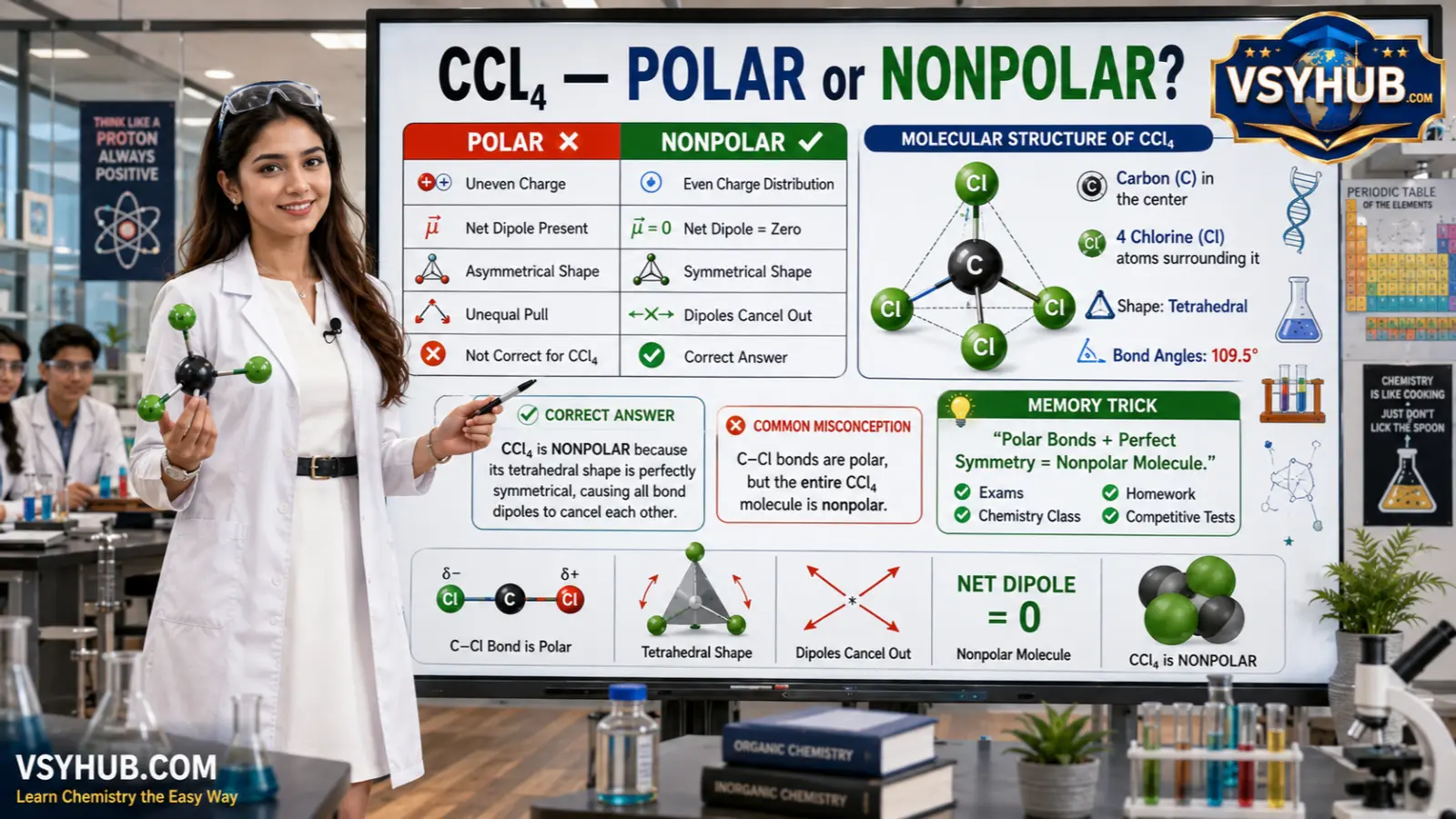
Answer: CCl4 (carbon tetrachloride) is a nonpolar molecule.
Although each carbon-chlorine (C–Cl) bond is polar, the molecule has a perfectly symmetrical tetrahedral shape. The bond dipoles cancel each other out, leaving no overall dipole moment.
Simple Explanation
1👉 CCl4 = Nonpolar molecule
2👉 C–Cl bond = Polar bond
3👉 Entire CCl4 molecule = Nonpolar because all bond polarities cancel
Examples
- ✅ CCl4 does not have a permanent positive and negative end.
- ✅ CCl4 mixes better with many nonpolar substances than with water.
- ✅ Its symmetrical shape makes it nonpolar.
Simple Rule
Remember this easy trick:
👉 Polar bonds + Perfect symmetry = Nonpolar molecule.
Even if individual bonds are polar, the whole molecule can still be nonpolar when the bond dipoles cancel one another.
What Does Is CCl4 Polar or Nonpolar Mean?
The question “Is CCl4 polar or nonpolar?” asks whether the carbon tetrachloride molecule has an uneven distribution of electrical charge.
To answer this, you need to understand two important chemistry ideas:
- Bond polarity
- Molecular polarity
A polar bond forms when two atoms share electrons unequally because one atom attracts electrons more strongly.
A nonpolar molecule has no overall positive or negative side because its electron distribution is balanced.
In CCl4:
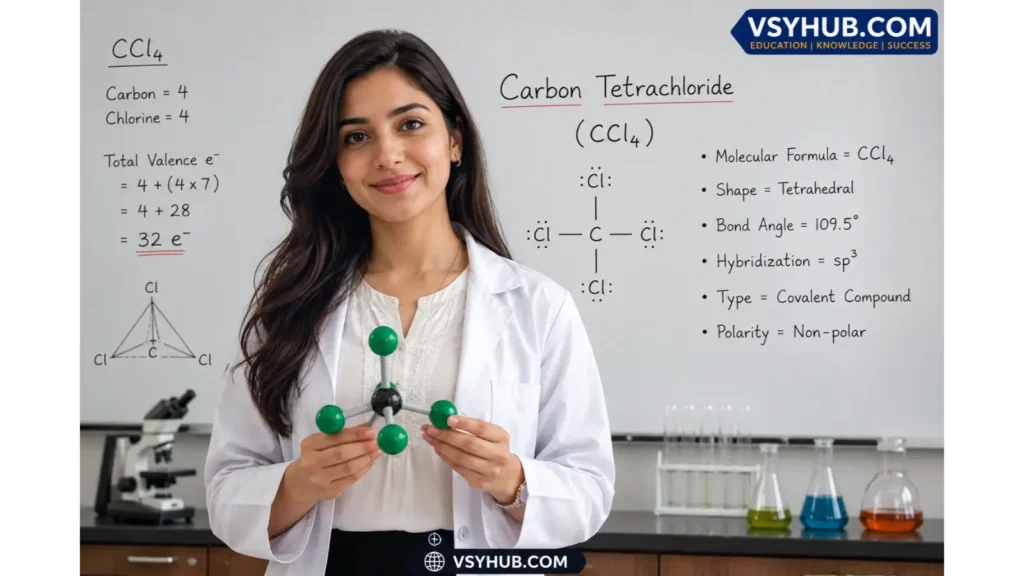
- Carbon is the central atom.
- Four chlorine atoms surround carbon equally.
- The molecule forms a tetrahedral structure.
- Every C–Cl bond is polar.
- The four bond dipoles point in different directions and cancel each other.
That is why the entire molecule is nonpolar.
Why This Matters
Knowing whether CCl4 is polar or nonpolar helps you understand:
- Solubility
- Chemical reactions
- Intermolecular forces
- Laboratory behavior
- Basic molecular geometry
These topics are commonly taught in high school and college chemistry.
Related Chemistry Terms
Synonyms
- Nonpolar molecule
- Symmetrical molecule
- Zero net dipole molecule
Opposites
- Polar molecule
- Asymmetrical molecule
- Molecule with a net dipole moment
Related Terms
- Electronegativity
- Dipole moment
- Covalent bond
- Lewis structure
- Molecular geometry
- Tetrahedral shape
- VSEPR theory
- Symmetry
- Polar covalent bond
Common Variations
Students often search for:
- Is carbon tetrachloride polar?
- Why is CCl4 nonpolar?
- Is CCl4 a polar molecule?
- CCl4 polarity explained
- CCl4 bond polarity
- Is CCl4 polar or nonpolar with diagram?
These searches all aim to understand the same chemistry concept from different angles.
The Origin of CCl4
CCl4 is the chemical formula for carbon tetrachloride.
The name comes from scientific naming rules:
- Carbon is the central element.
- Tetra is a Greek word meaning four.
- Chloride refers to the four chlorine atoms attached to carbon.
Carbon tetrachloride has been known for more than a century and was once widely used in:
- Cleaning fluids
- Fire extinguishers
- Industrial solvents
- Laboratory research
Today, its use is much more limited because scientists discovered that it is harmful to human health and the environment.
Even though it is no longer commonly used in homes, CCl4 remains an important example in chemistry because it clearly demonstrates how molecular shape determines polarity.
How to Pronounce Is CCl4 Polar or Nonpolar
Most teachers pronounce CCl4 as:
“See-See-El Four.”
The full chemical name is pronounced:
Carbon Tetrachloride
Pronunciation:
KAR-bun tet-ruh-KLOR-ide
Easy Speaking Trick
Break it into smaller parts:
- Carbon
- Tetra
- Chloride
Say each word slowly, then combine them naturally.
Common Pronunciation Mistakes
❌ Saying “C-C-one-four.”
✔ Say “C-C-L Four.”
❌ Pronouncing “tetra” as “tee-tra.”
✔ Pronounce it “tet-ruh.”
Learning the correct pronunciation makes classroom discussions and presentations much easier.
British English vs American English Usage
The scientific meaning of CCl4 is exactly the same in British and American English. The formula, pronunciation, and chemistry principles do not change between countries.
| Feature | British English | American English | Notes |
|---|---|---|---|
| Chemical Formula | CCl4 | CCl4 | Identical worldwide |
| Scientific Meaning | Same | Same | No difference |
| Molecular Shape | Tetrahedral | Tetrahedral | Universal chemistry term |
| Polarity | Nonpolar | Nonpolar | Accepted internationally |
| Classroom Usage | Same | Same | Used in science education globally |
Chemistry follows international standards, so students in the UK, US, India, Pakistan, Canada, Australia, and many other countries learn the same explanation.
Which One Should You Use?
When answering the question “Is CCl4 polar or nonpolar?”, always use the scientifically correct statement:
- ✅ CCl4 is a nonpolar molecule.
- ✅ Each C–Cl bond is polar.
- ✅ The overall molecule is nonpolar because of its symmetrical tetrahedral shape.
Quick Usage Examples
- School: “CCl4 is nonpolar because its bond dipoles cancel.”
- Exams: “Although C–Cl bonds are polar, CCl4 has no net dipole moment.”
- Laboratory: “Carbon tetrachloride behaves as a nonpolar solvent in many situations.”
- Science Discussions: “Molecular geometry is the reason CCl4 is nonpolar.”
Mini Usage Table
| Situation | Correct Statement |
|---|---|
| School homework | CCl4 is nonpolar. |
| Chemistry exam | Polar bonds but nonpolar molecule. |
| Scientific writing | Symmetrical tetrahedral structure results in zero net dipole moment. |
| Classroom discussion | Molecular shape determines the overall polarity. |
Understanding this simple idea will also help you answer similar questions about molecules such as CO₂, CH₄, BF₃, NH₃, and H₂O, where molecular shape plays a key role in determining whether a molecule is polar or nonpolar.
Common Mistakes With Is CCl4 Polar or Nonpolar
Many students understand that the C–Cl bond is polar, but they become confused when deciding whether the entire CCl4 molecule is polar. Here are the most common mistakes and how to avoid them.
Mistake 1: Thinking Polar Bonds Mean a Polar Molecule
❌ Incorrect: CCl4 is polar because the C–Cl bonds are polar.
✔ Correct: CCl4 is nonpolar because the four polar bonds cancel each other.
Why this happens: Students focus only on bond polarity and forget molecular shape.
Easy Tip: Always check the molecule’s geometry after identifying bond polarity.
Mistake 2: Ignoring Molecular Shape
❌ Incorrect: Bond polarity is the only thing that matters.
✔ Correct: Both bond polarity and molecular geometry determine molecular polarity.
Why this happens: Beginners often stop after calculating electronegativity differences.
Easy Tip: Learn the molecule’s shape using VSEPR theory before deciding if it is polar or nonpolar.
Mistake 3: Forgetting Symmetry
❌ Incorrect: Chlorine atoms pull electrons, so the molecule must be polar.
✔ Correct: The chlorine atoms pull equally in all directions, creating perfect balance.
Why this happens: Students imagine only one chlorine atom instead of all four.
Easy Tip: Picture four equal arrows pulling outward from the center.
Mistake 4: Confusing CCl4 With CHCl3
❌ Incorrect: CCl4 and CHCl3 have the same polarity.
✔ Correct: CCl4 is nonpolar, while CHCl3 (chloroform) is polar.
Why this happens: The formulas look similar.
Easy Tip: CCl4 has four identical surrounding atoms, while CHCl3 has different atoms that make the molecule asymmetric.
Mistake 5: Ignoring the Dipole Moment
❌ Incorrect: Every molecule with polar bonds has a dipole moment.
✔ Correct: CCl4 has a net dipole moment of zero because the bond dipoles cancel.
Why this happens: Students confuse bond dipoles with molecular dipoles.
Easy Tip: The overall dipole is what decides whether the molecule is polar.
Mistake 6: Memorizing Without Understanding
❌ Incorrect: CCl4 is nonpolar because the textbook says so.
✔ Correct: CCl4 is nonpolar because its tetrahedral symmetry cancels all bond dipoles.
Why this happens: Memorization without understanding leads to confusion in exams.
Easy Tip: Understand the reason instead of only remembering the answer.
Is CCl4 Polar or Nonpolar in Everyday Examples
Although carbon tetrachloride is not commonly used at home today, the concept of polarity appears in many everyday situations.
At School
A chemistry teacher asks why CCl4 does not dissolve well in water.
Answer: Water is polar, while CCl4 is nonpolar.
In Science Class
Students compare molecules like H₂O, NH₃, CO₂, CH₄, and CCl4 to understand how molecular shape affects polarity.
In Laboratory Experiments
Teachers explain that nonpolar solvents dissolve many nonpolar substances more effectively than polar solvents.
During Exams
A common question is:
“Why is CCl4 nonpolar even though its bonds are polar?”
The expected answer is:
“Because its tetrahedral symmetry causes all bond dipoles to cancel.”
In Online Learning
Educational videos often use 3D molecular models to show how four identical chlorine atoms balance each other’s pull.
In Homework
Students may be asked to draw the Lewis structure of CCl4 and explain why the molecule has no overall dipole moment.
In Conversations
Student A: “The bonds are polar.”
Student B: “Yes, but the molecule is still nonpolar because it’s symmetrical.”
Is CCl4 Polar or Nonpolar in Different Contexts
In Education
Polarity is one of the first major topics in chemical bonding.
Teachers use CCl4 because it clearly shows that bond polarity alone does not determine molecular polarity.
In Chemistry
Chemists study polarity to predict:
- Solubility
- Boiling point
- Melting point
- Molecular interactions
- Chemical reactions
In Laboratory Research
Scientists choose polar or nonpolar solvents depending on the materials they want to dissolve.
Understanding CCl4 helps students learn the principle of “like dissolves like.”
In Environmental Science
Carbon tetrachloride has environmental importance because it contributes to ozone layer damage and is considered a hazardous chemical.
Learning about its properties helps explain why its use is now restricted.
In Industry
Historically, CCl4 was used in:
- Cleaning products
- Degreasing agents
- Fire extinguishers
- Chemical manufacturing
Today, safer alternatives are preferred.
In Competitive Exams
Questions about CCl4 often appear in:
- High school chemistry exams
- College entrance tests
- Medical entrance exams
- Engineering entrance exams
- University chemistry courses
Students are usually expected to explain both bond polarity and molecular geometry.
Is CCl4 Polar or Nonpolar – Google Trends & Usage Data
The question “Is CCl4 polar or nonpolar?” remains one of the most searched chemistry topics because students frequently encounter it during lessons on chemical bonding and molecular geometry.
People usually search for this keyword before:
- School exams
- College entrance tests
- Chemistry quizzes
- Laboratory classes
- Homework assignments
Search interest increases during examination seasons when students review polarity, Lewis structures, and VSEPR theory.
Students from countries such as the United States, United Kingdom, India, Pakistan, Canada, and Australia regularly search this topic because the chemistry curriculum is very similar across these education systems.
Common Related Searches
People also search for:
- Why is CCl4 nonpolar?
- Is carbon tetrachloride polar?
- CCl4 Lewis structure
- CCl4 molecular geometry
- CCl4 bond angle
- CCl4 dipole moment
- Polar vs nonpolar molecules
- Difference between CCl4 and CHCl3
- How to determine molecular polarity
- Examples of nonpolar molecules
Voice Search Examples
Many users now ask search engines questions like:
- “Why is CCl4 nonpolar?”
- “Is carbon tetrachloride a polar molecule?”
- “How do I know CCl4 is nonpolar?”
- “Why are C–Cl bonds polar but CCl4 is not?”
- “What is the molecular shape of CCl4?”
These conversational searches have become increasingly common with voice assistants and mobile devices.
Comparison Table: Is CCl4 Polar or Nonpolar?
| Feature | CCl4 |
|---|---|
| Full Name | Carbon Tetrachloride |
| Molecular Formula | CCl4 |
| Bond Type | Polar covalent C–Cl bonds |
| Molecular Shape | Tetrahedral |
| Symmetry | Perfectly symmetrical |
| Net Dipole Moment | Zero |
| Overall Polarity | Nonpolar |
| Solubility in Water | Very low |
| Common Beginner Mistake | Assuming polar bonds make a polar molecule |
| Main Reason for Being Nonpolar | Bond dipoles cancel because of symmetry |
| Academic Importance | Common example of molecular polarity |
| Professional Relevance | Used to explain intermolecular forces and solvent behavior |
This comparison shows why CCl4 is classified as a nonpolar molecule despite containing four polar covalent bonds. The key factor is its symmetrical tetrahedral geometry, which causes all bond dipoles to cancel completely.
Is CCl4 Polar or Nonpolar in Professional Life
Understanding molecular polarity is useful in many science-related careers. Chemists, laboratory technicians, pharmacists, chemical engineers, environmental scientists, and teachers use polarity to predict how substances behave.
Workplace Communication
Professionals may discuss whether a solvent is polar or nonpolar before performing an experiment.
Example:
“Since CCl4 is nonpolar, it can dissolve many nonpolar compounds.”
Chemical Research
Researchers use polarity to:
- Choose suitable solvents
- Predict chemical reactions
- Separate mixtures
- Study intermolecular forces
Industrial Applications
Although carbon tetrachloride is now used much less because of safety concerns, it has historically been used in:
- Chemical manufacturing
- Laboratory research
- Industrial cleaning
- Organic chemistry
Understanding its polarity helps professionals select safer alternatives with similar chemical properties.
Is CCl4 Polar or Nonpolar for Students or Beginners
Many beginners find molecular polarity confusing because they learn about bond polarity before molecular geometry.
Here are a few simple tips:
- Learn electronegativity first.
- Identify whether each bond is polar or nonpolar.
- Draw the Lewis structure.
- Determine the molecular shape using VSEPR theory.
- Check if the bond dipoles cancel.
Easy Beginner Shortcut
Ask yourself these questions:
- Are the bonds polar?
- Is the molecule symmetrical?
- Do the dipoles cancel?
If the answer is yes, the molecule is probably nonpolar.
Signs, Characteristics, or Common Uses Related to Is CCl4 Polar or Nonpolar
Characteristics of CCl4
- Carbon atom in the center
- Four chlorine atoms surrounding carbon
- Tetrahedral molecular geometry
- Polar covalent C–Cl bonds
- Zero overall dipole moment
- Nonpolar molecule
- Symmetrical structure
Common Uses in Learning
- Teaching molecular geometry
- Explaining polarity
- Understanding dipole moments
- Learning VSEPR theory
- Comparing polar and nonpolar molecules
- Studying intermolecular forces
Common Exam Questions
Students are often asked:
- Why is CCl4 nonpolar?
- What is the shape of CCl4?
- Does CCl4 have a dipole moment?
- Are C–Cl bonds polar?
- Why do bond dipoles cancel?
Simple Trick to Remember Is CCl4 Polar or Nonpolar
The easiest memory rule is:
“Same atoms, same distance, same pull = Nonpolar molecule.”
Because all four chlorine atoms pull equally from every direction, the molecule stays balanced.
Think of It This Way
Imagine four friends standing around you in a perfect circle.
Each friend pulls your arm with exactly the same force.
You do not move in any direction because every pull is balanced.
CCl4 behaves the same way. Each chlorine atom pulls electrons equally, so the molecule has no overall positive or negative side.
Another quick memory shortcut is:
“Perfect symmetry removes polarity.”
Whenever you see a perfectly symmetrical tetrahedral molecule with identical outer atoms, check whether the dipoles cancel before deciding its polarity.
Expert Tips Section
Many students memorize that CCl4 is nonpolar but forget why. Understanding the reason makes chemistry much easier.
Expert Tips
- Always separate bond polarity from molecular polarity.
- Draw the Lewis structure before deciding polarity.
- Use VSEPR theory to identify molecular shape.
- Look for symmetry rather than guessing.
- Remember that identical outer atoms often create balanced dipoles.
- Compare CCl4 with H2O, NH3, CO2, and CHCl3 to strengthen your understanding.
- Practice drawing dipole arrows to see whether they cancel.
These habits will help you answer many polarity questions with confidence.
Related Searches People Also Ask
Why is CCl4 nonpolar?
Because its tetrahedral symmetry causes all four bond dipoles to cancel.
Are C–Cl bonds polar?
Yes. Chlorine is more electronegative than carbon, so each C–Cl bond is polar.
What is the shape of CCl4?
It has a tetrahedral molecular geometry.
Does CCl4 have a dipole moment?
No. Its overall dipole moment is zero.
Is carbon tetrachloride soluble in water?
Only slightly. Water is polar, while CCl4 is nonpolar.
What is the difference between CCl4 and CHCl3?
CCl4 is nonpolar because it is symmetrical. CHCl3 is polar because its atoms are not arranged symmetrically.
Which theory explains CCl4’s shape?
The VSEPR (Valence Shell Electron Pair Repulsion) theory.
Why do students confuse CCl4 polarity?
Because they often focus on the polar C–Cl bonds and forget the importance of molecular geometry.
Which molecules are similar to CCl4?
CH4, CO2, and BF3 are also common examples used to explain how symmetry affects polarity.
How can I quickly identify a nonpolar molecule?
Check the bond polarity, then look at the molecular shape. If the dipoles cancel because of symmetry, the molecule is nonpolar.
FAQs
Is CCl4 polar or nonpolar?
CCl4 is nonpolar because its tetrahedral symmetry cancels all bond dipoles.
Why are the C–Cl bonds polar?
Chlorine attracts shared electrons more strongly than carbon, creating polar covalent bonds.
What is the molecular geometry of CCl4?
The geometry is tetrahedral.
Does CCl4 have a net dipole moment?
No. The overall dipole moment is zero.
Is CCl4 a covalent compound?
Yes. It contains four covalent carbon-chlorine bonds.
Why is CCl4 important in chemistry?
It is one of the best examples for learning the difference between bond polarity and molecular polarity.
Is CCl4 used in modern laboratories?
Its use is limited today because it is hazardous, but it is still discussed in chemistry education.
What is the easiest way to remember CCl4’s polarity?
Remember: Polar bonds + perfect symmetry = nonpolar molecule.
Final Verdict
The answer is simple: CCl4 is a nonpolar molecule.
Although every carbon-chlorine bond is polar, the molecule’s perfectly symmetrical tetrahedral shape causes all bond dipoles to cancel. This leaves no overall dipole moment.
Easy memory rule:
Polar bonds do not always make a polar molecule. Molecular shape is the deciding factor.
Conclusion
If you’ve ever wondered “Is CCl4 polar or nonpolar?”, the key idea to remember is that molecular geometry matters just as much as bond polarity. Carbon tetrachloride contains four polar C–Cl bonds, but its perfectly balanced tetrahedral structure makes the entire molecule nonpolar. Once you understand how symmetry cancels dipoles, you’ll find it much easier to identify the polarity of many other molecules in chemistry.
Final memory trick: Look at the shape before you decide the polarity. If the molecule is perfectly symmetrical, the dipoles may cancel, making the molecule nonpolar.

Mk Azam is a Master’s graduate, content writer, and contributor at VsyHub.com. He enjoys creating clear, engaging, and informative content across a variety of topics. With a strong focus on accuracy and readability, he helps readers find practical insights and easy-to-understand information. His goal is to deliver valuable content that informs, educates, and inspires.