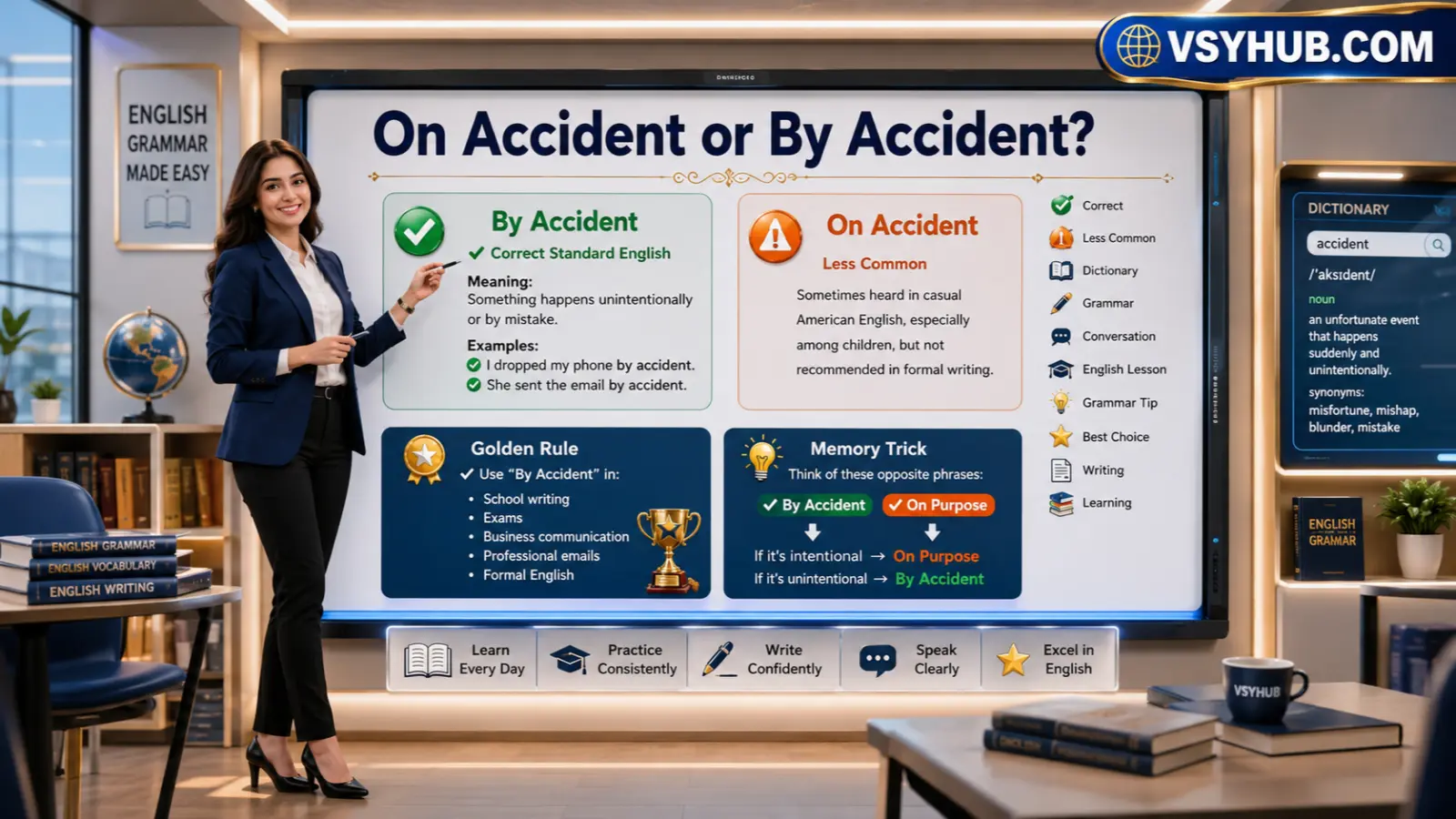
Imagine dropping your phone and saying, “I did it on accident.” A friend quickly replies, “Don’t you mean by accident?”
This small grammar question confuses many English learners. People usually search for on accident or by accident meaning, correct usage, pronunciation, examples,
grammar difference, and definition because they hear both phrases at school, work, social media, texting, and daily conversations.
In this guide, you’ll learn the meaning, pronunciation, examples, usage, grammar rules, common mistakes, expert tips, and simple explanations in easy English.
On Accident or By Accident – Quick Answer
The correct and traditional English phrase is by accident.
On accident is commonly heard in informal American English, especially in casual conversations, but it is generally considered nonstandard in formal writing.
Quick Meaning
👉 By accident = Something happened unintentionally or without planning.
👉 On accident = An informal version of by accident, mainly used in casual American speech.
Examples
✅ I broke the glass by accident.
She sent the email by accident.✅
✅ Some people say on accident, but by accident is preferred in school, business, and formal writing.
Simple Rule
Use by accident whenever you are writing an essay, email, report, or professional document.
Easy Memory Trick
Think of this simple sentence:
By = Not Planned
If something wasn’t planned, it happened by accident.
What Does On Accident or By Accident Mean?
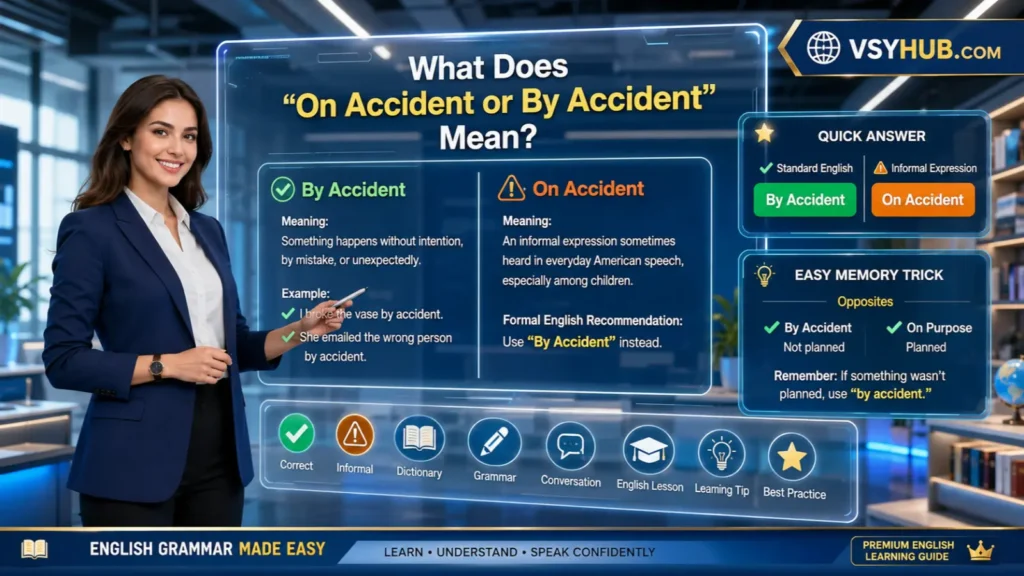
The phrases on accident and by accident both describe something that happens without intention. They tell us that a person did not mean for something to happen.
The difference is not in meaning—it is in grammar and standard usage.
By accident has been accepted in English for centuries and appears in dictionaries, grammar books, schools, newspapers, and professional writing.
On accident became popular much later, mainly in informal American speech. While many native speakers use it naturally, it is still less accepted in formal English.
Beginner Explanation
If you accidentally spill coffee on your shirt, you can say:
“I spilled my coffee by accident.”
This means you did not do it on purpose.
Practical Meaning
People use by accident whenever they want to explain that something happened unintentionally.
Examples include:
- Breaking a plate.
- Sending a message to the wrong person.
- Pressing the wrong button.
- Forgetting an appointment.
Professional Meaning
In workplaces, schools, and business communication, by accident is the correct choice.
Example:
“The file was deleted by accident.”
This sounds natural and professional.
Using on accident in formal writing may make your English appear less polished.
Internet and Social Media Meaning
On TikTok, Instagram, YouTube, Reddit, and other social platforms, many users write on accident because they hear friends and influencers say it.
Although it is common online, grammar experts still recommend by accident for standard English.
Synonyms
- Unintentionally
- Accidentally
- By mistake
- Without meaning to
- Inadvertently
Opposites
- On purpose
- Intentionally
- Deliberately
- Purposefully
- Knowingly
Related Terms
- Accidentally
- By mistake
- On purpose
- Intentionally
- Human error
- Slip-up
- Mishap
- Error
- Carelessly
- Unexpectedly
Common Variations
People also search for:
- By accident or on accident
- Is on accident correct?
- By accident meaning
- On accident meaning
- Accidentally or by accident
- By mistake vs by accident
- On purpose vs by accident
- Is on accident grammatically correct?
These searches all focus on understanding the correct English expression.
The Origin of On Accident or By Accident
The phrase by accident has been part of English for hundreds of years.
It comes from the older English use of the preposition by, which often describes the cause or method of something happening.
For example:
- By chance
- By luck
- By mistake
- By accident
These phrases all follow the same grammar pattern.
Where Did “On Accident” Come From?
Linguists believe on accident became popular in the United States during the late twentieth century.
Many language experts think it developed because children naturally copied the opposite phrase:
On purpose
Since English speakers often say on purpose, some began saying on accident in the same way.
Over time, the expression spread through everyday conversations.
Why Do Both Exist Today?
Language changes over time.
Many expressions begin as informal speech before becoming widely accepted.
Although on accident is now common in casual American English, most dictionaries, teachers, editors, and style guides still recommend by accident, especially in formal situations.
Modern Usage
Today:
- By accident is accepted worldwide.
- On accident is mainly informal and regional.
- Formal writing continues to prefer by accident.
How to Pronounce On Accident or By Accident
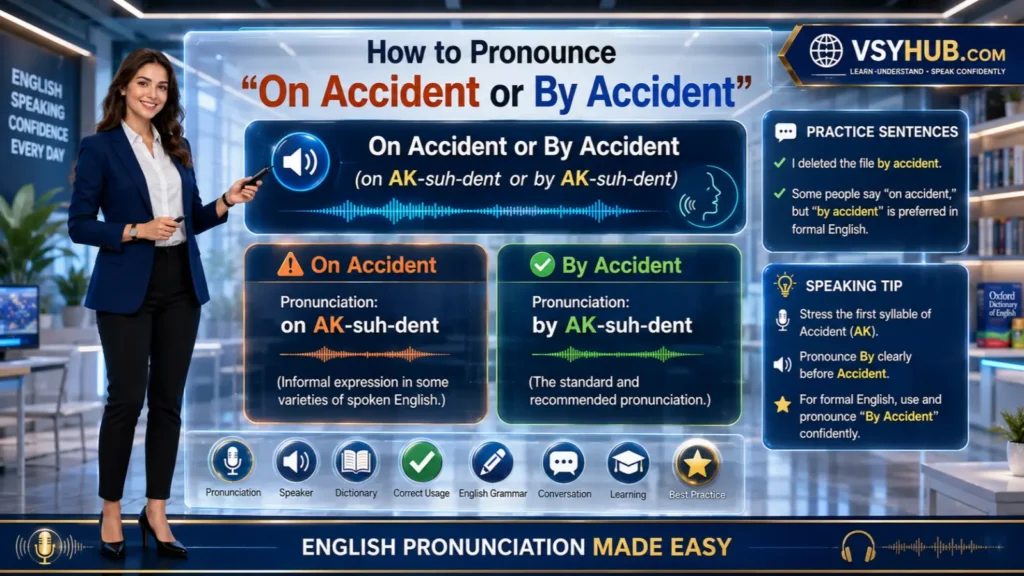
Both phrases are easy to pronounce once you break them into smaller parts.
By Accident
Pronunciation:
bye AK-si-dent
Phonetic:
/baɪ ˈæk.sɪ.dənt/
On Accident
Pronunciation:
on AK-si-dent
Phonetic:
/ɒn ˈæk.sɪ.dənt/ (British)
/ɑːn ˈæk.sɪ.dənt/ (American)
Syllable Breakdown
Accident
AK • si • dent
Three syllables.
Easy Speaking Trick
Say the phrase slowly:
By… Accident
Then gradually increase your speed.
Practice these sentences:
“I dropped my keys by accident.”
“I clicked the wrong link by accident.”
Common Pronunciation Mistakes
Incorrect:
- AK-see-dent
- Ack-zident
Correct:
- AK-si-dent
Stress the first syllable: AK.
British English vs American English Usage
Both British and American English understand the phrase by accident, but on accident is mainly heard in informal American speech.
| Feature | British English | American English | Notes |
|---|---|---|---|
| Preferred phrase | By accident | By accident | Standard in both varieties |
| “On accident” | Rare | Informal but common in speech | Avoid in formal writing |
| Grammar acceptance | Standard: By accident | Standard: By accident | Schools teach “by accident” |
| Pronunciation | Slight accent difference | Slight accent difference | Meaning stays the same |
| Formal writing | By accident | By accident | Best choice everywhere |
Is Usage the Same Worldwide?
Yes. If you are writing for an international audience, by accident is the safest and most widely accepted choice.
You can confidently use it in:
- School assignments
- Business emails
- Academic writing
- News articles
- Professional reports
- International communication
Which One Should You Use?
The answer depends on the situation, but for most people, the safest choice is simple:
Use by accident.
It is correct in formal and informal English and is accepted around the world.
Use By Accident When
- Writing school essays.
- Sending work emails.
- Creating business documents.
- Writing blogs or articles.
- Taking English exams.
- Speaking in professional settings.
- Communicating internationally.
Example:
“I deleted the document by accident.”
Use On Accident When
- Speaking casually with friends.
- Copying everyday American conversation.
- Writing informal text messages where grammar is less important.
Remember that some teachers, editors, and employers may still consider on accident incorrect.
Quick Usage Guide
| Situation | Best Choice | Reason |
|---|---|---|
| School homework | By accident | Grammatically correct |
| Business email | By accident | Professional English |
| Academic writing | By accident | Standard grammar |
| Casual conversation | By accident or on accident | Both may be heard |
| Social media comments | Either | Depends on personal style |
| International English | By accident | Understood everywhere |
For learners, the easiest rule is:
If you’re unsure, always choose “by accident.” It is correct in every situation and helps your English sound natural and professional.
Common Mistakes With On Accident or By Accident
Many English learners hear both phrases and assume they are equally correct in every situation. Here are the most common mistakes and how to avoid them.
Mistake 1: Using “On Accident” in Formal Writing
❌ Incorrect: I deleted the report on accident.
✔ Correct: I deleted the report by accident.
Explanation: Formal writing almost always uses by accident.
Beginner Tip: If you’re writing for school or work, always choose by accident.
Mistake 2: Confusing “By Accident” With “On Purpose”
❌ Incorrect: I broke the vase on purpose. (When you actually mean it was unintentional.)
✔ Correct: I broke the vase by accident.
Explanation: “By accident” means something was not planned. “On purpose” means you intended to do it.
Beginner Tip: Ask yourself, “Did I mean to do it?” If the answer is no, use by accident.
Mistake 3: Thinking “On Accident” Is Always Wrong
❌ Incorrect Belief: Nobody says “on accident.”
✔ Correct: Many native speakers, especially in the United States, use on accident in casual speech.
Explanation: It is common in informal conversation but is not the preferred form in standard English.
Beginner Tip: Understand it when you hear it, but use by accident in writing.
Mistake 4: Replacing “Accidentally” Incorrectly
❌ Incorrect: I accidentally forgot my homework by purpose.
✔ Correct: I accidentally forgot my homework.
✔ Correct: I forgot my homework by accident.
Explanation: “Accidentally” and “by accident” usually have the same meaning.
Beginner Tip: You can often replace one with the other.
Mistake 5: Using the Wrong Preposition
❌ Incorrect: I broke the glass with accident.
✔ Correct: I broke the glass by accident.
Explanation: English uses the preposition by, not with.
Beginner Tip: Remember the complete phrase: by accident.
Mistake 6: Mixing Both Expressions Together
❌ Incorrect: I did it on by accident.
✔ Correct: I did it by accident.
Explanation: Use only one expression.
Beginner Tip: Keep the phrase simple.
On Accident or By Accident in Everyday Examples
At Work
“My manager understood that I deleted the file by accident.”
At School
“I wrote the wrong answer by accident during the test.”
On Social Media
“I liked your old photo by accident!”
In Daily Life
“I left my keys at home by accident.”
In Emails
I attached the wrong document by accident. Please find the correct file attached.
In Text Messages
Friend: Why did you call me?
You: Sorry! I pressed your name by accident.
In Online Content
- “I subscribed by accident.”
- “I clicked the wrong link by accident.”
- “Did you send that message by accident?”
In Conversations
Person A: Why is the window broken?
Person B: My brother hit it by accident.
These examples sound natural and are commonly used in everyday English.
On Accident or By Accident in Different Contexts
In Education
Teachers encourage students to use by accident because it follows standard grammar rules.
Example:
“The student erased the answer by accident.”
In Business
Professional communication should always use by accident.
Example:
“The payment was sent by accident and has now been corrected.”
In the Workplace
Employees often explain honest mistakes using this phrase.
Examples include:
- Sending the wrong email.
- Printing the wrong document.
- Scheduling the wrong meeting.
In Grammar Learning
This phrase helps learners understand the difference between formal and informal English.
Learning by accident also makes it easier to remember similar expressions such as:
- By chance
- By mistake
- By coincidence
In Communication
Using by accident helps avoid confusion because it is accepted by English speakers worldwide.
On Social Media
Many creators use on accident because it sounds natural in casual conversation.
However, grammar pages and educational websites usually recommend by accident.
In Writing
Editors, publishers, teachers, and examiners almost always expect by accident in formal writing.
On Accident or By Accident – Google Trends & Usage Data
The question “on accident or by accident” continues to receive thousands of online searches because learners often hear both expressions.
Why People Search This Topic
People commonly want to know:
- Which phrase is grammatically correct?
- Why do Americans say “on accident”?
- Can I use “on accident” in an essay?
- Is “by accident” old-fashioned?
- Which phrase sounds more natural?
Search Popularity
Search interest stays high throughout the year because English learners, students, writers, and professionals regularly encounter both expressions.
Beginner Confusion
Many people become confused because:
- Native speakers sometimes use on accident.
- School grammar books teach by accident.
- Social media uses both expressions.
- Movies and TV shows often include informal speech.
Popular Around the World
This grammar topic is searched frequently in:
- United States
- United Kingdom
- India
- Pakistan
- Canada
- Australia
English learners everywhere want to know which phrase sounds most natural.
Related Long-Tail Searches
People also search for:
- Is on accident correct?
- By accident meaning
- By accident vs accidentally
- On purpose vs by accident
- Why do Americans say on accident?
- Is by accident grammatically correct?
- By accident examples
- On accident examples
- Formal alternative to by accident
- By accident in a sentence
Voice Search Examples
People ask voice assistants questions such as:
- “Should I say on accident or by accident?”
- “Is on accident incorrect?”
- “Why is by accident correct?”
- “Can I use on accident in school?”
- “What’s the difference between on accident and by accident?”
Comparison Table: On Accident or By Accident
| Feature | By Accident | On Accident |
|---|---|---|
| Standard English | ✅ Yes | ❌ No (generally nonstandard) |
| Meaning | Happened unintentionally | Same meaning |
| Grammar Acceptance | Fully accepted | Informal usage |
| Formal Writing | Recommended | Not recommended |
| Academic Writing | Correct | Avoid |
| Business Communication | Correct | Avoid |
| Casual Conversation | Common | Heard mainly in American English |
| International English | Best choice | Less common |
| Common Mistake | Rare | Used in formal writing |
On Accident or By Accident in Professional Life
Using correct grammar builds trust in professional communication.
Whether you’re writing an email, report, proposal, or presentation, by accident is the better choice.
Workplace Communication
Correct:
“The invoice was sent by accident.”
This sounds clear and professional.
Business Writing
Clients, managers, and coworkers expect standard English.
Choosing by accident shows careful writing and attention to detail.
Branding and Public Communication
Companies usually avoid informal grammar in:
- Website content
- Press releases
- Marketing materials
- Customer support emails
- User guides
Using standard English helps build credibility.
On Accident or By Accident for Students or Beginners
This grammar point is easier than it seems.
Why Beginners Get Confused
- They hear both phrases online.
- Friends may use different versions.
- Movies and TV shows often use casual speech.
- Grammar books recommend only one.
Easy Learning Tips
- Learn the full phrase by accident.
- Read books and newspapers to see correct usage.
- Listen for the difference between formal and informal English.
- Practice writing your own example sentences.
Beginner Shortcut
Remember this simple pattern:
- By accident ✅ Correct everywhere.
- On accident ⚠ Casual American speech.
If you remember this one rule, you’ll avoid the mistake in almost every situation.
Signs, Characteristics, or Common Uses Related to On Accident or By Accident
Understanding how these phrases are used will help you sound more natural in English.
1 Uses of By Accident
- Explaining an honest mistake.
- Describing something unplanned.
- Writing school assignments.
- Sending professional emails.
- Writing reports and articles.
- Speaking in formal conversations.
2 Common Uses of On Accident
- Casual conversations with friends.
- Informal American English.
- Social media comments.
- Text messages.
- Everyday spoken English in some regions.
3 Common Characteristics
- Both phrases describe something that was not intentional.
- Both have the same basic meaning.
- Only by accident is considered standard English.
- On accident is mostly heard in informal American speech.
- Both are the opposite of on purpose.
4 Common Writing Situations
You may use by accident when writing:
- Essays
- Business emails
- Job applications
- Research papers
- News articles
- Professional reports
Online Usage Patterns
People often search for:
- Is “on accident” correct?
- Why do Americans say “on accident”?
- By accident vs accidentally
- On purpose vs by accident
- Is by accident formal?
- Can I say on accident?
Industries Where Correct Grammar Matters
- Education
- Publishing
- Journalism
- Business
- Marketing
- Customer Service
- Law
- Government
- Healthcare
Using by accident in these industries helps your writing appear professional and reliable.
Simple Trick to Remember On Accident or By Accident
Easy Memory Rule
Think about these two expressions:
- By accident = Not planned.
- On purpose = Planned.
Notice that English naturally pairs these phrases.
Think of It This Way
Imagine two buttons.
Green Button: “I meant to do it.”
➡ On purpose
Red Button: “I didn’t mean to do it.”
➡ By accident
This simple comparison makes the correct phrase easy to remember.
Memory Shortcut
Remember this sentence:
“If it wasn’t planned, it happened by accident.”
Say it a few times, and the correct phrase will become natural.
Expert Tips
Many learners memorize grammar rules but still make mistakes. These tips can help you write more naturally.
Read Professional English
Books, newspapers, magazines, and trusted websites almost always use by accident.
Reading good English helps you remember correct grammar without extra effort.
Replace It With “Accidentally”
If you’re unsure, replace the phrase.
Example:
“I deleted the photo accidentally.”
“I deleted the photo by accident.”
If both sound natural, you’ve probably chosen the correct expression.
Listen for Context
When watching American movies or YouTube videos, you may hear on accident.
Remember that spoken English is often more informal than written English.
Proofread Your Writing
Before sending an email or submitting homework, quickly check for grammar expressions like:
- By accident
- By mistake
- On purpose
A short review can prevent simple mistakes.
Learn Expressions Together
These phrases follow a similar grammar pattern:
- By accident
- By mistake
- By chance
- By coincidence
Learning them together makes them easier to remember.
Related Searches People Also Ask
Is “on accident” grammatically correct?
It is common in informal American English, but by accident is the standard choice in formal English.
Why is “by accident” correct?
English has traditionally used the preposition by in expressions describing cause or method, such as by chance and by mistake.
Why do people say “on accident”?
Many language experts believe it developed by analogy with the phrase on purpose.
Can I use “on accident” in school?
It is better to use by accident in school assignments unless your teacher specifically says otherwise.
Is “by accident” old-fashioned?
No. It is still the standard and most widely accepted phrase today.
What’s the difference between “by accident” and “accidentally”?
There is almost no difference in meaning. Both describe something that happened unintentionally.
Which phrase should English learners use?
Use by accident because it is accepted everywhere.
Is “on accident” only used in America?
It is heard mostly in the United States and is much less common in other English-speaking countries.
Do dictionaries include “on accident”?
Some dictionaries mention it as an informal expression, but they still identify by accident as the standard phrase.
Is “by accident” used in business writing?
Yes. It is the preferred choice in professional communication.
Can I say “by mistake” instead?
Yes. In many situations, by mistake and by accident have similar meanings.
What is the opposite of “by accident”?
The opposite expression is on purpose.
Frequently Asked Questions
Which is correct: on accident or by accident?
By accident is the standard and grammatically preferred expression.
Is “on accident” wrong?
Not always. It is common in informal American speech, but it is generally avoided in formal writing.
Can I use “on accident” in an exam?
No. Use by accident for exams, essays, and academic writing.
Is “by accident” used in British English?
Yes. It is the normal expression in British English.
Can I replace “by accident” with “accidentally”?
Yes. Both usually have the same meaning.
Why do children often say “on accident”?
Many children copy the pattern of on purpose, making on accident feel natural to them.
Which phrase sounds more professional?
By accident always sounds more professional.
How can I remember the correct phrase?
Remember this simple rule:
By accident = Not planned.
Final Verdict
If you’re wondering whether to use on accident or by accident, the answer is simple.
By accident is the correct and standard English expression. It works in school, business, professional writing, and everyday conversations.
On accident may be heard in casual American English, but it is still considered informal and is best avoided in formal situations.
Easy Memory Rule
By accident = Correct everywhere.
On accident = Casual speech only.
When in doubt, choose by accident.
Conclusion
The difference between on accident and by accident is mainly about grammar and formality, not meaning. Both expressions describe something that happened unintentionally, but by accident has been the standard English phrase for centuries. It is accepted in schools, workplaces, books, newspapers, and professional communication around the world.
If you hear on accident in everyday conversation or on social media, don’t be surprised—it is part of informal American speech. However, if you want your English to sound natural, accurate, and professional, by accident is the safest choice.
Final Memory Trick: If you didn’t plan it, it happened by accident. If you planned it, you did it on purpose.

Aria Foster is a comparison and language writer who specializes in spelling differences, word meanings, grammar guides, and easy-to-understand language explanations. She creates clear, reader-friendly content that helps people understand commonly confused words and expressions.