You may have seen offense and offence in books, school lessons, news articles, social media posts, or work emails and wondered which spelling is correct.
People usually search for offense or offence meaning, correct spelling, pronunciation, examples, usage, definition, and grammar difference because both words look right.
The good news is that both spellings are correct in different types of English.
In this guide, you’ll learn the meaning, pronunciation, examples, usage, grammar rules, common mistakes, expert tips, and simple explanations in easy English.
Offense or Offence – Quick Answer
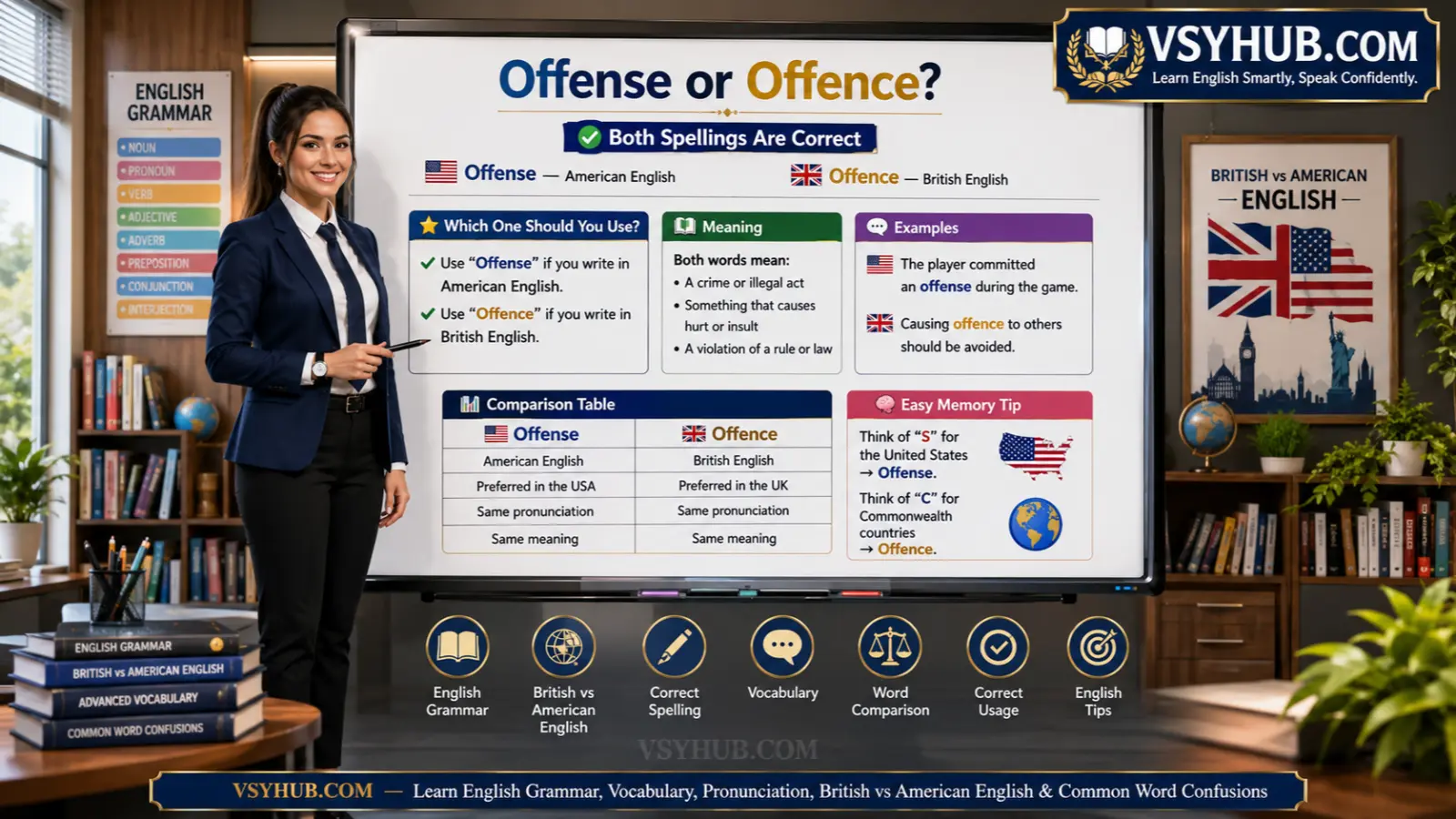
Short Answer: Both offense and offence are correct. The difference is the type of English you use.
👉 Offense = American English spelling
👉 Offence = British English spelling
Both words mean:
- An action that breaks a law or rule.
- Something that hurts or upsets another person.
- In sports, the team or players trying to score.
Examples
- American English: Speeding is a traffic offense.
- British English: Speeding is a traffic offence.
- Basketball: Their offense scored 95 points.
Simple Rule
If you write for the United States, use offense.
If you write for the United Kingdom or many Commonwealth countries, use offence.
Easy Memory Trick
S = States
C = Commonwealth
Think:
- OffenSE → United States
- OffenCE → Commonwealth countries like the UK, Australia, and New Zealand
What Does Offense or Offence Mean?
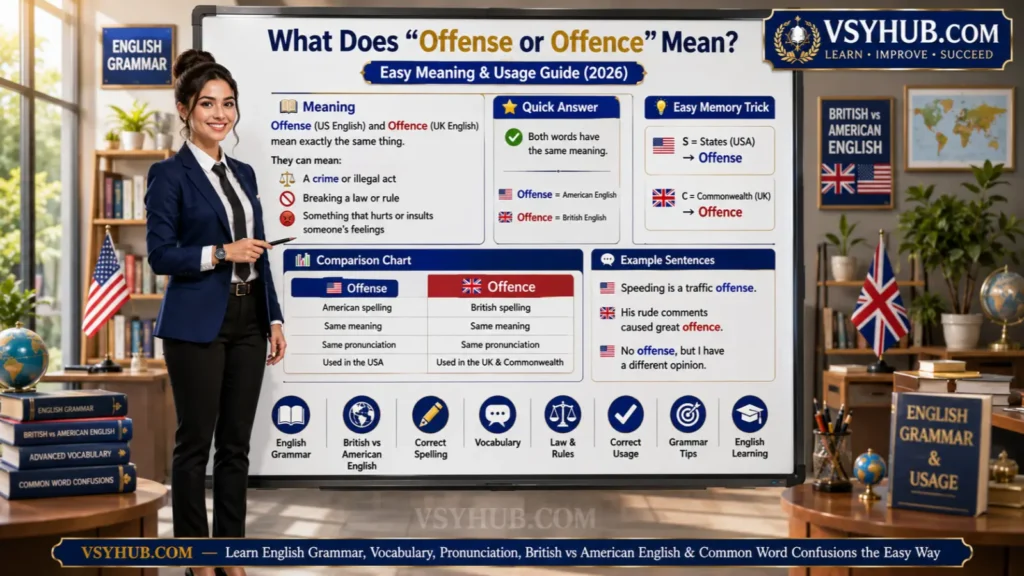
The words offense and offence have exactly the same meaning. Only the spelling changes depending on the variety of English.
They can describe something illegal, something rude, or an attacking position in sports.
Everyday Meaning
An offense or offence is something that breaks a rule or law.
Example:
- Parking in a no-parking area is an offense.
Emotional Meaning
It can also mean words or actions that hurt someone’s feelings.
Example:
- She took offense at his joke.
This means she felt hurt or insulted.
Professional Meaning
In law, an offense means a crime or violation of legal rules.
Example:
- Theft is a criminal offense.
Sports Meaning
In games like football, basketball, and American football, offense means the side trying to score points.
Example:
- Their offense played very well today.
Synonyms
- Crime
- Violation
- Wrongdoing
- Misconduct
- Insult
- Attack (sports)
- Breach
Opposites
- Defense (sports)
- Obedience
- Respect
- Compliance
- Good behavior
Related Terms
- Offend
- Offensive
- Defender
- Crime
- Penalty
- Rule violation
- Criminal act
Common Variations
- Criminal offense
- Serious offense
- Minor offense
- Traffic offense
- Take offense
- Offensive behavior
- First offense
The Origin of Offense or Offence
The word comes from the Latin word offendere, which means to strike against, hurt, or cause harm.
Later, it entered Old French as offense, then became part of Middle English.
Over time, English developed two spelling styles.
- British English kept the spelling offence.
- American English changed many words ending in -ce to -se, creating offense.
The meanings stayed the same even though the spelling became different.
Today, millions of people use both spellings around the world depending on where they live or write.
How to Pronounce Offense or Offence
Both spellings are pronounced exactly the same.
Pronunciation
uh-FENS
Phonetic Spelling
/əˈfɛns/
Syllables
Of • fense
Two syllables.
Easy Speaking Trick
Say it slowly:
uh + FENS
Then say it faster:
uh-FENS
Common Pronunciation Mistakes
❌ OFF-fence
✔ uh-FENS
Do not pronounce the second part like the word fence with extra emphasis.
British English vs American English Usage
The only difference is spelling.
| Feature | British English | American English | Notes |
|---|---|---|---|
| Standard spelling | Offence | Offense | Same meaning |
| Pronunciation | Same | Same | No difference |
| Legal writing | Offence | Offense | Depends on country |
| Sports | Usually offence | Offense | American sports almost always use offense |
| Grammar | Same | Same | No grammar difference |
| Meaning | Same | Same | Completely identical |
Countries That Commonly Use Each Spelling
Offense
- United States
Offence
- United Kingdom
- Australia
- New Zealand
- Pakistan
- India (often British English in schools)
- South Africa
- Ireland (commonly)
Which One Should You Use?
Choose the spelling that matches your audience.
Use Offense When
- Writing for American readers.
- Using American English.
- Creating content for US businesses.
- Writing for American schools or universities.
- Posting on US websites.
Use Offence When
- Writing in British English.
- Working with UK companies.
- Writing for British schools.
- Publishing in many Commonwealth countries.
- Following British style guides.
Formal Writing
Both spellings are correct if they match the English style you are using.
Informal Writing
Use the spelling your readers expect.
Academic Writing
Follow your teacher’s or university’s preferred style.
Workplace Writing
Stay consistent throughout the document.
Branding
Companies usually choose one spelling and use it everywhere.
Social Media
Use whichever spelling matches your audience.
Mini Usage Table
| Situation | Best Choice |
|---|---|
| American blog | Offense |
| British newspaper | Offence |
| US business email | Offense |
| UK government document | Offence |
| American football article | Offense |
| British classroom | Offence |
Continue with Part 2 for:
- Common Mistakes with Offense or Offence
- Everyday Examples
- Different Contexts
- Google Trends & Usage Data
- Comparison Table
- Professional Life
- Students & Beginners
- Common Uses
- Memory Tricks
- Expert Tips
- Related Searches
- FAQs
- Final Verdict
- Conclusion
- Meta Description
Common Mistakes With Offense or Offence
Many learners mix these spellings because they look almost the same. The key is to stay consistent with the type of English you are using.
Mistake 1: Mixing Both Spellings in One Document
❌ The offense was serious, and the offence was punished.
✔ The offense was serious, and the offense was punished. (American English)
✔ The offence was serious, and the offence was punished. (British English)
Why it happens: People copy text from different websites.
Beginner Tip: Choose one spelling and use it throughout your writing.
Mistake 2: Thinking They Have Different Meanings
❌ Offense means crime, but offence means insult.
✔ Both words have the same meanings.
Why it happens: The different spellings make people think the meanings are different.
Beginner Tip: Remember that only the spelling changes.
Mistake 3: Using British Spelling for American Schools
❌ The student committed a school offence. (US school paper)
✔ The student committed a school offense.
Why it happens: Learners study British English but write for American readers.
Beginner Tip: Match the spelling to your audience.
Mistake 4: Using American Spelling in British Exams
❌ This was a criminal offense. (British English exam)
✔ This was a criminal offence.
Why it happens: American websites are very popular online.
Beginner Tip: Follow your school’s English style guide.
Mistake 5: Confusing Offense With Offensive
❌ He was offense.
✔ He was offended.
✔ His words were offensive.
Why it happens: These words come from the same root.
Beginner Tip: Learn each form separately.
Mistake 6: Wrong Sports Usage
❌ The defense scored many points.
✔ The offense scored many points.
Why it happens: People confuse offense and defense.
Beginner Tip: Offense attacks. Defense protects.
Offense or Offence in Everyday Examples
At Work
“Our company has a zero-tolerance policy for workplace offenses.”
At School
“Cheating during an exam is a serious offense.”
On Social Media
“Some users took offense at the post.”
In Daily Life
“Running a red light is a traffic offense.”
In Emails
“Please avoid language that may cause offense to others.”
In Text Messages
“I hope my joke didn’t cause any offense.”
In Online Articles
“The suspect was charged with several criminal offenses.”
In Conversations
“I didn’t mean any offense by my comment.”
Offense or Offence in Different Contexts
In Grammar and Writing
Both spellings are correct. The only difference is American English versus British English.
Example:
- US: copyright offense
- UK: copyright offence
In Law
An offense is an act that breaks the law.
Examples include:
- Theft
- Fraud
- Assault
- Traffic violations
Legal documents always follow the country’s spelling style.
In Sports
In basketball, American football, and other sports, the offense is the team trying to score.
Example:
“Our offense played an excellent game today.”
The opposite is defense.
In Business
Companies use the word when discussing workplace rules or legal matters.
Example:
“A first offense will result in a warning.”
In Education
Teachers explain the spelling difference when teaching British and American English.
Students are encouraged to stay consistent.
In Communication
People often say:
“I took no offense.”
This means they were not upset.
On Social Media
Users may write:
“No offense, but I disagree.”
This phrase is often used before giving criticism, although it may still sound rude.
Offense or Offence – Google Trends & Usage Data
People around the world search for offense or offence because they want to know which spelling is correct.
Search interest is highest among:
- Students
- English learners
- Writers
- Bloggers
- Teachers
- Content creators
- Business professionals
Search Popularity by Country
United States
Most searches use offense because American English is standard.
United Kingdom
Most people search for offence.
Canada
Both spellings appear, depending on the writer.
Australia
British spelling (offence) is more common.
India
Many schools teach British English, so offence is common, but offense also appears online.
Pakistan
British English is widely taught, making offence the usual spelling.
Why Do People Search for This Word?
People often ask:
- Is offense or offence correct?
- Which spelling should I use?
- Is offense American English?
- Is offence British English?
- What does offense mean?
- How do you pronounce offense?
- Can I use both spellings?
These long-tail searches show that learners want a simple explanation with examples.
Comparison Table: Offense vs Offence
| Feature | Offense | Offence |
|---|---|---|
| Meaning | Same | Same |
| Correct spelling | Yes | Yes |
| English type | American | British |
| Pronunciation | Same | Same |
| Grammar | Same | Same |
| Legal usage | US | UK/Commonwealth |
| Academic writing | US schools | UK schools |
| Business writing | US companies | UK companies |
| Internet popularity | Higher globally | Strong in UK/Commonwealth |
| Common mistake | Mixing with offence | Mixing with offense |
Offense or Offence in Professional Life
Using the correct spelling helps your writing look professional.
For example:
- A US company expects offense.
- A UK company expects offence.
Legal documents, contracts, reports, policies, and business emails should always use one spelling consistently.
Professional Examples
- “This offense violates company policy.” (US)
- “This offence breaches company policy.” (UK)
Consistency shows attention to detail and improves credibility.
Offense or Offence for Students or Beginners
Many beginners worry because they see both spellings in books and online.
The easiest way to remember is:
- American English = offense
- British English = offence
Learning Tips
- Read American articles if you are learning American English.
- Read British newspapers if you are learning British English.
- Practice writing complete sentences.
- Use the same spelling throughout your homework or assignment.
Signs, Characteristics, and Common Uses Related to Offense or Offence
Common situations where the word is used include:
- Criminal law
- Traffic rules
- School discipline
- Workplace policies
- Sports commentary
- News reports
- Social media discussions
- Everyday conversations
- Government documents
- Business communication
Common phrases include:
- Criminal offense
- First offense
- Serious offense
- Minor offense
- Traffic offense
- Take offense
- Mean no offense
- No offense
Simple Trick to Remember Offense or Offence
Easy Memory Rule
S = States
C = Commonwealth
So remember:
- Offense → United States
- Offence → Commonwealth countries
Think of It This Way
Imagine the letter S wearing an American flag.
Imagine the letter C wearing a British crown.
This simple picture makes it much easier to remember the correct spelling.
Expert Tips
Here are a few tips that many articles forget to mention:
- Set your spell checker to US or UK English before writing.
- Never mix both spellings in the same article.
- Check your audience before publishing.
- Follow your school’s or company’s style guide.
- Learn common word pairs like offense/defense and offence/defence together.
- Read quality books and newspapers to become familiar with each spelling style.
Related Searches People Also Ask
Is offense or offence correct?
Both are correct. The spelling depends on the type of English.
Is offense American English?
Yes. Offense is the standard American spelling.
Is offence British English?
Yes. Offence is the standard British spelling.
What does offense mean in law?
It means a crime or a violation of the law.
What does offense mean in sports?
It is the team or players trying to score.
How do you pronounce offense?
It is pronounced uh-FENS.
Why are there two spellings?
American and British English developed different spelling conventions over time.
Can I use both spellings together?
No. Use only one spelling in a single piece of writing.
Is offense used in Canada?
Both spellings are seen, although British spelling is traditionally more common.
What is the opposite of offense in sports?
The opposite is defense.
FAQs
Is offense or offence the correct spelling?
Both are correct. Use offense in American English and offence in British English.
Do offense and offence have different meanings?
No. They have exactly the same meanings.
How do you pronounce offense?
It is pronounced uh-FENS.
Which spelling should students use?
Use the spelling required by your school or teacher.
Which spelling is better for business writing?
Use the spelling that matches your audience or company’s style guide.
Can I use offense in the UK?
It is understandable, but offence is the preferred British spelling.
What is the easiest way to remember the difference?
Remember S = States and C = Commonwealth.
Final Verdict
Both offense and offence are correct spellings of the same word.
Choose offense for American English and offence for British English. The meaning, pronunciation, and grammar stay the same. The most important rule is to remain consistent throughout your writing.
Conclusion
Understanding offense or offence is easier than it first appears. The only real difference is spelling based on the variety of English you use. Whether you are writing a school assignment, business report, legal document, blog post, or social media update, choosing the correct spelling for your audience will make your writing clearer and more professional.
A simple memory trick can help you every time: OffenSE for the United States and OffenCE for Commonwealth countries.

Aria Foster is a comparison and language writer who specializes in spelling differences, word meanings, grammar guides, and easy-to-understand language explanations. She creates clear, reader-friendly content that helps people understand commonly confused words and expressions.