You may have stopped while writing an email, school assignment, or social media post and wondered, “Should I write more clear or clearer?”
Many English learners search for this because both forms seem correct. People usually search for the keyword meaning, grammar difference, pronunciation, examples, and correct usage.
This small grammar choice can make your writing sound more natural and confident.
In this guide, you’ll learn the meaning, pronunciation, examples, usage, grammar rules, common mistakes, expert tips, and simple explanations in easy English.
More Clear or Clearer – Quick Answer
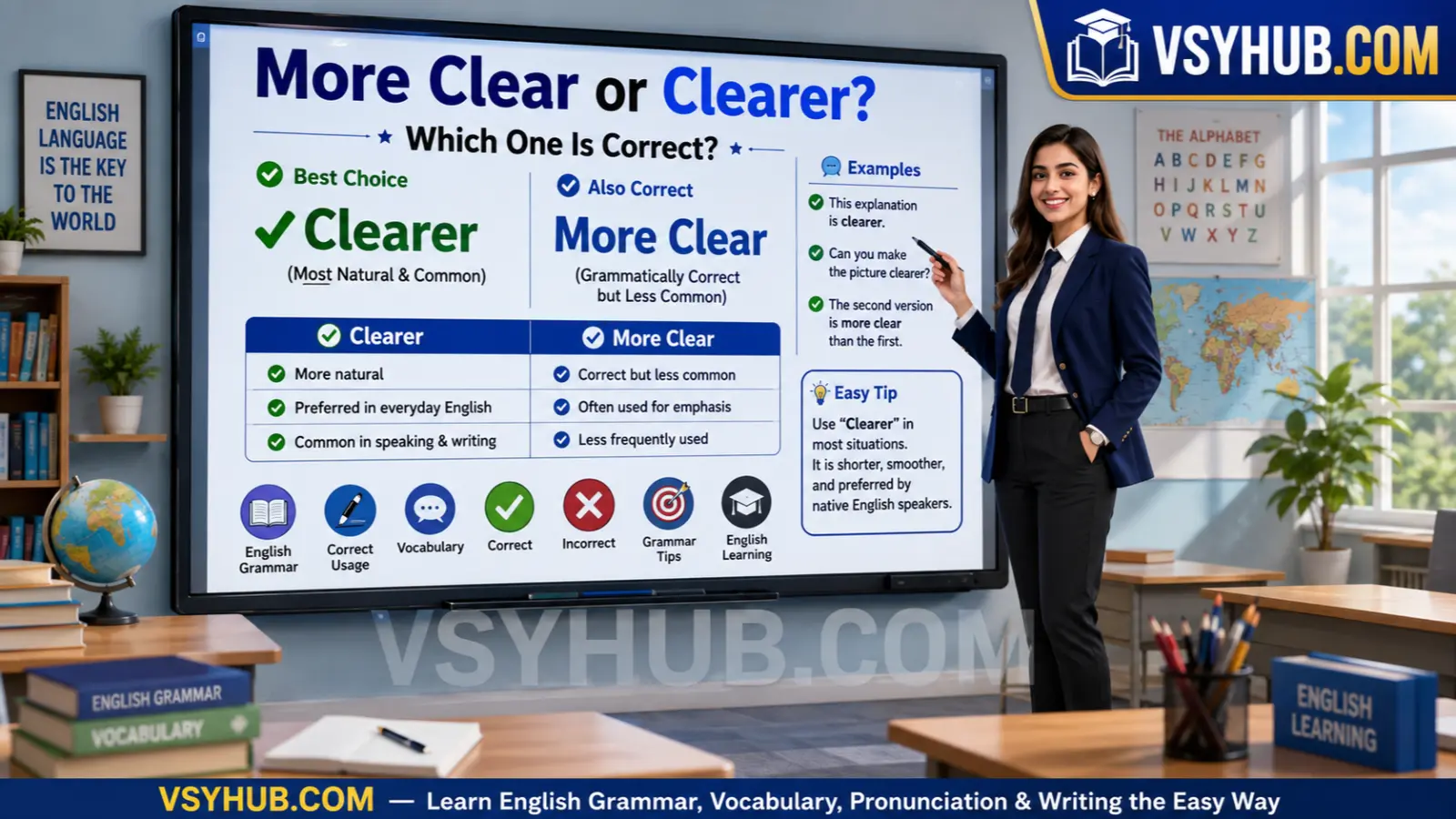
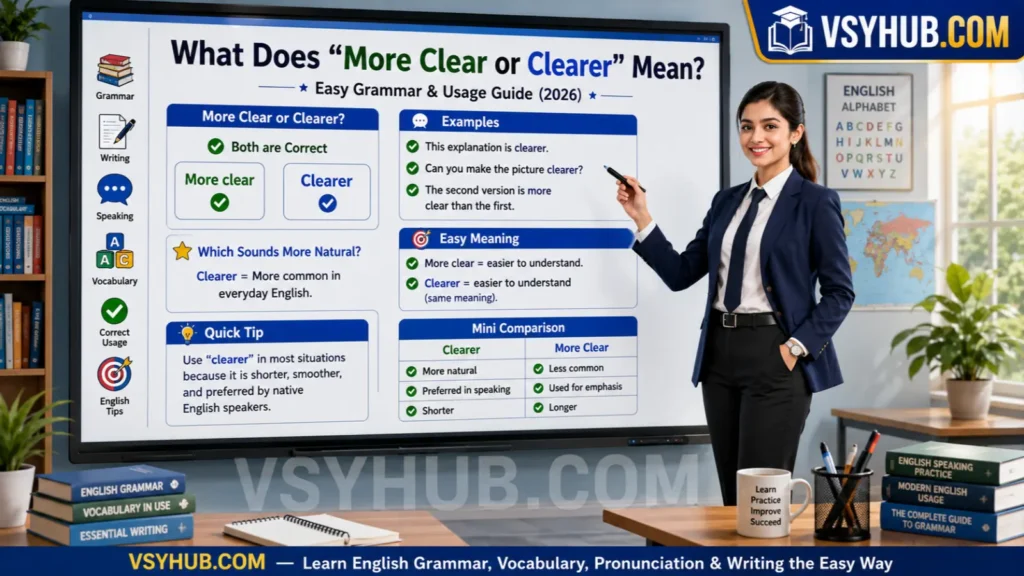
Quick Answer: Both more clear and clearer are grammatically correct, but clearer is usually the better and more natural choice in everyday English.
👉 More clear = A comparative form made with more + clear.
👉 Clearer = A comparative form made by adding -er to clear.
In most conversations, writing, and speaking, native English speakers prefer clearer.
Examples
Your explanation is clearer now.
Could you make your answer more clear?
This picture is clearer than the last one.
Simple Rule
👉 If the adjective is short like clear, the -er form is usually the best choice.
Easy Memory Trick:
Think, short words usually take “-er.” Since clear is a short adjective, clearer often sounds smoother.
What Does More Clear or Clearer Mean?
Both expressions compare two things. They show that one thing is easier to understand than another.
For example:
- This lesson is clearer than yesterday’s lesson.
- Can you make your instructions more clear?
In both sentences, the meaning is almost the same. The goal is to show better understanding or easier communication.
Beginner-Friendly Meaning
When something is clear, it is easy to
understand.
When something is clearer, it is even easier to understand.
When you say more clear, you also mean easier to understand, but this form is less common in everyday English.
Practical Meaning
People use these expressions when talking about:
- Writing
- Speaking
- Instructions
- Presentations
- Pictures
- Signs
- Videos
- Emails
- School lessons
- Business reports
Whenever you compare how easy something is to understand, you may use clearer or more clear.
Professional Meaning
At work, people often ask for clearer communication.
Examples:
- Please make this report clearer.
- Could you make your presentation more clear for new employees?
Both are acceptable, although clearer usually sounds more natural.
Internet and Social Media Meaning
Online, people often ask:
- Can you explain that more clearly?
- Your post is much clearer now.
- Please make the caption clearer.
Writers, bloggers, teachers, YouTubers, and content creators often use clearer because it sounds smoother and more natural.
Synonyms
Some words with similar meanings include:
- Easier to understand
- Simpler
- Plainer
- More understandable
- Better explained
- More obvious
- More direct
Opposites
Words with opposite meanings include:
- Confusing
- Unclear
- Difficult
- Complicated
- Vague
- Ambiguous
Related Terms
You may also see these related grammar words:
- Clearly
- Clarity
- Clarify
- Comparison
- Comparative adjective
- Better communication
- Easy explanation
Common Variations
People often search for similar phrases such as:
- More clearly
- Clearly
- Clear
- Clearest
- Less clear
- More understandable
- Easier to understand
The Origin of More Clear or Clearer
The word clear comes from the Latin word clarus, which means “bright,” “famous,” or “easy to see.” Over time, it entered Old French as cler before becoming clear in English.
As English grammar developed, adjectives formed comparisons in two common ways:
- Adding -er to short adjectives
- Using more before longer adjectives
Because clear is a short adjective with one syllable in many accents (or two in some), both clearer and more clear appeared in English writing.
Many famous English writers have used both forms over the years. However, modern English style guides and everyday speech usually prefer clearer because it sounds simpler and more natural.
Today, both forms are accepted, but clearer is much more common in conversation, education, business writing, and online communication.
How to Pronounce More Clear or Clearer
Pronunciation
More clear
Phonetic: mor kleer
Clearer
Phonetic: KLEER-er
Syllables
Clear = 1 syllable for many speakers (some pronounce it with two sounds)
Clearer = 2 syllables
Easy Speaking Trick
Say the word slowly:
Clear
Clear-er
Join them together naturally.
Common Pronunciation Mistakes
❌ Clee-ar-er
✔ KLEER-er
Avoid adding extra sounds between the syllables.
Another common mistake is speaking too quickly and dropping the second part of the word.
Practice these sentences aloud:
- Your answer is clearer now.
- The teacher gave a clearer explanation.
- Can you make this sentence more clear?
Reading these aloud helps improve both pronunciation and confidence.
British English vs American English Usage
Both British English and American English accept clearer and more clear. There is no spelling difference between the two.
| Feature | British English | American English | Notes |
|---|---|---|---|
| Preferred form | Clearer | Clearer | Most common choice |
| More clear | Correct | Correct | Less common but accepted |
| Spelling | Clear | Clear | No difference |
| Pronunciation | Very similar | Very similar | Small accent differences |
| Formal writing | Clearer preferred | Clearer preferred | Sounds smoother |
| Everyday speech | Mostly clearer | Mostly clearer | Widely used worldwide |
Overall, English speakers in the UK, the US, Canada, Australia, India, and Pakistan generally prefer clearer in everyday communication.
Which One Should You Use?
If you want your English to sound natural, choose clearer most of the time.
Use more clear only when it sounds better in a particular sentence or when you want extra emphasis.
Best Choice for Different Situations
- School assignments → Clearer
- Workplace emails → Clearer
- Business reports → Clearer
- Academic writing → Clearer
- Daily conversations → Clearer
- Text messages → Clearer
- Social media posts → Clearer
- Presentations → Clearer
Quick Examples
Your explanation is clearer now.
The new design is clearer than the old one.
Could you make this paragraph more clear?
The teacher gave a clearer example.
Mini Usage Table
| Situation | Better Choice |
|---|---|
| School writing | Clearer |
| Business communication | Clearer |
| Formal reports | Clearer |
| Friendly conversation | Clearer |
| Texting | Clearer |
| Blog writing | Clearer |
| Customer support | Clearer |
| Online tutorials | Clearer |
A good tip is to read your sentence aloud. If clearer sounds smoother, it is usually the best option.
Common Mistakes With More Clear or Clearer
Mistake 1: Thinking “More Clear” Is Wrong
❌ More clear is incorrect.
✔ More clear is grammatically correct, but clearer is usually preferred.
Why it happens: Many learners believe only one form is allowed.
Beginner Tip: Remember that both are correct, but clearer sounds more natural.
Mistake 2: Using “More Clearer”
❌ This explanation is more clearer.
✔ This explanation is clearer.
✔ This explanation is more clear.
Why it happens: Learners accidentally combine two comparative forms.
Beginner Tip: Choose only one comparative form.
Mistake 3: Forgetting the Comparison
❌ This report is clearer.
✔ This report is clearer than the last one.
Why it happens: People forget to mention what is being compared.
Beginner Tip: Use than when comparing two things.
Mistake 4: Using “Clearest” Instead
❌ This answer is clearest than yours.
✔ This answer is clearer than yours.
Why it happens: People confuse comparative and superlative forms.
Beginner Tip: Use clearer for comparing two things and clearest for comparing three or more.
Mistake 5: Choosing Difficult Words
❌ The explanation is more comprehensible.
✔ The explanation is clearer.
Why it happens: Writers try to sound too formal.
Beginner Tip: Simple English is usually easier for everyone.
Mistake 6: Using “Clear” Instead of “Clearly”
❌ Please explain clear.
✔ Please explain clearly.
Why it happens: Learners mix adjectives and adverbs.
Beginner Tip: Clear describes a noun, while clearly describes an action.
More Clear or Clearer in Everyday Examples
At Work
“My manager gave clearer instructions today.”
At School
“The teacher’s second example was much clearer.”
On Social Media
“Your post is clearer after you added pictures.”
In Daily Life
“This map is clearer than the old one.”
In Emails
“Could you make the meeting details clearer?”
In Text Messages
“Thanks! Your message is much clearer now.”
In Online Content
“This tutorial makes the process clearer for beginners.”
In Conversations
“I understand now because your explanation is clearer.”
More Clear or Clearer in Different Contexts
Education
Teachers want lessons to be easy to understand. A clearer explanation helps students learn faster and ask fewer questions.
Example:
“The science teacher used pictures to make the lesson clearer.”
Business
Companies value clear communication. Clearer reports, emails, and presentations reduce mistakes and save time.
Example:
“Our manager asked for a clearer project summary.”
Workplace Communication
Employees often rewrite documents to make them clearer for customers, managers, and coworkers.
Example:
“This email is clearer after removing unnecessary details.”
Writing and Blogging
Good writers choose words that readers understand quickly. A clearer sentence improves readability and keeps people engaged.
Example:
“The blog became clearer after adding simple examples.”
Social Media
People scroll quickly, so clearer captions and shorter posts attract more attention.
Example:
“The updated caption is much clearer and easier to read.”
Technology
Software instructions, user guides, and app messages should be clear. A clearer interface helps users complete tasks without confusion.
Example:
“The latest app update includes clearer navigation menus.”
Communication Skills
Whether speaking in person or online, clearer language helps avoid misunderstandings and builds confidence.
Example:
“She became a better speaker by using clearer words and shorter sentences.”
More Clear or Clearer – Google Trends & Usage Data
The phrase more clear or clearer is searched by thousands of English learners because it is a common grammar question. Many people notice both forms in books, websites, classrooms, and everyday conversations, which creates confusion about which one sounds better.
Search interest is especially strong in countries where English is widely learned, including the United States, the United Kingdom, India, Pakistan, Canada, and Australia. Students, teachers, bloggers, professionals, and content writers often look for a simple explanation before writing emails, reports, articles, or school assignments.
People also search using voice assistants with questions like:
- “Is it more clear or clearer?”
- “Which is correct, more clear or clearer?”
- “Can I say more clear?”
- “Why do people say clearer instead of more clear?”
- “Is clearer better in formal writing?”
Related long-tail searches include:
- Is clearer grammatically correct?
- More clear vs clearer examples
- Clearer meaning in English
- Difference between more clear and clearer
- How to use clearer in a sentence
- Clearer or more clearly
- Comparative form of clear
- Easy grammar rules for clear and clearer
These searches show that users want quick, beginner-friendly answers with real examples. Articles that explain the grammar in simple English and provide practical examples are more likely to satisfy search intent and perform well in Google search results.
Comparison Table: More Clear or Clearer
| Feature | More Clear | Clearer |
|---|---|---|
| Grammar | Correct | Correct |
| Meaning | Easier to understand | Easier to understand |
| Most Natural | Less common | More common |
| Everyday English | Sometimes used | Widely used |
| Academic Writing | Acceptable | Preferred |
| Professional Writing | Acceptable | Preferred |
| Emails | Acceptable | Better choice |
| Social Media | Less common | More common |
| Pronunciation | More words | Shorter and smoother |
| Common Mistake | Using “more clearer” | None when used correctly |
The table shows that both forms are grammatically correct. However, clearer is usually the best choice because it sounds more natural in modern English.
More Clear or Clearer in Professional Life
Clear communication is important in almost every job. Whether you work in an office, teach students, write blogs, or speak with customers, using natural English helps people understand your message faster.
Many companies encourage employees to write clearly because confusing messages can cause mistakes and waste time.
Workplace Examples
- Please write a clearer project summary.
- The manager asked for clearer instructions.
- Your report is much clearer after the revision.
- We need clearer goals before starting the project.
Professional Writing
Business emails, reports, proposals, and presentations should be easy to understand. In these situations, clearer is usually the preferred choice because it sounds concise and professional.
Example:
Original: Please make this report more clear.
Better: Please make this report clearer.
Branding and Marketing
Companies want customers to understand their products quickly. A clearer message builds trust and improves communication.
Example:
“Our new advertisement has a clearer message for customers.”
More Clear or Clearer for Students or Beginners
Many English learners become confused because they see both forms in books, websites, and conversations.
The good news is that you do not have to memorize many grammar rules.
Why Beginners Get Confused
- Both forms are grammatically correct.
- Different writers choose different styles.
- Some grammar books explain both forms.
- Native speakers sometimes use either one.
Easy Learning Tips
- Use clearer in most situations.
- Read English books and notice how native writers compare adjectives.
- Listen to English podcasts or videos.
- Practice writing one sentence every day.
- Read your sentence aloud to hear what sounds natural.
Beginner Shortcut
If the adjective is short, try the -er form first.
Examples:
- small → smaller
- fast → faster
- kind → kinder
- clear → clearer
This simple habit will help you make better grammar choices.
Signs, Characteristics, or Common Uses Related to More Clear or Clearer
You usually need clearer or more clear when you are comparing how easy something is to understand.
Common Uses
- Giving instructions
- Explaining ideas
- Writing emails
- Teaching lessons
- Making presentations
- Creating blog posts
- Writing social media captions
- Improving customer support
Common Writing Patterns
- clearer than
- much clearer
- even clearer
- make it clearer
- become clearer
- sound clearer
- look clearer
Online Usage Patterns
People often use these expressions in:
- YouTube tutorials
- Blog articles
- Online courses
- Discussion forums
- Facebook posts
- LinkedIn articles
- Business emails
Industries That Use Clear Communication
- Education
- Healthcare
- Technology
- Customer service
- Marketing
- Journalism
- Law
- Finance
In all these fields, clearer writing helps people understand information quickly and correctly.
Simple Trick to Remember More Clear or Clearer
Here is an easy rule you can remember every time you write.
Memory Rule:
Short adjectives usually take -er.
Since clear is a short adjective, clearer is normally the better choice.
Think of It This Way
Imagine you are climbing a small step instead of a long staircase.
For short adjectives, English takes the short path by adding -er.
Examples:
- tall → taller
- smart → smarter
- bright → brighter
- clear → clearer
If you remember this pattern, you will make the correct choice most of the time.
Expert Tips
Many grammar articles simply say that both forms are correct. However, skilled writers know there is more to good writing than grammar.
Read Your Sentence Aloud
If clearer sounds smoother, use it.
Keep Sentences Short
Short sentences are often clearer than long ones.
Example:
Long: Due to the circumstances previously discussed, the explanation became more understandable.
Better: The explanation became clearer.
Avoid Double Comparatives
Never write:
❌ More clearer
Always choose one form.
✔ Clearer
✔ More clear
Focus on the Reader
Good writing is not about using difficult words. It is about helping readers understand your message quickly.
Edit Before Publishing
After writing an email, report, or article, ask yourself:
“Can I make this sentence clearer?”
This simple question can greatly improve your writing.
Related Searches People Also Ask
Is “clearer” grammatically correct?
Yes. It is the most common comparative form of clear.
Can I say “more clear”?
Yes. It is grammatically correct, although clearer is usually preferred.
What is the comparative form of clear?
The standard comparative form is clearer.
Why do people say clearer instead of more clear?
Because English usually adds -er to short adjectives.
Is more clearer correct?
No. It is a double comparative and should be avoided.
Which sounds more natural in conversation?
Most native speakers naturally choose clearer.
Is clearer better in formal writing?
Yes. It is generally preferred in academic and professional writing.
How do I remember the rule?
Think of short adjectives adding -er.
What is the difference between clear and clearly?
Clear is an adjective, while clearly is an adverb.
Can clearer describe writing?
Yes. You can say:
“The article is clearer now.”
Can I use clearer in business emails?
Absolutely. It is common in professional communication.
Is clearer used worldwide?
Yes. English speakers in many countries commonly use clearer.
FAQs
Is “more clear or clearer” correct?
Both are correct, but clearer is usually more natural.
Which one should students use?
Students should normally use clearer because it is the preferred comparative form.
Can I use “more clear” in formal writing?
Yes, but many editors and teachers prefer clearer.
How do you pronounce “clearer”?
It is commonly pronounced KLEER-er.
Why is “more clearer” wrong?
Because it combines two comparative forms. Use only clearer or more clear.
Is “clearer” used in business English?
Yes. It is very common in emails, reports, and presentations.
What is the easiest way to remember this grammar rule?
Remember: Short adjective = add -er. So clear → clearer.
Final Verdict
If you are deciding between more clear or clearer, the safest and most natural choice is clearer.
Both forms are grammatically correct, but clearer is preferred in everyday conversations, schoolwork, business writing, and professional communication.
The easiest rule to remember is:
Short adjective → use -er.
So when in doubt, choose clearer.
Conclusion
Choosing between more clear or clearer is easier than it first seems. While both expressions are correct, clearer is the form most native English speakers use because it is shorter, smoother, and more natural. It works well in conversations, emails, school assignments, blog posts, and workplace writing.
Whenever you compare how easy something is to understand, remember this simple trick: short adjectives usually take “-er.” So if you ever pause while writing, you’ll know that clearer is usually the best choice.

Aria Foster is a comparison and language writer who specializes in spelling differences, word meanings, grammar guides, and easy-to-understand language explanations. She creates clear, reader-friendly content that helps people understand commonly confused words and expressions.