You may have seen anyway and anyways in text messages, social media posts, school work, or even daily conversations.
Many beginners wonder if both words are correct or if one is a mistake.
People usually search for is it anyway or anyways meaning, correct spelling, pronunciation, examples, usage, definition, and grammar difference before using them in writing.
In this guide, you’ll learn the meaning, pronunciation, examples, usage, grammar rules, common mistakes, expert tips, and simple explanations in easy English.
Anyway or Anyways – Quick Answer
The short answer is simple:
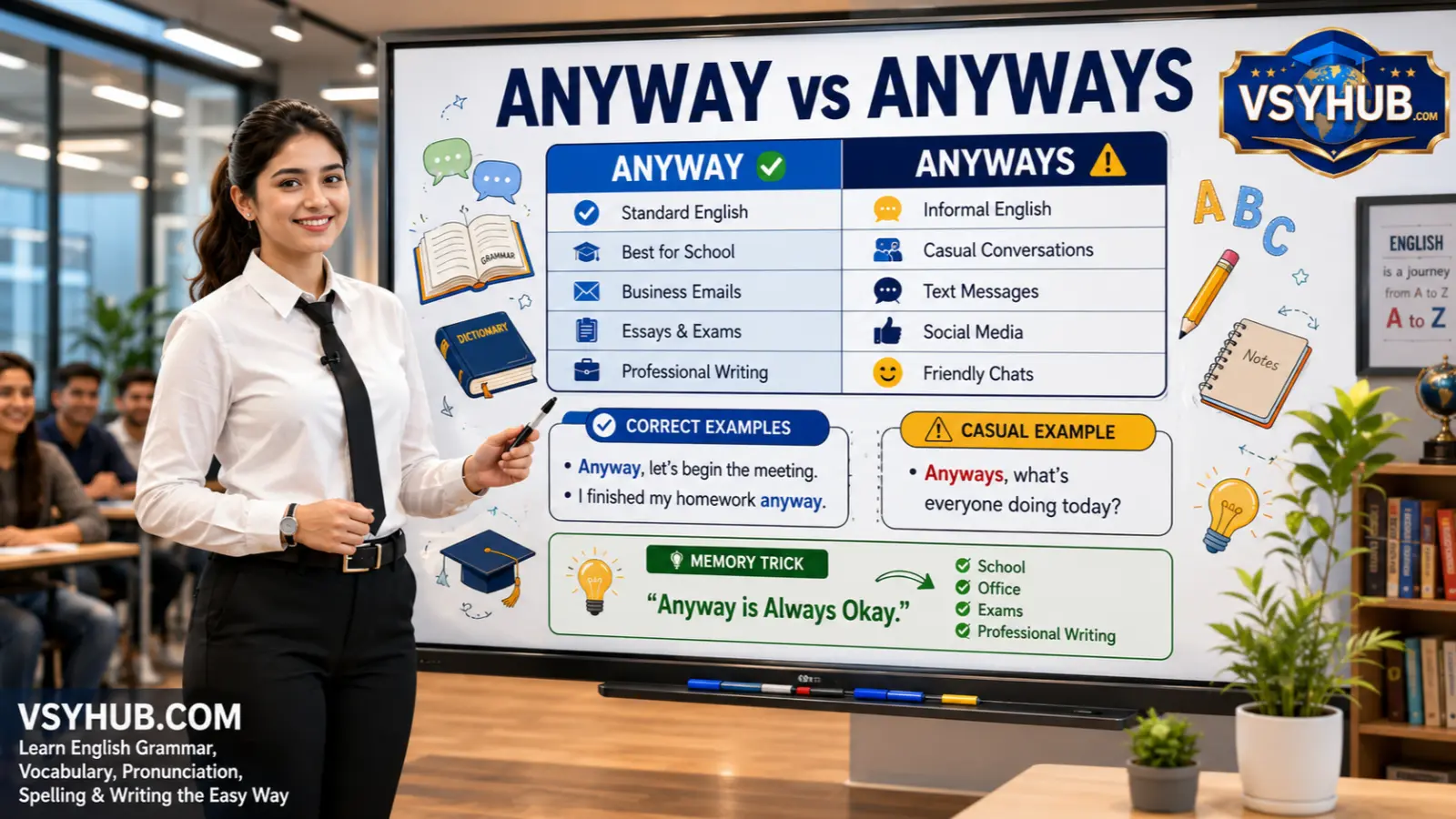
👉 Anyway = The standard and correct word for formal and informal English.
👉 Anyways = An informal variation that is common in casual speech and online conversations but is usually avoided in formal writing.
In most situations, anyway is the better choice.
Examples
✅ Anyway, let’s finish the meeting.
✅ I forgot my keys, but I found another way in anyway.
✅ Anyways, what are your weekend plans? (Acceptable in casual conversation, but not in formal writing.)
Simple Rule
Use anyway for school, work, emails, essays, reports, and professional writing.
Use anyways only when chatting casually with friends or writing in a relaxed tone.
Easy Memory Trick
Think of it this way:
Anyway is the “official” word. Anyways is the “casual” word.
If you’re unsure which one to use, choose anyway.
What Does “Anyway or Anyways” Mean?
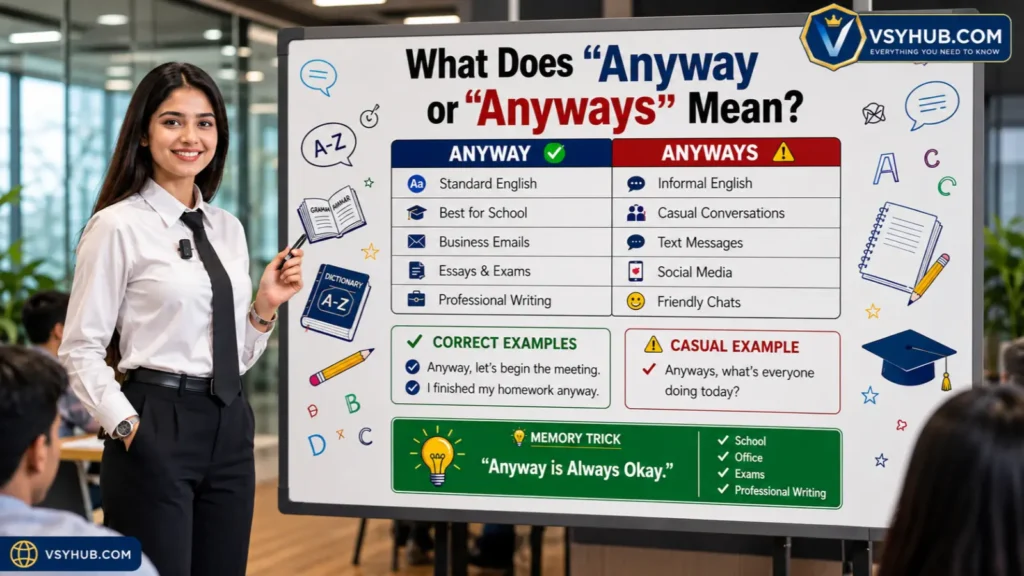
Both anyway and anyways help move a conversation forward or return to the main topic. They often mean regardless, in any case, or let’s continue.
Although they have the same basic meaning, they are not used in exactly the same way.
Meaning of “Anyway”
Anyway is an adverb that means:
- Regardless of what happened
- In any case
- Returning to the main topic
- Despite something
- Moving the conversation forward
Examples:
- Anyway, let’s start the lesson.
- I was tired, but I went anyway.
- Anyway, that’s all I wanted to say.
Meaning of “Anyways”
Anyways has almost the same meaning as anyway, but it sounds more casual.
People often use it:
- In friendly conversations
- On social media
- In text messages
- In informal storytelling
Examples:
- Anyways, I’ll call you later.
- Anyways, that was a funny day.
- Anyways, let’s get some food.
Many style guides still recommend using anyway instead of anyways, especially in formal writing.
Practical Meaning
You can think of these words as conversation helpers. They help speakers:
- Change the subject
- Return to the main point
- Finish a discussion
- Continue talking after an interruption
Professional Meaning
In workplaces and business writing, anyway is the preferred choice because it sounds more polished and professional.
Example:
✔ Anyway, I’ll send the report this afternoon.
Instead of:
✘ Anyways, I’ll send the report this afternoon.
Internet and Social Media Meaning
On platforms like TikTok, Instagram, Facebook, Reddit, and X, people often write anyways because it feels relaxed and conversational.
For example:
- Anyways… here’s what happened.
- Anyways, thanks for watching!
- Anyways, that’s my opinion.
This doesn’t mean it is the best choice for professional writing. It simply reflects the casual style of online communication.
Synonyms
Depending on the sentence, anyway can mean:
- Regardless
- In any case
- Still
- Nevertheless
- Nonetheless
- Besides
- After all
Opposites
There is no exact opposite, but these words can express a different idea:
- Therefore
- Consequently
- Because of that
- As a result
Related Terms
You may also see:
- Anyway then
- Anyway now
- Anyhow
- At any rate
- Regardless
- Even so
Common Variations
Some related forms include:
- Anyway
- Anyways
- Anyhow
- In any case
- At any rate
Among these, anyway is the most common choice in standard English.
The Origin of “Anyway or Anyways”
The word anyway has been part of English for hundreds of years. It comes from combining the words any and way to express the idea of “in whatever way” or “regardless.”
Over time, English speakers began using anyway not only to describe actions but also to connect ideas in conversations.
For example:
- I don’t really like the weather, but I’ll go anyway.
- Anyway, let’s move to the next question.
As spoken English changed, many people naturally added an -s to create anyways. This happened with several English words because everyday speech often becomes more relaxed than formal writing.
The word anyways has been recorded for centuries, but it has usually been treated as an informal or dialect form rather than the standard version.
Today, both words are understood by native English speakers, but they are used in different situations.
How the Usage Changed Over Time
In the past:
- Books and newspapers almost always used anyway.
- Teachers encouraged students to avoid anyways.
Today:
- Anyway remains the standard form.
- Anyways is common in casual speech.
- Social media has made anyways even more visible.
- Many younger speakers use anyways naturally in conversations and online posts.
Why People Still Get Confused
Many learners hear native speakers say anyways in videos, podcasts, or conversations. Then they see anyway in books, school lessons, and official documents.
This difference between spoken English and written English causes confusion.
The easiest rule is simple:
- Formal English = Anyway
- Casual English = Anyways
How to Pronounce “Anyway or Anyways”
Both words are pronounced almost the same.
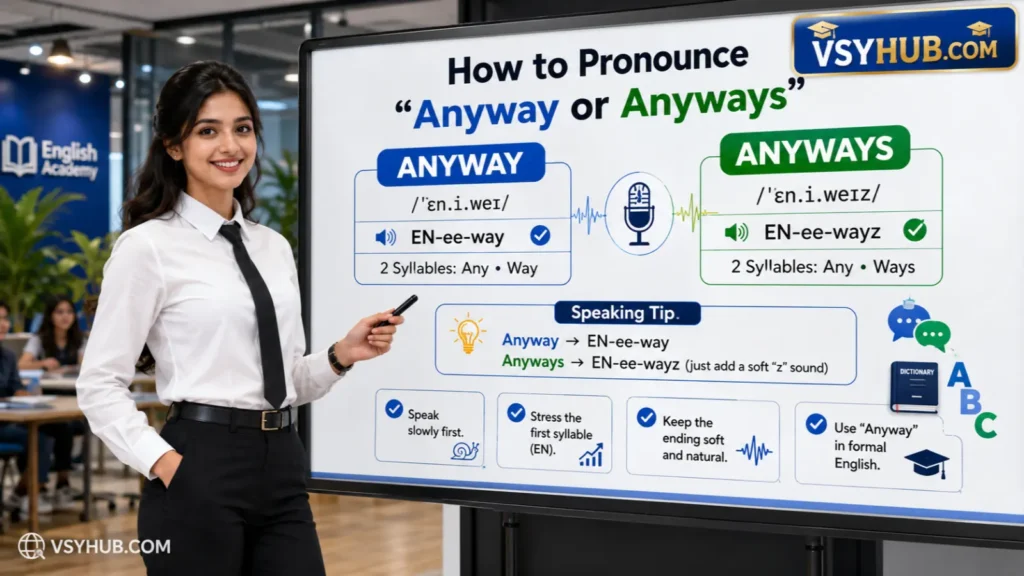
Anyway
Phonetic pronunciation:
/ˈɛn.i.weɪ/
Easy pronunciation:
EN-ee-way
Syllables:
Any • way
Anyways
Phonetic pronunciation:
/ˈɛn.i.weɪz/
Easy pronunciation:
EN-ee-wayz
Syllables:
Any • ways
The only difference is the soft “z” sound at the end of anyways.
Easy Speaking Trick
Say “any way” slowly.
Now say it faster:
Any-way
To pronounce anyways, simply add a gentle “z” sound at the end:
Any-wayz
Common Pronunciation Mistakes
❌ Saying “anny-way”
✔ Say “EN-ee-way.”
❌ Stressing the last syllable too much.
✔ Stress the first syllable: EN-ee-way.
❌ Forgetting the ending sound in anyways.
✔ Add a light “z” sound only if you’re saying anyways.
British English vs American English Usage
Both British English and American English understand anyway and anyways, but they do not use them equally.
In both countries, anyway is the standard form taught in schools, used in newspapers, academic writing, business communication, and official documents.
Anyways is mainly heard in casual conversations, informal storytelling, and online posts. It is more common in spoken American English than in formal British English, though people in both countries may use it informally.
| Feature | British English | American English | Notes |
|---|---|---|---|
| Standard form | Anyway | Anyway | Preferred in all formal writing |
| Informal variation | Sometimes “Anyways” | “Anyways” is more common | Mostly used in casual speech |
| Formal writing | Anyway | Anyway | Best choice for essays, emails, and reports |
| Academic writing | Anyway | Anyway | Teachers and editors recommend this form |
| Everyday conversation | Mainly Anyway | Anyway and Sometimes Anyways | Depends on personal speaking style |
| Pronunciation | Very similar | Very similar | Only the final z sound changes in anyways |
| Business communication | Anyway | Anyway | Professional writing favors anyway |
Which One Should You Use?
For almost every situation, anyway is the safest and most correct choice. It is accepted in formal and informal English and is recommended by teachers, editors, and style guides.
Use anyway when writing:
- School assignments
- Essays
- Business emails
- Reports
- Professional documents
- Job applications
- Academic papers
- Website content
- News articles
Examples:
- Anyway, I’ll finish the project today.
- We decided to continue anyway.
- Anyway, thank you for your time.
You can use anyways in relaxed situations, such as:
- Text messages
- Friendly chats
- Social media posts
- Personal stories
- Casual conversations
Examples:
- Anyways, let’s watch a movie.
- Anyways, that’s what happened yesterday.
- Anyways, see you tomorrow.
Quick Usage Table
| Situation | Best Choice |
|---|---|
| School homework | Anyway |
| College essays | Anyway |
| Office emails | Anyway |
| Business meetings | Anyway |
| News writing | Anyway |
| Blog articles | Anyway |
| Text messages | Anyway or Anyways |
| Social media posts | Anyway or Anyways |
| Friendly conversations | Anyway or Anyways |
| Professional presentations | Anyway |
For clear, correct, and confident English, remember this simple rule:
When in doubt, choose “anyway.” It is correct in almost every situation and helps your writing sound natural, polished, and professional.
Common Mistakes with “Anyway” and “Anyways”
Many English learners use anyway and anyways correctly most of the time, but a few common mistakes can make writing sound less natural. Learning these mistakes will help you write with more confidence.
Mistake 1: Using anyways in formal writing
❌ Incorrect: Anyways, I have attached the report.
✔ Correct: Anyway, I have attached the report.
Why?
Formal writing follows standard English, and anyway is the accepted form.
Beginner Tip:
If you’re writing for school, work, or business, always choose anyway.
Mistake 2: Thinking anyways is wrong
❌ Incorrect Idea: “Anyways is never an English word.”
✔ Correct Explanation: Anyways is a real English word, but it is informal.
Why?
Many native speakers use it in everyday conversation, even though editors usually prefer anyway.
Beginner Tip:
Don’t panic if you hear anyways. Just know when to use it.
Mistake 3: Using anyway instead of any way
❌ Incorrect: Is there anyway to fix this?
✔ Correct: Is there any way to fix this?
Why?
- Anyway = regardless or moving to another topic.
- Any way = any possible method.
Beginner Tip:
If you can replace it with any method, write any way (two words).
Mistake 4: Adding anyways just to sound friendly
❌ Incorrect: Anyways, dear customer, your payment has been received.
✔ Correct: Anyway, dear customer, your payment has been received.
Why?
Professional messages should sound clear and polished.
Beginner Tip:
Friendly does not always mean informal.
Mistake 5: Overusing anyway
❌ Incorrect: Anyway, I woke up. Anyway, I ate breakfast. Anyway, I went to work.
✔ Correct: I woke up, ate breakfast, and went to work. Anyway, that’s how my day started.
Why?
Using the word too often makes writing repetitive.
Beginner Tip:
Use anyway only when it helps connect ideas.
Mistake 6: Confusing pronunciation
❌ Incorrect: Saying any-way-see.
✔ Correct: EN-ee-way
✔ Anyways: EN-ee-wayz
Why?
The words have only two syllables.
Beginner Tip:
Practice saying them slowly before speaking naturally.
Anyway or Anyways in Everyday Examples
Here are natural examples you may hear every day.
At Work
- Anyway, let’s begin today’s meeting.
- The project was difficult, but we finished it anyway.
- Anyways, I’ll update you tomorrow. (Casual workplace chat.)
At School
- Anyway, the teacher explained the answer.
- I forgot my notebook, but I completed the homework anyway.
- Anyways, who’s ready for the quiz?
On Social Media
- Anyways, here’s my travel vlog.
- Anyway, thanks for reading my post.
- Anyways, what do you think about this trend?
In Daily Life
- Anyway, let’s go shopping.
- It started raining, but we went for a walk anyway.
- Anyways, dinner is ready.
In Emails
Formal:
Anyway, thank you for your time and support.
Informal:
Anyways, talk to you soon!
In Text Messages
- Anyways 😂 see you tonight.
- Anyway, don’t worry about it.
- Anyways, I’m almost there.
In Online Articles
- Anyway, let’s look at the next example.
- Anyway, here’s a simple explanation.
Professional writers almost always choose anyway.
In Conversations
Friend 1: “I missed the bus.”
Friend 2: “Anyway, you still made it on time.”
Or:
Friend 1: “That movie was strange.”
Friend 2: “Anyways, let’s watch something else.”
Both sound natural, but anyway is more widely accepted.
Anyway or Anyways in Different Contexts
In Grammar Learning
Grammar books teach anyway because it is the standard English form.
Teachers often recommend using it in:
- Essays
- Exams
- Assignments
- Research papers
In Business Communication
Professional communication values clarity and consistency.
Good examples:
- Anyway, I’ll send the proposal tomorrow.
- Anyway, thank you for attending today’s meeting.
Avoid:
- Anyways, attached is the quarterly report.
In Everyday Communication
Friends and family often speak naturally without worrying about grammar rules.
Examples:
- Anyways, let’s order pizza.
- Anyways, that’s enough for today.
This sounds relaxed and friendly.
In Social Media
On TikTok, Instagram, Facebook, YouTube, Reddit, and X, anyways appears very often.
Creators use it because it sounds conversational.
Examples:
- Anyways… here’s what happened.
- Anyways, follow for more tips!
- Anyways, thanks for watching!
Many influencers intentionally choose anyways to sound casual.
In Texting
Text messages are informal, so both words appear regularly.
Examples:
- Anyway, I’m outside.
- Anyways lol 😂
- Anyways, call me later.
There is no strict grammar rule in casual texting.
In Blogging and Online Writing
Professional blogs usually use anyway because it improves readability and follows standard English.
Personal blogs may use anyways to create a friendly voice.
In Public Speaking
Speakers often say:
- Anyway, let’s move on.
- Anyway, here’s the next point.
Although some speakers naturally say anyways, formal presentations usually favor anyway.
In Creative Writing
Writers sometimes choose anyways in dialogue to make characters sound realistic.
Example:
“Anyways,” Jake laughed, “we survived the trip.”
This reflects natural speech rather than formal grammar.
Anyway or Anyways – Google Trends & Usage Data
People search “is it anyway or anyways” because they want to know which form is correct and when each one should be used. The confusion often starts after hearing native speakers say anyways while seeing anyway in books, school lessons, and professional writing.
The topic remains popular because English learners, students, writers, and professionals all want to avoid grammar mistakes. It is also common in voice searches where users ask questions naturally instead of typing single words.
Why People Search This Keyword
Common reasons include:
- They heard anyways in a conversation.
- They saw anyway in a book or email.
- They want to write correctly for school or work.
- They are preparing for English exams.
- They create blogs or social media content.
- They want to sound like a native English speaker.
Countries Where This Search Is Popular
The question “Is it anyway or anyways?” is commonly searched in:
- United States
- United Kingdom
- Canada
- Australia
- India
- Pakistan
English learners in these countries often compare spoken English with formal grammar rules.
Common Long-Tail Searches
People also search for questions like:
- Is anyway grammatically correct?
- Is anyways a real word?
- Anyway vs anyways difference
- Should I write anyway or anyways?
- Can I use anyways in an essay?
- Is anyways informal?
- Anyway meaning with examples
- Any way vs anyway explained
- How do you pronounce anyway?
- Why do people say anyways?
These conversational searches show that users want quick, beginner-friendly answers with real-life examples. By understanding the difference between anyway, anyways, and any way, you can write more naturally and confidently in every situation.
Comparison Table: Anyway or Anyways
| Feature | Anyway | Anyways |
|---|---|---|
| Standard English | ✅ Yes | ⚠ Informal |
| Meaning | Regardless, in any case, moving to the main point | Same basic meaning |
| Pronunciation | EN-ee-way | EN-ee-wayz |
| Formal Writing | ✅ Recommended | ❌ Not recommended |
| Academic Writing | ✅ Best choice | ❌ Avoid |
| Business Emails | ✅ Professional | ❌ Too casual |
| Social Media | ✅ Common | ✅ Very common |
| Text Messages | ✅ Common | ✅ Common |
| Everyday Speech | ✅ Very common | ✅ Casual and friendly |
| Grammar Status | Standard English | Informal variation |
| Best for Beginners | ✅ Yes | Only in casual conversations |
Anyway or Anyways in Professional Life
Using the right word helps your writing look clear and professional. Even though many people say anyways in conversation, anyway is the safer choice in almost every workplace.
Workplace Communication
Managers, coworkers, and clients expect professional English in emails, reports, and presentations.
Examples:
- Anyway, I’ll complete the project before Friday.
- Anyway, thank you for attending today’s meeting.
- Anyway, let’s discuss the next task.
These sentences sound natural and professional.
Business Writing
Business documents should always use anyway because it follows standard English grammar.
Examples:
- Anyway, we approved the proposal.
- Anyway, the meeting will begin at 10 a.m.
- Anyway, please review the attached document.
Avoid writing:
❌ Anyways, please review the attached document.
Branding and Marketing
Companies usually choose anyway because it builds trust and professionalism.
A casual brand aimed at young audiences may sometimes use anyways on social media to sound more friendly, but official websites and advertisements normally use anyway.
Professional Presentations
When speaking to an audience, anyway sounds polished and confident.
Example:
“Anyway, let’s move to our final point.”
This keeps your presentation smooth and easy to follow.
Anyway or Anyways for Students or Beginners
Many students become confused because they hear anyways from native speakers but read anyway in textbooks.
The good news is that the rule is simple.
Why Beginners Get Confused
- Native speakers often use informal English.
- Social media encourages casual language.
- School teaches standard grammar.
- Both words have almost the same meaning.
Easy Learning Tips
- Use anyway in homework.
- Use anyway in exams.
- Use anyway in essays.
- Use anyway in emails.
- Use anyways only with friends or in relaxed conversations.
Beginner Shortcut
If your teacher will read it, write anyway.
If your best friend will read it, anyway or anyways can both sound natural.
Practice Sentences
Fill in the blank:
- ________, let’s begin the lesson.
- I went to school ________.
- ________, thanks for your help!
Answers:
- Anyway
- Anyway
- Anyway (or “Anyways” in a casual message)
Signs, Characteristics, and Common Uses Related to Anyway or Anyways
Here are the most common ways people use these words.
Common Uses
- Returning to the main topic
- Ending a discussion
- Changing the subject
- Showing that something happened despite a problem
- Making conversations flow naturally
Common Writing Patterns
- Anyway, let’s continue.
- I finished it anyway.
- Anyway, that’s enough for today.
- Anyways, what happened next?
- Anyways, let’s grab some coffee.
Online Usage Patterns
You’ll often see anyways in:
- TikTok captions
- Instagram comments
- Facebook posts
- Reddit discussions
- YouTube videos
- Group chats
- Text messages
You’ll usually see anyway in:
- News articles
- Blogs
- School books
- Business emails
- Official websites
- Professional documents
Writing Situations
Choose anyway when writing:
- Essays
- Reports
- Applications
- Business letters
- Academic papers
- Website articles
Choose anyways when writing:
- Friendly texts
- Casual chats
- Social media captions
- Personal stories
Simple Trick to Remember Anyway or Anyways
Here’s an easy memory rule that works every time.
Memory Rule
Anyway = Always Okay
If you’re unsure which word to choose, use anyway. It is correct in almost every situation.
Think of It This Way
Imagine you’re wearing clothes for an important job interview.
You would choose neat and professional clothes.
In the same way, anyway is the “professional outfit” for your writing.
Now imagine you’re relaxing at home with close friends.
You might wear comfortable clothes instead.
That’s how anyways works. It feels relaxed, casual, and informal.
Quick Memory Shortcut
- School = Anyway
- Office = Anyway
- Exam = Anyway
- Email = Anyway
- Friends = Anyway or Anyways
- Texting = Anyway or Anyways
When in doubt, choose anyway.
Expert Tips
Many grammar articles simply tell you which word is correct. Here are a few extra tips that will help you write better English.
Read Your Sentence Aloud
If anyways sounds too casual for the situation, replace it with anyway.
Match Your Audience
Ask yourself:
- Is this for a teacher?
- Is this for a client?
- Is this for my boss?
If the answer is yes, write anyway.
Learn the Difference Between “Anyway” and “Any Way”
Remember:
- Anyway = regardless or moving to another point.
- Any way = any possible method.
Example:
- Is there any way to solve this problem?
- We solved it anyway.
Keep Your Writing Consistent
Don’t switch between anyway and anyways in the same formal article. Pick one style that matches your audience.
Proofread Before Publishing
Before sending an email or publishing an article, quickly check every use of anyways. In most professional writing, changing it to anyway is the better choice.
Related Searches People Also Ask
Here are some questions people often search online, along with simple answers.
Is anyways a real English word?
Yes. It is a real word, but it is considered informal and is mainly used in casual speech.
Is anyway grammatically correct?
Yes. It is the standard and preferred form in both formal and informal English.
What is the difference between anyway and any way?
Anyway is an adverb meaning “regardless” or “in any case.” Any way means “any possible method.”
Can I use anyways in an essay?
It is better not to. Teachers and editors usually expect anyway in academic writing.
Why do people say anyways?
Many native speakers use it naturally in everyday conversation because it sounds relaxed and friendly.
Is anyways common on social media?
Yes. It appears often in captions, comments, and text messages because online communication is usually informal.
Which word should English learners use?
English learners should use anyway because it is correct in almost every situation.
Is the pronunciation different?
Only slightly. Anyways has an extra “z” sound at the end.
Can I use anyway in emails?
Yes. It is the best choice for professional and personal emails.
Is anyways wrong?
Not completely. It is simply less formal than anyway and should be used carefully.
FAQs
Is it correct to say “anyway” or “anyways”?
Both are used in English, but anyway is the standard form. Anyways is informal.
Which word should I use in school?
Use anyway in homework, essays, exams, and assignments.
Can native English speakers say “anyways”?
Yes. Many native speakers use it in casual conversations, even though formal writing prefers anyway.
Is “anyways” acceptable in business emails?
No. Business communication should normally use anyway.
How do you pronounce “anyway”?
It is pronounced EN-ee-way.
What does “anyway” mean?
It means regardless, in any case, or returning to the main topic.
What is the easiest rule to remember?
If you’re writing something important, always choose anyway.
Final Verdict
So, is it anyway or anyways?
The best answer is anyway.
It is the standard English form and works in school, business, professional writing, and everyday conversations. Anyways is not completely wrong, but it is informal and is best saved for casual chats, text messages, and social media.
The easiest rule is:
When you’re not sure, use “anyway.”
Conclusion
The difference between anyway and anyways is small, but choosing the right one can make your English sound more natural and professional. While both words share the same basic meaning, anyway is the standard choice for almost every situation, including school, work, emails, and formal writing. Anyways is mainly used in relaxed conversations and online chats.
One final memory trick: “Anyway is always okay.” If you remember that simple sentence, you’ll almost always choose the correct word with confidence.

Aria Foster is a comparison and language writer who specializes in spelling differences, word meanings, grammar guides, and easy-to-understand language explanations. She creates clear, reader-friendly content that helps people understand commonly confused words and expressions.