Have you ever searched for SF6 polar or nonpolar while doing homework, preparing for an exam, or watching a chemistry video online?
Many beginners feel confused because molecular shapes and polarity can seem difficult at first.
People usually search for SF6 polar or nonpolar meaning, definition, pronunciation, examples, and simple explanations to better understand chemical bonding.
In this guide, you’ll learn the meaning, pronunciation, examples, usage, basic chemistry rules, common misconceptions, expert tips, and simple explanations in easy English.
SF6 Polar or Nonpolar – Quick Answer
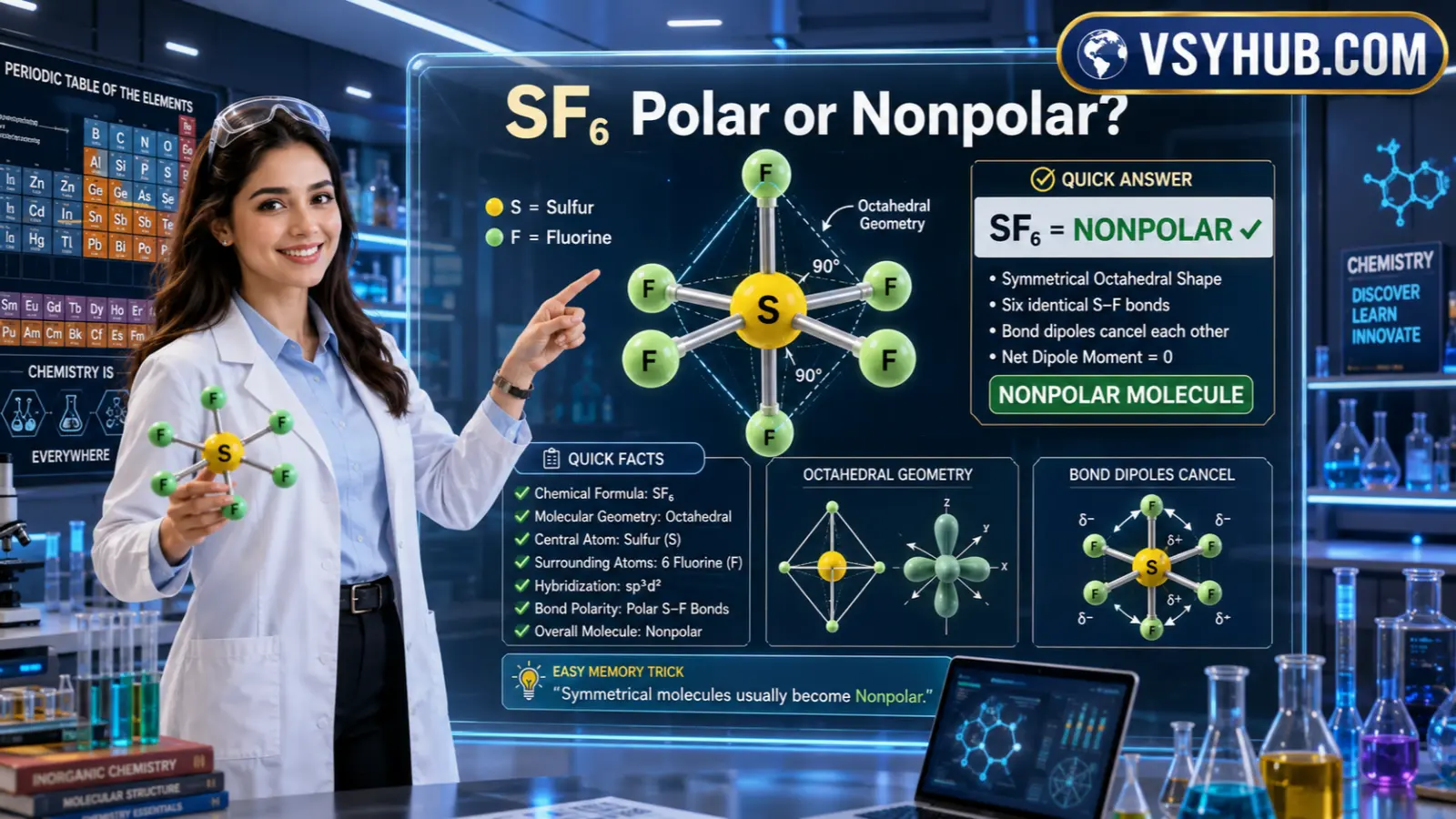
SF6 (Sulfur Hexafluoride) is a nonpolar molecule.
Although each sulfur-fluorine (S–F) bond is polar because fluorine attracts electrons more strongly than sulfur, the entire SF6 molecule is nonpolar. This happens because its six polar bonds are arranged in a perfectly symmetrical shape, causing all bond dipoles to cancel each other.
Quick Facts
1👉 SF6 = Sulfur Hexafluoride
2👉 Bond Type = Polar covalent bonds
3👉 Molecular Shape = Octahedral
4👉 Overall Molecule = Nonpolar
Examples
5✅ SF6 does not have a permanent dipole moment.
6✅ The six fluorine atoms surround sulfur evenly.
7✅ The bond polarities cancel because of the molecule’s symmetry.
Simple Rule
👉 If a molecule has polar bonds but a perfectly symmetrical shape, it can still be nonpolar.
Think of six people pulling a rope equally from every direction. Even though everyone is pulling hard, the rope does not move because all the forces balance each other.
What Does SF6 Polar or Nonpolar Mean?
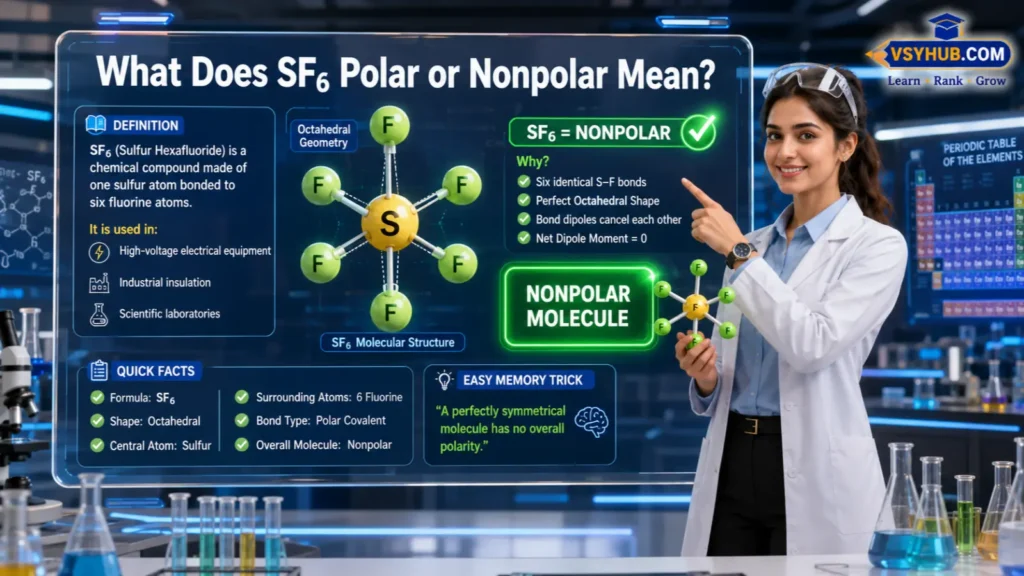
The phrase “SF6 polar or nonpolar” refers to determining whether the sulfur hexafluoride molecule has an uneven or even distribution of electrical charge.
To answer this question, chemists study:
- The atoms in the molecule.
- The type of chemical bonds.
- The molecule’s three-dimensional shape.
- Whether the bond dipoles cancel or create a net dipole.
SF6 is made of:
- One sulfur (S) atom.
- Six fluorine (F) atoms.
Fluorine is one of the most electronegative elements, so every S–F bond is polar. However, these six bonds point in different directions in a perfectly balanced arrangement. As a result, the molecule has no overall positive or negative side, making it nonpolar.
Why Is This Important?
Knowing whether a molecule is polar or nonpolar helps explain:
- How it dissolves.
- How it reacts with other substances.
- Its physical properties.
- Its behavior in laboratory experiments.
- Its industrial applications.
Students often learn polarity when studying:
- Chemical bonding
- Molecular geometry
- Lewis structures
- VSEPR theory
- Intermolecular forces
Synonyms
Although “polar or nonpolar” has no exact synonym, related chemistry terms include:
- Molecular polarity
- Dipole behavior
- Charge distribution
- Molecular symmetry
- Bond polarity
Opposites
- Polar molecule
- Nonpolar molecule
These are opposite classifications used in chemistry.
Related Terms
- Electronegativity
- Covalent bond
- Dipole moment
- VSEPR theory
- Octahedral geometry
- Lewis dot structure
- Molecular geometry
- Symmetry
- Intermolecular forces
Common Variations
People search for this topic using many different phrases, including:
- Is SF6 polar?
- Is SF6 nonpolar?
- Why is SF6 nonpolar?
- SF6 polarity explained
- SF6 molecular geometry
- SF6 dipole moment
- Sulfur hexafluoride polarity
- SF6 Lewis structure and polarity
These searches all focus on understanding the same chemistry concept.
The Origin of SF6
SF6 stands for Sulfur Hexafluoride.
The name comes from standard chemical naming rules.
- Sulfur is the central element.
- Hexa- is a Greek prefix meaning six.
- Fluoride means fluorine atoms bonded to sulfur.
Scientists first prepared sulfur hexafluoride in the early 1900s while studying fluorine chemistry. Over time, it became important in electrical engineering because it is chemically stable, nonflammable, and an excellent electrical insulator.
Today, SF6 is commonly discussed in:
- Chemistry classrooms
- College laboratories
- Electrical power systems
- Scientific research
- Engineering textbooks
Although the compound has many useful industrial applications, it is also known as a powerful greenhouse gas. Because of this, industries now work to reduce emissions and use it responsibly.
How to Pronounce SF6 Polar or Nonpolar
Most people pronounce SF6 by saying each letter followed by the number.
SF6
Pronunciation:
ess-eff-six
You may also hear:
Sulfur Hexafluoride
Pronunciation:
SUL-fur HEK-suh-FLOOR-ide
Syllables
Sulfur
Sul • fur
Hexafluoride
Hex • a • fluor • ide
Easy Speaking Trick
Say it slowly:
Ess → Eff → Six
Then say:
Sulfur → Hexa → Fluoride
Breaking long scientific words into smaller parts makes them much easier to pronounce.
Common Pronunciation Mistakes
❌ Saying “SF six” as one word.
✔ Say each letter separately: Ess-Eff-Six.
❌ Skipping part of “Hexafluoride.”
✔ Pronounce each syllable clearly.
British English vs American English Usage
Unlike grammar or spelling topics, scientific formulas are written the same way worldwide.
| Feature | British English | American English | Notes |
|---|---|---|---|
| Formula | SF6 | SF6 | Identical worldwide |
| Chemical Name | Sulfur Hexafluoride* | Sulfur Hexafluoride | Scientific naming is standardized |
| Pronunciation | Very similar | Very similar | Minor accent differences only |
| Meaning | Nonpolar molecule | Nonpolar molecule | No difference |
| Scientific Usage | Same | Same | International standard |
*In general English, British spelling often uses sulphur, but modern scientific organizations and IUPAC recommend sulfur, making it the accepted form in chemistry worldwide.
Which One Should You Use?
When writing about this compound, always use the standard scientific terminology accepted worldwide.
Best Practices
- Use SF6 in scientific writing.
- Write Sulfur Hexafluoride the first time you mention it.
- Use nonpolar molecule when describing its overall polarity.
- Mention that the S–F bonds are polar if explaining why the molecule is still nonpolar.
- Refer to its octahedral geometry when discussing molecular shape.
Quick Usage Examples
| Situation | Correct Usage |
|---|---|
| School assignment | SF6 is a nonpolar molecule. |
| Science exam | SF6 has polar bonds but an overall nonpolar structure. |
| Laboratory report | The octahedral geometry cancels the bond dipoles. |
| Educational article | SF6 is nonpolar because its molecular symmetry balances all bond polarities. |
| Online chemistry discussion | SF6 is a classic example of a molecule with polar bonds but no overall dipole moment. |
Understanding this distinction is one of the most common learning goals in introductory chemistry because it shows that bond polarity alone does not determine whether a molecule is polar—the molecular shape matters just as much.
Common Mistakes with SF6 Polar or Nonpolar
Many students understand electronegativity but still become confused when deciding whether SF6 is polar or nonpolar. Here are the most common mistakes and how to avoid them.
Mistake 1: Thinking Polar Bonds Always Mean a Polar Molecule
❌ Incorrect: SF6 has polar bonds, so it must be polar.
✔ Correct: SF6 has polar S–F bonds, but the molecule is nonpolar because the bond dipoles cancel each other.
Why this happens: Students often focus only on the bond type and forget about the molecule’s shape.
Easy Tip: Always check the molecular geometry after identifying the bond polarity.
Mistake 2: Ignoring Molecular Shape
❌ Incorrect: Only electronegativity matters.
✔ Correct: Both electronegativity and molecular geometry determine molecular polarity.
Why this happens: Beginners sometimes stop after calculating electronegativity differences.
Easy Tip: Remember this simple order:
- Draw the Lewis structure.
- Find the molecular shape.
- Check whether dipoles cancel.
Mistake 3: Confusing Bond Polarity with Molecular Polarity
❌ Incorrect: Bond polarity and molecular polarity are the same thing.
✔ Correct: They are related but different concepts.
- Bond polarity describes one chemical bond.
- Molecular polarity describes the entire molecule.
Mistake 4: Forgetting About Symmetry
❌ Incorrect: Six polar bonds make SF6 highly polar.
✔ Correct: Six identical bonds arranged symmetrically create a nonpolar molecule.
Easy Tip: Perfect symmetry usually cancels dipole moments.
Mistake 5: Comparing SF6 with Water
❌ Incorrect: Water is polar, so SF6 should also be polar.
✔ Correct: Water has a bent shape, while SF6 has an octahedral shape.
Their geometries are completely different, which changes their polarity.
Mistake 6: Misreading the Lewis Structure
❌ Incorrect: Drawing fluorine atoms unevenly around sulfur.
✔ Correct: Place six fluorine atoms evenly around the sulfur atom.
An incorrect Lewis structure often leads to an incorrect polarity answer.
SF6 Polar or Nonpolar in Everyday Examples
Although most people do not use SF6 in daily conversations, understanding its polarity helps explain many real-world applications.
At School
A chemistry teacher asks:
“Is SF6 polar or nonpolar?”
A correct answer would be:
“SF6 is nonpolar because its octahedral shape cancels all bond dipoles.”
During Homework
A student studies molecular geometry and notices that every S–F bond is polar.
After checking the molecule’s shape, the student correctly concludes that the entire molecule is nonpolar.
In Science Videos
Many educational videos use SF6 as a classic example to show that:
Polar bonds do not always create a polar molecule.
In Laboratory Learning
Students compare molecules such as:
- H2O
- CO2
- NH3
- CH4
- SF6
This comparison helps them understand how molecular shape affects polarity.
In Online Learning
Questions often include:
- Why is SF6 nonpolar?
- Does SF6 have a dipole moment?
- Is sulfur hexafluoride polar?
These questions help beginners strengthen their chemistry fundamentals.
In Exams
Multiple-choice questions frequently ask:
Which molecule is nonpolar?
Students who understand molecular geometry can confidently identify SF6 as the correct answer.
SF6 Polar or Nonpolar in Different Contexts
Education
SF6 is one of the most common examples used in high school and college chemistry.
Teachers use it to explain:
- VSEPR theory
- Molecular geometry
- Dipole moments
- Covalent bonding
- Molecular symmetry
It is considered one of the easiest examples for learning why shape matters.
Chemistry
Chemists classify SF6 as:
- Covalent
- Nonpolar
- Octahedral
- Symmetrical
- Stable
These properties make it an excellent teaching model.
Electrical Engineering
SF6 plays an important role in high-voltage electrical equipment.
Because it is chemically stable and an excellent electrical insulator, it is commonly used in:
- Circuit breakers
- Gas-insulated switchgear (GIS)
- High-voltage substations
- Electrical transmission systems
Its nonpolar nature contributes to its stable molecular behavior.
Environmental Science
Although SF6 has valuable industrial uses, it is also a very strong greenhouse gas.
Scientists are researching safer alternatives and better methods to reduce emissions while maintaining reliable electrical systems.
Scientific Research
Researchers study SF6 to understand:
- Gas behavior
- Molecular interactions
- Spectroscopy
- Atmospheric chemistry
- Advanced materials
Its simple geometry makes it useful for many scientific investigations.
SF6 Polar or Nonpolar – Google Trends & Usage Data
Interest in SF6 polar or nonpolar increases throughout the year, especially during school semesters and examination periods.
Students often search this topic because polarity is one of the most challenging parts of introductory chemistry.
Popular searches include:
- Is SF6 polar or nonpolar?
- Why is SF6 nonpolar?
- SF6 Lewis structure
- SF6 molecular geometry
- SF6 bond polarity
- SF6 dipole moment
- SF6 VSEPR shape
- Sulfur hexafluoride polarity explained
Why People Search This Topic
Most learners want to understand why a molecule with polar bonds can still be classified as nonpolar.
They are usually trying to:
- Prepare for chemistry exams.
- Complete homework assignments.
- Understand molecular geometry.
- Learn VSEPR theory.
- Improve basic chemistry concepts.
Countries Where This Topic Is Popular
Search interest is consistently strong in countries with active science education, including:
- United States
- United Kingdom
- India
- Pakistan
- Canada
- Australia
Students, teachers, and self-learners from these regions frequently search for beginner-friendly explanations.
Voice Search Questions
Many learners now use voice assistants and ask questions like:
- “Is SF6 polar or nonpolar?”
- “Why is sulfur hexafluoride nonpolar?”
- “What is the shape of SF6?”
- “Does SF6 have a dipole moment?”
- “How do I know if SF6 is polar?”
These conversational searches show the growing demand for simple and easy-to-understand chemistry explanations.
Comparison Table: SF6 Polar or Nonpolar
| Feature | SF6 |
|---|---|
| Full Name | Sulfur Hexafluoride |
| Molecular Formula | SF6 |
| Bond Type | Polar covalent |
| Molecular Shape | Octahedral |
| Symmetry | Perfectly symmetrical |
| Overall Polarity | Nonpolar |
| Dipole Moment | Zero |
| Central Atom | Sulfur |
| Surrounding Atoms | Six fluorine atoms |
| Electron Geometry | Octahedral |
| VSEPR Type | AX6 |
| Common Beginner Mistake | Assuming polar bonds always make a polar molecule |
| Professional Usage | Chemistry, electrical engineering, scientific research |
| Academic Importance | Molecular geometry, VSEPR theory, chemical bonding |
SF6 Polar or Nonpolar in Professional Life
Understanding molecular polarity is valuable in many scientific and technical careers.
Professionals who regularly work with concepts like SF6 include:
- Chemists
- Chemical engineers
- Electrical engineers
- Laboratory technicians
- Environmental scientists
- Materials scientists
- Science teachers
Workplace Example
An electrical engineer selecting an insulating gas for high-voltage equipment needs to understand the physical and chemical properties of SF6, including its stability and molecular structure.
Research Example
A chemistry researcher may compare SF6 with other molecules to study intermolecular forces, molecular symmetry, or spectroscopic behavior.
SF6 Polar or Nonpolar for Students or Beginners
Many beginners struggle with polarity because several chemistry concepts work together.
Common areas of confusion include:
- Bond polarity
- Molecular geometry
- Electronegativity
- Dipole moments
- VSEPR theory
Easy Learning Steps
Follow these four simple steps whenever you study molecular polarity:
- Draw the Lewis structure.
- Identify the molecular shape.
- Check whether each bond is polar.
- Decide whether the dipoles cancel.
Beginner Shortcut
Remember this simple rule:
Polar bonds + symmetrical shape = often a nonpolar molecule.
SF6 is one of the best examples of this rule because its six identical S–F bonds are arranged evenly around the sulfur atom, creating perfect symmetry and canceling the overall dipole moment.
Signs, Characteristics, or Common Uses Related to SF6 Polar or Nonpolar
Understanding the characteristics of SF6 helps you quickly identify why it is nonpolar and where it is used.
Common Characteristics
- SF6 contains one sulfur atom and six fluorine atoms.
- Every S–F bond is polar covalent.
- The molecule has an octahedral geometry.
- It is perfectly symmetrical.
- The dipole moments cancel each other.
- It has no permanent dipole moment.
- It is chemically stable.
- It is colorless, odorless, and nonflammable.
Common Uses of SF6
Because of its unique properties, SF6 is widely used in science and industry.
- High-voltage circuit breakers
- Gas-insulated switchgear (GIS)
- Electrical substations
- Scientific laboratories
- Physics experiments
- Medical imaging research (limited applications)
- Semiconductor manufacturing
- Insulation for electrical equipment
Common Patterns to Remember
When studying polarity, SF6 follows these patterns:
- Polar bonds ✔
- Symmetrical molecule ✔
- Zero net dipole ✔
- Overall nonpolar ✔
These patterns make SF6 one of the most frequently used examples in chemistry textbooks.
Simple Trick to Remember SF6 Polar or Nonpolar
A simple memory trick can help you answer exam questions quickly.
Easy Memory Rule
“Symmetry beats bond polarity.”
Even though every S–F bond is polar, the molecule is perfectly balanced. Since all the bond dipoles point evenly in different directions, they cancel each other.
Think of It This Way
Imagine six friends standing in a circle around you.
Each friend pulls your backpack with the same force.
Because everyone pulls equally from every direction, you stay in the center without moving.
SF6 behaves the same way. Each fluorine atom pulls electrons toward itself, but all six pulls are equal. The result is no overall dipole, so SF6 is nonpolar.
Quick Memory Shortcut
Remember this formula:
Polar Bonds + Perfect Symmetry = Nonpolar Molecule
Whenever you see SF6, think:
Six equal fluorine atoms → Perfect balance → Nonpolar.
Expert Tips (Bonus)
Many students memorize answers without understanding the reason. These tips will help you solve polarity questions with confidence.
Always Follow the Same Process
Instead of guessing:
- Draw the Lewis structure.
- Count electron groups.
- Find the molecular geometry.
- Identify polar bonds.
- Check whether dipoles cancel.
This method works for almost every polarity question.
Learn the Most Common Shapes
Memorizing common molecular geometries makes chemistry much easier.
Examples include:
- Linear
- Bent
- Trigonal planar
- Trigonal pyramidal
- Tetrahedral
- Trigonal bipyramidal
- Octahedral
Don’t Judge by Bond Polarity Alone
One of the biggest beginner mistakes is assuming that polar bonds always produce a polar molecule.
Always examine the entire molecule, not just one bond.
Practice with Similar Molecules
Compare SF6 with molecules such as:
- CO2
- CH4
- BF3
- NH3
- H2O
- XeF4
Comparing their shapes helps you recognize polarity patterns much faster.
Use Visual Learning
Drawing three-dimensional molecular shapes or using molecular model kits can make polarity much easier to understand than reading definitions alone.
Related Searches People Also Ask
Here are some questions people commonly search online about SF6 and molecular polarity.
Is SF6 polar or nonpolar?
SF6 is nonpolar because its octahedral shape causes all bond dipoles to cancel.
Why are the S–F bonds polar?
Fluorine is much more electronegative than sulfur, so each bond has an unequal sharing of electrons.
What is the molecular geometry of SF6?
SF6 has an octahedral molecular geometry according to VSEPR theory.
Does SF6 have a dipole moment?
No. The molecule has a net dipole moment of zero.
What is the Lewis structure of SF6?
Sulfur is the central atom bonded to six fluorine atoms with single covalent bonds.
Is SF6 ionic or covalent?
SF6 is a covalent compound with polar covalent bonds.
Why do students confuse SF6 polarity?
Many beginners think polar bonds automatically create a polar molecule, but they often forget to consider molecular symmetry.
What is the VSEPR notation for SF6?
The VSEPR notation is AX6, which produces an octahedral geometry.
Is SF6 used in real life?
Yes. It is widely used in high-voltage electrical equipment because of its excellent insulating properties.
How can I remember SF6 is nonpolar?
Remember that perfect symmetry cancels dipoles.
FAQs
Is SF6 polar or nonpolar?
SF6 is nonpolar because its six polar bonds are arranged symmetrically in an octahedral shape.
Why does SF6 have polar bonds but remain nonpolar?
Each S–F bond is polar, but the bond dipoles cancel because they point in opposite directions equally.
What is the shape of SF6?
SF6 has an octahedral molecular geometry.
Does SF6 have a permanent dipole moment?
No. Its net dipole moment is zero.
Is SF6 important for chemistry students?
Yes. It is one of the best examples for learning the relationship between bond polarity and molecular geometry.
Which theory explains the shape of SF6?
The VSEPR (Valence Shell Electron Pair Repulsion) theory explains its octahedral shape.
Is sulfur hexafluoride a covalent compound?
Yes. It consists of covalent bonds between sulfur and fluorine atoms.
What is the easiest way to remember SF6 is nonpolar?
Remember this rule: Perfect symmetry cancels dipoles.
Final Verdict
The answer is simple:
SF6 is a nonpolar molecule.
Although every sulfur-fluorine bond is polar, the molecule’s octahedral symmetry causes all bond dipoles to cancel. This gives SF6 a zero net dipole moment.
Easy Memory Rule
Polar bonds do not always mean a polar molecule.
Always check the molecular shape before deciding whether a compound is polar or nonpolar.
Conclusion
Understanding SF6 polar or nonpolar becomes much easier once you know that both bond polarity and molecular geometry determine molecular polarity. SF6 contains six polar S–F bonds, but its perfectly symmetrical octahedral structure balances every bond dipole, making the entire molecule nonpolar.
Whenever you solve a polarity question, remember these three simple steps: identify the bond polarity, determine the molecular shape, and check whether the dipoles cancel. This approach will help you correctly classify not only SF6 but many other molecules in chemistry.

Mk Azam is a Master’s graduate, content writer, and contributor at VsyHub.com. He enjoys creating clear, engaging, and informative content across a variety of topics. With a strong focus on accuracy and readability, he helps readers find practical insights and easy-to-understand information. His goal is to deliver valuable content that informs, educates, and inspires.