Have you ever listened to music with headphones and wondered why some audio feels wider, clearer, and more immersive than others?
Maybe you saw the words “mono” and “stereo” on your phone, speaker, recording software, car audio system, or streaming app and weren’t sure what they meant.
People usually search for mono or stereo meaning, mono vs stereo difference, stereo pronunciation, audio examples, recording usage, and which one is better for music or podcasts.
The confusion is common because both terms relate to sound, but they work in different ways.
Understanding the difference is important whether you’re a student, content creator, musician, gamer, podcaster, or simply someone who enjoys listening to audio.
In this guide, you’ll learn the meaning, pronunciation, examples, usage, grammar rules, common mistakes, expert tips, and simple explanations in easy English.
Mono or Stereo – Quick Answer
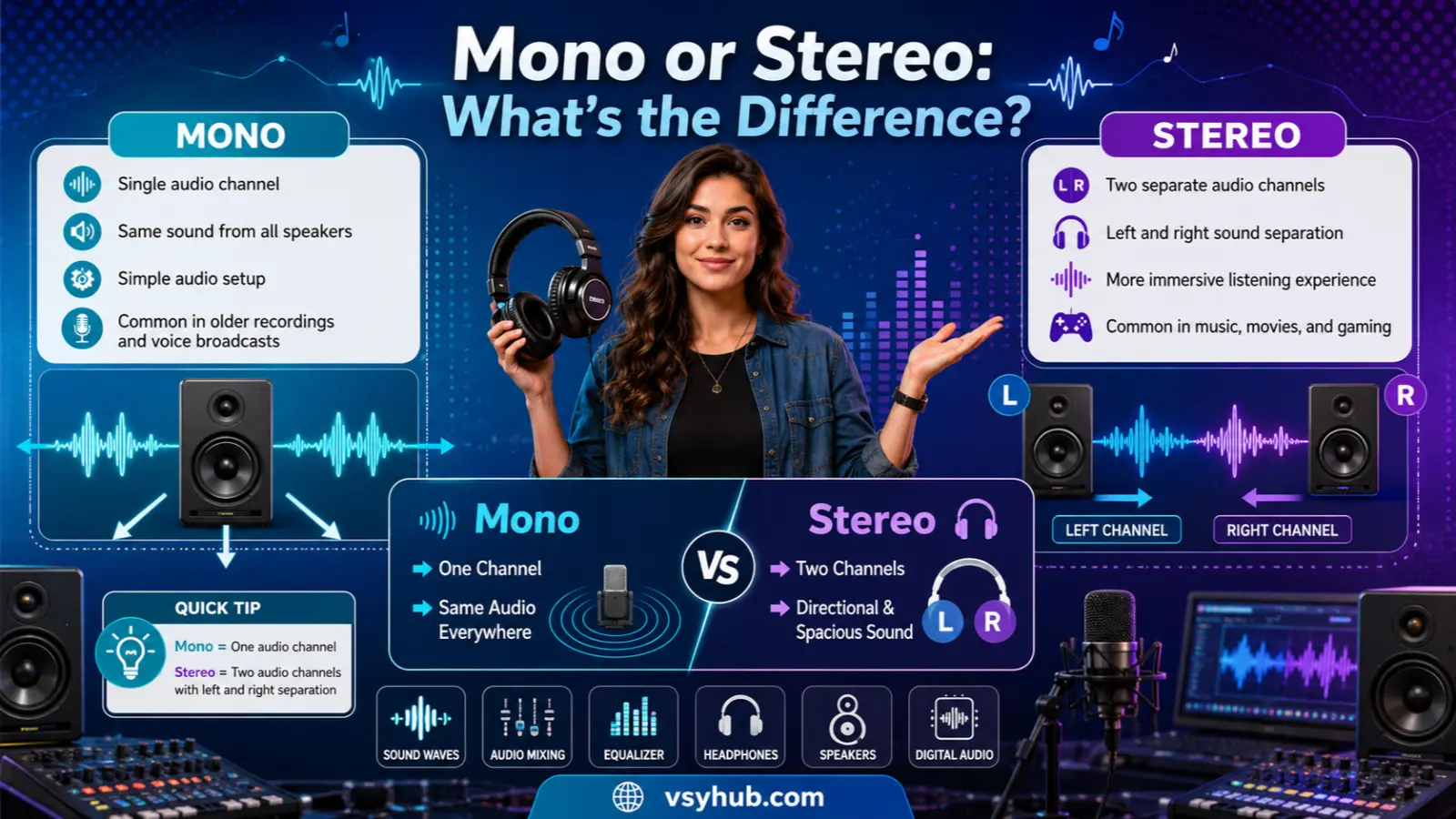
Mono and stereo are two different audio formats.
👉 Mono = One audio channel
👉 Stereo = Two audio channels (left and right)
Mono plays the same sound through all speakers.
Stereo separates sound into left and right channels to create a wider and more realistic listening experience.
Examples
A phone call is usually mono.
A podcast may be recorded in mono.
Most modern songs are released in stereo.
Movies often use stereo or surround sound.
Gaming headsets commonly use stereo audio.
Simple Rule
👉 If sound comes from a single channel, it is mono.
👉 If sound comes from separate left and right channels, it is stereo.
Easy Memory Trick
Think of it this way:
Mono = One
Stereo = Separate sides
One channel versus two channels.
What Does Mono or Stereo Mean?
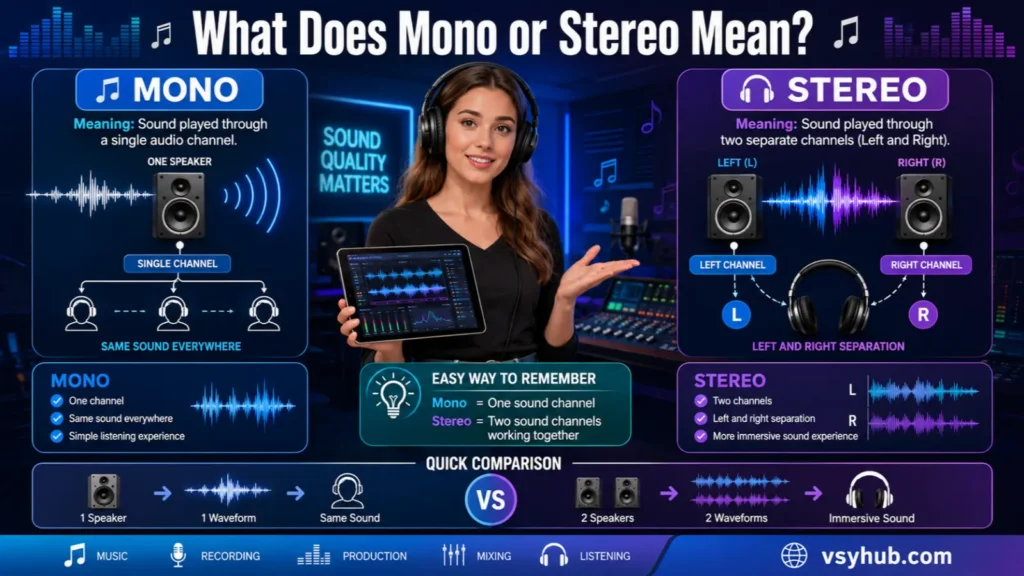
What Is Mono?
Mono is short for “monophonic.”
It uses a single audio channel. Every speaker receives the same sound signal.
Whether you listen through one speaker, two speakers, or headphones, the sound remains identical.
What Is Stereo?
Stereo is short for “stereophonic.”
It uses two audio channels:
- Left channel
- Right channel
Different sounds can be placed in different positions, creating a sense of space and direction.
For example, a guitar may sound stronger in the left ear while a piano sounds stronger in the right ear.
Synonyms
Mono
- Single-channel audio
- Monophonic sound
- One-channel recording
Stereo
- Two-channel audio
- Stereophonic sound
- Dual-channel recording
Opposites
| Term | Opposite |
|---|---|
| Mono | Stereo |
| Single-channel | Dual-channel |
Related Terms
- Audio channels
- Sound recording
- Headphones
- Speakers
- Mixing
- Sound engineering
- Podcasting
- Music production
- Spatial audio
- Surround sound
Common Variations
- Mono recording
- Mono microphone
- Mono audio track
- Stereo recording
- Stereo speakers
- Stereo headphones
The Origin of Mono or Stereo
The word mono comes from the Greek word monos, meaning “single” or “alone.”
The word stereo comes from the Greek word stereos, meaning “solid” or “three-dimensional.”
Early radio broadcasts were mainly mono because technology was limited.
As audio technology improved during the 1950s and 1960s, stereo became popular. Music listeners enjoyed a more realistic listening experience because sounds could be placed across two channels.
Today, stereo is the standard format for music, movies, games, and streaming platforms.
How to Pronounce Mono or Stereo
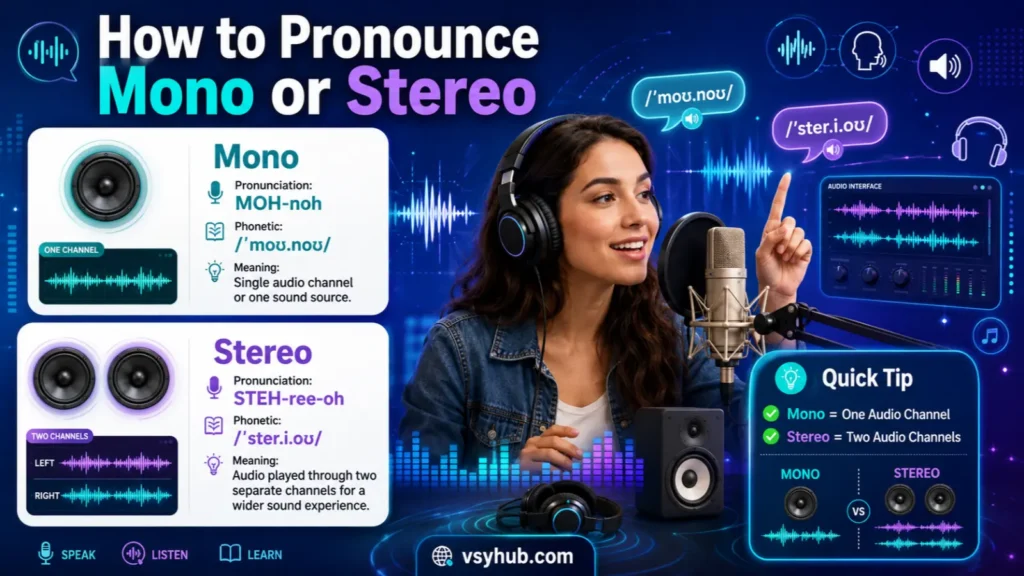
Mono Pronunciation
Phonetic pronunciation:
MOH-noh
Syllables:
Mo-no
Easy speaking trick:
Say “mo” as in “moment.”
Stereo Pronunciation
Phonetic pronunciation:
STEH-ree-oh
Syllables:
Ste-re-o
Easy speaking trick:
Start with “stair” and add “ee-oh.”
Common Pronunciation Mistakes
❌ Mon-oh
✅ MOH-noh
❌ Ster-ro
✅ STEH-ree-oh
British English vs American English Usage
The meanings of mono and stereo are the same in both British and American English.
| Feature | British English | American English | Notes |
|---|---|---|---|
| Mono spelling | Mono | Mono | Same |
| Stereo spelling | Stereo | Stereo | Same |
| Meaning | Same | Same | No difference |
| Audio usage | Same | Same | Universal |
| Professional use | Common | Common | Global term |
These terms are used worldwide in audio technology.
Which One Should You Use?
The answer depends on your goal.
Use Mono When
- Recording podcasts
- Recording voiceovers
- Making phone calls
- Saving storage space
- Creating simple audio content
Use Stereo When
- Listening to music
- Watching movies
- Playing video games
- Producing music
- Creating immersive audio experiences
Quick Usage Table
| Situation | Best Choice |
|---|---|
| Podcast | Mono |
| Phone Call | Mono |
| Music Listening | Stereo |
| Gaming | Stereo |
| Movie Watching | Stereo |
| Voice Recording | Mono |
Common Mistakes With Mono or Stereo
Mistake 1
❌ All audio should be stereo.
✔ Mono is often better for speech recordings.
Many beginners assume stereo is always superior.
Mistake 2
❌ Mono sounds broken.
✔ Mono is a professional audio format.
Mono is intentionally used in many situations.
Mistake 3
❌ Stereo means louder audio.
✔ Stereo means wider audio placement.
It changes space, not volume.
Mistake 4
❌ Podcasts must use stereo.
✔ Many podcasts are recorded in mono.
Speech usually does not need stereo separation.
Mistake 5
❌ One speaker cannot play stereo.
✔ Stereo requires two separate channels.
A single speaker usually combines channels.
Mistake 6
❌ Mono and stereo are different sound qualities.
✔ They describe channel arrangement.
Sound quality depends on recording and equipment.
Mistake 7
❌ Stereo is always necessary.
✔ Mono can be the better option for voice-focused content.
Mono or Stereo in Everyday Examples
Work
“We recorded the training video narration in mono.”
School
“The media class learned the difference between mono and stereo audio.”
Social Media
“This video sounds much better in stereo headphones.”
Daily Life
“My car automatically switches to stereo music playback.”
Emails
“Please export the voice recording as mono audio.”
Text Messages
“Are these headphones stereo or mono?”
Online Content
“Most music streaming services use stereo recordings.”
Conversations
“I can hear the drums on one side because the song is in stereo.”
Mono or Stereo in Different Contexts
Music Production
Stereo helps create depth and width.
Producers place instruments across the left and right channels.
Example:
A guitar may appear slightly left while vocals stay centered.
Podcasting
Many podcasters choose mono because listeners mainly focus on speech.
Mono files are smaller and easier to manage.
Gaming
Stereo helps players identify where sounds come from.
Footsteps may appear on the left or right side.
Video Creation
Creators often use stereo for a richer viewing experience.
Voiceovers may still be recorded in mono.
Technology
Audio software often allows switching between mono and stereo tracks.
Education
Students studying media production learn both formats as basic audio concepts.
Mono or Stereo – Google Trends & Usage Data
People search for mono or stereo because audio technology is part of everyday life.
Common searches include:
- What is mono audio?
- What is stereo sound?
- Mono vs stereo for podcasts
- Mono or stereo microphone
- Which is better mono or stereo?
- Difference between mono and stereo recording
- Stereo headphones meaning
- Mono audio example
Interest is especially strong in the:
- United States
- United Kingdom
- India
- Pakistan
- Canada
- Australia
The growth of podcasting, music streaming, gaming, and content creation continues to increase searches for these terms.
Voice-search examples include:
- Should I record in mono or stereo?
- What does stereo audio mean?
- Is mono better for podcasts?
- Why does stereo sound wider?
Comparison Table: Mono or Stereo
| Feature | Mono | Stereo |
|---|---|---|
| Meaning | One channel | Two channels |
| Audio Channels | 1 | 2 |
| Sound Direction | None | Left and right |
| Music Experience | Basic | Immersive |
| Podcast Recording | Excellent | Sometimes unnecessary |
| Gaming | Limited | Better positioning |
| File Size | Smaller | Larger |
| Professional Usage | Voice recordings | Music and entertainment |
| Beginner Friendly | Yes | Yes |
| Popularity Today | Common | More common |
Mono or Stereo in Professional Life
Audio professionals choose between mono and stereo based on the project.
Workplace Communication
Training videos often use mono narration.
Broadcasting
Radio stations may use both formats depending on the content.
Marketing
Advertising videos often use stereo audio for a richer experience.
Content Creation
YouTubers frequently record voice tracks in mono and export final videos in stereo.
Practical Example
A podcast host records voice in mono but adds stereo background music during editing.
Mono or Stereo for Students or Beginners
Many beginners struggle because both formats sound similar at first.
Common confusion includes:
- Thinking stereo is always better
- Assuming mono is outdated
- Believing stereo means louder sound
Easy Learning Tips
- Mono = one channel
- Stereo = two channels
- Voice recordings often use mono
- Music usually uses stereo
Signs, Characteristics, or Common Uses Related to Mono or Stereo
Common Uses of Mono
- Podcasts
- Voiceovers
- Phone systems
- Radio communication
- Interviews
Common Uses of Stereo
- Music streaming
- Movies
- Television
- Gaming
- Concert recordings
Industries Using These Terms
- Music production
- Broadcasting
- Film production
- Gaming
- Education
- Marketing
- Podcasting
Simple Trick to Remember Mono or Stereo
Easy Memory Rule
Mono starts with M.
Think:
M = One Main Channel
Stereo starts with S.
Think:
S = Separate Left and Right Sounds
Think of It This Way
Imagine taking a photo.
Mono is like looking through one eye.
Stereo is like looking through both eyes and seeing more depth.
The same idea applies to sound.
Expert Tips Section
Use Mono for Speech
Voice recordings usually sound clean and professional in mono.
Use Stereo for Entertainment
Music, movies, and games benefit from stereo separation.
Test With Headphones
The difference is easier to hear through headphones.
Avoid Unnecessary Stereo Recording
If your content only contains one voice, mono may be the smarter choice.
Learn Basic Audio Mixing
Understanding channels helps improve recording quality and editing skills.
Related Searches People Also Ask
What is the difference between mono and stereo audio?
Mono uses one channel. Stereo uses two channels.
Is stereo better than mono?
Not always. It depends on the purpose.
Why do podcasts use mono?
Because speech does not require left-right separation.
Are songs recorded in stereo?
Most modern songs are.
What does mono mean on a phone?
It combines audio into a single channel.
Can stereo become mono?
Yes. Most audio software can convert it.
Are headphones stereo?
Most modern headphones are stereo.
Does mono save storage space?
Yes. Mono files are generally smaller.
Why does stereo sound wider?
Because left and right channels carry different audio information.
Is mono outdated?
No. It is still widely used professionally.
FAQs
What is mono audio?
Mono audio uses one sound channel.
What is stereo audio?
Stereo audio uses two channels, left and right.
Which is better for music?
Stereo is usually better for music.
Which is better for podcasts?
Mono is often preferred for podcasts.
Can I convert stereo to mono?
Yes, most editing software allows conversion.
Is mono louder than stereo?
Not necessarily. Loudness depends on the recording.
Do smartphones support stereo?
Most modern smartphones support stereo playback.
Why do gamers use stereo headsets?
Stereo helps identify sound direction.
Does stereo improve sound quality?
It improves sound placement, not necessarily quality.
Is mono still used today?
Yes. Many professional voice recordings use mono.
Can one speaker play stereo sound?
A single speaker typically combines both channels.
Should beginners learn both formats?
Yes. Understanding both helps with audio recording and editing.
Final Verdict
The difference between mono or stereo is simple.
👉 Mono uses one audio channel.
👉 Stereo uses two audio channels.
If you are recording speech, mono is often the best choice.
If you are listening to music, gaming, or watching movies, stereo usually provides a richer experience.
Remember this easy rule:
Mono = One channel
Stereo = Two channels
Conclusion
Understanding mono or stereo can help you make better choices when recording, editing, or listening to audio. Mono keeps things simple and works well for voice recordings. Stereo creates a wider and more immersive listening experience that is ideal for music, movies, and gaming.
The most important thing to remember is that neither format is automatically better. The right choice depends on what you are doing.
One final memory trick:
Mono = One sound path. Stereo = Sound from two sides.
Once you remember that, the difference becomes easy to understand.