Have you ever filled out a tax form, business application, bank document, or online registration and seen the terms TIN and EIN?
Many people get confused because these terms often appear together, especially when dealing with taxes, businesses, or government paperwork.
People usually search for: TIN or EIN meaning, TIN vs EIN difference, correct tax identification number, EIN definition, TIN examples, and how to use TIN or EIN.
Understanding these terms is important whether you’re a student learning about taxes, a business owner, a freelancer, or someone completing official forms.
Using the wrong number can lead to paperwork mistakes and delays.
In this guide, you’ll learn the meaning, pronunciation, examples, usage, grammar rules, common mistakes, expert tips, and simple explanations in easy English.
TIN or EIN – Quick Answer
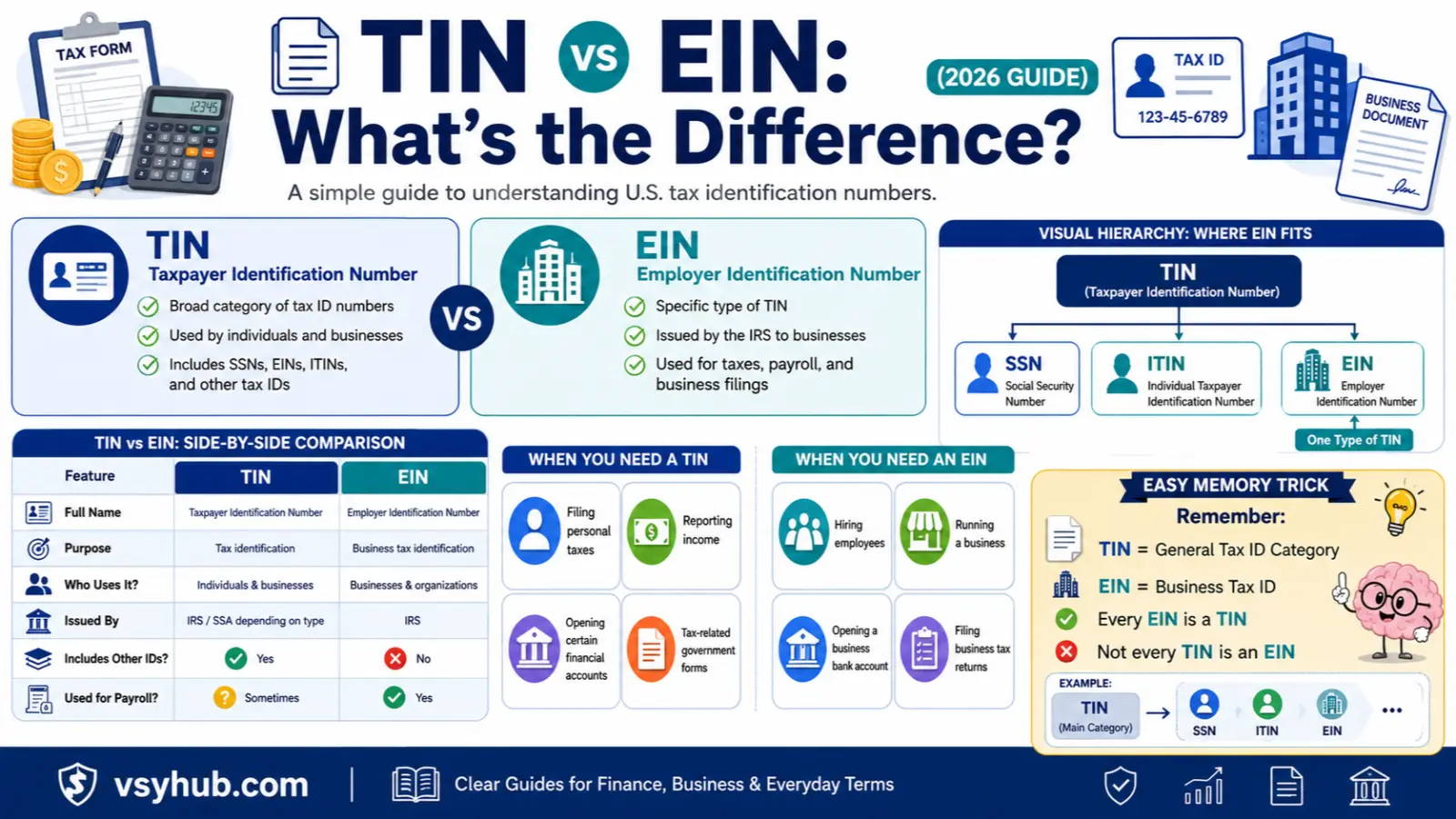
TIN and EIN are not the same thing, but they are closely related.
👉 TIN = Taxpayer Identification Number
A TIN is a general term used by tax authorities to identify taxpayers.
👉 EIN = Employer Identification Number
An EIN is a specific type of TIN used mainly by businesses and organizations.
Simple Explanation
Think of it this way:
- Every EIN is a TIN.
- Not every TIN is an EIN.
Examples
A company uses an EIN when filing business taxes.
An individual may use a Social Security Number (SSN), which is also a type of TIN.
A nonprofit organization uses an EIN.
A sole proprietor may need an EIN for business purposes.
Banks often request a TIN for tax reporting.
Simple Rule
👉 TIN is the umbrella term. EIN is one type under that umbrella.
Easy Memory Trick
TIN = Total Identification Number category
EIN = Employer Identification Number for businesses
What Does Tin or EIN Mean?
Meaning of TIN
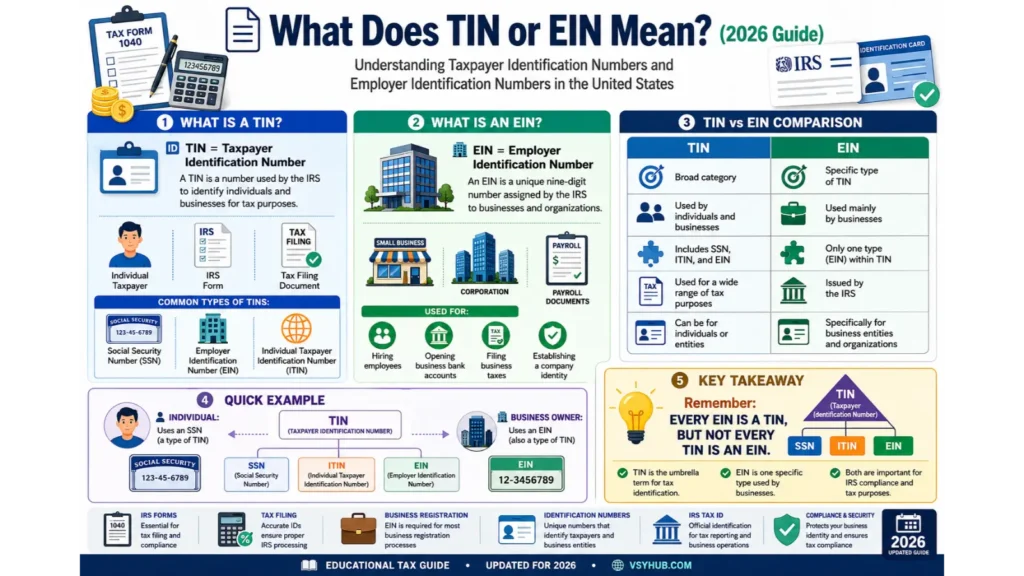
A Taxpayer Identification Number (TIN) is a number used to identify a person or organization for tax purposes.
Different types of TINs include:
- Social Security Number (SSN)
- Employer Identification Number (EIN)
- Individual Taxpayer Identification Number (ITIN)
- Other government-issued tax IDs
Meaning of EIN
An Employer Identification Number (EIN) is a nine-digit number assigned to businesses and organizations.
It works much like a Social Security Number but for a business.
Practical Meaning
Businesses use EINs to:
- File taxes
- Open business bank accounts
- Hire employees
- Apply for licenses
- Register companies
Professional Meaning
In accounting, payroll, finance, and tax administration, EINs help identify business entities accurately.
Synonyms
TIN
- Tax ID
- Taxpayer Number
- Tax Identification Number
EIN
- Employer Tax ID
- Federal Tax ID
- Business Tax Number
Opposites
There is no direct opposite, but common alternatives include:
- Anonymous records
- Unidentified taxpayer status
Related Terms
- SSN
- ITIN
- Tax filing
- Payroll
- Business registration
- IRS
- Tax compliance
Common Variations
- Tax ID
- Federal Tax ID
- Business EIN
- Taxpayer Number
- Employer Tax Number
The Origin of Tin or EIN
The concept of taxpayer identification numbers developed as governments needed a reliable way to track tax records and reduce administrative errors.
In the United States, tax identification systems expanded during the twentieth century as businesses grew and tax regulations became more complex.
The EIN was introduced to help distinguish business entities from individual taxpayers. Over time, banks, government agencies, payroll systems, and financial institutions adopted EINs as a standard business identifier.
Today, TINs and EINs play a major role in tax reporting, employment records, and business operations.
How to Pronounce Tin or EIN
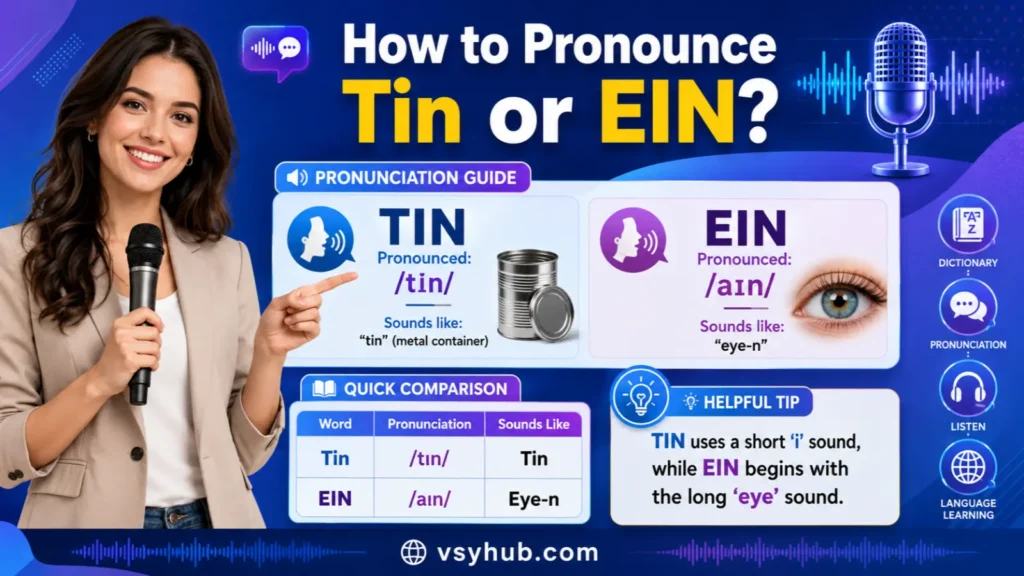
TIN Pronunciation
TIN
Phonetic pronunciation:
tin
Sounds exactly like the metal “tin.”
One syllable.
EIN Pronunciation
EIN
Phonetic pronunciation:
ee-eye-en
Each letter is pronounced separately.
Three syllables.
Easy Speaking Trick
- TIN sounds like “tin can.”
- EIN sounds like saying the letters E-I-N.
Common Pronunciation Mistakes
❌ Pronouncing EIN as one word.
✔ Say each letter separately: E-I-N.
British English vs American English Usage
The terms TIN and EIN are primarily associated with the U.S. tax system. However, the concept of tax identification numbers exists worldwide.
| Feature | British English | American English | Notes |
|---|---|---|---|
| TIN Usage | Used in tax discussions | Common | Same meaning |
| EIN Usage | Rare | Very common | U.S.-specific term |
| Tax ID Concept | Exists | Exists | Used globally |
| Business Tax Number | Different names | EIN | Depends on country |
| Pronunciation | Same | Same | No major difference |
Which One Should You Use?
The correct choice depends on what the form is asking for.
Use TIN When
- A form requests a Taxpayer Identification Number.
- The document applies to individuals or businesses.
- The exact type of tax ID is not specified.
Use EIN When
- A business tax form asks for an Employer Identification Number.
- Opening a business bank account.
- Hiring employees.
- Registering a company.
Quick Usage Table
| Situation | Use TIN | Use EIN |
|---|---|---|
| Personal tax filing | ✔ | ❌ |
| Business registration | ✔ | ✔ |
| Hiring employees | ❌ | ✔ |
| Bank tax reporting | ✔ | ✔ |
| Government tax forms | ✔ | Depends |
Common Mistakes With Tin or EIN
Mistake 1
❌ “TIN and EIN mean exactly the same thing.”
✔ EIN is a type of TIN.
Why it happens: People often see them used together.
Mistake 2
❌ Using an EIN when a personal TIN is required.
✔ Use the identification number requested on the form.
Tip: Read instructions carefully.
Mistake 3
❌ Assuming every person has an EIN.
✔ Most individuals do not need an EIN.
Why it happens: Business terminology can be confusing.
Mistake 4
❌ Thinking only large companies need EINs.
✔ Small businesses often need EINs too.
Tip: Business size does not always matter.
Mistake 5
❌ Entering the wrong number format.
✔ Double-check all tax identification numbers.
Why it happens: Numbers can look similar.
Mistake 6
❌ Calling every tax number an EIN.
✔ Use TIN when discussing tax IDs generally.
Tip: Remember that EIN is just one category.
Mistake 7
❌ Confusing EIN with ITIN.
✔ These are different identification numbers.
Tip: Learn the purpose of each tax ID.
Tin or EIN in Everyday Examples
Work
“Our company EIN is required for payroll setup.”
School
“In business class, students learned the difference between a TIN and an EIN.”
Social Media
“I finally got my EIN and launched my small business today.”
Daily Life
“The bank asked me for my tax identification number.”
Emails
“Please provide your EIN for vendor registration.”
Text Messages
“Do I need a TIN or EIN for this form?”
Online Content
“Understanding TIN vs EIN can help new entrepreneurs.”
Conversations
“My accountant explained that my EIN is one type of TIN.”
Tin or EIN in Different Contexts
Business Context
Businesses use EINs for tax filing, payroll processing, and banking.
Example:
“A startup received its EIN before opening a company account.”
Accounting Context
Accountants use TINs to identify taxpayers accurately.
Example:
“The tax return requires the correct TIN.”
Banking Context
Financial institutions use tax identification numbers for reporting purposes.
Example:
“The bank verified the business EIN.”
Tax Filing Context
Tax authorities rely on TINs to match tax records.
Example:
“Incorrect TIN information may delay processing.”
Entrepreneurship Context
New business owners often apply for EINs during company setup.
Example:
“The entrepreneur obtained an EIN before hiring staff.”
Tin or EIN – Google Trends & Usage Data
People frequently search for TIN and EIN because tax forms, banking documents, and business registrations often mention both terms.
Common search behavior includes:
- What is a TIN?
- What is an EIN?
- TIN vs EIN difference
- Is EIN the same as TIN?
- How do I find my EIN?
- Which tax ID should I use?
Search interest is especially strong in:
- United States
- Canada
- United Kingdom
- India
- Pakistan
- Australia
Many beginners encounter these terms while:
- Starting a business
- Filing taxes
- Opening bank accounts
- Applying for loans
- Registering online payment systems
Voice-search examples include:
- “What is the difference between a TIN and EIN?”
- “Do I need a TIN or EIN?”
- “Is an EIN considered a TIN?”
- “Can I use my EIN as a tax identification number?”
Comparison Table: Tin or EIN
| Feature | TIN | EIN |
|---|---|---|
| Full Form | Taxpayer Identification Number | Employer Identification Number |
| Type | General category | Specific type of TIN |
| Used By | Individuals and businesses | Businesses and organizations |
| Tax Purpose | Identification | Business identification |
| Number Category | Umbrella term | Subcategory |
| Professional Use | High | High |
| Academic Use | Common in tax studies | Common in business studies |
| Banking Use | Yes | Yes |
| Common Confusion | Broad meaning | Often mistaken for all TINs |
| Popularity | Very high | Very high |
Tin or EIN in Professional Life
Understanding the difference between TIN and EIN is important in professional settings.
Workplace Communication
Employees in accounting, HR, and finance regularly use these terms.
Example:
“Please verify the EIN before submitting payroll documents.”
Business Communication
Companies share EIN information with banks, vendors, and government agencies.
Example:
“The supplier requested our EIN for tax records.”
Branding and Business Setup
New businesses often obtain an EIN early in the registration process.
Example:
“The company secured its EIN before launching operations.”
Financial Accuracy
Using the correct tax identifier helps avoid paperwork issues and compliance problems.
Tin or EIN for Students or Beginners
Many beginners struggle because both terms involve taxes and identification numbers.
Why Beginners Get Confused
- Similar purpose
- Often appear together
- Technical language
- Business terminology
Easy Learning Trick
Remember:
TIN = Big category
EIN = One specific member of that category
Beginner Shortcut
Imagine a fruit basket.
- TIN = Fruit basket
- EIN = Apple inside the basket
This makes the relationship easier to remember.
Signs, Characteristics, or Common Uses Related to Tin or EIN
Common Uses of TIN
- Tax returns
- Financial reporting
- Banking records
- Government forms
- Identity verification
Common Uses of EIN
- Hiring employees
- Payroll management
- Business taxes
- Corporate banking
- Company registration
Industries Frequently Using EINs
- Retail
- Technology
- Healthcare
- Manufacturing
- Education
- Nonprofit organizations
- Financial services
Online Usage Patterns
People often search these terms when:
- Starting a company
- Filing taxes online
- Completing payment platform registration
- Opening business accounts
Simple Trick to Remember Tin or EIN
Easy Memory Rule
TIN = Tax ID family
EIN = Business member of the family
Think of it this way:
Imagine a school.
The school represents TIN.
One classroom inside the school represents EIN.
The classroom belongs to the school, just as an EIN belongs to the TIN category.
Memory Shortcut
All EINs are TINs, but not all TINs are EINs.
This single sentence helps most people remember the difference instantly.
Expert Tips Section
Learn the Hierarchy
Don’t memorize random definitions.
Instead remember:
- TIN is the broad category.
- EIN is one type within the category.
Read Forms Carefully
Government and banking forms often specify exactly which number is required.
Double-Check Tax Documents
Incorrect tax identification numbers can create delays and errors.
Keep Business Records Organized
Store EIN-related documents securely and separately from personal records.
Use Context Clues
If the discussion is about a company, payroll, or employees, EIN is often the relevant term.
Related Searches People Also Ask
Is an EIN the same as a TIN?
No. An EIN is one type of TIN.
What does TIN stand for?
TIN stands for Taxpayer Identification Number.
What does EIN stand for?
EIN stands for Employer Identification Number.
Can an individual have an EIN?
Yes, in some business situations.
Why do businesses need an EIN?
They use it for taxes, payroll, and banking.
Is a Social Security Number a TIN?
Yes. An SSN is a type of TIN.
Can a business operate without an EIN?
Some businesses can initially, but many require one.
How do I know whether a form needs a TIN or EIN?
Read the instructions carefully.
Why do banks request tax identification numbers?
For tax reporting and compliance.
What is the easiest way to remember TIN vs EIN?
Remember that EIN belongs under the TIN category.
FAQs
What is the main difference between TIN and EIN?
TIN is a general tax identification category, while EIN is a specific business tax identifier.
Is EIN a type of TIN?
Yes, every EIN is considered a TIN.
Can I use TIN and EIN interchangeably?
Not always. The correct choice depends on the document requirements.
What does TIN mean?
TIN stands for Taxpayer Identification Number.
What does EIN mean?
EIN stands for Employer Identification Number.
Is an SSN also a TIN?
Yes. A Social Security Number is a type of TIN.
Who usually needs an EIN?
Businesses, nonprofits, and employers commonly need EINs.
How is EIN pronounced?
It is pronounced letter by letter: E-I-N.
Is TIN used outside the United States?
Yes. Many countries use taxpayer identification systems.
Why do people confuse TIN and EIN?
Because EIN is one of the most common types of TIN.
Final Verdict
The simple answer is that TIN and EIN are related but not identical.
- TIN is the broad tax identification category.
- EIN is a specific tax ID used mainly for businesses.
The easiest memory rule is:
Every EIN is a TIN, but not every TIN is an EIN.
If you’re dealing with business taxes, payroll, or company registration, you’ll likely encounter an EIN. If you’re discussing tax identification in general, TIN is the broader term.
Conclusion
Understanding the difference between TIN or EIN becomes much easier once you know that one is a category and the other is a specific type within that category. This distinction is important for tax forms, business registration, banking, and professional communication.
Whenever you see these terms, remember the simple rule: TIN is the umbrella term, and EIN is one specific kind of tax identification number. Keeping this idea in mind can help you avoid mistakes and complete forms with confidence.
A final easy memory trick: Think of TIN as the family and EIN as one member of that family.