Have you ever heard someone talk about convergent thinking or divergent thinking and wondered what those words actually mean?
Many students, professionals, teachers, and even social media users come across these terms and feel confused about the difference.
People usually search for: convergent or divergent meaning, convergent vs divergent thinking, pronunciation, examples, usage, definition, and differences between convergent and divergent.
Understanding these terms is important because they are widely used in education, psychology, business, creativity, problem-solving, and workplace discussions.
Knowing the difference can help you learn better, think more clearly, and improve decision-making skills.
In this guide, you’ll learn the meaning, pronunciation, examples, usage, grammar rules, common mistakes, expert tips, and simple explanations in easy English.
Convergent or Divergent – Quick Answer
Convergent and divergent are both correct words, but they have different meanings.
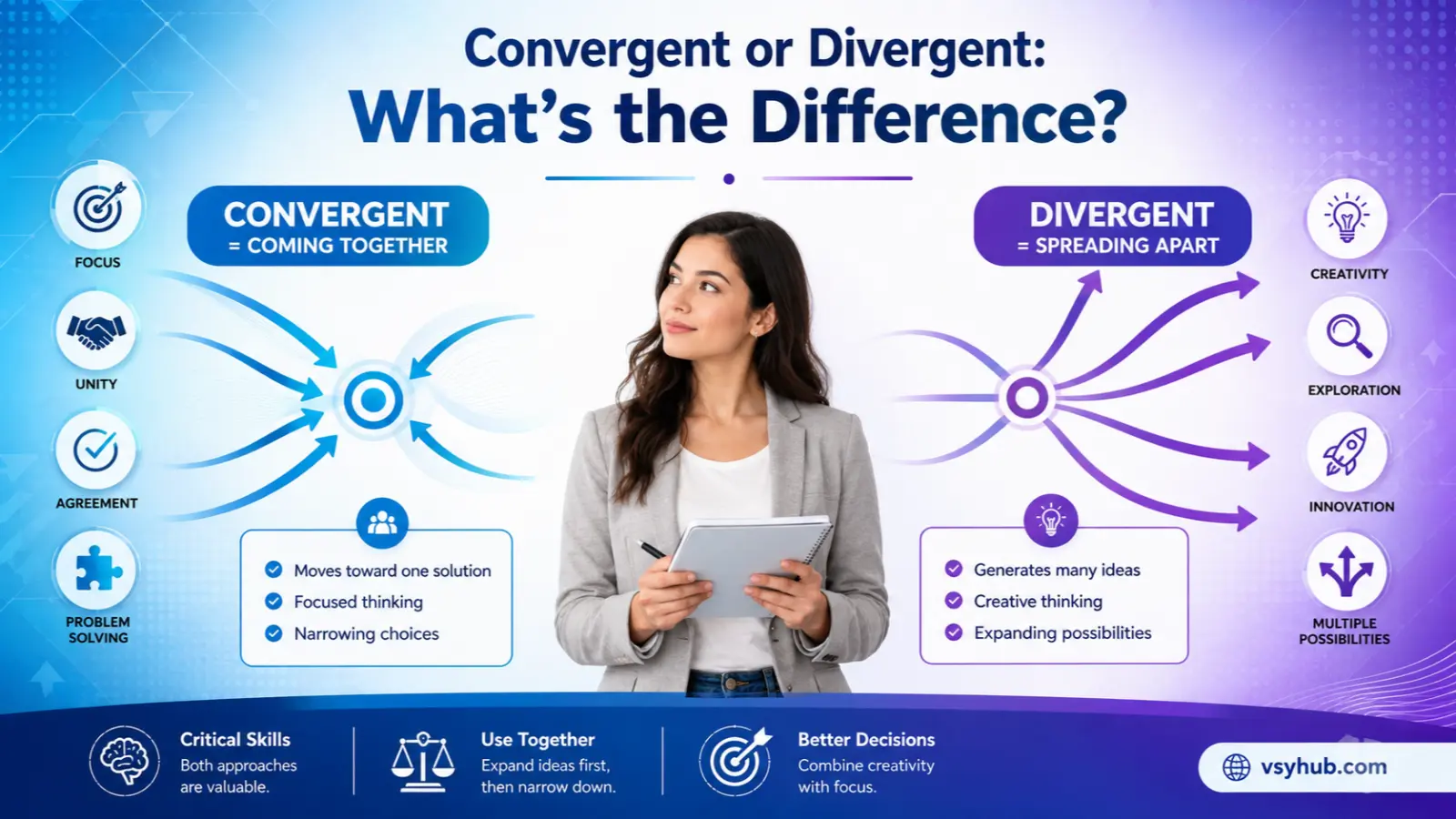
1👉 Convergent = Moving toward one answer, idea, or point.
2 👉 Divergent = Moving away into different ideas, directions, or possibilities.
Examples
The math problem required convergent thinking to find the correct answer.
The brainstorming session encouraged divergent thinking and creativity.
Scientists used a convergent approach to solve the issue.
Artists often rely on divergent thinking to generate new ideas.
The discussion became divergent as people shared different opinions.
Simple Rule
👉 Convergent = Come Together
👉 Divergent = Divide Apart
Easy Memory Trick
Think of the letter C in Convergent as Coming together.
Think of the letter D in Divergent as Different directions.
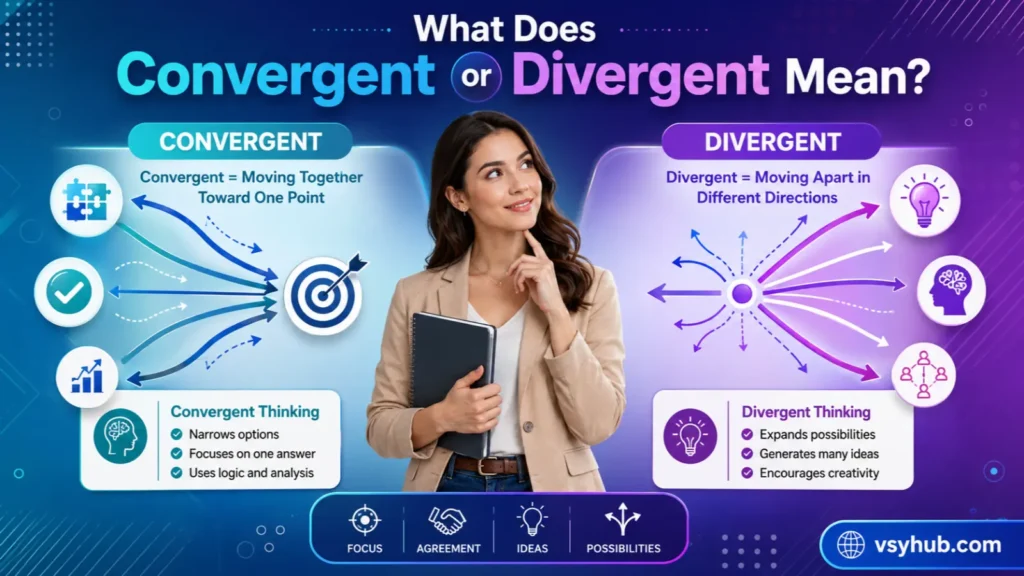
What Does Convergent or Divergent Mean?
Both words describe how things move, develop, or connect.
What Does Convergent Mean?
Convergent refers to things coming together toward a single point, solution, or result.
In psychology and education, convergent thinking means finding the best or most correct answer to a problem.
Example:
“Students used convergent thinking to solve the equation.”
What Does Divergent Mean?
Divergent refers to things spreading apart into different directions, ideas, or possibilities.
In psychology and creativity, divergent thinking means generating multiple ideas and exploring different solutions.
Example:
“The design team used divergent thinking to create innovative products.”
Synonyms
Convergent Synonyms
- Focused
- Unified
- Directed
- Consistent
- Centralized
- Similar
Divergent Synonyms
- Different
- Creative
- Varied
- Diverse
- Separate
- Distinct
Opposites
| Word | Opposite |
|---|---|
| Convergent | Divergent |
| Unified | Separate |
| Focused | Scattered |
| Similar | Different |
Related Terms
- Critical thinking
- Creative thinking
- Brainstorming
- Problem-solving
- Innovation
- Decision-making
- Analytical thinking
- Lateral thinking
Common Variations
- Convergent thinking
- Divergent thinking
- Convergent evolution
- Divergent evolution
- Convergent learning
- Divergent learning
- Convergent questions
- Divergent questions
The Origin of Convergent or Divergent
Both words come from Latin roots.
Convergent
The word comes from the Latin word convergere, which means “to incline together” or “to come together.”
Over time, it became associated with things moving toward a common point.
Divergent
The word comes from the Latin word divergere, meaning “to separate” or “to go different ways.”
It later became commonly used in science, psychology, education, and communication.
Today, both terms are widely used worldwide in schools, businesses, and professional development programs.
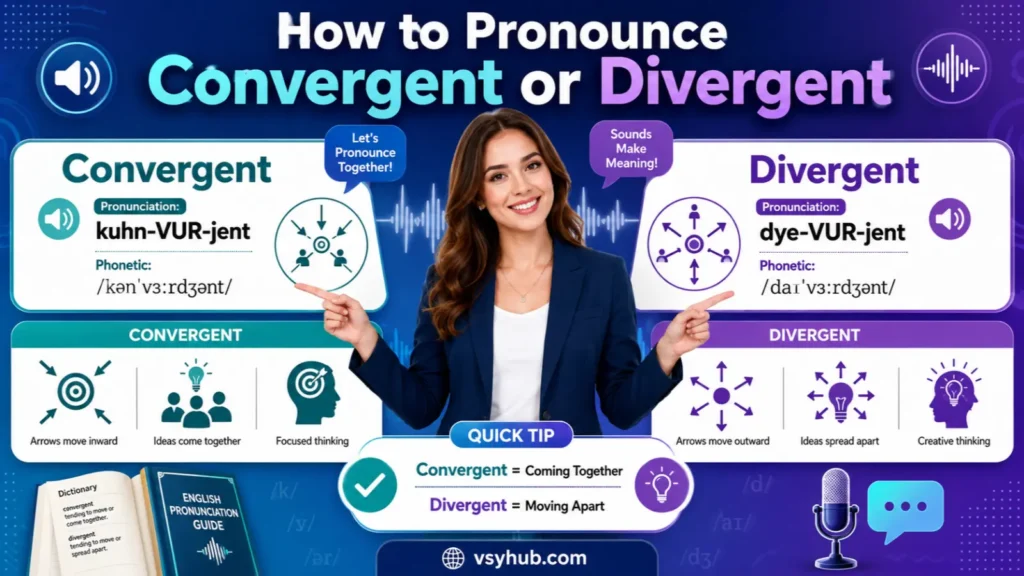
How to Pronounce Convergent or Divergent
Convergent
Phonetic pronunciation:
kuhn-VUR-juhnt
Syllables:
con-ver-gent
Divergent
Phonetic pronunciation:
dye-VUR-juhnt
Syllables:
di-ver-gent
Easy Speaking Trick
Say:
- Con + ver + gent
- Di + ver + gent
Focus on stressing the middle syllable.
Common Pronunciation Mistakes
❌ CON-ver-gent
✅ kuhn-VUR-juhnt
❌ DI-ver-gent
✅ dye-VUR-juhnt
British English vs American English Usage
The meanings remain the same in both regions.
| Feature | British English | American English | Notes |
|---|---|---|---|
| Spelling | Convergent | Convergent | Same |
| Spelling | Divergent | Divergent | Same |
| Meaning | Same | Same | No difference |
| Education Usage | Common | Common | Frequently used |
| Psychology Usage | Common | Common | Widely accepted |
| Pronunciation | Slight accent differences | Slight accent differences | Meaning unchanged |
Which One Should You Use?
Use convergent when talking about:
- One correct answer.
- Focused problem-solving.
- Analytical thinking.
- Decision-making.
- Similar outcomes.
Use divergent when talking about:
- Creativity.
- Brainstorming.
- Multiple ideas.
- Innovation.
- Different viewpoints.
Quick Usage Table
| Situation | Best Word |
|---|---|
| Solving a math problem | Convergent |
| Choosing one answer | Convergent |
| Brainstorming ideas | Divergent |
| Creative writing | Divergent |
| Innovation meetings | Divergent |
| Final decision making | Convergent |
Common Mistakes With Convergent or Divergent
Mistake 1
❌ Brainstorming requires convergent thinking.
✔ Brainstorming usually requires divergent thinking because many ideas are generated.
Mistake 2
❌ Divergent thinking finds one correct answer.
✔ Convergent thinking is used to find one correct answer.
Mistake 3
❌ Convergent and divergent mean the same thing.
✔ They are opposites in many contexts.
Mistake 4
❌ Creative writing is mostly convergent.
✔ Creative writing often uses divergent thinking.
Mistake 5
❌ Exams always test divergent thinking.
✔ Many exams focus heavily on convergent thinking.
Mistake 6
❌ Businesses only need convergent thinking.
✔ Successful businesses use both types.
Mistake 7
❌ One style is better than the other.
✔ Both are useful depending on the situation.
Convergent or Divergent in Everyday Examples
Work
“Our team used divergent thinking to develop marketing ideas.”
“Management used convergent thinking to choose the best strategy.”
School
“The teacher asked a convergent question with one correct answer.”
“The project encouraged divergent thinking and creativity.”
Social Media
“Content creators often use divergent thinking to stand out.”
Daily Life
“When comparing phone plans, you use convergent thinking to make a final choice.”
Emails
“We brainstormed several options before selecting one final solution.”
Text Messages
“Let’s think of different ideas first.”
Online Content
“Creative influencers often use divergent approaches.”
Conversations
“Different opinions made the discussion divergent.”
Convergent or Divergent in Different Contexts
Education
Teachers use both methods.
Convergent questions test knowledge.
Divergent questions encourage exploration and discussion.
Example:
Convergent question:
“What is 2 + 2?”
Divergent question:
“How many ways can we solve this problem?”
Psychology
Psychologists often study convergent and divergent thinking to understand intelligence, creativity, and learning styles.
Convergent thinking supports logical reasoning.
Divergent thinking supports innovation and imagination.
Business
Businesses need both approaches.
Divergent thinking generates ideas.
Convergent thinking selects the best idea.
Example:
A company brainstorms 50 product ideas using divergent thinking and then chooses the top three using convergent thinking.
Workplace Communication
Managers often encourage divergent discussions during planning meetings.
After discussion, teams switch to convergent thinking to make decisions.
Technology
Software developers use divergent thinking when designing new features.
They use convergent thinking when selecting the final design.
Marketing
Marketers rely on divergent thinking to create campaigns.
Convergent thinking helps identify the most effective campaign.
Writing
Authors use divergent thinking when developing story ideas.
Editors use convergent thinking when refining the final version.
Productivity
High-performing individuals often alternate between both thinking styles.
First, explore possibilities.
Then, choose the best option.
Convergent or Divergent – Google Trends & Usage Data
Interest in convergent and divergent thinking has grown because of:
- Online learning.
- Creativity training.
- Business innovation.
- Leadership development.
- Educational psychology.
- Workplace problem-solving.
These terms are frequently searched in:
- United States
- United Kingdom
- India
- Pakistan
- Canada
- Australia
Common related searches include:
- What is convergent thinking?
- What is divergent thinking?
- Convergent vs divergent examples
- Difference between convergent and divergent thinking
- Convergent and divergent questions
- Divergent thinking activities
- Convergent learning examples
- Creative thinking skills
Voice-search users often ask:
- “What is the difference between convergent and divergent thinking?”
- “Is convergent thinking good or bad?”
- “Why is divergent thinking important?”
- “Can a person use both convergent and divergent thinking?”
Comparison Table: Convergent or Divergent
| Feature | Convergent | Divergent |
|---|---|---|
| Meaning | Moves toward one answer | Explores many answers |
| Goal | Best solution | Multiple possibilities |
| Thinking Style | Analytical | Creative |
| Focus | Narrow | Broad |
| Education | Exams and tests | Projects and discussions |
| Workplace | Decision-making | Brainstorming |
| Innovation | Evaluates ideas | Generates ideas |
| Creativity | Lower emphasis | Higher emphasis |
| Common Outcome | One answer | Many ideas |
| Typical Use | Problem-solving | Idea generation |
Convergent or Divergent in Professional Life
Professionals use both thinking styles every day.
Workplace Communication
Convergent thinking helps teams:
- Make decisions.
- Solve technical problems.
- Evaluate options.
Divergent thinking helps teams:
- Develop new products.
- Improve services.
- Discover opportunities.
Business Communication Example
Step 1:
Generate 20 marketing ideas using divergent thinking.
Step 2:
Select the strongest campaign using convergent thinking.
This balance often leads to better business results.
Convergent or Divergent for Students or Beginners
Many beginners struggle because the words sound similar.
Why Students Get Confused
- Both words appear in psychology classes.
- Both end with “-vergent.”
- Both describe thinking processes.
Easy Learning Shortcut
Remember:
Convergent = One Answer
Divergent = Many Answers
Beginner Practice
Ask yourself:
“Am I trying to find one solution or many solutions?”
One solution = Convergent
Many solutions = Divergent
Characteristics or Common Uses Related to Convergent or Divergent
The Signs of Convergent Thinking
- Focus on accuracy.
- Logical reasoning.
- Structured process.
- Decision-making.
- Evaluation of options.
- Fact-based conclusions.
Signs of Divergent Thinking
- Creativity.
- Curiosity.
- Imagination.
- Exploration.
- Flexibility.
- Idea generation.
Industries That Use Both
- Education
- Marketing
- Technology
- Design
- Healthcare
- Engineering
- Business
- Research
Simple Trick to Remember Convergent or Divergent
Memory Rule
Convergent = Come Together
Divergent = Different Directions
Think of it this way:
Imagine roads.
Convergent roads merge into one highway.
Divergent roads split into many routes.
That image makes the difference easy to remember.
Expert Tips Section
Use Both Thinking Styles Together
Many people believe they must choose one style.
In reality, successful problem-solvers use both.
Start With Divergent Thinking
Generate as many ideas as possible.
Avoid judging ideas too early.
Finish With Convergent Thinking
Review your ideas.
Choose the most practical option.
Improve Creativity
Practice brainstorming without limits.
Improve Decision-Making
Practice narrowing choices based on evidence and goals.
Writing Tip
Use divergent thinking for first drafts.
Use convergent thinking for editing and proofreading.
Related Searches People Also Ask
What is convergent thinking?
Convergent thinking focuses on finding one correct answer or solution.
What is divergent thinking?
Divergent thinking generates multiple ideas and possibilities.
Which is more important?
Both are important because they serve different purposes.
Can students use both?
Yes. Most learning activities require both styles.
Is divergent thinking creative?
Yes. It is strongly linked to creativity and innovation.
Is convergent thinking analytical?
Yes. It focuses on logic and accuracy.
Why do employers value divergent thinking?
It helps create new ideas and solve complex problems.
Why is convergent thinking useful?
It helps make decisions and reach conclusions.
Are brainstorming sessions divergent?
Usually yes, because they encourage many ideas.
Are multiple-choice tests convergent?
Usually yes, because there is typically one correct answer.
Can businesses use both approaches?
Absolutely. Successful organizations often combine both.
Is divergent thinking used in design?
Yes. Designers use it to explore creative possibilities.
How do teachers use convergent questions?
They assess understanding and knowledge.
How do teachers use divergent questions?
They encourage discussion and critical thinking.
Can creativity be learned?
Yes. Practicing divergent thinking can improve creativity.
FAQs
Is convergent or divergent correct?
Both are correct words with different meanings.
What is the main difference between convergent and divergent?
Convergent seeks one answer, while divergent explores many possibilities.
Which one is used in creativity?
Divergent thinking is more closely linked to creativity.
Which one is used in exams?
Many exams focus on convergent thinking.
Are convergent and divergent opposites?
In many situations, yes.
Can one person use both?
Yes. Most people naturally use both styles.
Is divergent thinking important at work?
Yes. It helps teams create innovative solutions.
Is convergent thinking important in business?
Yes. It helps organizations make effective decisions.
How can I remember the difference?
Think: Convergent = Come together. Divergent = Different directions.
Which comes first in problem-solving?
Often divergent thinking comes first, followed by convergent thinking.
Final Verdict
The difference between convergent or divergent is simple:
👉 Convergent = One best answer.
👉 Divergent = Many possible answers.
The easiest memory rule is:
Convergent = Come Together
Divergent = Different Directions
If you’re solving a problem and choosing one solution, use convergent thinking. If you’re creating ideas and exploring possibilities, use divergent thinking.
Conclusion
Understanding convergent or divergent can improve learning, creativity, communication, and problem-solving. These two thinking styles are not competitors. Instead, they work best together.
Divergent thinking helps you create possibilities. Convergent thinking helps you choose the best one. Whether you’re a student, teacher, business professional, writer, or creator, using both can help you achieve better results.
One final memory trick: imagine roads. If the roads join together, think convergent. If the roads split into different paths, think divergent.