Have you ever written a sentence like “He’s my brother” or “His my brother” and felt confused? You are not alone.
Many English learners, students, and even native speakers mix up his or he’s because they look similar but mean very different things.
This confusion appears in school writing, texting, social media posts, workplace emails, and daily conversations.
People usually search for: his or he’s meaning, correct usage, grammar difference, examples, pronunciation, and rules.
It can feel small, but using the wrong one can change the meaning of your sentence completely.
In this guide, you’ll learn the meaning, pronunciation, examples, usage, grammar rules, common mistakes, expert tips, and simple explanations in easy English.
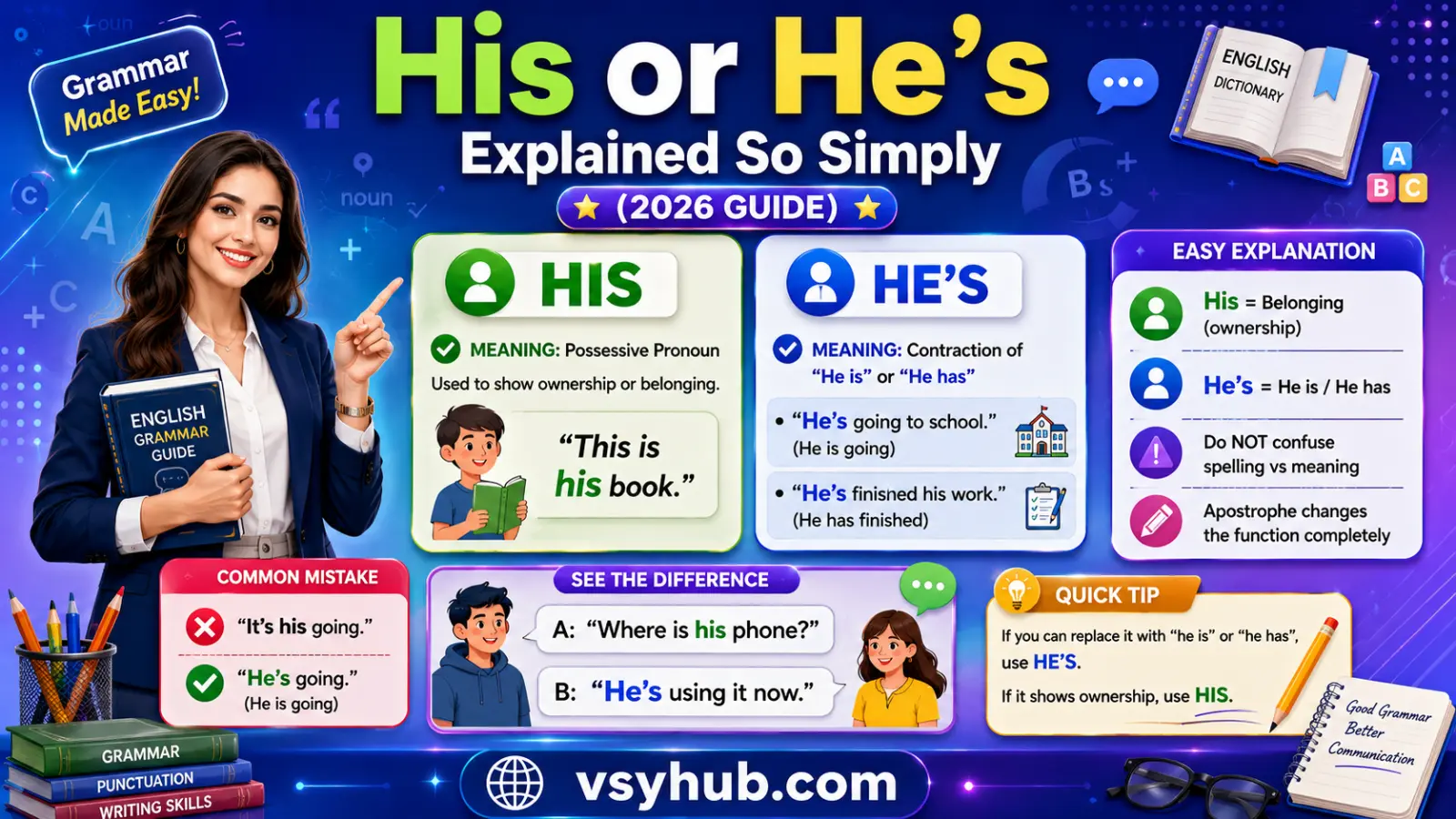
⭐ His or he’s – Quick Answer
👉 His = shows possession (something belongs to a male person)
👉 He’s = short form of “he is” or “he has”
Simple Rule:
👉 If you can replace it with “he is” or “he has”, use he’s
👉 If you are showing ownership, use his
Examples:
- This is his book. ✅ (book belongs to him)
- He’s happy today. ✅ (he is happy)
- He’s finished his work. ✅ (he has finished)
- I like his idea. ✅ (idea belongs to him)
Easy Memory Trick:
👉 His = Possession (ownership)
👉 He’s = He is / He has (action or state)
Think:
“His” has no apostrophe, so nothing is missing. “He’s” has an apostrophe, so letters are missing (is/has).
📖 What Does His or He’s Mean?
Understanding his or he’s becomes easy when you break them down.
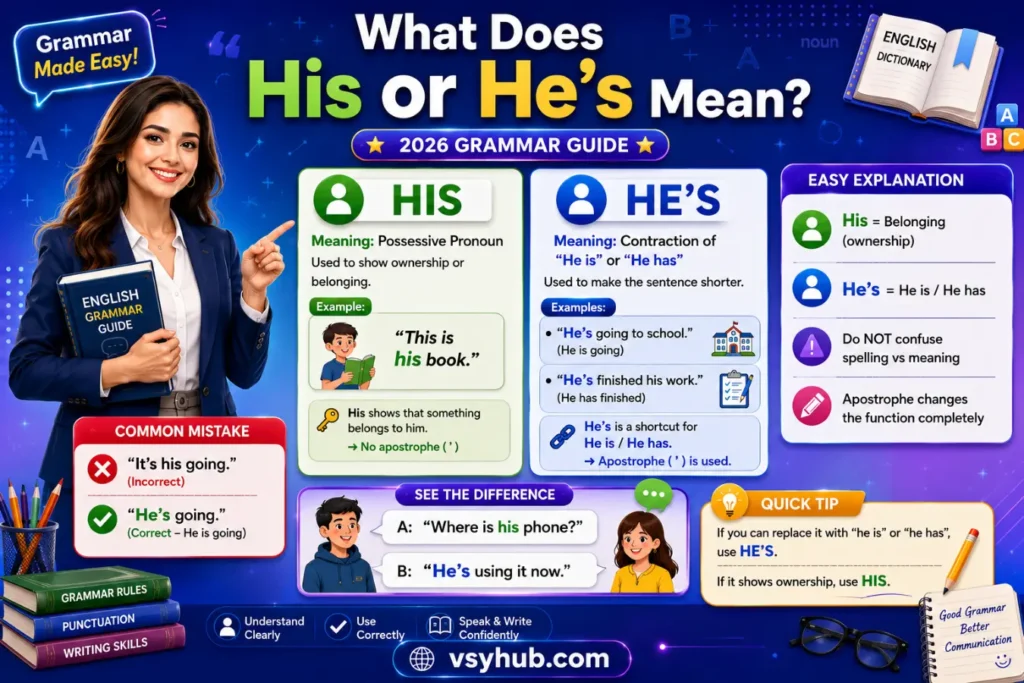
👉 “His” Meaning
“His” is a possessive adjective. It shows that something belongs to a male person or boy.
Example:
- That is his phone.
- I met his sister.
It is used before a noun (book, car, house, idea).
👉 “He’s” Meaning
“He’s” is a contraction (short form).
It means:
- He is
- He has
Example:
- He’s very kind. (He is very kind)
- He’s gone home. (He has gone home)
Synonyms
- His → belonging to him, male possession
- He’s → he is, he has
Related Terms
- Her / She’s
- Its / It’s
- Your / You’re
- Their / They’re
Common Variations
- his (possessive)
- he’s (contraction)
- he is (full form)
- he has (perfect tense form)
🕰️ The Origin of His or He’s
The confusion between his or he’s comes from the evolution of English grammar.
“His”
- Comes from Old English word “his”
- Used for centuries to show ownership
- One of the oldest possessive forms in English
“He’s”
- Developed later as English became faster in writing and speaking
- Apostrophe was introduced to show missing letters
- “He’s” = he is / he has (shortened speech form)
Over time, texting and social media made contractions like “he’s” even more common.
🔊 How to Pronounce His or He’s
Pronunciation:
- His → /hɪz/ → “hiz”
- He’s → /hiːz/ → “heez”
Syllables:
- His → 1 sound
- He’s → 1 sound (but longer vowel)
Easy Speaking Trick:
- “His” sounds short and sharp
- “He’s” sounds smoother and longer
Common Mistake:
Beginners often pronounce both the same, but they are slightly different.
🇬🇧 British English vs American English Usage
Good news: his or he’s is used the same in British and American English.
There is no spelling difference.
| Feature | British English | American English | Notes |
|---|---|---|---|
| His | Same usage | Same usage | Possession |
| He’s | Same usage | Same usage | He is / He has |
| Grammar rule | Identical | Identical | No difference |
| Formal writing | Acceptable | Acceptable | Both correct |
| Spoken English | Very common | Very common | Contractions widely used |
✅ Which One Should You Use?
Here is a simple guide:
Use “His” when:
- Showing ownership
- Talking about something belonging to a male person
Examples:
- His car is new.
- I like his style.
- This is his house.
Use “He’s” when:
- You mean “he is”
- You mean “he has”
Examples:
- He’s tired. (He is tired)
- He’s done the job. (He has done the job)
- He’s my teacher. (He is my teacher)
Quick Usage Table:
| Situation | Use |
|---|---|
| Ownership | his |
| Description | he’s |
| Action (past) | he’s (he has) |
| Identity | he’s |
❌ Common Mistakes with His or He’s
Mistake 1
❌ He’s book is on the table
✔ His book is on the table
👉 “Book” shows possession, so use “his”
Mistake 2
❌ His very happy today
✔ He’s very happy today
👉 You need “he is”
Mistake 3
❌ He’s car is fast
✔ His car is fast
👉 Car belongs to him
Mistake 4
❌ I met he’s brother
✔ I met his brother
👉 “Brother” needs possession word “his”
Mistake 5
❌ His finished homework
✔ He’s finished homework
👉 Missing “has”
Mistake 6
❌ He’s phone is ringing
✔ His phone is ringing
👉 Phone belongs to him
Mistake 7
❌ His going to school
✔ He’s going to school
👉 Needs “is”
🌍 His or He’s in Everyday Examples
Work
- His report is ready.
- He’s attending the meeting.
School
- His teacher is strict.
- He’s studying hard.
Social Media
- He’s trending today.
- I like his post.
Daily Life
- His bike is new.
- He’s at home.
Emails
- His request is approved.
- He’s available tomorrow.
Text Messages
- He’s busy right now.
- That is his number.
Online Content
- His video went viral.
- He’s gaining followers.
Conversations
- He’s my best friend.
- His idea is smart.
🧠 His or He’s in Different Contexts
Grammar Learning
Students often confuse:
- possession (his)
- contraction (he’s)
Example:
- His answer is correct.
- He’s answering the question.
Workplace Communication
Correct usage improves professionalism:
- His performance is strong.
- He’s leading the project.
Social Media Usage
Short forms are common:
- He’s amazing!
- That is his style.
Relationships
- He’s very caring.
- His support means a lot.
Writing
- Academic writing prefers clarity
- “He’s” is fine, but “he is” is more formal
📈 His or He’s – Google Trends & Usage Data
People search his or he’s because:
- They confuse possessive vs contraction
- They want correct grammar for school
- They write essays or exams
- They post on social media
- They learn English as a second language
Popular Countries:
- United States
- United Kingdom
- India
- Pakistan
- Canada
- Australia
Related Searches:
- his vs he’s difference
- when to use his
- he’s meaning
- grammar confusion his he’s
- examples of his and he’s
Voice Search Queries:
- “What is the difference between his and he’s?”
- “When do we use his in a sentence?”
- “Is he’s he is or he has?”
📊 Comparison Table: His or He’s
| Feature | His | He’s |
|---|---|---|
| Correctness | Possessive | Contraction |
| Meaning | Belonging | He is / He has |
| Grammar role | Possessive adjective | Contraction |
| Pronunciation | short “hiz” | long “heez” |
| Formal usage | Very common | Common |
| Academic usage | Required | Sometimes avoided |
| Internet usage | Moderate | Very high |
| Common mistake | Using for “he is” | Using for possession |
💼 His or He’s in Professional Life
Correct grammar matters in business communication.
Examples:
- His report is excellent.
- He’s leading the marketing team.
- His analysis is accurate.
Why it matters:
- Shows professionalism
- Avoids misunderstanding
- Improves writing clarity
- Builds trust in communication
🎓 His or He’s for Students or Beginners
Beginners struggle because:
- Both words sound similar
- Apostrophe is confusing
- English rules feel complicated
Easy trick:
👉 Think “his = belonging”
👉 Think “he’s = he is”
Shortcut:
If you can expand it to:
- he is → use he’s
- he has → use he’s
- ownership → use his
🔍 Signs and Common Uses
- “his” appears before nouns (his book, his car)
- “he’s” appears before verbs or adjectives
- Apostrophe shows missing letters
- Common in texting and speech
- Very frequent in social media posts
🧩 Simple Trick to Remember His or He’s
👉 His = No apostrophe = ownership
👉 He’s = Apostrophe = missing words
Think of it this way:
If something belongs to a boy → his
If something is happening → he’s
Example:
- His phone → belongs to him
- He’s calling → he is calling
🏆 Expert Tips
- Always check if you can replace “he’s” with “he is” or “he has”
- Read your sentence aloud
- Look for possession (belonging words)
- Practice with daily sentences
- Avoid overthinking apostrophes
🌐 Related Searches People Also Ask
- how to use his in a sentence
- what does he’s mean in text
- difference between his and he’s grammar
- is he’s correct grammar
- examples of his vs he’s
- when to use his or he’s
- he’s meaning and usage
- common mistakes with his and he’s
- simple grammar rules for beginners
- English possessive adjectives explained
❓ FAQs
1. What is the difference between his and he’s?
His shows ownership, and he’s means he is or he has.
2. Is he’s always “he is”?
No, it can also mean “he has”.
3. Can I use his for people?
Yes, when something belongs to him.
4. Is he’s formal or informal?
It is informal, but acceptable in writing.
5. Why is his confused with he’s?
Because they sound similar and look close.
6. Can I use he’s in essays?
Yes, but formal essays prefer “he is” or “he has”.
7. What does his mean in grammar?
It is a possessive adjective.
8. Is he’s a contraction?
Yes, it is short for he is or he has.
9. How do I remember his vs he’s?
His = possession, he’s = he is/has.
10. Can his and he’s be used together?
Yes, in one sentence:
He’s holding his phone.
11. What is the easiest rule?
If ownership → his, if action → he’s.
12. Is apostrophe important?
Yes, it changes meaning completely.
🏁 Final Verdict
The difference between his or he’s is simple once you understand it:
👉 His = belonging
👉 He’s = he is / he has
Easiest memory rule:
If you can expand it → use he’s
If you are showing ownership → use his
Just remember:
No apostrophe = possession, Apostrophe = action
✅ Conclusion
Understanding his or he’s helps you write clearer English in school, work, texting, and daily life. The rule is very simple, but powerful. “His” shows ownership, while “he’s” is a shortcut for “he is” or “he has.” Once you practice a few examples, you will never confuse them again.
Final easy trick:
👉 Ownership = his
👉 Action = he’s