When you are writing a text, email, school assignment, or social media post, you may suddenly wonder: too much or to much—which one is correct?
This is a very common beginner English mistake because “too” and “to” sound similar but have different jobs.
People usually search for the keyword meaning, correct spelling, pronunciation, examples, usage, definition, and grammar difference.
In this guide, you’ll learn the meaning, pronunciation, examples, usage, grammar rules, common mistakes, expert tips, and simple explanations in easy English.
Too Much or To Much – Quick Answer
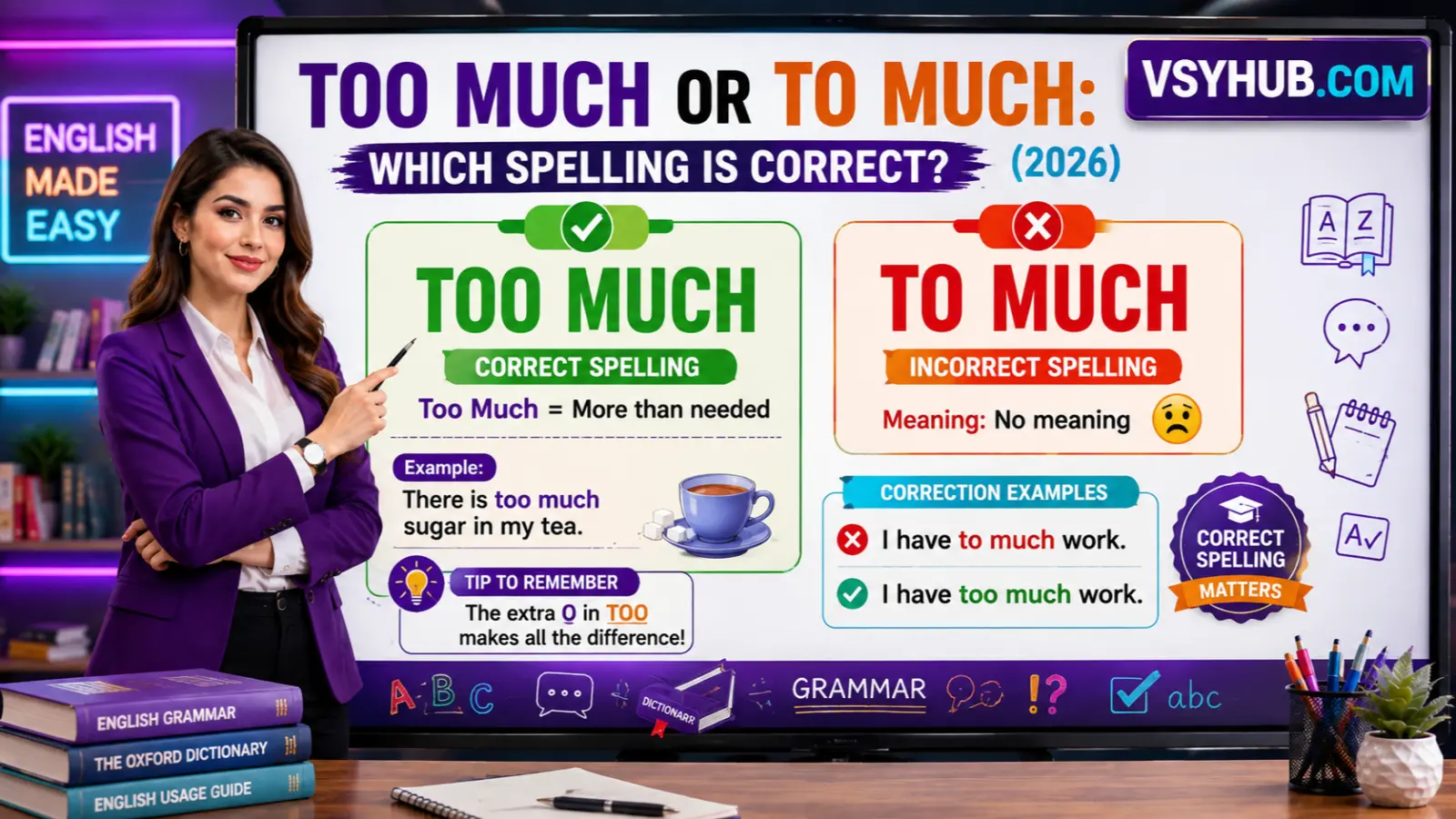
👉 Too much = correct when you mean an excessive amount or more than needed.
👉 To much = usually incorrect when you are trying to say “an excessive amount.”
The correct phrase is too much.
Examples:
- I ate too much food. ✅
- She spends too much money. ✅
- There is too much noise here. ✅
Incorrect:
- I ate to much food. ❌
Simple Rule
👉 Too = more than needed
👉 To = usually shows direction, purpose, or part of an infinitive
Easy memory trick: If you can replace the phrase with “more than enough,” use “too.”
For example:
This coffee is too much for me.
This coffee is more than enough for me.
What Does Too Much or To Much Mean?
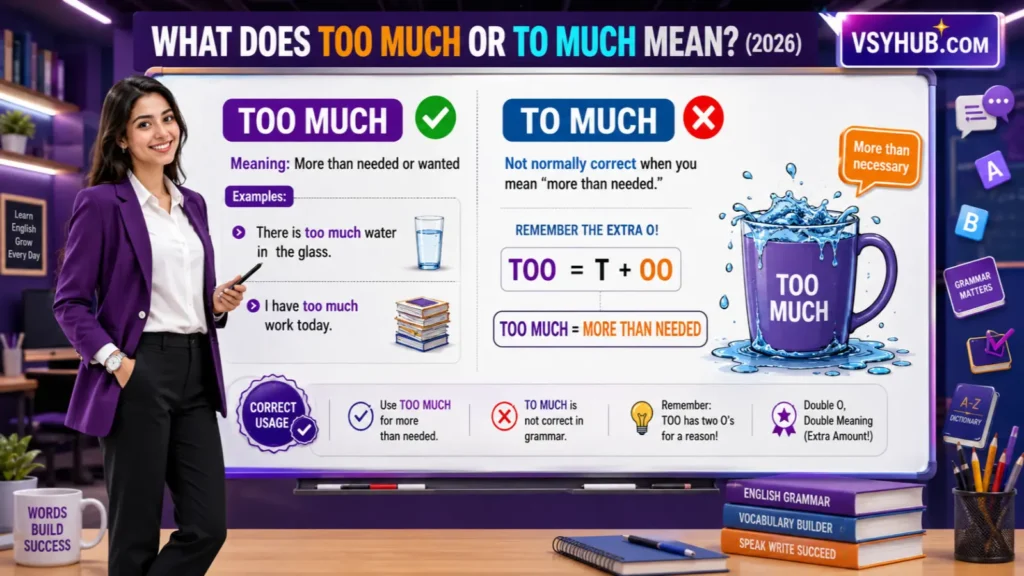
Too much means an amount that is greater than what is wanted, needed, suitable, or comfortable.
The word too adds the idea of excess. It can describe something that has gone beyond a reasonable or desired level.
For example:
- You are talking too much.
- He has too much homework.
- We spent too much time waiting.
- This bag costs too much money.
The phrase to much is generally not correct when expressing excess. It is usually a spelling or grammar mistake caused by confusion between to and too.
Synonyms
Depending on the sentence, synonyms for too much include:
- Excessive
- More than enough
- Overly
- An excessive amount
- More than necessary
Opposites
The opposite idea can be expressed with:
- Too little
- Not enough
- A small amount
- Less than needed
Related Terms
Some related expressions include:
- Too many
- Very much
- So much
- Much too
- Too little
- More than enough
- Not enough
Common Variations
You may see too much used with uncountable nouns:
- too much water
- too much money
- too much time
- too much information
- too much work
For countable plural nouns, use too many:
- too many books
- too many questions
- too many people
The Origin of Too Much or To Much
The two words have different histories.
Too comes from Old English tō, which was used in meanings connected with “also” and “excessively.” Over time, its meaning developed into the modern uses we know today, including the idea of something being excessive.
Much comes from Old English mycel, meaning “great” or “large.” It developed into the modern word much, which is commonly used with uncountable nouns.
To also has Old English roots and has long been used to express direction, movement, purpose, and relationships between words.
The similar pronunciation of to and too is one reason English learners often confuse them in writing.
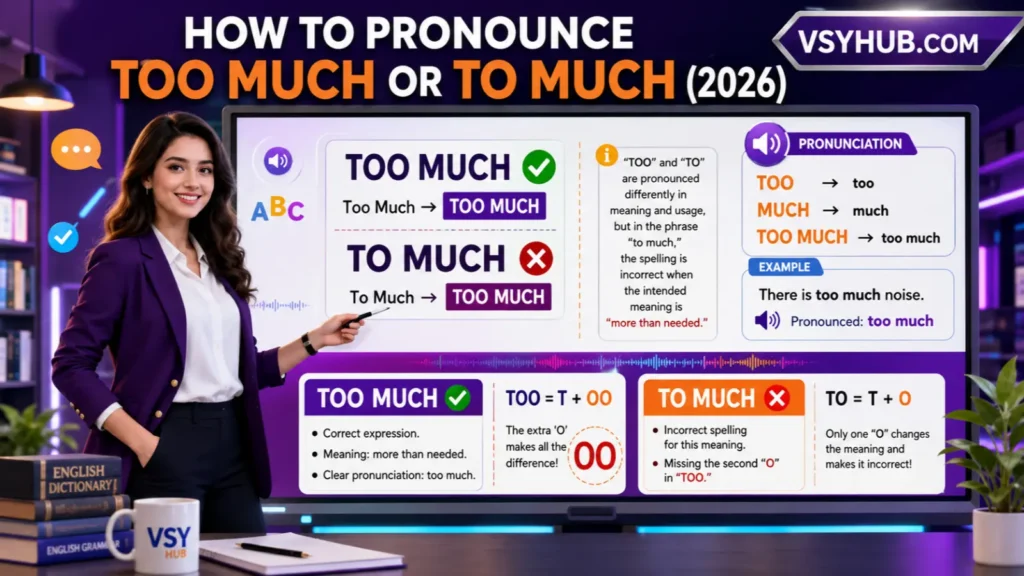
How to Pronounce Too Much or To Much
The correct phrase too much is pronounced:
Too much → /tuː mʌtʃ/
An easy pronunciation guide is:
too much → TOO MUCH
Break it into two parts:
- Too = “too”
- Much = “much”
The first word has a long oo sound, like the sound in food.
The second word sounds like much, rhyming roughly with such.
Common Pronunciation Mistake
Because to and too are pronounced the same in many normal sentences, speakers cannot always hear the spelling difference.
That is why this is mainly a writing and grammar problem, not a pronunciation problem.
British English vs American English Usage
There is no important British-American spelling difference here. Both British English and American English use too much when describing an excessive amount.
| Feature | British English | American English | Notes |
|---|---|---|---|
| Correct phrase | Too much | Too much | Same |
| Incorrect form | To much | To much | Usually incorrect |
| Pronunciation | /tuː mʌtʃ/ | /tuː mʌtʃ/ | Essentially the same |
| Meaning | Excessive amount | Excessive amount | Same |
| Formal writing | Too much | Too much | Correct |
| Texting | Too much | Too much | Correct |
Which One Should You Use?
Use too much when you mean that something is excessive.
Formal writing
- The company spends too much money on unnecessary advertising.
Academic writing
- Excessive screen time may lead to too much reliance on digital tools.
Workplace communication
- We have too much work to finish today.
Texting
- You worry too much 😂
Social media
- This song has too much energy!
The phrase to much should normally be corrected to too much when you mean “more than necessary.”
Common Mistakes With Too Much or To Much
Mistake 1
❌ I have to much homework.
✔ I have too much homework.
The sentence means the amount of homework is excessive, so too is required.
Mistake 2
❌ She talks to much.
✔ She talks too much.
Here, too much describes an excessive amount of talking.
Mistake 3
❌ There is to much water in the glass.
✔ There is too much water in the glass.
Water is an uncountable noun, so too much is appropriate.
Mistake 4
❌ This phone costs to much.
✔ This phone costs too much.
The meaning is that the phone is more expensive than desired.
Mistake 5
❌ You eat to much sugar.
✔ You eat too much sugar.
The word too shows an excessive amount.
Mistake 6
❌ I spend to much time online.
✔ I spend too much time online.
Use too because the amount of time is excessive.
Mistake 7
❌ There are too much people here.
✔ There are too many people here.
This mistake is slightly different. People is countable, so use too many, not too much.
Too Much or To Much in Everyday Examples
Work
“We have too much work to complete before Friday.”
School
“I have too much homework tonight.”
Social Media
“I spend too much time scrolling through social media.”
Daily Life
“I bought too much food for the party.”
Emails
“Thank you so much. I hope I have not taken too much of your time.”
Text Messages
“I think I ate too much pizza.”
Online Content
“Some websites contain too much information on one page.”
Conversations
“You are thinking too much about this problem.”
Too Much or To Much in Different Contexts
Grammar Learning
For English learners, too much is an important phrase because it teaches the difference between to and too.
Remember:
Too much time = an excessive amount of time.
Business
Businesses may use too much when discussing costs, resources, time, or effort.
For example:
The project is taking too much time.
Education
Students commonly use the phrase when talking about homework, studying, information, or school pressure.
We have too much homework this week.
Relationships
The phrase can describe excessive attention, communication, worry, or emotion.
You worry too much about what people think.
Social Media
People frequently use too much in casual posts and comments.
This video has too much drama.
Too Much – Google Trends and Usage Data
The search phrase “too much or to much” is popular because to and too sound alike in everyday speech. Learners often know what they want to say but become unsure when writing it.
Searches may come from people looking for:
- too much or to much grammar
- too much meaning
- is too much correct
- to much vs too much
- too much examples
- how to use too much
- too much pronunciation
- why is too much spelled with two o’s
This confusion can appear in searches from the US, UK, India, Pakistan, Canada, and Australia, especially among English learners.
Voice searches also commonly take forms such as:
“Is it too much or to much?”
“How do you spell too much?”
“What is the difference between to and too?”
Comparison Table: Too Much or To Much
| Feature | Too Much | To Much |
|---|---|---|
| Correctness | ✅ Correct | ❌ Usually incorrect |
| Meaning | Excessive amount | No intended standard meaning in this use |
| Pronunciation | /tuː mʌtʃ/ | Often pronounced the same |
| Grammar role | Excess + quantity | Incorrect in this context |
| Professional usage | Correct | Avoid |
| Academic usage | Correct | Avoid |
| Internet usage | Common | Usually a typo |
| Common mistake | Confusing it with “to” | Confusing it with “too” |
Too Much in Professional Life
Correct grammar can make workplace communication clearer and more professional.
Consider the difference:
❌ “The project requires to much time.”
✔ “The project requires too much time.”
The second sentence immediately communicates the intended meaning.
You may use too much when discussing:
- time
- money
- work
- effort
- information
- resources
- communication
- pressure
- responsibility
For example:
“We are spending too much money on this campaign.”
Too Much for Students or Beginners
Beginners often struggle because to, too, and two sound similar.
A simple way to separate them is:
To → direction or infinitive
“I want to learn.”
Too → excessive or also
“It is too difficult.”
“I want to come too.”
Two → the number 2
“I have two books.”
Beginner Shortcut
If your sentence means “more than needed,” choose too.
too much
too many
too expensive
too difficult
too fast
Common Uses of Too Much
You will commonly see too much before uncountable nouns:
- too much water
- too much coffee
- too much money
- too much noise
- too much work
- too much information
- too much pressure
- too much time
You can also use it after verbs:
- worry too much
- talk too much
- eat too much
- spend too much
- work too much
- think too much
Simple Trick to Remember Too Much
Think of too as a warning sign.
When something goes beyond the amount you want, use too.
Think of it this way:
Too = extra
1 If you have too much food, you have more food than you need.
2 If you have too much work, you have more work than you can comfortably handle.
3 If you spend too much money, you spend more money than you should.
Memory Shortcut
Too = more than enough.
To = direction or purpose.
That simple difference can prevent many common spelling mistakes.
Expert Tips
Experienced writers do not rely only on how words sound. They look at the meaning and grammatical role of the word.
Before writing to much, ask yourself:
“Am I talking about an excessive amount?”
If the answer is yes, write too much.
Also remember the related pattern:
Uncountable noun → too much
Countable plural noun → too many
Examples:
- too much water
- too much time
- too many books
- too many people
Reading your sentence aloud can help you understand the meaning, but it will not always reveal the spelling because to and too can sound identical.
Related Searches People Also Ask
Is “too much” grammatically correct?
Yes. Too much is grammatically correct when you mean an excessive amount or more than needed.
Is it “too much” or “to much”?
The correct phrase is too much when describing an excessive amount.
Why do people write “to much”?
People often write to much because to and too sound alike in normal speech.
What does “too much” mean?
It means more than is wanted, needed, suitable, or comfortable.
Can I say “too much money”?
Yes. Money is uncountable, so too much money is correct.
Is “too much” formal English?
Yes. It is normal English and can be used in casual, academic, and professional writing.
What is the difference between “too much” and “too many”?
Use too much with uncountable nouns and too many with countable plural nouns.
How can I remember “too much”?
Remember: too = more than enough. If something is excessive, use too.
FAQs
Is “to much” ever correct?
The exact sequence “to much” can appear in unusual grammatical structures where to belongs to another part of the sentence, but it is not the correct replacement for too much meaning “excessive.”
Is “too much” one word?
No. Too much is written as two separate words.
Is “too much” used with countable nouns?
Usually no. For plural countable nouns, use too many, such as “too many cars.”
How do you pronounce “too much”?
It is pronounced approximately TOO MUCH, with /tuː/ for “too” and /mʌtʃ/ for “much.”
What is an example of “too much”?
“I spent too much money on that jacket.”
Is “too much” correct in an email?
Yes. It is completely acceptable in professional emails when the meaning fits the sentence.
What is the easiest way to remember too and to?
Think too = extra. If you mean “more than needed,” use too.
Final Verdict
Too much is the correct spelling when you mean more than enough, excessive, or more than needed.
❌ To much is normally incorrect for this meaning.
The easiest rule is:
👉 Too = more than enough.
👉 To = direction, purpose, or infinitive.
Conclusion
The difference between too much or to much may look tiny, but choosing the right word makes your English clearer and more accurate. Too much is the correct phrase when you are talking about an excessive amount, such as too much time, too much money, too much work, or too much food.
The best memory trick is simple: too means extra. If something is more than you need or want, choose too. Once you connect too with the idea of “more than enough,” this common English mistake becomes much easier to avoid.

Mk Azam is a Master’s graduate, content writer, and contributor at VsyHub.com. He enjoys creating clear, engaging, and informative content across a variety of topics. With a strong focus on accuracy and readability, he helps readers find practical insights and easy-to-understand information. His goal is to deliver valuable content that informs, educates, and inspires.