Have you ever typed ment instead of meant and wondered if it was correct?
Many people face this confusion while writing school assignments, work emails, social media posts, text messages, or online comments.
People usually search for meant or ment meaning, correct spelling, pronunciation, examples, usage, definition, and grammar difference because both words sound almost the same.
In this guide, you’ll learn the meaning, pronunciation, examples, usage, grammar rules, common mistakes, expert tips, and simple explanations in easy English.
Meant or Ment – Quick Answer
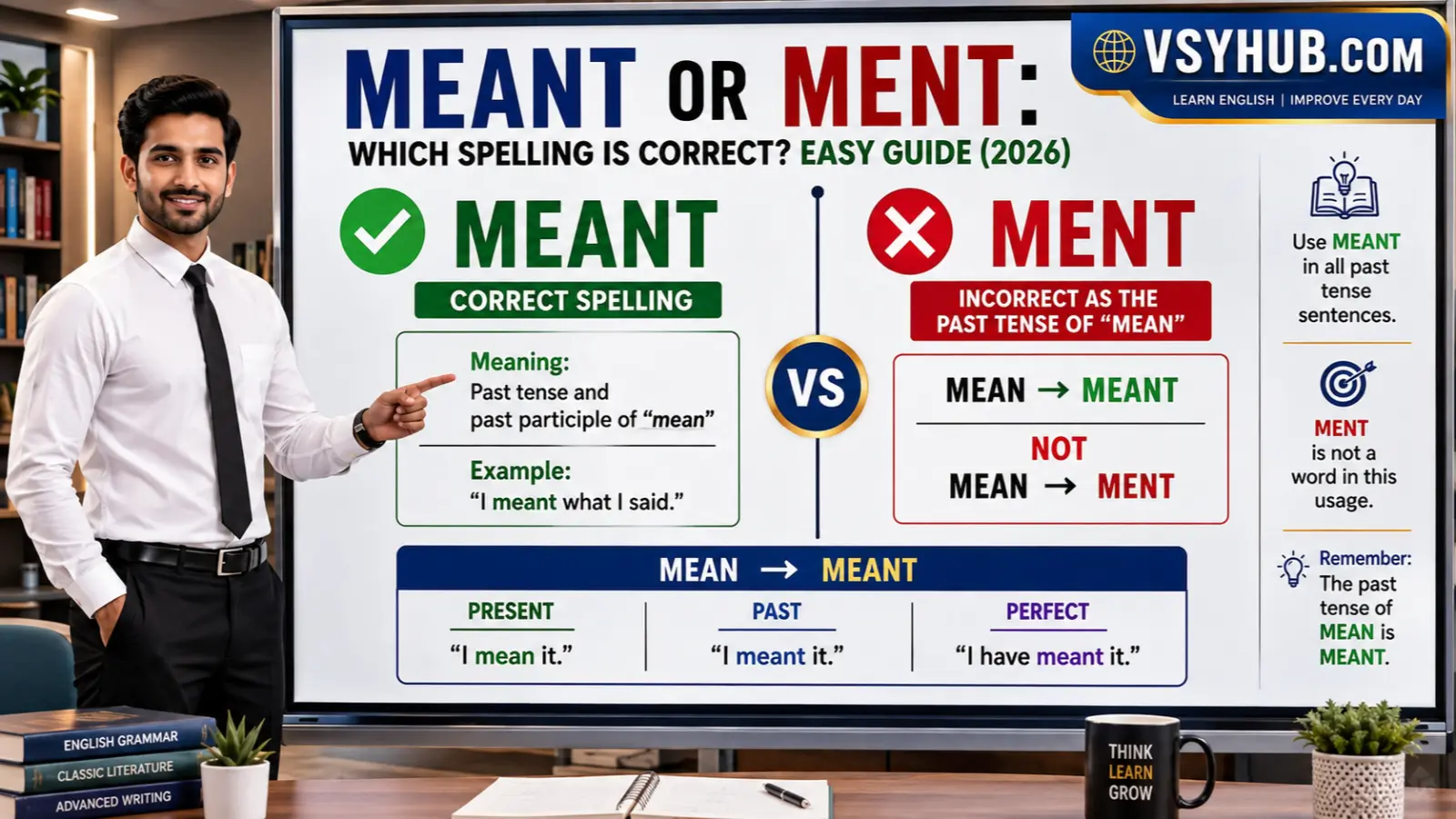
👉 Meant = The correct past tense and past participle of “mean.”
👉 Ment = An incorrect spelling in standard English.
If you want to say someone intended something or wanted to express an idea, always use meant.
Examples
✅ I meant to call you yesterday.
✅ What did you mean by that?
❌ I ment to call you yesterday.
Simple Rule
Think of “meant” as the past form of “mean.” If you’re talking about something someone intended, the correct spelling is always meant.
What Does Meant Mean?
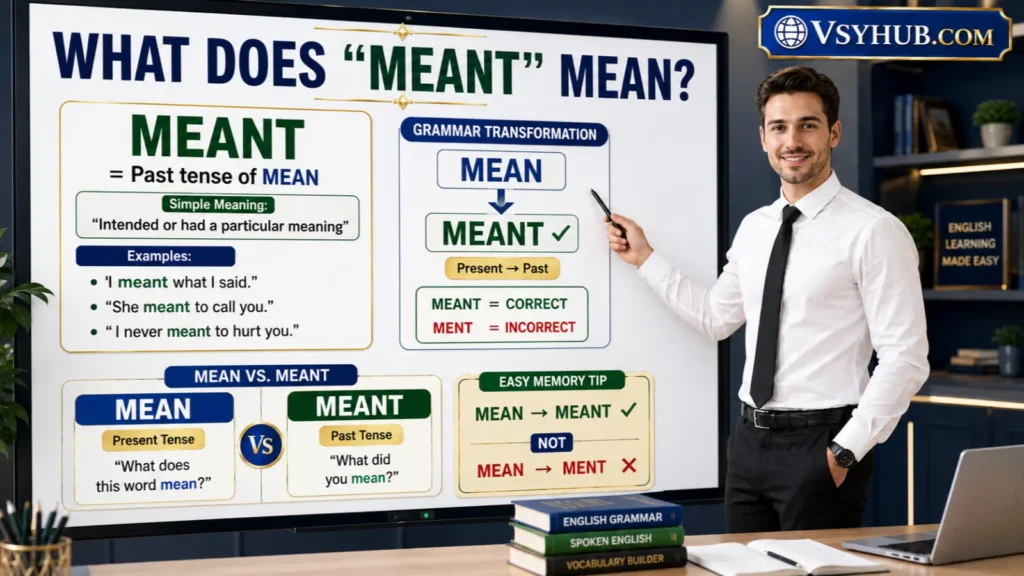
The word meant is the past tense and past participle of the verb mean.
It describes something that someone intended, planned, expressed, or wanted to communicate.
Beginner Explanation
When you say meant, you’re talking about an intention or a message from the past.
Example:
“I meant no harm.”
This means the speaker did not intend to hurt anyone.
Practical Meaning
People use meant every day when talking about:
- Intentions
- Explanations
- Feelings
- Plans
- Communication
Professional Meaning
In workplaces, meant is often used to explain decisions, instructions, or expectations.
Example:
“The manager meant the deadline was final.”
Synonyms
- Intended
- Planned
- Expressed
- Signified
- Referred to
Opposites
- Ignored
- Misunderstood
- Avoided
- Withheld
Related Terms
- Mean
- Meaning
- Meaningful
- Meantime
- Intention
Common Variations
- Mean
- Means
- Meaning
- Meant
- Meaningful
The Origin of Meant
The word meant comes from the Old English word mǣnan, which meant “to intend” or “to signify.”
Over hundreds of years, English spelling changed, but meant remained the accepted past tense of mean.
Because English pronunciation does not always match spelling, many learners mistakenly write ment instead of meant.
How to Pronounce Meant
Phonetic pronunciation:
meant → ment
It has one syllable.
Easy Speaking Trick
Say the word “sent.”
Now replace the s with m.
You get meant.
Common Pronunciation Mistakes
People usually pronounce meant correctly but spell it incorrectly because the sound does not clearly reveal the letters ea.
British English vs American English Usage
| Feature | British English | American English | Notes |
|---|---|---|---|
| Correct spelling | Meant | Meant | Same spelling |
| Incorrect spelling | Ment | Ment | Incorrect everywhere |
| Pronunciation | Almost identical | Almost identical | Minor accent differences |
| Grammar | Same | Same | No difference |
Both British and American English use meant as the correct spelling.
Which One Should You Use?
Always choose meant.
Use it in:
- Academic writing
- School assignments
- Business emails
- Professional reports
- Social media posts
- Text messages
- Daily conversations
Avoid ment because it is considered a spelling mistake.
Quick Usage Table
| Situation | Correct Choice |
|---|---|
| School | Meant |
| Workplace | Meant |
| Business | Meant |
| Social media | Meant |
| Texting | Meant |
| Formal writing | Meant |
Common Mistakes With Meant or Ment
Mistake 1
❌ I ment to help.
✔ I meant to help.
Why?
People spell the word exactly as it sounds.
Mistake 2
❌ What you ment was funny.
✔ What you meant was funny.
Tip:
Remember that mean becomes meant.
Mistake 3
❌ She ment no offense.
✔ She meant no offense.
Why?
Many English words have silent letters.
Mistake 4
❌ He ment every word.
✔ He meant every word.
Tip:
Practice common irregular verbs.
Mistake 5
❌ They ment well.
✔ They meant well.
Why?
Fast typing often causes spelling errors.
Mistake 6
❌ I really ment it.
✔ I really meant it.
Tip:
Always proofread before sending messages.
Meant in Everyday Examples
Work
“I meant to send the report this morning.”
School
“The teacher meant the homework was due tomorrow.”
Social Media
“I never meant to offend anyone.”
Daily Life
“I meant to buy milk.”
“I meant to reply earlier. Sorry for the delay.”
Text Message
“I meant what I said.”
Online Content
“The article meant to explain grammar simply.”
Conversation
“What exactly did you mean?”
Meant in Different Contexts
Education
Teachers use meant to explain intentions and meanings in reading and writing lessons.
Example:
“The author meant to inspire readers.”
Business
Managers often clarify instructions using meant.
Example:
“I meant the updated policy.”
Writing
Writers use meant when describing characters’ intentions.
Example:
“She meant to protect her family.”
Communication
People use meant to explain misunderstandings.
Example:
“I didn’t mean that. I meant something else.”
Social Media
Users often apologize by saying:
“I never meant to upset anyone.”
Grammar Learning
Students learn that meant is an irregular verb form.
Understanding this helps improve spelling accuracy.
Meant or Ment – Google Trends & Usage Data
Many people search meant or ment because pronunciation makes both spellings sound similar.
Common searches include:
- Is ment a word?
- How do you spell meant?
- Meant meaning
- Meant pronunciation
- Meant examples
- Mean past tense
- Difference between meant and ment
This spelling question is especially common among learners in the United States, United Kingdom, India, Pakistan, Canada, and Australia.
Voice searches often include:
- “How do you spell meant?”
- “Is ment correct?”
- “What is the past tense of mean?”
Comparison Table: Meant or Ment
| Feature | Meant | Ment |
|---|---|---|
| Correct spelling | Yes | No |
| Dictionary word | Yes | No (standard English) |
| Meaning | Past tense of mean | Misspelling |
| Pronunciation | Ment | Ment |
| Academic writing | Correct | Incorrect |
| Workplace writing | Correct | Incorrect |
| Social media | Correct | Often seen as typo |
| Grammar | Correct | Incorrect |
| Common mistake | Rare | Very common |
Meant in Professional Life
Correct spelling builds trust.
Whether you’re writing:
- Emails
- Reports
- Presentations
- Job applications
- Business proposals
Using meant instead of ment shows professionalism.
Example:
“I meant to attach the updated file.”
Meant for Students or Beginners
Many beginners struggle because English pronunciation can be confusing.
Easy Learning Tips
- Learn irregular verbs.
- Read more English books.
- Practice writing complete sentences.
- Use spell-check tools.
- Review your work before submitting it.
Signs, Characteristics, or Common Uses Related to Meant
People usually use meant when talking about:
- Past intentions
- Explanations
- Clarifications
- Feelings
- Communication
- Instructions
- Personal goals
- Apologies
- Written messages
- Professional discussions
Simple Trick to Remember Meant
Easy Memory Rule
Mean → Meant
Think of it this way:
If you already know:
- Dream → Dreamt (British usage)
- Build → Built
Then simply remember:
Mean → Meant
Even though you hear ment, the correct spelling always includes ea.
Expert Tips
Many writers overlook these simple tricks.
Read Your Sentence Aloud
If you’re talking about a past intention, meant is almost certainly correct.
Learn Verb Families
Practice:
- Mean → Meant
- Teach → Taught
- Think → Thought
Learning similar verb patterns improves spelling.
Use Digital Proofreading
Most grammar tools will instantly highlight ment as a spelling mistake.
Read More English
Regular reading helps your brain recognize correct spelling naturally.
Related Searches People Also Ask
Is ment a real English word?
In standard English, ment is not accepted as the correct spelling of the past tense of mean.
Why is meant spelled with “ea”?
English spelling developed over centuries, so pronunciation and spelling do not always match.
What is the past tense of mean?
The past tense of mean is meant.
Why do people write ment?
Because meant is pronounced like ment, many learners spell it by sound.
How do you remember meant?
Think of the pattern mean → meant and remember the silent ea.
Can I use ment in an essay?
No. Always write meant in academic work.
Is meant used in everyday English?
Yes. Native speakers use it daily in conversations and writing.
Is meant formal or informal?
It works in both formal and informal situations.
Does spell-check catch ment?
Most modern writing tools recognize ment as a spelling mistake.
Is meant difficult to learn?
Not once you understand it is the irregular past tense of mean.
FAQs
Is meant the correct spelling?
Yes. Meant is always correct in standard English.
Is ment ever correct?
No. It is considered a spelling mistake.
How do you pronounce meant?
It is pronounced ment.
What does meant mean?
It refers to something someone intended or wanted to express.
Why do people confuse meant and ment?
Both sound the same when spoken.
Can I use meant in business writing?
Yes. It is correct for all professional communication.
Is meant an irregular verb?
Yes. It is the irregular past tense of mean.
What is the easiest way to remember meant?
Remember: Mean becomes meant.
Final Verdict
The answer is simple.
Meant is the correct spelling.
Ment is an incorrect spelling in standard English.
The easiest memory trick is:
Mean → Meant
Whenever you talk about a past intention, always choose meant.
Conclusion
The confusion between meant or ment is very common because both sound alike. However, only meant is correct in standard English. Whether you’re writing for school, work, social media, or daily conversations, using the right spelling makes your writing clearer and more professional. Keep practicing, read carefully, and remember this simple trick: if it’s the past tense of “mean,” it’s always “meant.”

Mk Azam is a Master’s graduate, content writer, and contributor at VsyHub.com. He enjoys creating clear, engaging, and informative content across a variety of topics. With a strong focus on accuracy and readability, he helps readers find practical insights and easy-to-understand information. His goal is to deliver valuable content that informs, educates, and inspires.