Have you ever stopped while writing a message, school assignment, email, or social media post because you weren’t sure whether to use lies or lays? You’re not alone.
These two words look almost the same, but they have different meanings and grammar rules. Many English learners, students, writers, and even native speakers mix them up because they come from two different verbs.
People usually search for: lies or lays meaning, correct usage, pronunciation, examples, definition, grammar difference, when to use lies or lays, and common mistakes.
Understanding the difference helps you write more clearly and speak with confidence in everyday conversations, school, work, and online.
In this guide, you’ll learn the meaning, pronunciation, examples, usage, grammar rules, common mistakes, expert tips, and simple explanations in easy English.
Lies or Lays – Quick Answer
If you want a fast answer, here it is:
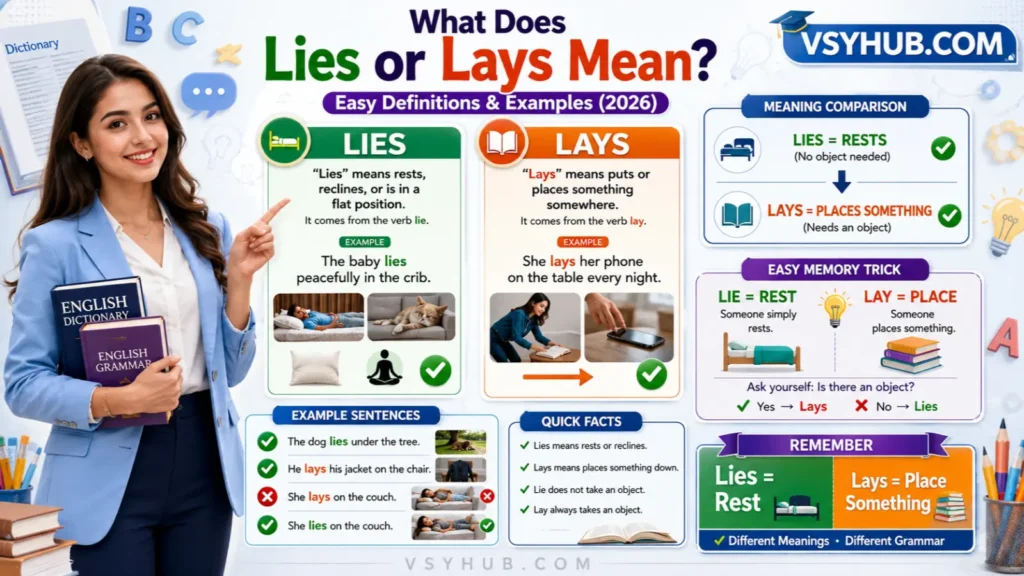
👉 Lies = Comes from the verb lie, which means to rest, recline, or be in a flat position.
👉 Lays = Comes from the verb lay, which means to put or place something somewhere.
The biggest difference is simple:
- Lie does not take a direct object.
- Lay always needs an object because you place something.
Examples
1. ✅ The cat lies on the sofa every afternoon.
2. ✅ My phone lies on the table.
3. ✅ She lays the books on the desk before class.
4. ✅ He lays fresh flowers on his grandmother’s grave every Sunday.
5. ✅ The chef lays the vegetables on a large tray before cooking.
Simple Rule
Lie = Rest.
Lay = Place something.
Easy Memory Trick
Think about the word place.
Both lay and place involve moving something.
If nothing is being placed, lie is usually the correct choice.
What Does Lies or Lays Mean?
Although these words are often confused, they belong to different verbs and describe different actions.
What Does “Lies” Mean?
Lies is the third-person singular form of the verb lie.
It means:
- To rest on a surface.
- To be in a certain position.
- To remain located somewhere.
Examples:
- The baby lies peacefully in the crib.
- The village lies between two rivers.
- His backpack lies near the classroom door.
“Lies” can also refer to someone telling something that is not true, but that comes from another verb, to lie meaning to tell an untruth.
Example:
- He lies to his parents.
Because English has two different verbs spelled lie, beginners often become confused.
What Does “Lays” Mean?
Lays is the third-person singular form of lay.
It means to:
- Put something somewhere.
- Place an object carefully.
- Set something down.
Examples:
- She lays her keys on the kitchen counter.
- The teacher lays the worksheets on every desk.
- The farmer lays fresh straw inside the barn.
Unlike lies, lays always involves an object.
Ask yourself:
What is being placed?
If you can answer that question, lays is probably correct.
Synonyms
Lies (Rest)
- Rests
- Reclines
- Sleeps
- Remains
- Stays
- Sits (in some contexts)
Lays (Places)
- Places
- Puts
- Sets
- Positions
- Arranges
- Deposits
Opposites
Lies
- Stands
- Rises
- Gets up
- Moves
Lays
- Picks up
- Removes
- Lifts
- Takes away
Related Terms
Understanding these related words makes the grammar easier.
- Lie
- Lay
- Lain
- Laid
- Lying
- Laying
- Rest
- Place
- Position
- Recline
Common Variations
People often search for similar grammar questions, including:
- Lie vs lay
- Laying vs lying
- Lie, lay, lain
- Lay, laid, laid
- Is it lies or lays?
- Does it lie or lay there?
- Lying on the bed or laying on the bed?
Learning these forms together helps you avoid future mistakes.
The Origin of Lies or Lays
The confusion between lies and lays has existed for hundreds of years because English inherited these words from Old English.
The verb lie, meaning “to rest,” comes from the Old English word licgan, which meant to recline or remain in a resting position.
The verb lay, meaning “to place,” comes from the Old English word lecgan, which meant to put something down.
Over time, English pronunciation changed, but both words stayed very similar in spelling. Because their past forms are also different, many learners continue to confuse them today.
Here is another reason people struggle:
| Verb | Present | Past | Past Participle | Present Participle |
|---|---|---|---|---|
| Lie (rest) | Lie | Lay | Lain | Lying |
| Lay (place) | Lay | Laid | Laid | Laying |
Notice something tricky?
The past tense of “lie” is “lay.”
That is one of the biggest reasons English learners become confused.

How to Pronounce Lies or Lays
Fortunately, both words are easy to pronounce.
Lies
Phonetic pronunciation:
lyz
It rhymes with:
- eyes
- flies
- skies
Say it like:
“lyz.”
Lays
Phonetic pronunciation:
layz
It rhymes with:
- days
- plays
- stays
Say it like:
“layz.”
Syllables
| Word | Syllables |
|---|---|
| Lies | 1 |
| Lays | 1 |
Easy Speaking Trick
Imagine these sentences:
“The dog lies down.”
“The mother lays the baby in the crib.”
Repeat them several times.
Soon, your brain will naturally connect:
- lies = resting
- lays = placing
Common Pronunciation Mistakes
Many learners accidentally pronounce lies like lease or lays like less.
Remember:
- Lies sounds like eyes.
- Lays sounds like days.
Speaking them correctly also helps you remember their meanings.
British English vs American English Usage
Good news! There is no spelling difference between British English and American English for lies and lays.
The grammar rules stay exactly the same in both versions of English.
| Feature | British English | American English | Notes |
|---|---|---|---|
| Spelling | Lies / Lays | Lies / Lays | Same spelling |
| Pronunciation | Nearly identical | Nearly identical | Minor accent differences only |
| Grammar | Same | Same | Same grammar rules |
| Everyday Usage | Same | Same | Used worldwide |
| Formal Writing | Same | Same | Accepted everywhere |
| School English | Same | Same | Standard grammar |
Whether you’re writing in the UK, the US, Canada, Australia, India, Pakistan, or anywhere else, the rule never changes:
- Lies = rests.
- Lays = places.
The next part will cover:
- Which One Should You Use?
- Common Mistakes (7 detailed examples)
- Everyday Examples
- Lies or Lays in Different Contexts
- Professional Writing
- Students & Beginners
- and more.
Lies or Lays in Professional Life
Using lies and lays correctly may seem like a small detail, but it can make your writing look more professional. Whether you’re writing emails, reports, blog posts, or business documents, correct grammar helps readers understand your message and builds trust.
Workplace Communication
In offices and businesses, clear writing is important. Using the wrong word can confuse readers.
Correct examples:
- The report lies on the manager’s desk.
- She lays the contract on the conference table.
- The company’s success lies in excellent customer service.
- He lays all the project files in one shared folder.
Professional Writing
Editors, teachers, and employers often notice grammar mistakes. Choosing the correct word shows attention to detail.
| Situation | Correct Usage |
|---|---|
| Business email | The invoice lies in the attached folder. |
| Office meeting | She lays the printed agenda on every chair. |
| Report writing | The solution lies in better planning. |
| Presentation | He lays the charts on the table before speaking. |
Branding and Marketing
Businesses also use these words in advertising and website content.
Examples:
- Our strength lies in quality customer support.
- The designer lays out the webpage before publishing it.
- Success lies in understanding your audience.
- The company lays a strong foundation for future growth.
Lies or Lays for Students or Beginners
Many students struggle with these words because they look similar but follow different grammar rules.
Why Beginners Get Confused
- The words sound similar.
- The past tense of lie is lay, which is confusing.
- Both words are common in everyday English.
- Many people hear them used incorrectly in casual speech.
Easy Learning Tips
- Remember that lie means rest.
- Remember that lay means put.
- Ask yourself, “Is something being placed?”
- Read example sentences every day.
- Practice using both words in your own writing.
Beginner Shortcut
If you can replace the word with put, use lay or lays.
If you can replace it with rest, use lie or lies.
Example:
“The book lies on the shelf.”
The book is resting.
“The librarian lays the book on the shelf.”
Someone places it there.
Signs, Characteristics, or Common Uses Related to Lies or Lays
Here are the most common situations where these words appear.
Common Uses of “Lies”
- Describing location.
- Talking about resting.
- Explaining where something is.
- Figurative expressions.
- Geography.
Examples:
- The answer lies in careful research.
- The town lies near the coast.
- The cat lies under the table.
Common Uses of “Lays”
- Placing objects.
- Organizing materials.
- Preparing food.
- Setting tables.
- Arranging items.
Examples:
- She lays the plates on the table.
- He lays his jacket on the chair.
- The gardener lays fresh soil around the plants.
Common Writing Situations
You’ll often see these words in:
- School essays.
- Business reports.
- Books.
- Newspapers.
- News websites.
- Blogs.
- Social media captions.
- Instruction manuals.
Simple Trick to Remember Lies or Lays
Here’s one of the easiest memory tricks.
Memory Rule
Lie = Rest.
Lay = Place.
Now remember this sentence:
People lie. People lay things.
If there is an object being moved or placed, use lay.
If nothing is being placed, use lie.
Think of It This Way
Imagine a pillow.
The pillow lies on the bed.
You lay the pillow on the bed.
The pillow rests by itself.
You perform the action of placing it.
That simple picture can help you remember the difference forever.
Expert Tips
Professional editors use a few simple tricks to avoid confusing lies and lays.
Tip 1: Look for an Object
Ask yourself:
“What is being placed?”
If you can answer that question, use lay.
Tip 2: Replace the Word
Replace it with another simple verb.
If rest works, choose lie.
If put works, choose lay.
Tip 3: Read the Sentence Aloud
Reading aloud often makes grammar mistakes easier to hear.
Tip 4: Learn the Verb Forms Together
Instead of memorizing one word, learn the complete verb forms.
Lie – Lay – Lain – Lying
Lay – Laid – Laid – Laying
Tip 5: Practice with Daily Sentences
Write five new sentences every day.
Small daily practice improves grammar much faster than memorizing rules.
Related Searches People Also Ask
Many people search for questions related to lies or lays. Here are some common ones with simple answers.
Is it “lies” or “lays” on the table?
Use lies if the object is already resting.
What is the difference between lie and lay?
Lie means to rest. Lay means to place something.
Why is “lay” the past tense of “lie”?
English developed over hundreds of years, and many old verbs changed differently. This is one reason learners find these words confusing.
Is “laying in bed” correct?
Usually, no.
If you’re resting, say lying in bed.
How do I remember lie and lay?
Think:
Lie = Rest
Lay = Place
What are the past forms?
Lie → Lay → Lain
Lay → Laid → Laid
Are lies and lays pronounced differently?
Yes.
Lies rhymes with eyes.
Lays rhymes with days.
Is “lies” always about telling something false?
No.
It can also mean resting or being located somewhere.
Can “lays” be used without an object?
Usually no.
It normally needs something that is being placed.
Which word appears more often?
Lies is slightly more common because it has multiple meanings, including resting and telling an untruth.
Frequently Asked Questions
Is “lies” grammatically correct?
Yes. It is correct when someone or something rests, remains, or is located somewhere.
Is “lays” grammatically correct?
Yes. It is correct when someone places something.
Which is easier to remember?
Think:
Lie = Rest
Lay = Put
Is “the book lays on the desk” correct?
No.
Correct:
The book lies on the desk.
Can people lie on a bed?
Yes.
People lie on beds.
Can someone lay on a bed?
Only when referring to the past tense of lie, such as:
“He lay on the bed yesterday.”
Is this mistake common?
Yes. Even native English speakers sometimes confuse these verbs.
Do schools teach this grammar?
Yes. It is a common topic in English grammar lessons.
Does British English use different rules?
No. British and American English use the same grammar rules.
How can I stop making this mistake?
Practice replacing the word with rest or put before writing.
Final Verdict
So, which word should you use?
Use lies when someone or something is resting, remaining, or located somewhere.
Use lays when someone places or puts something somewhere.
The easiest rule is:
- Lie = Rest
- Lay = Place
If you remember that one sentence, you’ll avoid this common grammar mistake in most situations.
Conclusion
Understanding the difference between lies and lays is easier than it first appears. Although the words look alike, they describe different actions. Lies means to rest or remain in a place, while lays means to put or place something somewhere. Once you learn this simple rule and practice with real-life examples, choosing the correct word becomes much more natural.
Whenever you’re unsure, ask yourself one question: “Is something being placed?” If the answer is yes, use lays. If not, lies is usually the right choice. With regular practice, you’ll write and speak English more confidently in school, at work, and in everyday conversations.

Aria Foster is a comparison and language writer who specializes in spelling differences, word meanings, grammar guides, and easy-to-understand language explanations. She creates clear, reader-friendly content that helps people understand commonly confused words and expressions.