Have you ever typed bitting when you actually meant biting? You’re not alone. Many students, writers, professionals, and English learners become confused because both words look similar, but they have very different meanings.
People usually search for bitting or biting meaning, correct spelling, pronunciation, examples, usage, definition, and grammar difference when writing school assignments, work emails, social media posts, or everyday messages.
Knowing the correct word helps you write clearly and avoid embarrassing mistakes. In this guide, you’ll learn the meaning, pronunciation, examples, usage, grammar rules, common mistakes, expert tips, and simple explanations in easy English.
Bitting or Biting – Quick Answer
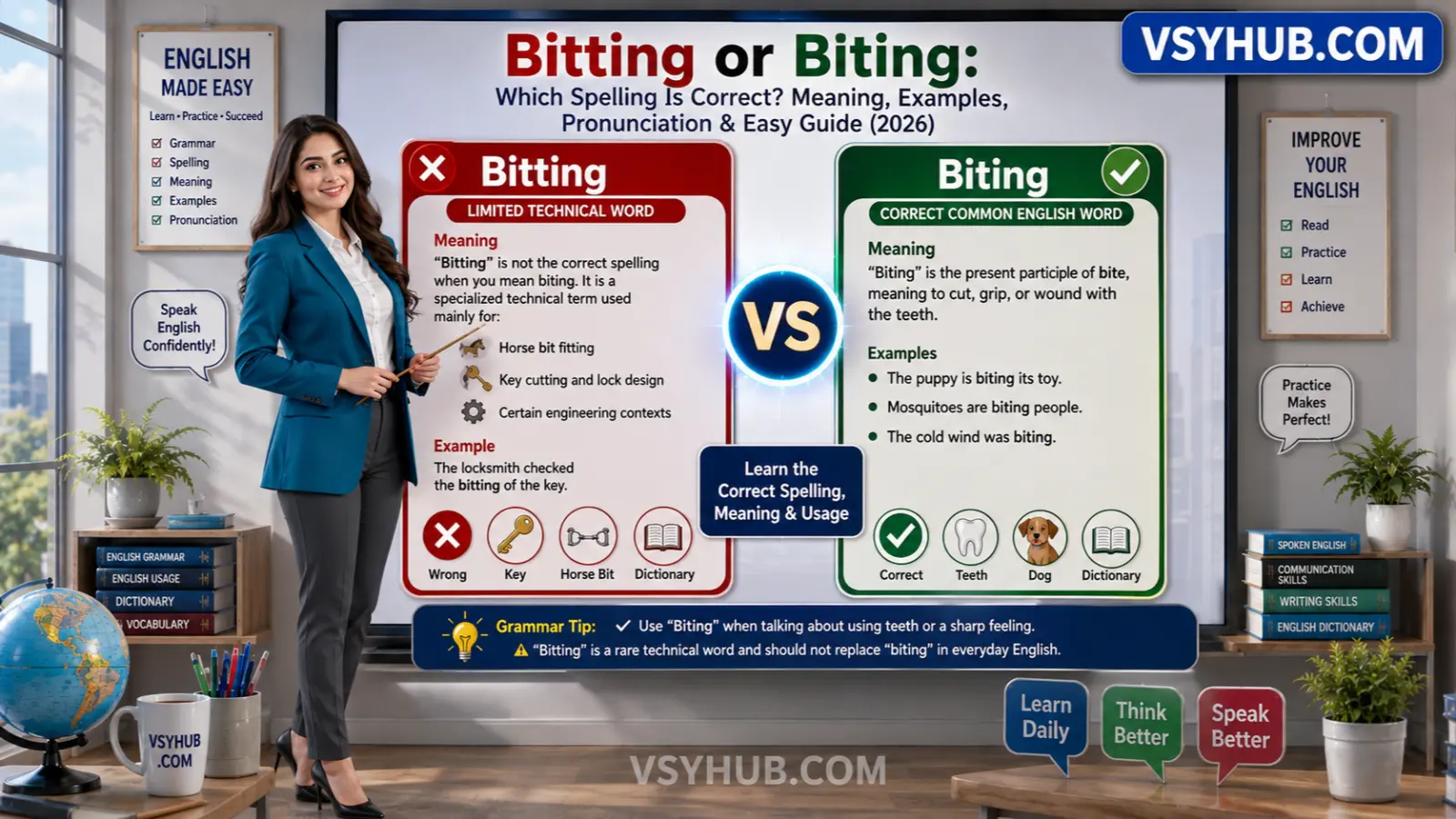
The words bitting and biting are both real English words, but they are not interchangeable. In most everyday writing, biting is the correct word people need.
👉 Biting = The present participle of bite, meaning to cut, grip, or wound with the teeth. It can also describe something sharp, harsh, or very cold.
👉 Bitting = A technical word related to a bit, especially the metal piece placed in a horse’s mouth or the process of fitting or using a bit. It is mostly used in horse riding, engineering, and a few specialized industries.
Examples
The puppy is biting its toy.
Mosquitoes keep biting us every evening.
Her biting comments hurt his feelings.
The horse trainer checked the bitting before the competition.
Proper bitting helps the horse respond comfortably to the rider.
Simple Rule
Use biting whenever you’re talking about teeth, insects, animals, people, pain, cold weather, or harsh words.
Use bitting only when discussing horse equipment or other technical subjects involving a bit.
Easy Memory Trick
Think of it this way:
- Bite → Biting = Uses teeth.
- Bit → Bitting = Uses a horse’s bit or technical equipment.
If teeth are involved, the answer is almost always biting.

What Does Bitting or Biting Mean?
Although these two words differ by only one letter, they belong to different ideas and are used in different situations.
What Does Biting Mean?
Biting comes from the verb bite. It describes the action of using teeth to cut, hold, or injure something. It can also describe words, weather, humor, or criticism that feel sharp or hurtful.
People often use biting in daily conversations, books, news articles, schools, workplaces, and online content.
Examples:
- The dog is biting the stick.
- Stop biting your nails.
- The wind was biting all morning.
- She gave a biting reply during the meeting.
- The insect keeps biting my arm.
What Does Bitting Mean?
Bitting refers to the selection, fitting, adjustment, or use of a bit, especially the metal mouthpiece used to control a horse while riding.
Outside horse riding, the word can occasionally appear in technical fields where a bit is a component of machinery or equipment. However, this use is uncommon for most English learners.
Examples:
- The rider discussed the horse’s bitting with the trainer.
- Proper bitting can improve communication between horse and rider.
- The instructor explained different bitting options for young horses.
Emotional and Practical Meaning
Understanding the difference matters because using the wrong word can completely change the meaning of your sentence.
Imagine writing:
The puppy is bitting my shoe.
Native English speakers would immediately notice something is wrong because puppies bite things—they do not perform bitting.
Likewise, writing:
The trainer adjusted the horse’s biting.
would sound incorrect because horse trainers adjust the bitting or the bit, not the action of biting.
Synonyms of Biting
- Chewing
- Gnawing
- Nipping
- Chomping
- Clamping
- Piercing
- Sharp
- Cutting
- Harsh
- Severe
Synonyms of Bitting
- Bit fitting
- Bit adjustment
- Bridle fitting
- Horse tack setup
- Bit selection
Opposites of Biting
- Releasing
- Letting go
- Healing
- Comforting
- Gentle
- Soft
Opposites of Bitting
There is no direct opposite, but related ideas include:
- Removing the bit
- Bitless riding
- Bit-free control
Related Terms
These words often appear with biting or bitting:
- Bite
- Bit
- Teeth
- Horse
- Bridle
- Saddle
- Rider
- Animal behavior
- Dog bite
- Insect bite
- Frost
- Sharp criticism
- Horse training
- Equestrian equipment
- Mouthpiece
Common Variations
You may see these forms in writing:
- Bite
- Bites
- Bit
- Bitten
- Biting
- Horse bit
- Bitless bridle
- Bitted horse
- Bitting system
The Origin of Bitting or Biting
Although the words look alike, they developed from different English roots.
Origin of Biting
The word biting comes from the Old English verb bītan, meaning “to bite or cut with the teeth.” This word has existed for more than one thousand years and has remained common throughout the history of English.
Over time, people also began using biting in a figurative sense.
For example:
- Biting cold means extremely cold.
- Biting criticism means harsh or hurtful criticism.
- Biting humor means very sharp or sarcastic humor.
Today, biting is one of the most frequently used forms of the verb bite.
Origin of Bitting
The word bitting developed from the noun bit, referring to the metal mouthpiece placed in a horse’s mouth.
Horse riding has been important for transportation, farming, sports, and military history for thousands of years. As horse training became more advanced, English speakers created terms such as bitting, bitted, and bitless to describe different riding methods and equipment.
Today, bitting is mostly used by:
- Horse trainers
- Riders
- Veterinarians
- Equestrian coaches
- Horse equipment manufacturers
Outside these fields, the average English speaker rarely uses this word.

How to Pronounce Bitting or Biting
Correct pronunciation helps you sound more confident in conversations and presentations.
Biting
Phonetic pronunciation:
BYE-ting
IPA: /ˈbaɪ.tɪŋ/
There are two syllables:
Bite + ing
Say it slowly:
“Bye” + “ting”
Examples:
- The dog is biting the toy.
- The cold wind feels biting today.
Bitting
Phonetic pronunciation:
BIT-ing
IPA: /ˈbɪt.ɪŋ/
There are also two syllables:
Bit + ting
Say it slowly:
“Bit” + “ting”
Examples:
- The trainer explained proper bitting.
- Good bitting improves horse control.
Common Pronunciation Mistakes
Many learners accidentally pronounce biting like bitting because the spellings look similar.
Remember:
- Biting has the long “I” sound, like bike or time.
- Bitting has the short “I” sound, like sit or big.
Easy Speaking Trick
Imagine saying these two familiar words:
- Biting → Sounds like “buy thing.”
- Bitting → Sounds like “bit thing.”
Repeating them slowly a few times will make the difference much easier to hear and remember.
British English vs American English Usage
The good news is that there is no spelling difference between British English and American English for biting or bitting. Both varieties of English use the same spellings and meanings.
| Feature | British English | American English | Notes |
|---|---|---|---|
| Spelling of biting | Biting | Biting | Identical in both varieties |
| Spelling of bitting | Bitting | Bitting | Identical but rarely used outside equestrian fields |
| Pronunciation | Nearly the same | Nearly the same | Accent may vary slightly |
| Everyday Usage | Biting is common | Biting is common | Used in daily speech and writing |
| Technical Usage | Bitting in horse riding | Bitting in horse riding | Mostly used by equestrian professionals |
| Academic Writing | Biting appears frequently | Biting appears frequently | Bitting appears only in specialized topics |
Which One Should You Use?
In almost every everyday situation, biting is the correct choice. It is the word used in schools, workplaces, emails, conversations, books, websites, and social media whenever you are talking about the action of biting or describing something sharp or harsh.
Choose biting when:
- Talking about people or animals using their teeth.
- Describing insect bites.
- Referring to freezing weather.
- Describing harsh criticism or sharp humor.
- Writing school assignments or professional documents.
- Posting on social media or sending text messages.
Choose bitting only when:
- Discussing horse riding or equestrian sports.
- Talking about selecting or adjusting a horse’s bit.
- Writing technical content related to horse equipment.
- Referring to specialized mechanical uses of a bit.
Quick Usage Table
| Situation | Correct Word |
|---|---|
| A dog using its teeth | Biting |
| A mosquito attacking someone | Biting |
| Very cold weather | Biting |
| Harsh criticism | Biting |
| Horse bit adjustment | Bitting |
| Equestrian training | Bitting |
| School essay | Usually Biting |
| Social media caption | Usually Biting |
In simple words, if you’re writing about everyday life, the correct word is almost always biting. Reserve bitting for horse-related or highly specialized technical discussions.
Common Mistakes With Bitting or Biting
Because bitting and biting look almost the same, many English learners accidentally use the wrong word. Here are the most common mistakes and how to avoid them.
Mistake 1: Using bitting Instead of biting
❌ Incorrect: The puppy is bitting my hand.
✔ Correct: The puppy is biting my hand.
Explanation: A puppy uses its teeth to bite, so the correct form is biting.
Beginner Tip: If teeth are involved, choose biting.
Mistake 2: Using biting When Talking About Horse Equipment
❌ Incorrect: The trainer discussed the horse’s biting.
✔ Correct: The trainer discussed the horse’s bitting.
Explanation: Horse trainers talk about bitting, which refers to the bit or how it fits the horse.
Beginner Tip: If the topic is horse riding, remember bit → bitting.
Mistake 3: Thinking Bitting Is a Misspelling
❌ Incorrect: “Bitting isn’t a real English word.”
✔ Correct: Bitting is a real word, but it is used mainly in equestrian and technical fields.
Explanation: The word exists, but it is much less common than biting.
Beginner Tip: Rare doesn’t mean incorrect.
Mistake 4: Confusing Pronunciation
❌ Incorrect: Pronouncing biting like bitting.
✔ Correct:
- Biting = BYE-ting
- Bitting = BIT-ing
Explanation: One has a long “I” sound, while the other has a short “I” sound.
Beginner Tip: Say the words slowly until the sounds become natural.
Mistake 5: Using Bitting in School Essays
❌ Incorrect: The child was bitting his pencil.
✔ Correct: The child was biting his pencil.
Explanation: This sentence describes using teeth, so biting is correct.
Mistake 6: Assuming Both Words Mean the Same Thing
❌ Incorrect: “Bitting and biting are interchangeable.”
✔ Correct: They have different meanings and are used in different situations.
Explanation: Similar spelling does not always mean similar meaning.
Mistake 7: Ignoring Context
❌ Incorrect: Choosing a word just because it looks right.
✔ Correct: Always read the entire sentence before deciding.
Explanation: The surrounding words usually tell you which spelling fits best.
Bitting or Biting in Everyday Examples
Real-life examples make the difference much easier to understand.
At Work
- The report received biting criticism from the manager.
- The trainer explained proper bitting techniques during the equestrian workshop.
- Customers disliked the writer’s biting review.
- The horse specialist recommended changing the bitting.
At School
- The dog was biting the classroom toy.
- Our teacher explained why mosquitoes keep biting people.
- The science book mentioned animal biting behavior.
- Students in an agriculture class learned about horse bitting.
On Social Media
- “My puppy won’t stop biting everything!”
- “That comedian has a biting sense of humor.”
- “Today’s weather is absolutely biting.”
- “Learning about horse bitting today at the riding club.”
In Daily Life
- Stop biting your fingernails.
- The cat keeps biting the blanket.
- The cold wind felt biting this morning.
- The instructor adjusted the horse’s bitting before the ride.
In Emails
Correct
Please be careful because the new puppy is still biting visitors.
Correct
We will discuss different bitting options during tomorrow’s horse training session.
Text Messages
- “My little brother keeps biting his lip.”
- “The mosquitoes are biting again!”
- “The trainer changed the horse’s bitting today.”
Online Content
- “How to stop a puppy from biting.”
- “Best bitting options for beginner riders.”
- “Why is my kitten biting my fingers?”
- “Understanding horse bitting systems.”
In Conversations
Friend 1: Why is your dog chewing the chair?
Friend 2: He’s still biting everything because he’s teething.
Another conversation:
Rider: We changed the horse’s bitting.
Coach: Good choice. It should make riding more comfortable.
Bitting or Biting in Different Contexts
In Grammar and English Learning
For grammar students, biting is much more important because it is the present participle of the verb bite.
Examples:
- The baby is biting the spoon.
- The snake is biting its prey.
Meanwhile, bitting is considered a specialized vocabulary word and is rarely taught in general English classes.
In Education
Teachers usually introduce biting while teaching verbs and verb forms.
Students often learn:
- Bite
- Bites
- Bit
- Bitten
- Biting
Only students studying agriculture, veterinary science, or equestrian subjects are likely to encounter bitting.
In Business Communication
Business writing rarely uses bitting unless the company works with horses or riding equipment.
However, biting may appear in expressions like:
- Biting criticism
- Biting remarks
- Biting market competition
Example:
The article contained biting comments about the company’s customer service.
In Workplace Communication
Managers may describe feedback as:
- Constructive criticism
- Honest criticism
- Biting criticism
Example:
His biting email upset several team members.
In Animal Care
This is one of the most common contexts for biting.
Examples include:
- Dog biting
- Cat biting
- Snake biting
- Puppy biting
- Insect biting
These phrases appear in veterinary clinics, pet care guides, and animal behavior articles.
In Horse Riding
This is where bitting is most common.
Topics include:
- Horse bitting
- Correct bitting
- Bit selection
- Bit fitting
- Rider communication
- Horse comfort
Professionals carefully choose the correct bitting for each horse to improve safety and comfort.
In Psychology
The word biting can describe emotional behavior.
Examples:
- Biting sarcasm
- Biting humor
- Biting comments
These phrases describe words that emotionally hurt someone.
In Relationships
People sometimes use biting to describe communication styles.
Example:
Her biting words made him feel disappointed.
This meaning is emotional rather than physical.
In Technology
The word biting occasionally appears in cybersecurity or software discussions as part of metaphors.
Example:
The company faced biting criticism after the data breach.
The word bitting is rarely used in technology except when discussing drill bits or specialized equipment.
In Marketing
Advertisers sometimes use expressions like:
- Biting satire
- Biting humor
- Biting reviews
These expressions suggest strong emotional impact that grabs attention.
In Media and Journalism
Journalists often write:
- Biting editorial
- Biting political cartoon
- Biting commentary
- Biting analysis
Here, biting means sharp, direct, and sometimes critical.
In Everyday Writing
Most writers only need biting.
Examples include:
- The child is biting his sandwich.
- The cold air is biting my face.
- The comedian delivered biting jokes.
Unless your topic involves horse equipment, bitting will rarely appear in everyday writing.
Bitting or Biting – Google Trends & Usage Data
Search interest for bitting or biting continues to grow because English learners want to avoid spelling mistakes and improve their writing. Many people are surprised to discover that bitting is actually a real word, even though biting is far more common.
The popularity of this keyword is driven by students, bloggers, teachers, content writers, and professionals who want clear grammar guidance.
People usually search for questions like:
- Is it bitting or biting?
- Is bitting a real word?
- What does biting mean?
- How do you pronounce biting?
- What is the difference between bitting and biting?
- When should I use bitting?
- Is biting correct in English?
- How do I remember the difference?
Why People Search This Keyword
The confusion happens because:
- Both words are correctly spelled.
- They look almost identical.
- One is common, while the other is highly specialized.
- Spell checkers may not explain the difference.
- English learners often assume only one word is correct.
Search Popularity Around the World
The keyword is frequently searched in:
- United States – Students, pet owners, and writers search for the grammar difference.
- United Kingdom – Interest comes from both English learners and the horse-riding community.
- India – Competitive exam students often search for spelling and usage.
- Pakistan – Learners look for simple grammar explanations and pronunciation.
- Canada – Teachers and students search for everyday examples.
- Australia – Horse riding is popular, so both biting and bitting receive searches.
Related Long-Tail Searches
People also search for:
- Difference between bitting and biting
- Is bitting correct English?
- Biting meaning with examples
- Bitting in horse riding
- Biting pronunciation
- Biting grammar rules
- Biting sentence examples
- Why is biting spelled this way?
- Bite, bit, bitten, and biting explained
- Bitting vs biting in English
These long-tail searches show that users are looking for practical, beginner-friendly answers rather than dictionary definitions alone.
Comparison Table: Bitting or Biting
| Feature | Biting | Bitting |
|---|---|---|
| Correct English Word | ✅ Yes | ✅ Yes |
| Main Meaning | Using the teeth to cut, grip, or wound something | The fitting, selection, or use of a horse’s bit or a technical bit |
| Part of Speech | Present participle/adjective | Noun or technical term |
| Root Word | Bite | Bit |
| Pronunciation | BYE-ting (/ˈbaɪ.tɪŋ/) | BIT-ing (/ˈbɪt.ɪŋ/) |
| Everyday Usage | Very common | Rare |
| Professional Usage | Animal care, writing, journalism, medicine | Horse riding, veterinary science, equestrian sports |
| Academic Usage | Frequently used | Mainly in specialized subjects |
| Internet Popularity | Very high | Low |
| Social Media Usage | Common | Rare |
| Common Mistake | Confused with bitting | Used instead of biting |
| Best Choice for Most Writers | ✅ Biting | ❌ Usually not |
Bitting or Biting in Professional Life
Choosing the correct word helps you communicate clearly in professional settings. A small spelling mistake can change the meaning of your sentence and make your writing look less polished.
Workplace Communication
In most workplaces, you’ll almost always use biting rather than bitting.
Examples:
- The newspaper published a biting review of the company’s latest product.
- His biting remarks during the meeting upset several employees.
- The article contained biting criticism of the new policy.
If you work in the horse industry, however, bitting becomes an important technical term.
Example:
- Our team specializes in proper bitting solutions for competition horses.
Professional Writing
Editors, journalists, and business writers often use biting to describe strong opinions or sharp criticism.
Examples:
- The report included biting comments from industry experts.
- The columnist is famous for her biting political analysis.
- The review offered biting observations about customer service.
Branding and Marketing
Marketing professionals sometimes use biting to create a strong emotional effect.
Examples:
- A biting advertising campaign.
- Biting humor that captures attention.
- Biting satire in promotional content.
These expressions suggest bold, memorable, and powerful communication.
Business Communication
Correct spelling builds trust.
Imagine these two sentences:
❌ The puppy keeps bitting customers.
✅ The puppy keeps biting customers.
Only the second sentence is correct because it refers to the action of using teeth.
Industry-Specific Usage
Some industries use bitting regularly, including:
- Horse training
- Equestrian sports
- Veterinary medicine
- Horse equipment manufacturing
- Agricultural education
Outside these fields, biting is the word you’ll almost always need.
Bitting or Biting for Students or Beginners
Many beginners struggle with these words because they look almost identical. Fortunately, remembering the difference is easier than it first appears.
Why Beginners Get Confused
Common reasons include:
- Both words contain the letters bit.
- Both are real English words.
- Spell checkers may accept both spellings.
- Dictionaries often explain them briefly without enough examples.
- Students rarely learn the technical meaning of bitting.
Easy Learning Tips
- Learn the verb family: bite – bites – bit – bitten – biting.
- Remember that bitting belongs mainly to horse riding.
- Focus on the meaning instead of just the spelling.
- Read complete example sentences.
- Practice saying each word aloud.
Beginner Shortcuts
Ask yourself one simple question:
Is someone or something using teeth?
If the answer is yes, use biting.
If you’re talking about a horse’s bit, use bitting.
Practice Sentences
Choose the correct word.
- The puppy is _____ the toy.
. : biting
- The trainer explained proper horse _____.
. : bitting
- The mosquito keeps _____ my arm.
. : biting
- The rider changed the horse’s _____.
. : bitting
- The freezing wind felt _____.
. : biting
Signs, Characteristics, or Common Uses Related to Bitting or Biting
Common Uses of Biting
- Animal behavior
- Human actions
- Insect bites
- Cold weather
- Strong criticism
- Sharp humor
- News articles
- Books
- School assignments
- Everyday conversations
Common Uses of Bitting
- Horse riding
- Horse training
- Veterinary care
- Equestrian competitions
- Bit fitting
- Riding equipment
- Agricultural education
- Horse welfare
Writing Patterns
You’ll often see biting with words like:
- Dog
- Puppy
- Cat
- Snake
- Mosquito
- Cold
- Wind
- Sarcasm
- Criticism
- Humor
- Comments
You’ll often see bitting with words like:
- Horse
- Bit
- Bridle
- Saddle
- Rider
- Trainer
- Rein
- Mouthpiece
- Equestrian
- Veterinary
Online Usage Patterns
Across blogs, websites, and social media:
- Biting appears millions of times because it is part of everyday English.
- Bitting appears mainly on equestrian websites and horse-care resources.
Industries That Commonly Use These Words
Biting
- Education
- Journalism
- Healthcare
- Veterinary clinics
- Pet care
- Publishing
- Media
- Law enforcement (animal bite reports)
Bitting
- Horse breeding
- Horse training
- Riding schools
- Veterinary hospitals
- Agriculture
- Equestrian competitions
Simple Trick to Remember Bitting or Biting
The easiest way to remember these words is to think about what is happening.
Easy Memory Rule
Bite → Biting → Teeth
Bit → Bitting → Horse bit
If someone, an animal, or an insect is using teeth or a mouth to grab something, choose biting.
If you’re discussing the metal piece placed in a horse’s mouth, choose bitting.
Think of It This Way
Imagine two pictures in your mind.
Picture One
A playful puppy is biting your shoe.
You immediately think about teeth, so the correct word is biting.
Picture Two
A horse trainer is checking the horse’s bit before a competition.
Since the topic is the horse’s bit, the correct word is bitting.
This simple mental image makes it much easier to remember the difference.
Expert Tips
Many writers rely only on spell check, but spell check cannot always tell you which word fits your sentence. These expert tips will help you choose the correct spelling every time.
Read the Whole Sentence
Never choose a word by spelling alone. Read the complete sentence to understand the context.
Look for Context Clues
Words like dog, cat, mosquito, teeth, or cold usually point to biting.
Words like horse, bridle, rider, trainer, or bit usually point to bitting.
Learn Word Families
Remember these related forms:
- Bite
- Bites
- Bit
- Bitten
- Biting
Understanding the word family makes grammar much easier.
Practice With Real Examples
Instead of memorizing definitions, read articles, books, and news stories. Seeing words in context helps you remember them naturally.
Proofread Before You Publish
Whether you’re writing an email, essay, blog post, or social media caption, take a few seconds to reread your work. One quick review can catch spelling mistakes and improve your writing.
Related Searches People Also Ask
Here are some common questions people search online about bitting or biting, along with simple answers.
Is bitting a real English word?
Yes. Bitting is a real word, but it is mainly used in horse riding and other specialized fields.
Which is correct: bitting or biting?
For everyday English, biting is usually the correct word. Bitting is correct only in technical or equestrian contexts.
What does biting mean?
Biting means using the teeth to cut, grip, or wound something. It can also describe harsh words or very cold weather.
What does bitting mean in horse riding?
It refers to selecting, fitting, or using the horse’s bit to improve communication and comfort between the rider and the horse.
How do you pronounce biting?
It is pronounced BYE-ting with a long “I” sound.
How do you pronounce bitting?
It is pronounced BIT-ing with a short “I” sound.
Why do people confuse these words?
Because they are spelled similarly, but they have different meanings and are used in different situations.
Is biting used in formal writing?
Yes. It is common in academic writing, journalism, literature, and professional communication.
Can biting describe criticism?
Yes. Biting criticism means very sharp, harsh, or severe criticism.
How can I remember the difference?
Think of teeth for biting and horse bit for bitting.
FAQs
Is biting the correct spelling?
Yes. Biting is the correct spelling when talking about the action of using teeth or describing something sharp or harsh.
Is bitting wrong?
No. It is a correct English word but is mainly used in horse riding and specialized technical fields.
Which word is more common?
Biting is much more common in everyday English than bitting.
Can I use bitting in a school essay?
Only if your essay is about horse riding or equestrian topics.
Is biting a verb?
It is the present participle of the verb bite and can also function as an adjective.
Does British English spell these words differently?
No. Both British and American English use the same spellings.
Can biting describe weather?
Yes. Biting cold means extremely cold weather.
Why does spell check accept bitting?
Because bitting is a real word, even though it is rarely used outside specialized contexts.
Final Verdict
The answer is simple:
- Biting is the correct choice for almost all everyday writing. It refers to using teeth, insect bites, harsh criticism, or freezing weather.
- Bitting is also correct, but it is a specialized term used mainly in horse riding and equestrian fields.
Easy memory rule:
Teeth = Biting ✅
Horse bit = Bitting ✅
If you’re writing an email, essay, blog post, or social media update, you’ll almost always want biting.
Conclusion
Although bitting and biting look very similar, they have different meanings and should not be used interchangeably. Biting is the everyday word that describes using teeth or something sharp and harsh, while bitting belongs to the specialized world of horse riding and equipment.
By understanding the context and using the simple memory trick—teeth = biting, horse bit = bitting—you can choose the correct word with confidence. The next time you see these spellings, you’ll know exactly which one to use.

Aria Foster is a comparison and language writer who specializes in spelling differences, word meanings, grammar guides, and easy-to-understand language explanations. She creates clear, reader-friendly content that helps people understand commonly confused words and expressions.