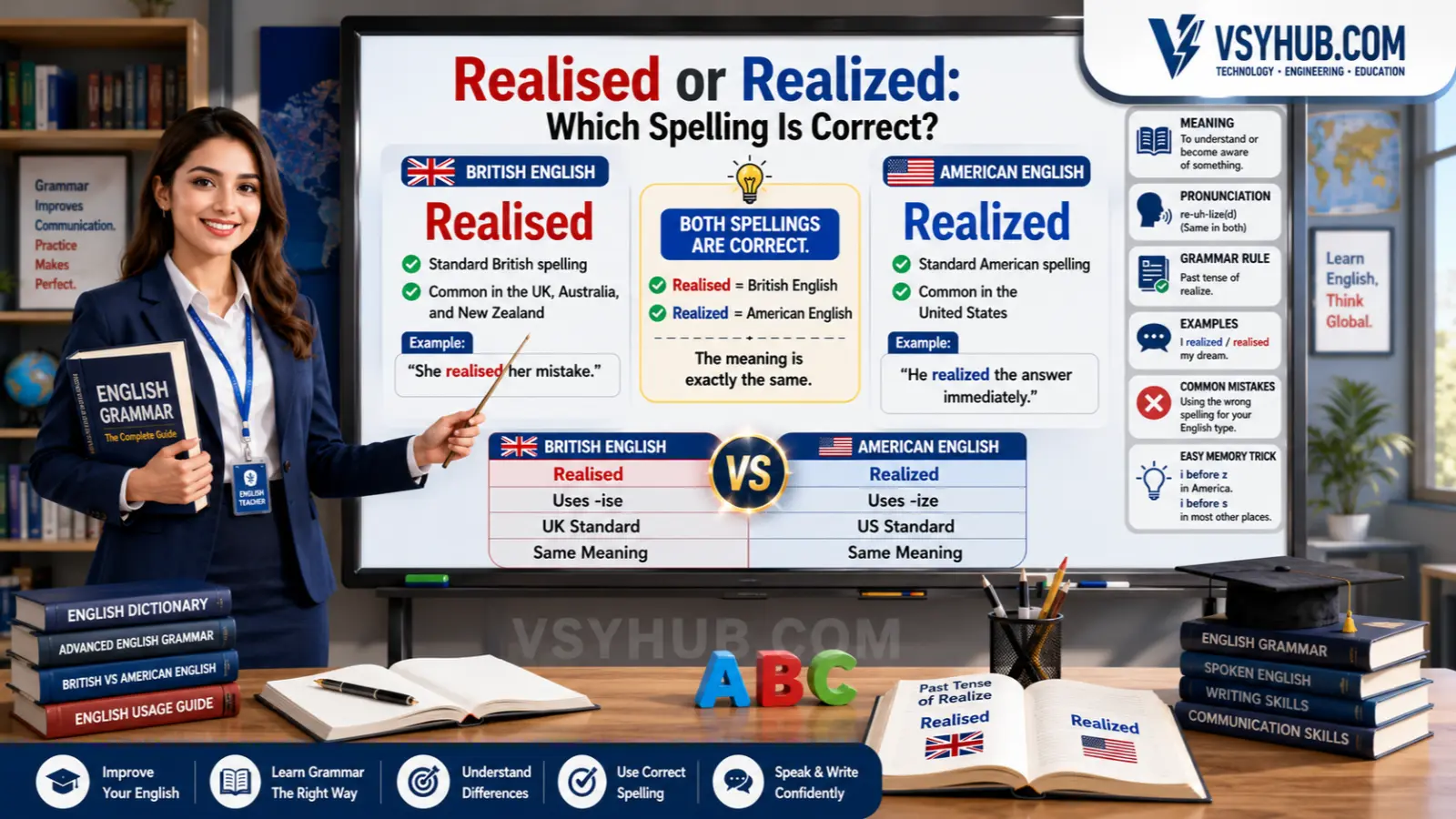
Have you ever typed realised or realized and wondered which spelling is correct? Many people face this confusion while writing school assignments, work emails, social media posts, or online articles.
People usually search for the correct spelling, meaning, pronunciation, grammar difference, usage, and examples because they want to write confidently.
The good news is that both spellings are correct, but they are used in different forms of English. In this guide, you’ll learn the meaning, pronunciation, examples, usage, grammar rules, common mistakes, expert tips, and simple explanations in easy English.
Realised or Realized – Quick Answer
👉 Realised = The preferred British English spelling.
👉 Realized = The preferred American English spelling.
Both words have exactly the same meaning. They are the past tense and past participle of the verb realise/realize, meaning to become aware of something, understand something, or achieve something.
Examples
- ✅ I realised I had forgotten my keys. (British English)
- ✅ I realized I had forgotten my keys. (American English)
- ✅ She finally realised her dream.
- ✅ He realized the answer during the exam.
- ✅ We realised/realized the meeting had already started.
Simple Rule
Use “realised” when writing for a British audience. Use “realized” when writing for an American audience. Never mix both spellings in the same document.

What Does Realised or Realized Mean?
The words realised and realized describe the moment when someone suddenly understands something or when something becomes true or is achieved.
For example:
- You suddenly understand your mistake.
- You achieve a lifelong goal.
- You become aware of important news.
- You recognize a fact you didn’t notice before.
Although the spelling changes depending on the variety of English, the meaning never changes.
Synonyms
- Understood
- Recognized
- Discovered
- Noticed
- Learned
- Achieved
- Accomplished
Opposites
- Ignored
- Missed
- Overlooked
- Forgot
- Misunderstood
Related Terms
- Realise
- Realize
- Awareness
- Recognition
- Understanding
- Achievement
- Discovery
Common Variations
- Realise
- Realize
- Realising
- Realizing
- Realisation
- Realization
The Origin of Realised or Realized
The verb comes from the word real, which has roots in Late Latin and Old French. English adopted the word several centuries ago.
Over time, English developed two common spelling systems.
British English traditionally prefers -ise endings, such as:
- realise
- organise
- recognise
American English usually prefers -ize endings, such as:
- realize
- organize
- recognize
Interestingly, some respected British publishers, including Oxford style, also accept -ize spellings. However, most British schools, newspapers, and everyday writers still prefer realise and realised.
Today, both spellings are widely recognized around the world.

How to Pronounce Realised or Realized
Both spellings are pronounced exactly the same.
Phonetic pronunciation:
REE-uh-lized
IPA:
/ˈrɪə.laɪzd/
Syllables
Real • ized
Easy Speaking Trick
Say:
“REE + uh + lized.”
The spelling changes, but the pronunciation stays exactly the same.
Common Pronunciation Mistakes
- Saying “ree-leezed.”
- Stressing the second syllable too much.
- Pronouncing the “s” differently because of the spelling.
Remember, realised and realized sound identical.
British English vs American English Usage
| Feature | British English | American English | Notes |
|---|---|---|---|
| Preferred spelling | Realised | Realized | Both are correct |
| Verb form | Realise | Realize | Same meaning |
| Pronunciation | Same | Same | No difference |
| Grammar | Same | Same | Only spelling changes |
| Meaning | Same | Same | Completely identical |
| Everyday use | Very common | Very common | Depends on audience |
Which One Should You Use?
Choosing the right spelling depends on who will read your writing.
Use Realised if you are writing for:
- UK readers
- Australia
- New Zealand
- Most British schools
- British newspapers
- Many international organizations following British English
Example:
“I realised my phone was at home.”
Use Realized if you are writing for:
- United States
- American universities
- American businesses
- US websites
- American publishers
Example:
“I realized my phone was at home.”
Mini Usage Table
| Situation | Best Choice |
|---|---|
| UK school essay | Realised |
| US college paper | Realized |
| British company | Realised |
| American company | Realized |
| International audience | Follow one style consistently |
The most important rule is consistency. Pick one spelling style and use it throughout your document.
Common Mistakes with Realised or Realized
Mistake 1
❌ I realised the answer yesterday, but later I realized another mistake.
✔ Use only one spelling style in the same document.
Tip: Don’t switch between British and American spelling.
Mistake 2
❌ I realisez my mistake.
✔ I realized my mistake.
The past tense must end in -ed.
Mistake 3
❌ I realise yesterday.
✔ I realised yesterday.
Use the past tense when talking about completed actions.
Mistake 4
❌ She has realize the truth.
✔ She has realized the truth.
Use the past participle after has, have, or had.
Mistake 5
❌ They realiseds their error.
✔ They realised their error.
Never add an extra s to the past tense.
Mistake 6
❌ He realized about the problem.
✔ He realized the problem.
The verb usually does not need about after it.
Mistake 7
❌ I am realized now.
✔ I realize now.
Use the correct verb form for the sentence.
Realised or Realized in Everyday Examples
Work
“I realized the report was missing a page.”
School
“She realised the answer after reading the question twice.”
Social Media
“I just realized I’ve been following the wrong account!”
Daily Life
“We realised we left the lights on.”
Emails
“I realized there was a mistake in the attachment.”
Text Messages
“Oops! I just realised I’m late.”
Online Content
“The writer realized the article needed more examples.”
Conversations
“I suddenly realised what you meant.”
Due to the response length limit, this is Part 1 of the complete article.
Realised or Realized in Different Contexts
Understanding how realised and realized are used in different situations will help you write more naturally and confidently.
Education
Students often use these words when writing essays, reports, and exam answers.
Examples:
- I realised my calculation was wrong after checking it.
- She realized the importance of studying every day.
Business
Clear communication is important in the workplace. Using the correct spelling for your audience makes your writing look more professional.
Examples:
- The company realized higher profits this year.
- We realised the project needed more planning.
Workplace Communication
Employees frequently use these words in emails, presentations, and meetings.
Examples:
- I realized the deadline had changed.
- She realised the client wanted a different design.
Grammar Learning
English learners often search for this spelling difference because they want to avoid mistakes in writing.
Examples:
- I realized both spellings are correct.
- My teacher explained why British English uses “realised.”
Writing and Publishing
Editors usually choose one style guide and use it throughout an article, book, or website.
For example:
- A UK magazine may use realised everywhere.
- A US blog may use realized throughout the article.
Social Media
People usually don’t notice the spelling difference on social media, but using one style consistently still looks more polished.
Example:
“I just realized how fast this year has gone!”
Communication
Whether you’re sending an email, writing a blog, or posting online, your audience determines which spelling is best.
Realised or Realized – Google Trends & Usage Data
The search term “realised or realized” remains popular because English learners, students, writers, bloggers, and professionals want to know which spelling is correct.
People commonly search questions like:
- Is realised correct?
- Is realized American English?
- Realised vs realized grammar.
- How do you spell realized in British English?
- Is realised wrong?
Search interest is especially high in countries where both British and American English are widely used, including:
- United States
- United Kingdom
- India
- Pakistan
- Canada
- Australia
Many voice searches also include questions such as:
- “Should I use realised or realized?”
- “What’s the difference between realised and realized?”
- “Which spelling is correct in British English?”
These searches show that people want simple explanations with practical examples.
Comparison Table: Realised or Realized
| Feature | Realised | Realized |
|---|---|---|
| Correct spelling | Yes | Yes |
| Meaning | Same | Same |
| Pronunciation | Same | Same |
| Grammar | Past tense and past participle | Past tense and past participle |
| British English | Preferred | Accepted by some style guides but less common |
| American English | Rare | Preferred |
| Academic writing | UK style | US style |
| Business writing | UK companies | US companies |
| Internet usage | Common in UK | Common worldwide |
| Common mistake | Mixing with American spelling | Mixing with British spelling |
Realised or Realized in Professional Life
Using the correct spelling shows attention to detail and professionalism.
For example:
- A British company expects British spelling in reports.
- An American employer usually expects American spelling.
- International businesses often choose one style guide for all documents.
Professional Examples
- We realized the marketing campaign needed changes.
- The team realised the customer wanted a simpler solution.
- I realized there was an error in the financial report.
- She realised the presentation needed more examples.
Matching your audience’s English style makes your communication clearer and more consistent.
Realised or Realized for Students or Beginners
Many beginners think one spelling is wrong because they only learned one version of English.
The truth is much simpler.
Remember these points:
- Both spellings are correct.
- The meaning never changes.
- The pronunciation stays the same.
- Only the spelling changes depending on the type of English.
Easy Learning Tips
- Reading British books? Use realised.
- Reading American books? Use realized.
- Follow your teacher’s style guide.
- Don’t switch spelling styles in the same assignment.
Signs, Characteristics, and Common Uses Related to Realised or Realized
You will often see these words when someone:
- Understands something suddenly.
- Learns an important fact.
- Notices a mistake.
- Achieves a dream or goal.
- Discovers new information.
- Writes about personal experiences.
- Shares stories on social media.
- Writes business emails.
- Creates blog articles.
- Tells a life lesson.
Common writing situations include:
- School essays
- Business reports
- Academic papers
- Books
- News articles
- Online blogs
- Text messages
- Daily conversations
Simple Trick to Remember Realised or Realized
Here’s the easiest memory rule.
- S = British Style
- Z = American Style
Think of it this way:
Imagine two friends.
One lives in London and writes realised.
The other lives in New York and writes realized.
They both mean exactly the same thing—they just spell it differently.
This simple picture makes it much easier to remember.
Expert Tips Section
Many writers focus only on whether realised or realized is correct. Professional editors also pay attention to consistency.
Here are some expert tips:
- Choose British or American English before you start writing.
- Use your word processor’s spell-check for the correct language setting.
- Keep the same spelling throughout your article.
- Check your organization’s style guide before publishing.
- Read your work aloud to catch grammar mistakes.
- If writing for an international audience, follow one standard consistently.
- Save a personal proofreading checklist for common spelling differences.
These habits improve clarity and make your writing look more professional.
Related Searches People Also Ask
Is realised correct?
Yes. It is the standard British English spelling.
Is realized correct?
Yes. It is the standard American English spelling.
Why are there two spellings?
British and American English developed different spelling preferences over time.
Which spelling should I use in an essay?
Use the spelling style required by your school, teacher, or institution.
Is realized wrong in the UK?
No. It is accepted by some British style guides, although realised is more common.
How do I remember the difference?
Think S = British Style and Z = American Style.
Are they pronounced differently?
No. Both are pronounced the same.
Can I mix both spellings?
No. Stay consistent throughout your writing.
Is realise the same as realize?
Yes. The only difference is the spelling style.
Why do people search for this word?
Because both spellings are correct, many learners want to know which one fits their audience.
FAQs
Is realised or realized correct?
Both are correct. Realised is British English, while realized is American English.
Do they have different meanings?
No. They have exactly the same meaning.
Which spelling is more common?
Realized is more common worldwide because American English has a broad global influence. Realised remains the preferred choice in most British English writing.
How do you pronounce realised?
It is pronounced REE-uh-lized.
Is realized grammatically correct?
Yes. It is the correct American English past tense and past participle of realize.
Can I use realised in the United States?
People will understand it, but realized is the preferred spelling.
Which spelling should students use?
Use the version your teacher, school, or university requires.
Is realised used in Australia?
Yes. Australian English generally follows British spelling, so realised is commonly used.
Why do dictionaries list both spellings?
Because both are accepted standard English spellings.
What is the easiest way to remember?
Remember S = British Style and Z = American Style.
Final Verdict
Both realised and realized are correct English spellings.
Use realised for British English and realized for American English. The pronunciation, grammar, and meaning stay exactly the same. The only difference is the spelling style you choose for your audience.
The easiest memory rule is:
S = British Style
Z = American Style
Stay consistent, and you’ll never go wrong.
Conclusion
The confusion between realised and realized is common, but the answer is simple. Both spellings are correct and mean the same thing. Your choice depends on whether you are writing in British or American English. Whether you’re a student, professional, blogger, or English learner, using one spelling consistently will make your writing look polished and trustworthy. Keep the simple memory trick in mind—S for British Style and Z for American Style—and you’ll always choose the right spelling with confidence.

Aria Foster is a comparison and language writer who specializes in spelling differences, word meanings, grammar guides, and easy-to-understand language explanations. She creates clear, reader-friendly content that helps people understand commonly confused words and expressions.