Have you ever typed usable or useable and wondered which spelling is correct? You’re not alone.
Many students, writers, professionals, and English learners pause when they see these two versions because both appear in dictionaries and online articles.
People usually search for: usable or useable meaning, correct spelling, pronunciation, examples, usage, definition, grammar difference, and when to use each spelling.
You may also notice these words in school assignments, workplace emails, websites, social media posts, product descriptions, and everyday conversations.
Knowing the preferred spelling helps your writing look more natural and professional.
In this guide, you’ll learn the meaning, pronunciation, examples, usage, grammar rules, common mistakes, expert tips, and simple explanations in easy English.
Usable or Useable – Quick Answer
Short Answer:
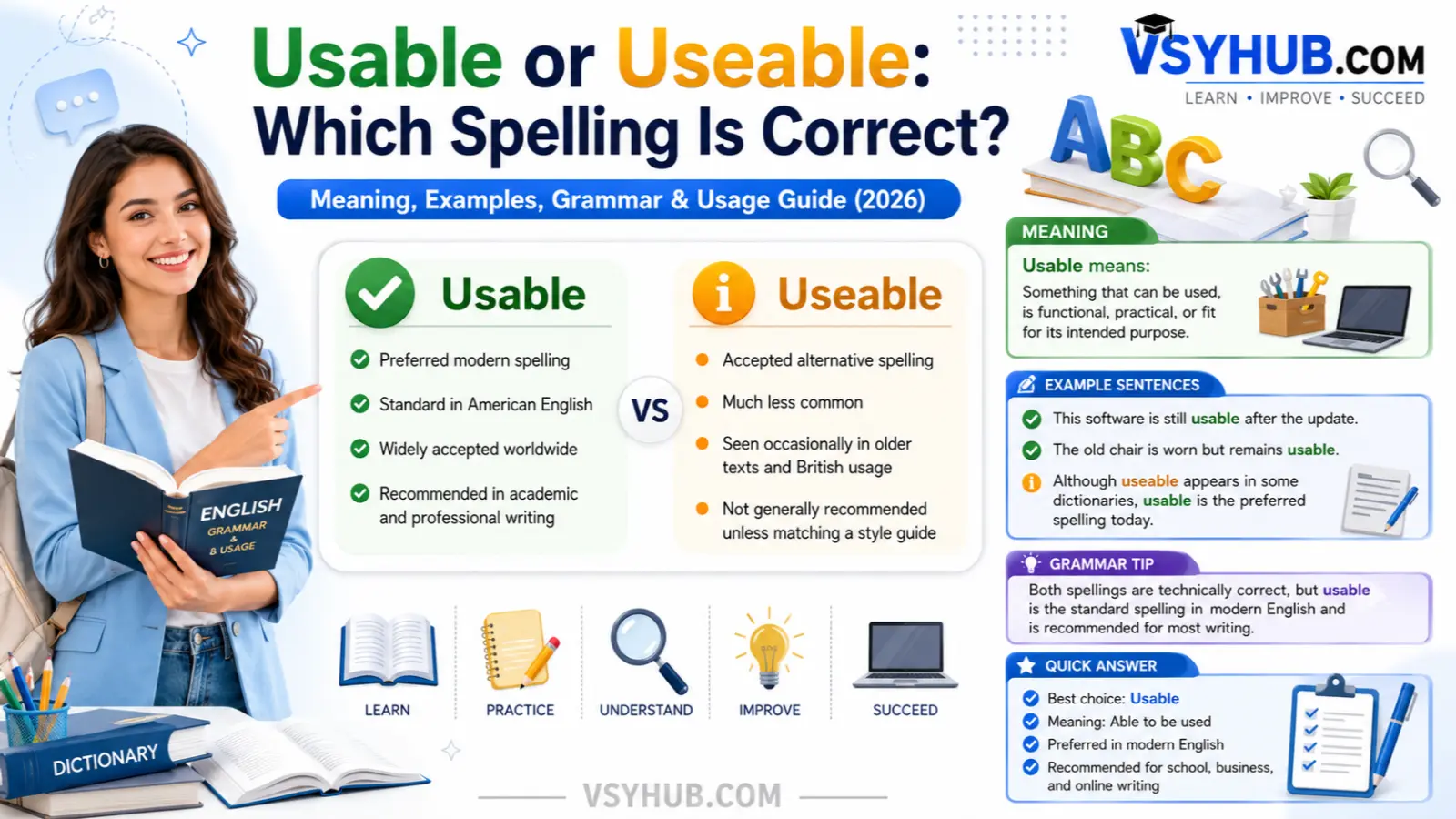
Both usable and useable are correct spellings.
However:
👉 Usable = The preferred and most common spelling in modern English.
👉 Useable = A correct alternative spelling, but it is much less common.
Most dictionaries recognize both spellings, but usable is the version you will see most often in books, newspapers, business writing, schools, and websites.
Examples
✅ This laptop is still usable after five years.
The room became usable after the repairs.✅
✅ Is this old phone still usable?
The software is usable on both Windows and Mac.✅
Although useable is correct, usable is preferred in modern writing.✅
Simple Rule
Think of it this way:
Use + able = usable.
Even though useable follows the same pattern, modern English has largely settled on usable as the standard spelling.
What Does Usable or Useable Mean?
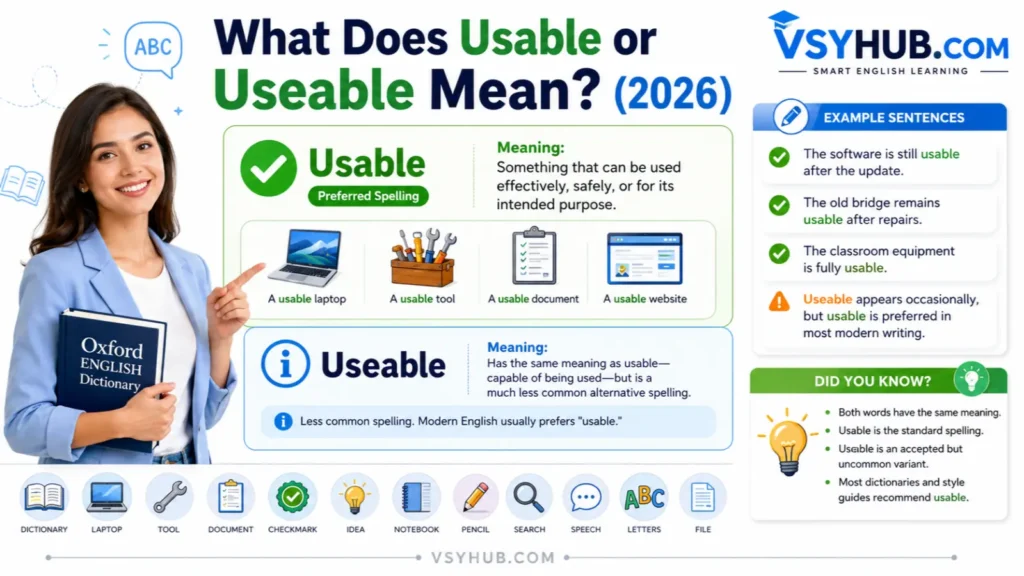
The words usable and useable have exactly the same meaning.
They describe something that can be used or is suitable for use.
If something works properly and serves its purpose, it is usable.
Simple Definition
Usable (or useable) means:
- Able to be used
- Ready for use
- Practical enough for a purpose
- In working condition
Everyday Meaning
In daily life, people use the word when talking about objects, tools, technology, furniture, buildings, clothing, or anything that still works.
Examples:
- The chair is old but still usable.
- We found a usable parking space.
- The document is usable after editing.
- Your password is no longer usable.
- This data is usable for our research.
Professional Meaning
In business and technology, usable often means that a product, system, website, or application is easy to use and works correctly.
Examples:
- The new software has a more usable interface.
- We need usable customer data.
- The design is simple and usable.
Academic Meaning
Teachers and researchers use the word when discussing information, evidence, equipment, or materials that are suitable for study or research.
Example:
The collected information was usable for the final report.
Synonyms
Depending on the context, synonyms include:
- Practical
- Functional
- Useful
- Serviceable
- Operable
- Effective
- Working
- Accessible
- Convenient
- Fit for use
Opposites
- Unusable
- Useless
- Broken
- Faulty
- Inoperable
- Damaged
- Ineffective
Related Terms
- Use
- Useful
- Usefulness
- User-friendly
- Functionality
- Accessibility
- Practicality
- Operable
- Working condition
Common Variations
- Usable space
- Usable data
- Usable software
- Usable product
- Usable information
- Usable interface
- Usable design
- Usable equipment
- Usable condition
- Usable resource
The Origin of Usable or Useable
The word comes from the English verb use, which has roots in Old French user, meaning “to employ” or “to make use of.” That word ultimately comes from the Latin word uti, meaning “to use.”
As English developed, the suffix -able was added to many verbs to create adjectives that mean “capable of being.”
For example:
- Read → Readable
- Wash → Washable
- Comfort → Comfortable
- Predict → Predictable
- Use → Usable
Historically, both usable and useable appeared in English writing. Earlier dictionaries accepted both forms because English spelling was less standardized than it is today.
Over time, publishers, educators, style guides, and dictionaries began favoring usable. Today, it is the standard spelling in most modern writing.
Although useable still appears occasionally, especially in older books or personal writing, it is much less common.
How to Pronounce Usable or Useable
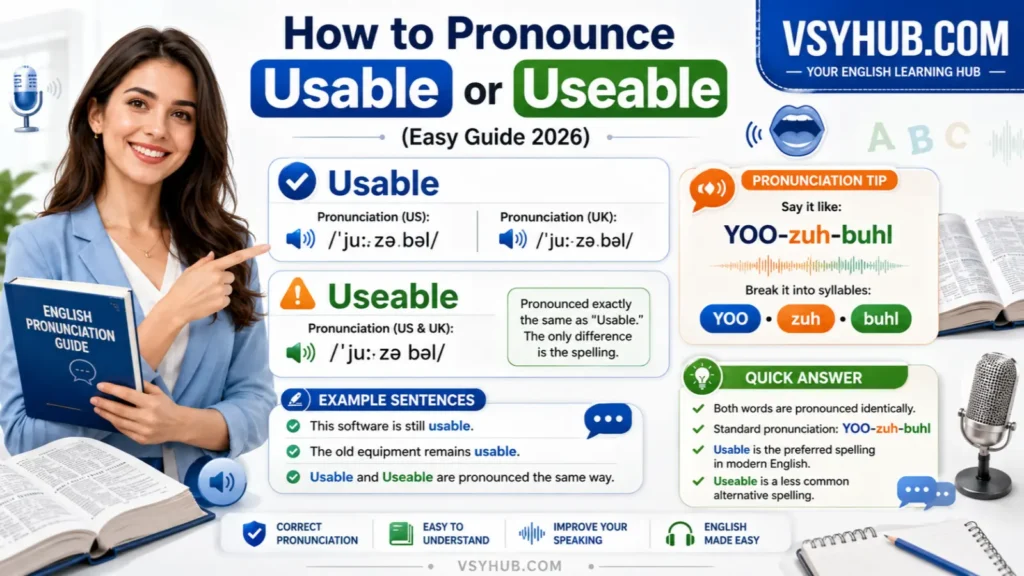
Both spellings are pronounced exactly the same way.
Phonetic Pronunciation
Usable
YOO-zuh-buhl
IPA: /ˈjuː.zə.bəl/
Syllables
Us-a-ble
Three syllables:
YOO + zuh + buhl
Easy Speaking Trick
Say the word use first.
Then add uh-buhl.
It becomes:
YOO-zuh-buhl
Common Pronunciation Mistakes
Incorrect:
- yoo-sable
- oo-zable
- use-able with a long pause
Correct:
- YOO-zuh-buhl
Practice sentences:
- This phone is still usable.
- We need usable information.
- Is the old computer usable?
British English vs American English Usage
Both British English and American English accept usable and useable. However, usable is strongly preferred in both varieties.
| Feature | British English | American English | Notes |
|---|---|---|---|
| Preferred spelling | Usable | Usable | Standard in both countries |
| Alternative spelling | Useable | Useable | Correct but uncommon |
| Pronunciation | Same | Same | No difference |
| Meaning | Same | Same | “Able to be used” |
| Formal writing | Usable | Usable | Recommended choice |
| Academic writing | Usable | Usable | Preferred by schools and universities |
| Business writing | Usable | Usable | Most professional option |
| Everyday writing | Mostly usable | Mostly usable | More familiar to readers |
Which One Should You Use?
If you’re unsure, choose usable.
It is the safest choice for almost every situation.
Use usable in:
- School assignments
- College essays
- Business reports
- Workplace emails
- Websites
- Blog articles
- Books
- Newspapers
- Marketing materials
- Professional documents
- Social media captions
- Product descriptions
You can use useable, but many readers may think it looks unusual because they rarely see it.
Quick Usage Examples
✅ This information is usable.
The old table is still usable.✅
✅ We found a usable solution.
The website has a usable design.✅
Mini Usage Table
| Situation | Best Choice |
|---|---|
| School | Usable |
| College | Usable |
| Workplace | Usable |
| Business | Usable |
| Academic writing | Usable |
| Marketing | Usable |
| Social media | Usable |
| Personal writing | Either, but usable is preferred |
Common Mistakes with Usable or Useable
Mistake 1: Thinking “useable” is wrong
❌ Useable is an incorrect word.
✔ Useable is correct, but usable is the preferred spelling.
Why this happens: Many people only see usable, so they assume the other spelling is incorrect.
Tip: Remember that both are accepted, but usable is the better choice.
Mistake 2: Mixing both spellings in one document
❌ Our software is usable. This tool is useable.
✔ Our software is usable. This tool is usable.
Explanation: Pick one spelling and stay consistent.
Mistake 3: Using “usable” when you mean “useful”
❌ This advice is usable.
✔ This advice is useful.
Explanation: Advice is usually described as useful, while usable is more often used for things that can actually be used.
Mistake 4: Assuming British English prefers “useable”
❌ British English uses useable.
✔ British English usually prefers usable too.
Why this mistake happens: People often expect British English to keep older spellings, but that is not the case here.
Mistake 5: Pronouncing the word incorrectly
❌ yoo-sable
✔ YOO-zuh-buhl
Speaking the word naturally makes your English sound more fluent.
Mistake 6: Using “usable” for something that doesn’t work
❌ The broken phone is usable.
✔ The broken phone is unusable.
If something cannot be used, the correct adjective is unusable.
Usable or Useable in Professional Life
Professional writing should always be clear, consistent, and easy to understand.
Since usable is the spelling most readers expect, it creates a more polished impression.
Examples in the workplace:
- We need usable data before the meeting.
- The final report is now usable.
- This design provides a more usable experience.
- The updated manual is easier to follow and more usable.
Why It Matters
Using standard spelling:
- Improves credibility.
- Builds reader trust.
- Makes documents easier to read.
- Matches most company style guides.
- Looks more professional.
Whether you’re writing emails, reports, presentations, proposals, or website content, usable is usually the better choice.
Usable or Useable for Students or Beginners
Many beginners become confused because they learn the rule:
Verb + able = adjective.
So they naturally expect:
Use + able = useable
This seems logical, which is why useable still exists.
However, English spelling has developed over time, and usable became the preferred standard.
Easy Learning Tips
- Remember that both spellings are correct.
- Use usable in exams.
- Use usable in essays.
- Use usable in homework.
- Use usable in professional writing.
- Stay consistent throughout your work.
The more you read modern English books and websites, the more often you’ll see usable.
Signs, Characteristics, or Common Uses Related to Usable or Useable
The word usable appears in many areas of everyday life. While useable has the same meaning, usable is the spelling you will see most often.
Common Uses
- Describing products that still work
- Talking about software and websites
- Referring to usable information or data
- Explaining whether an object is fit for use
- Writing business reports and emails
- Creating product descriptions
- Discussing school assignments and research
- Giving instructions or recommendations
Common Writing Patterns
You’ll often see usable with nouns like:
- Usable space
- Usable data
- Usable software
- Usable website
- Usable design
- Usable equipment
- Usable information
- Usable solution
- Usable material
- Usable resource
Industries That Frequently Use the Word
- Education
- Technology
- Software development
- User Experience (UX) design
- Business
- Marketing
- Engineering
- Manufacturing
- Healthcare
- Construction
- Real estate
- Government
Online Usage Patterns
On the internet, usable is commonly found in:
- Blog articles
- Product reviews
- App descriptions
- Software documentation
- Online courses
- Technical guides
- User manuals
- Help centers
- E-commerce websites
Simple Trick to Remember Usable or Useable
The easiest way to remember the correct spelling for modern writing is this:
If you’re unsure, always choose usable.
It is the spelling preferred by:
- Most dictionaries
- Schools
- Universities
- Publishers
- Businesses
- Professional writers
- Style guides
Think of It This Way
Imagine you’re sending an important email to your teacher or manager.
Which spelling will look more familiar?
✅ Usable
Most readers recognize this spelling immediately, making your writing look natural and professional.
Memory Shortcut
Remember this simple sentence:
Usable is the usual choice.
Both words are correct, but usable is the one you’ll use most often.
Expert Tips
Many articles simply tell you that both spellings are correct. Here are a few extra tips that can improve your writing.
1. Follow Your Style Guide
If you’re writing for school, work, or a client, follow the preferred style guide. Nearly all modern guides recommend usable.
2. Stay Consistent
Don’t switch between usable and useable in the same article or document.
3. Read Modern Sources
Reading newspapers, books, university websites, and trusted blogs helps you become familiar with standard spelling.
4. Use Spell Check Carefully
Most spell checkers suggest usable because it is much more common. If useable isn’t flagged, remember that it is still an accepted variant.
5. Learn Related Words
Understanding related vocabulary helps improve your English naturally.
Examples include:
- Use
- Useful
- User
- User-friendly
- Usability
- Usage
- Utilize
- Utility
6. Practice with Real Sentences
Instead of memorizing rules, write your own examples.
For example:
- This desk is still usable.
- We need usable information.
- The website is easy to use and highly usable.
Writing your own sentences helps you remember the spelling much faster.
Related Searches People Also Ask
Is usable or useable correct?
Both are correct, but usable is the preferred spelling in modern English.
Why is usable more common than useable?
Over time, publishers and dictionaries began favoring usable, making it the standard choice in most writing.
What does usable mean?
It means something is able to be used or suitable for use.
Is useable a real word?
Yes. It is an accepted alternative spelling, although it is much less common.
How do you pronounce usable?
It is pronounced YOO-zuh-buhl.
Is usable an adjective?
Yes. It describes something that can be used.
What is the opposite of usable?
The opposite is unusable.
Can I use usable in academic writing?
Yes. In fact, usable is the recommended spelling for academic writing.
Is usable used in technology?
Yes. It is very common in software, UX design, websites, and product development.
Is there a difference in meaning between usable and useable?
No. Both words have exactly the same meaning.
Which spelling do dictionaries recommend?
Most dictionaries list both spellings, but usable appears first because it is the preferred form.
Which spelling should English learners remember?
English learners should remember usable, since it is the version they will encounter most often.
FAQs
Is usable the correct spelling?
Yes. Usable is the standard and preferred spelling in modern English.
Is useable wrong?
No. It is a correct alternative spelling but is much less common.
Which spelling should I use in school?
Use usable unless your teacher asks for a different style.
Which spelling is better for business writing?
Usable is the better choice because it is widely recognized and looks more professional.
Are usable and useable pronounced differently?
No. Both are pronounced the same way: YOO-zuh-buhl.
Does British English use usable?
Yes. British English generally prefers usable, just like American English.
Can I use useable in formal writing?
You can, since it is correct, but usable is the recommended option for formal writing.
What part of speech is usable?
It is an adjective.
What is an example sentence with usable?
“The old computer is still usable for basic tasks.”
How can I remember the correct spelling?
Remember this simple phrase: “Usable is the usual choice.”
Final Verdict
The answer is simple.
- ✅ Usable is the preferred and most widely used spelling.
- ✅ Useable is also correct but much less common.
- ✅ Both words have the same meaning and pronunciation.
- ✅ For school, work, academic writing, websites, and professional communication, choose usable.
Easiest Memory Rule
Usable is the usual choice.
If you remember that one sentence, you’ll almost always choose the spelling that readers expect.
Conclusion
Choosing between usable and useable doesn’t have to be confusing. Although both spellings are accepted in English dictionaries, usable has become the standard in modern writing. You’ll see it in schools, businesses, newspapers, websites, books, and professional documents around the world.
If your goal is clear, natural, and professional English, usable is the safest option. It looks familiar to readers, matches most style guides, and works well in almost every situation.
Whenever you hesitate, remember this easy trick:
Usable is the usual choice. It will help you write with confidence every time.

Aria Foster is a comparison and language writer who specializes in spelling differences, word meanings, grammar guides, and easy-to-understand language explanations. She creates clear, reader-friendly content that helps people understand commonly confused words and expressions.