Have you ever written an email, school assignment, or social media post and wondered whether you should use affectively or effectively? You’re not alone.
These two words look and sound similar, so many English learners—and even native speakers—mix them up. Using the wrong one can change the meaning of your sentence and make your writing less clear.
People usually search for: affectively or effectively meaning, correct usage, pronunciation, examples, definition, grammar difference, and when to use each word.
This confusion often appears in school, the workplace, academic writing, online searches, and everyday conversations.
In this guide, you’ll learn the meaning, pronunciation, examples, usage, grammar rules, common mistakes, expert tips, and simple explanations in easy English.
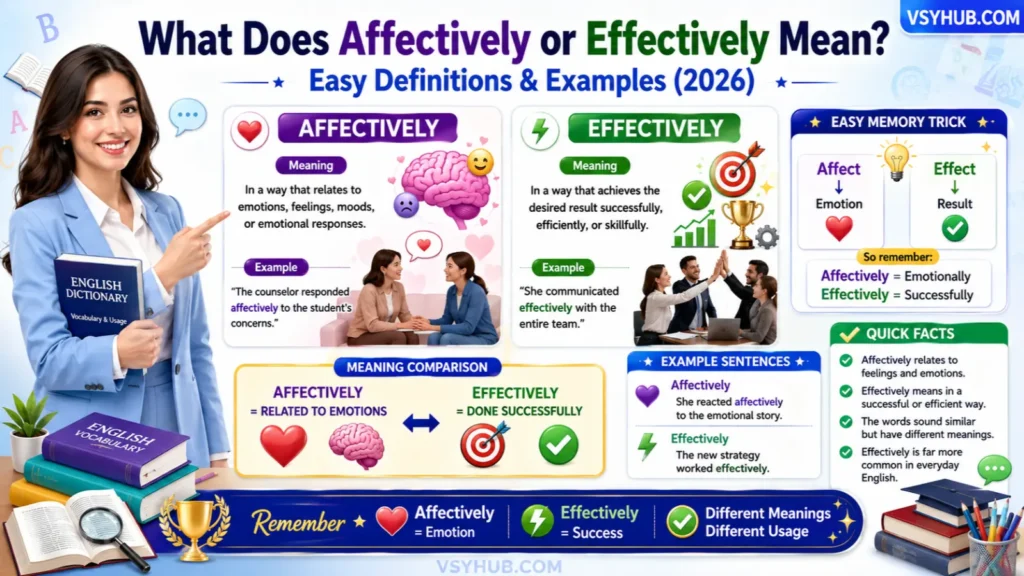
Affectively or Effectively – Quick Answer
If you’re in a hurry, here’s the simple answer.
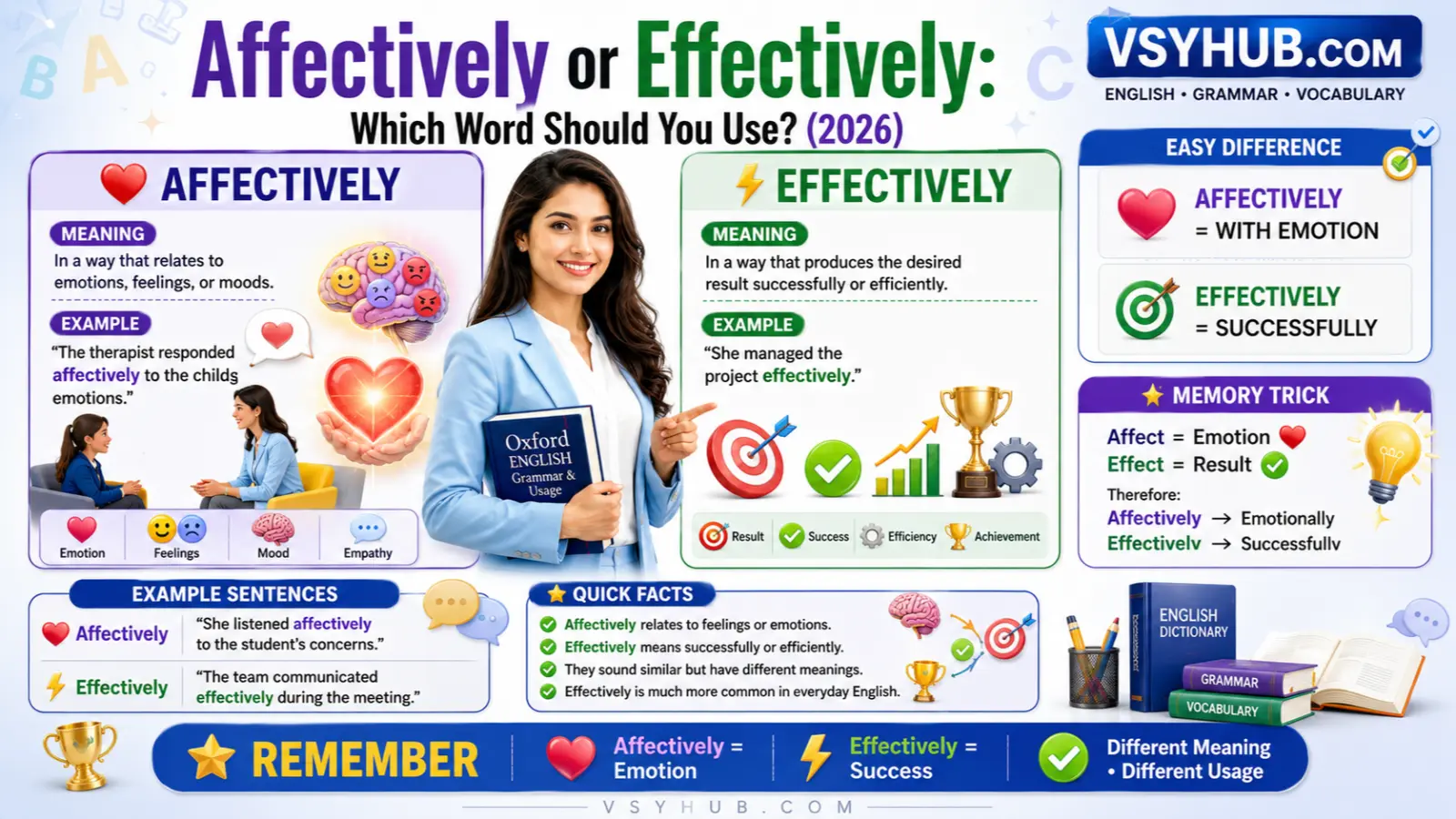
👉 Affectively = In a way that relates to feelings, emotions, or moods.
👉 Effectively = In a way that produces the desired result or works successfully.
Examples
- ✅ The counselor listened affectively, showing care and empathy.
- ✅ She managed the project effectively, finishing it ahead of schedule.
- ✅ Good teachers communicate effectively with students.
- ✅ Emotional support can help people respond affectively during difficult times.
- ✅ The new software works effectively on most computers.
Simple Rule
Affectively = A for Affection and Emotions.
Effectively = E for Efficient Results.
If you’re talking about feelings, choose affectively.
If you’re talking about success, performance, or results, choose effectively.
What Does Affectively or Effectively Mean?
Although these words look alike, they have very different meanings.
What Does Affectively Mean?
Affectively is an adverb based on the adjective affective. It describes something connected with emotions, feelings, moods, or emotional responses.
You will often see this word in:
- Psychology
- Education
- Mental health
- Emotional development
- Scientific research
Examples:
- Children learn affectively through positive emotional experiences.
- The therapist responded affectively to the patient’s concerns.
- Music can influence people affectively by changing their mood.
What Does Effectively Mean?
Effectively is an adverb based on the adjective effective. It means successfully, efficiently, or in a way that achieves the intended result.
This is the much more common word.
You will often see it in:
- Business
- Schools
- Workplaces
- Technology
- Marketing
- Everyday conversations
Examples:
- The team worked effectively together.
- She communicates effectively during meetings.
- The medicine reduced the pain effectively.
Synonyms
Affectively
- Emotionally
- Feelingly
- Compassionately
- Sensitively
- Empathetically
Effectively
- Successfully
- Efficiently
- Properly
- Competently
- Productively
Opposites
| Affectively | Effectively |
|---|---|
| Emotionlessly | Ineffectively |
| Unemotionally | Poorly |
| Coldly | Unsuccessfully |
Related Terms
- Affect
- Effect
- Affective learning
- Effective communication
- Emotional intelligence
- Productivity
- Emotional response
- Performance
- Efficiency
- Results
Common Variations
- Affect
- Affective
- Affectively
- Effect
- Effective
- Effectively
- Effectiveness
- Ineffective
The Origin of Affectively or Effectively
Understanding where these words come from makes them easier to remember.
Affectively
The word affectively comes from the Latin word affectus, meaning “emotion,” “feeling,” or “state of mind.”
Over time, psychologists and educators began using affective to describe anything related to emotions rather than thoughts or actions.
Today, the word is mainly used in academic and professional settings.
Effectively
The word effectively comes from the Latin word effectus, meaning “result” or “achievement.”
Its meaning has stayed almost the same for hundreds of years. It refers to producing a successful outcome or accomplishing something.
Because almost every job and daily task involves achieving results, effectively is used much more often than affectively.
How to Pronounce Affectively or Effectively
Correct pronunciation helps you sound more confident.
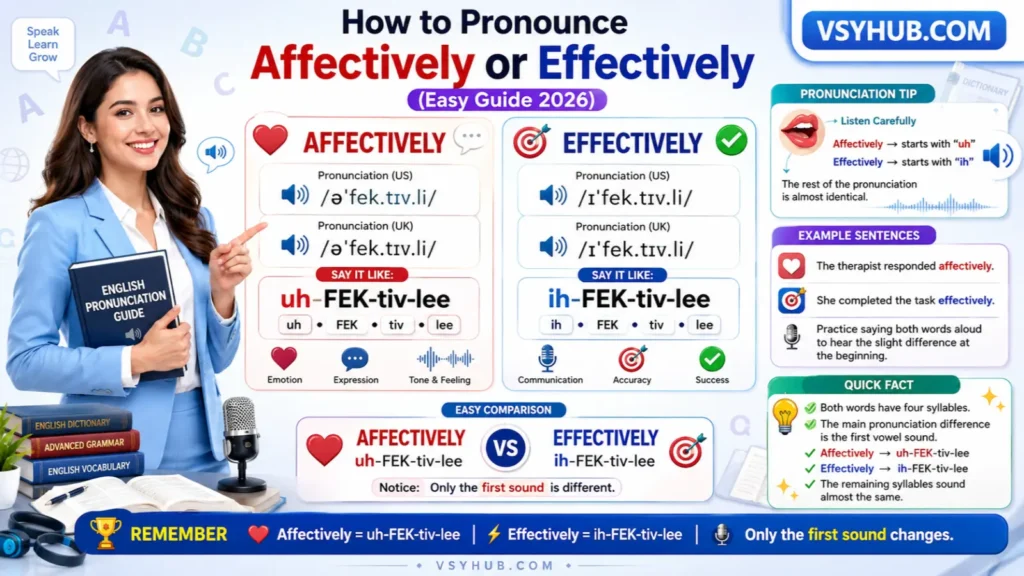
Affectively
Phonetic: uh-FEK-tiv-lee
Syllables: af-fec-tive-ly
Speaking Tip
Stress the second syllable:
uh-FEK-tiv-lee
Effectively
Phonetic: ih-FEK-tiv-lee
Syllables: ef-fec-tive-ly
Speaking Tip
Notice that both words sound very similar.
The biggest difference is the first sound:
- Affectively → starts with uh
- Effectively → starts with ih
Common Pronunciation Mistakes
- Mixing the two because they sound alike.
- Forgetting the second syllable stress.
- Saying “effectly” instead of “effectively.”
British English vs American English Usage
Both British and American English use these words in the same way.
| Feature | British English | American English | Notes |
|---|---|---|---|
| Spelling | Affectively | Affectively | Same spelling |
| Spelling | Effectively | Effectively | Same spelling |
| Meaning | Same | Same | No difference |
| Pronunciation | Slight accent difference | Slight accent difference | Meaning stays the same |
| Grammar | Same | Same | Used identically |
There is no spelling difference between British and American English for these words.
Which One Should You Use?
Choosing the correct word depends on what you want to say.
Use affectively when talking about:
- Feelings
- Emotions
- Psychology
- Emotional learning
- Human behavior
Examples
- The child developed affectively through supportive parenting.
- The movie affected viewers affectively.
Use effectively when talking about:
- Success
- Performance
- Productivity
- Communication
- Business
- Technology
- Everyday tasks
Examples
- She solved the problem effectively.
- The team communicated effectively.
- The training improved employee performance effectively.
Quick Usage Table
| Situation | Correct Word |
|---|---|
| Talking about emotions | Affectively |
| Talking about success | Effectively |
| Academic psychology | Affectively |
| Workplace writing | Effectively |
| Emails | Effectively |
| Business reports | Effectively |
| Emotional research | Affectively |
| Social media advice | Usually Effectively |
Common Mistakes With Affectively or Effectively
Mistake 1
❌ She managed the project affectively.
✔ She managed the project effectively.
Why?
Managing a project is about achieving results, not expressing emotions.
Mistake 2
❌ Emotional learning happens effectively.
✔ Emotional learning happens affectively.
Why?
The discussion is about feelings and emotional development.
Mistake 3
❌ The medicine worked affectively.
✔ The medicine worked effectively.
Why?
Medicine is judged by how well it works.
Mistake 4
❌ He communicated affectively during the meeting.
✔ He communicated effectively during the meeting.
Why?
Communication in business focuses on clear results.
Mistake 5
❌ The therapist listened effectively to understand emotions.
✔ The therapist listened affectively to understand emotions.
Why?
The therapist is responding with emotional understanding.
Mistake 6
❌ The software runs affectively.
✔ The software runs effectively.
Why?
Software performance is about efficiency.
Mistake 7
❌ The students completed the assignment affectively.
✔ The students completed the assignment effectively.
Why?
Completing work successfully requires effectively.
Affectively or Effectively in Everyday Examples
The best way to understand these words is by seeing them in real-life situations.
At Work
Affectively
- The manager spoke affectively, showing genuine concern for the team’s stress.
- Good leaders respond affectively when employees face personal challenges.
Effectively
- The team completed the project effectively before the deadline.
- She organized the meeting effectively, so everyone understood their tasks.
At School
Affectively
- Teachers help students grow affectively by creating a caring classroom.
- The lesson encouraged students to respond affectively to the story.
Effectively
- The teacher explained the math problem effectively.
- Students studied effectively by making a daily revision schedule.
On Social Media
Affectively
- The video connected affectively with viewers because it shared a touching story.
- Many charities create content that speaks affectively to people’s emotions.
Effectively
- The creator used short videos effectively to reach more followers.
- The campaign spread its message effectively across different platforms.
In Daily Life
Affectively
- Parents often comfort children affectively during difficult moments.
- Friends can support each other affectively by listening with empathy.
Effectively
- She cleaned the kitchen effectively in less than an hour.
- The new vacuum works effectively on carpets.
In Emails
Affectively
- Your message should acknowledge the customer’s feelings affectively before offering a solution.
Effectively
- Keep your email short and effectively explain your main point.
- He answered every question effectively in one clear email.
In Text Messages
Affectively
- “I’m really sorry you’re going through this.” This responds affectively because it shows emotional support.
Effectively
- “Meeting moved to 3 PM.” This message communicates effectively because it is clear and direct.
In Online Content
Affectively
- Storytelling often connects affectively with readers by creating emotional moments.
Effectively
- Good blog articles answer readers’ questions effectively.
- Clear headings help visitors find information effectively.
In Everyday Conversations
Affectively
- She reacted affectively after hearing the sad news.
Effectively
- He explained the directions effectively, so nobody got lost.
Affectively or Effectively in Different Contexts
Different situations call for different words. Knowing the context makes choosing the correct one much easier.
In Education
Teachers often talk about three learning areas:
- Cognitive (thinking)
- Affective (feelings)
- Psychomotor (physical skills)
Here, affectively relates to students’ emotions, attitudes, motivation, and values.
Example
Students often learn affectively when they feel encouraged and respected.
Meanwhile, teachers teach effectively when students clearly understand the lesson.
In Psychology
Psychologists frequently use affective and affectively.
These words describe:
- Emotional responses
- Mood
- Feelings
- Emotional development
- Emotional regulation
Example
The therapy helped the patient respond affectively to stressful situations.
In Business
Business professionals almost always use effectively.
Common phrases include:
- Communicate effectively
- Lead effectively
- Manage effectively
- Sell effectively
- Work effectively
- Solve problems effectively
Example
Successful managers delegate work effectively.
In Workplace Communication
Managers want employees to:
- Write clearly.
- Listen carefully.
- Work efficiently.
- Solve problems.
Because these actions focus on results, effectively is almost always the correct choice.
Example
She handled customer complaints effectively.
However, in leadership training, emotional intelligence is also important.
Example
She responded affectively when an employee shared a personal concern.
In Marketing
Marketing uses both ideas.
Companies want advertisements that:
- Connect emotionally (affectively).
- Increase sales (effectively).
Examples
The advertisement connected affectively with parents.
The campaign increased sales effectively.
In Technology
Technology discussions almost always use effectively.
Examples include:
- Use software effectively.
- Protect data effectively.
- Manage storage effectively.
- Search effectively online.
In Writing
Good writing should be:
- Clear
- Easy to understand
- Organized
- Effective
Therefore, writers usually use effectively.
But when discussing literature or poetry, affectively may describe emotional impact.
Examples
The novel affected readers affectively.
The article explained the topic effectively.
In Communication
Communication involves both emotions and clarity.
If you’re discussing emotional understanding, use affectively.
If you’re discussing successful communication, use effectively.
Examples
The counselor listened affectively.
The speaker presented the topic effectively.
Affectively or Effectively – Google Trends and Usage Data
Many people search for affectively or effectively because the words are similar in spelling and pronunciation. Search interest often increases during the school year when students write essays, complete assignments, or prepare for exams.
Professionals also search for this topic when writing reports, emails, research papers, and business documents. Since effectively is much more common in everyday English, people sometimes use it by habit even when affectively is the correct choice.
The confusion is especially common among English learners in countries such as the United States, the United Kingdom, India, Pakistan, Canada, and Australia, where English is widely used for education and work.
People also search using voice assistants with questions like:
- What is the difference between affectively and effectively?
- Is affectively a real word?
- When should I use effectively?
- How do you pronounce affectively?
- Which word is correct in psychology?
- Affectively vs effectively examples.
- Affectively meaning in simple English.
- Effectively meaning with sentences.
- Can affectively and effectively be used interchangeably?
- How do I remember the difference between affectively and effectively?
These long-tail searches show that users are looking for clear, beginner-friendly explanations rather than complicated grammar rules.
Comparison Table: Affectively vs Effectively
| Feature | Affectively | Effectively |
|---|---|---|
| Meaning | In an emotional way | In a successful or efficient way |
| Related To | Feelings and emotions | Results and performance |
| Part of Speech | Adverb | Adverb |
| Base Word | Affective | Effective |
| Common Usage | Psychology and education | Everyday English, business, school |
| Popularity | Less common | Very common |
| Professional Writing | Limited use | Very common |
| Academic Writing | Common in psychology | Common in all subjects |
| Internet Usage | Rare | Extremely common |
| Common Mistake | Used instead of effectively | Used when affectively is needed |
| Easy Memory Tip | A = Affection | E = Efficiency |
Affectively or Effectively in Professional Life
Choosing the right word can make your professional writing more accurate and polished.
In Business Emails
Use effectively when talking about completing tasks, solving problems, or communicating clearly.
Examples
- We worked effectively as a team.
- The new process reduced costs effectively.
- Please manage your time effectively.
In Leadership
Good leaders do two important things:
- They communicate effectively.
- They support employees affectively when emotions are involved.
A balanced leader understands both performance and people.
In Customer Service
Customer service professionals should:
- Listen affectively to understand customers’ feelings.
- Solve problems effectively to keep customers satisfied.
Using both skills creates a better customer experience.
In Healthcare
Doctors, nurses, counselors, and therapists often use both concepts.
They respond affectively by showing empathy and compassion, while treating patients effectively with the right care and medical decisions.
Understanding the difference helps professionals communicate more accurately in reports, research, and everyday practice.
Affectively or Effectively for Students or Beginners
If you’re learning English, don’t worry if these two words seem confusing. They look almost the same, but they are used in different situations.
The easiest way to remember them is to think about what you’re talking about.
- If it’s about feelings or emotions, use affectively.
- If it’s about success or getting good results, use effectively.
Many students accidentally choose the wrong word because they focus on the spelling instead of the meaning.
Why Beginners Get Confused
Here are the most common reasons:
- Both words end in -ly.
- Both have similar pronunciation.
- Both come from similar-looking base words.
- Both appear in formal writing.
- Spell check may not catch the mistake because both are real words.
Easy Learning Tips
- Learn the meaning before memorizing the spelling.
- Read example sentences every day.
- Practice writing one sentence with each word.
- Notice how newspapers, books, and websites use them.
- Think about whether your sentence is about emotions or results.
Signs, Characteristics, or Common Uses Related to Affectively or Effectively
Common Uses of Affectively
You will usually find affectively in topics related to:
- Psychology
- Emotional intelligence
- Counseling
- Education
- Human behavior
- Mental health
- Emotional development
- Social sciences
- Research papers
- Learning theories
Common Uses of Effectively
This word is used much more often in everyday English.
Common situations include:
- Workplace communication
- Business writing
- School assignments
- Public speaking
- Project management
- Marketing
- Technology
- Customer service
- Leadership
- Productivity
- Time management
- Daily conversations
Common Writing Patterns
People often write phrases such as:
With Affectively
- Respond affectively
- Learn affectively
- Connect affectively
- React affectively
- Engage affectively
With Effectively
- Work effectively
- Communicate effectively
- Teach effectively
- Study effectively
- Lead effectively
- Solve problems effectively
- Use resources effectively
- Manage time effectively
- Learn effectively
- Write effectively
Simple Trick to Remember Affectively or Effectively
Here’s an easy memory trick that many learners find helpful.
Memory Rule
Affectively = Affection = Feelings ❤️
Effectively = Effective = Results ✅
When you see the word affectively, think about emotions, empathy, and feelings.
When you see effectively, think about success, productivity, and getting the job done.
Think of It This Way
Imagine two people helping a friend.
Person A gives the friend a warm hug, listens carefully, and offers emotional support.
They helped affectively.
Person B creates a plan, solves the problem, and fixes the situation quickly.
They helped effectively.
Sometimes, the best helper does both.
Expert Tips
Many articles simply tell you the meanings of these words. Here are some practical tips that can help you avoid mistakes in real writing.
1. Check the Topic of Your Sentence
Ask yourself:
Am I talking about feelings or results?
This simple question usually gives you the correct answer.
2. Replace the Word
If successfully fits, use effectively.
If emotionally fits, use affectively.
Example:
She completed the task successfully.
Therefore:
She completed the task effectively.
Example:
He responded emotionally.
Therefore:
He responded affectively.
3. Learn the Base Words
Knowing the root words makes everything easier.
- Affective → emotions
- Effective → successful
4. Read Academic Writing Carefully
If you’re studying psychology or education, you’ll see affectively more often than in everyday English.
In business articles, you’ll almost always find effectively.
5. Proofread Before You Submit
Before sending an email or assignment, ask:
- Is this sentence about emotions?
- Or is it about achieving results?
This quick check prevents many writing mistakes.
Related Searches People Also Ask
Many people have questions beyond the basic difference between affectively and effectively. Here are some of the most common searches with simple answers.
Is affectively a real English word?
Yes. It is a real word, but it is mostly used in psychology, education, and emotional development.
What does effectively mean in simple English?
It means doing something successfully or in a way that produces the desired result.
Why do people confuse affectively and effectively?
They look and sound similar, but they describe different ideas. One is about emotions, while the other is about results.
Which word is more common?
Effectively is much more common in everyday English.
Can I use affectively in business writing?
Usually no, unless you’re discussing emotional intelligence, leadership, or psychology.
Is effectively always the correct choice?
No. If you’re writing about feelings or emotional responses, affectively is the correct word.
How can I remember the difference?
Remember:
- Affectively = Affection = Feelings
- Effectively = Effective = Results
Which word appears more in schools?
Students usually learn effectively first because it is common in general English. Affectively often appears in higher education, especially psychology and education courses.
Can both words appear in the same sentence?
Yes.
Example:
A good teacher supports students affectively while teaching the lesson effectively.
Which word should English learners focus on first?
Learn effectively first because it is used much more often in daily conversations, workplaces, and writing.
Frequently Asked Questions
Is affectively the same as effectively?
No. Affectively relates to emotions, while effectively means successfully or efficiently.
Which word is more common?
Effectively is far more common in everyday English.
Is affectively used in psychology?
Yes. It is commonly used in psychology, education, and emotional development.
Can I use effectively instead of affectively?
Not always. If your sentence is about emotions or feelings, affectively is the correct choice.
How do I pronounce affectively?
Say it as uh-FEK-tiv-lee.
How do I pronounce effectively?
Say it as ih-FEK-tiv-lee.
Which word should I use in an email?
In most professional emails, effectively is the correct choice because you’re usually discussing communication, work, or results.
Why is affectively less common?
Because it is mainly used in specialized subjects like psychology, counseling, and education, while effectively is useful in almost every field.
Can these words be used interchangeably?
No. They have different meanings and should not replace each other.
What is the easiest way to remember them?
Think:
- A = Affection = Affectively
- E = Efficiency = Effectively
Final Verdict
The difference between affectively and effectively is simple once you know what each word means.
- Affectively is about feelings, emotions, empathy, and emotional responses.
- Effectively is about success, efficiency, productivity, and achieving results.
If you’re writing about psychology, counseling, or emotions, affectively is often the right choice.
For almost everything else—including school assignments, business writing, emails, presentations, technology, and daily conversations—effectively is usually the word you need.
Conclusion
Although affectively and effectively look similar, they describe two very different ideas. Choosing the right word helps your writing become clearer, more accurate, and more professional.
Whenever you’re unsure, ask yourself one simple question: Am I talking about emotions or results? If it’s about emotions, choose affectively. If it’s about achieving a goal or doing something well, choose effectively.
The easiest memory trick is this: Affectively starts with “A” for Affection and feelings, while Effectively starts with “E” for Efficiency and excellent results. Once you remember that rule, you’ll be able to use both words with confidence.

Aria Foster is a comparison and language writer who specializes in spelling differences, word meanings, grammar guides, and easy-to-understand language explanations. She creates clear, reader-friendly content that helps people understand commonly confused words and expressions.