Have you ever seen a sign that says Lost and Found, received a message saying “I found your wallet,” or wondered whether you should use lost or found in a sentence?
Many English learners get confused because these two words are closely connected but have opposite meanings. You may see them at school, work, airports, shopping malls, on social media, in text messages, and during online searches.
People usually search for: lost or found meaning, correct usage, pronunciation, examples, definition, grammar difference, and everyday use. Understanding these words helps you communicate more clearly in daily life.
In this guide, you’ll learn the meaning, pronunciation, examples, usage, grammar rules, common mistakes, expert tips, and simple explanations in easy English.
Lost or Found – Quick Answer
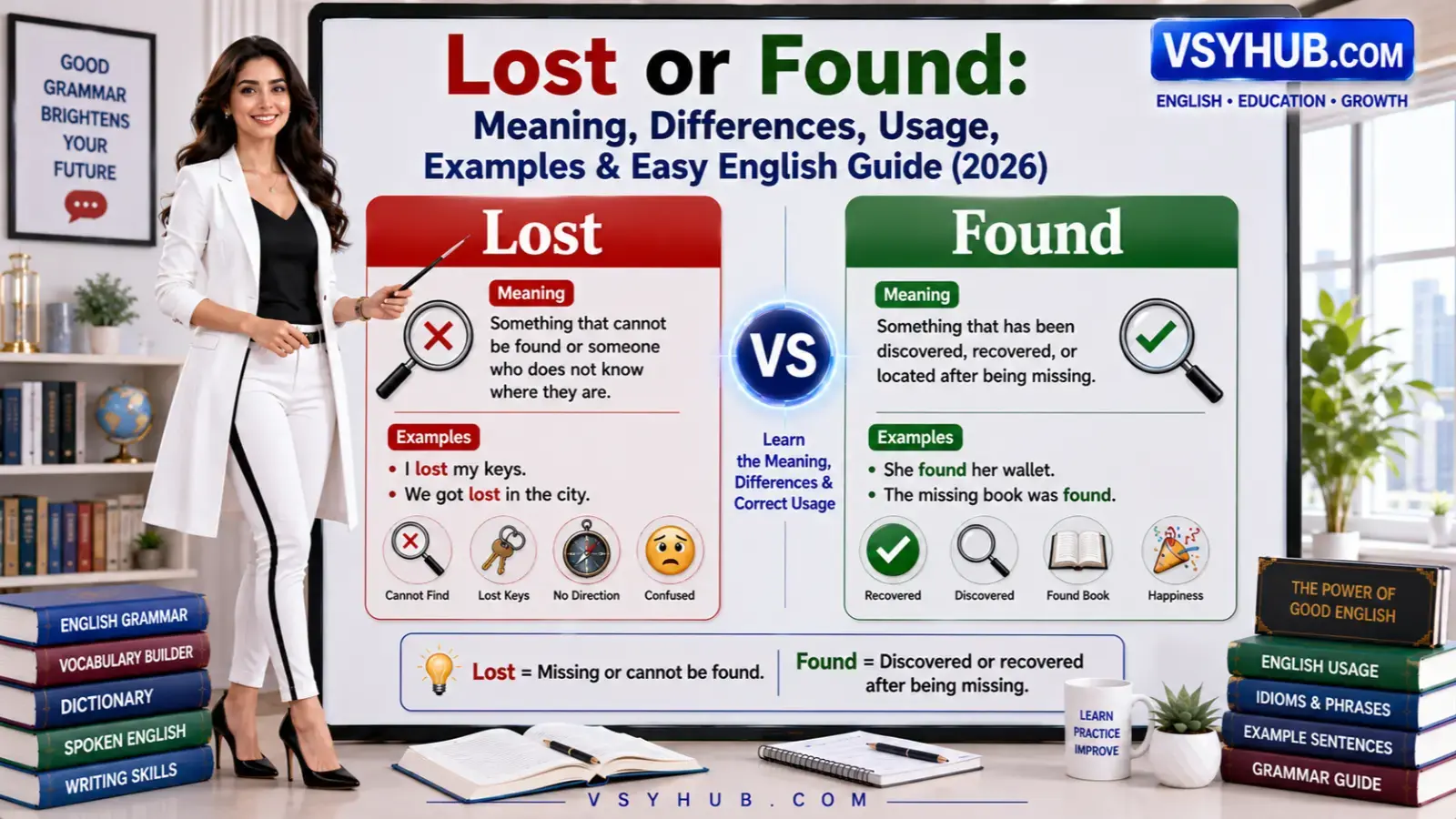
Lost and found are opposite words that describe whether something or someone is missing or has been discovered.
👉 Lost = Something is missing or cannot be found.
👉 Found = Something has been discovered or located after being missing.
Simple Meanings
- Lost means you no longer know where something is.
- Found means you have discovered something that was missing.
Examples
- ✅ I lost my phone yesterday.
- ✅ She found my keys under the sofa.
- ✅ We got lost while driving home.
- ✅ The teacher found the missing notebook.
- ✅ The dog was lost for two days before it was found.
Simple Rule
Use lost when something is missing.
Use found when something has been discovered.
Easy Memory Trick
Think of this sentence:
If you lose it, it’s lost. If you discover it, it’s found.
This simple rule works in almost every situation.
What Does Lost or Found Mean?
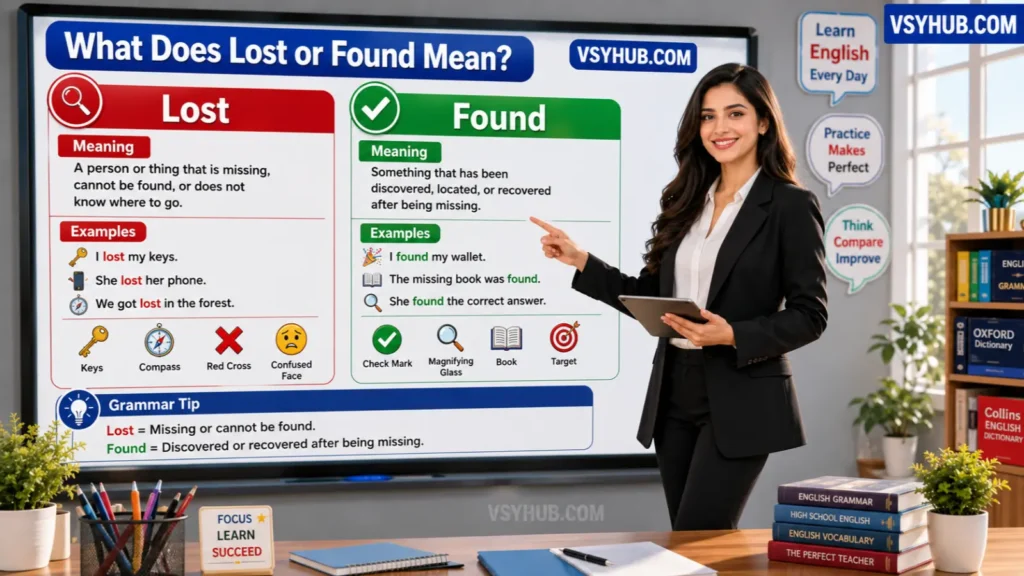
The words lost and found describe two opposite stages of the same situation. One tells us something has gone missing, while the other tells us it has been discovered.
What Does Lost Mean?
Lost is the past tense and past participle of the verb lose.
It means:
- Something cannot be located.
- Someone does not know where they are.
- An opportunity has disappeared.
- A game or competition was not won.
- Someone feels confused or unsure.
Examples:
- I lost my wallet.
- She lost the race.
- We got lost in the forest.
- He felt lost after changing schools.
- The company lost an important customer.
What Does Found Mean?
Found is the past tense and past participle of the verb find.
It means:
- Something has been discovered.
- Someone has located a missing person or object.
- New information has been discovered.
- A solution has been identified.
Examples:
- I found your glasses.
- Scientists found a new species.
- She found her passport.
- We found the correct answer.
- The police found the missing child safely.
Lost and Found Together
The phrase lost and found refers to a place where missing items are collected until their owners claim them.
Examples include:
- Airport lost and found office
- School lost and found room
- Hotel lost and found desk
- Shopping mall lost and found counter
- Train station lost and found service
Example sentence:
“The airport’s lost and found office returned my suitcase.”
Emotional Meaning
These words are also used to describe feelings.
Lost can mean:
- Confused
- Lonely
- Unsure about life
- Without direction
Example:
After graduating, he felt lost because he didn’t know what career to choose.
Found can mean:
- Feeling confident
- Discovering your purpose
- Becoming emotionally stronger
- Finding happiness
Example:
She finally found her passion for teaching.
Professional Meaning
In workplaces, these words are often used when discussing documents, equipment, or information.
Examples:
- We lost an important file.
- The IT team found the missing data.
- The manager found an error in the report.
Internet and Social Media Meaning
Online, people often write:
- Lost my password.
- Found this amazing website.
- Lost my account access.
- Found the perfect solution on YouTube.
- Lost connection.
- Found the answer on Google.
These expressions are common across social media, forums, and online communities.
Synonyms of Lost
Depending on the context, lost may mean:
- Missing
- Misplaced
- Gone
- Disappeared
- Confused
- Defeated
- Uncertain
- Vanished
Synonyms of Found
Common alternatives include:
- Discovered
- Located
- Recovered
- Identified
- Detected
- Spotted
- Retrieved
- Uncovered
Opposites
| Word | Opposite |
|---|---|
| Lost | Found |
| Missing | Located |
| Misplaced | Recovered |
| Gone | Present |
| Hidden | Discovered |
Related Terms
You may also come across these related words:
- Lose
- Find
- Missing
- Recovery
- Search
- Discovery
- Locate
- Recover
- Misplace
- Return
- Search party
- Lost property
- Lost and found
- Recovered item
Common Variations
These expressions are widely used in everyday English:
- Lost item
- Found item
- Lost property
- Lost and found office
- Found object
- Lost child
- Found safely
- Lost luggage
- Found evidence
- Lost opportunity
- Found solution
- Lost password
- Found online
The Origin of Lost or Found
The words lost and found have been part of the English language for hundreds of years.
The History of Lost
The word lose comes from Old English losian, which meant “to perish,” “be destroyed,” or “go missing.”
Over time, the past form became lost, and people began using it to describe many situations, including:
- Losing possessions
- Losing games
- Losing money
- Losing direction
- Feeling emotionally lost
Today, lost is one of the most common English words used in daily conversations.
The History of Found
The word find comes from Old English findan, meaning “to discover” or “to come across.”
Its past tense became found, which has remained unchanged for centuries.
People use found in many situations, including:
- Finding objects
- Finding answers
- Finding people
- Finding opportunities
- Finding happiness
How the Phrase “Lost and Found” Developed
As public places became busier, schools, railway stations, airports, hotels, and shopping centers needed a place to keep items that visitors accidentally left behind.
This led to the familiar phrase Lost and Found, which became a standard name for offices that store recovered belongings until owners claim them.
Today, almost every airport, university, hotel, sports stadium, and large business has a Lost and Found department.
Modern Internet Usage
The words have also become popular online.
People often search for phrases like:
- Lost my password
- Found my account
- Lost files
- Found solution
- Lost connection
- Found this helpful guide
On social media, these words are also used emotionally.
Examples include:
- “I felt lost before I started college.”
- “I finally found myself.”
- “Lost without coffee.”
- “Found my dream job.”
This shows how the meanings have expanded beyond physical objects to include emotions, relationships, careers, and personal growth.
How to Pronounce Lost or Found
Correct pronunciation helps you sound more natural in English conversations.
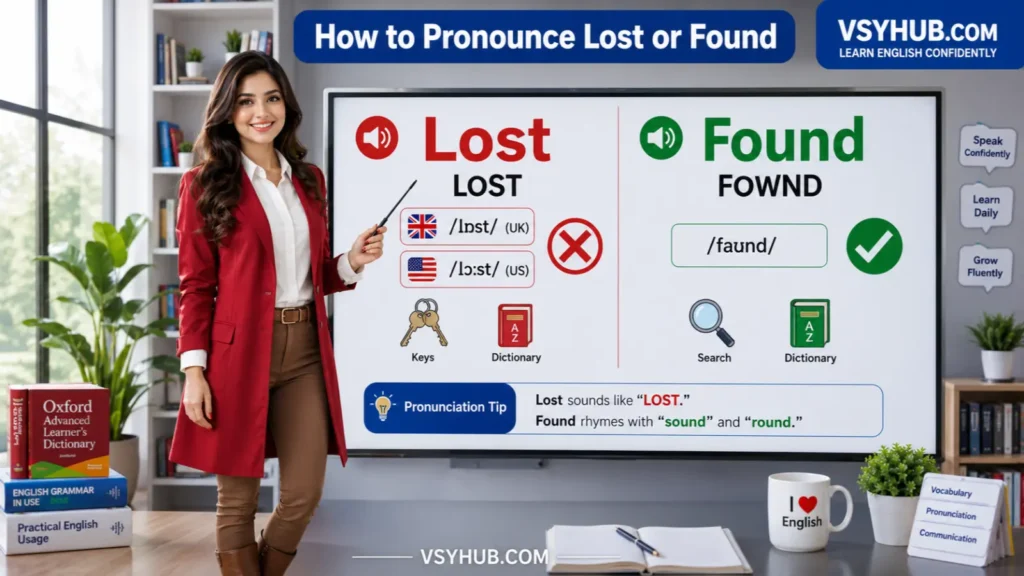
How to Pronounce Lost
Phonetic pronunciation:
lost → lawst (UK)
lost → lawst or lahst (US, depending on accent)
Syllables: 1
Speaking Tip
Stretch the o sound slightly before saying st.
Practice:
- Lost my keys.
- Lost my phone.
- Lost my way.
How to Pronounce Found
Phonetic pronunciation:
found → fownd
It rhymes with:
- Round
- Sound
- Ground
- Bound
Syllables: 1
Speaking Tip
Start with the “f” sound, then pronounce “ow” as in cow, and finish with nd.
Practice:
- Found my wallet.
- Found the answer.
- Found a new job.
Common Pronunciation Mistakes
❌ Saying lost like “loost.”
✔ Say lawst.
❌ Saying found like “foned.”
✔ Say fownd.
Reading aloud and listening to native speakers can help improve your pronunciation over time.
British English vs American English Usage
The good news is that lost and found have the same spelling and meaning in both British English and American English. The differences are mostly in accent and pronunciation.
| Feature | British English | American English | Notes |
|---|---|---|---|
| Spelling | Lost | Lost | No difference |
| Spelling | Found | Found | No difference |
| Meaning | Same | Same | Used worldwide |
| Grammar | Same | Same | Standard English |
| Pronunciation | Slightly longer vowel sounds | Accent varies by region | Meaning remains the same |
| Everyday Usage | Very common | Very common | Used in speech and writing |
| Formal Writing | Accepted | Accepted | Suitable for academic and business writing |
| Phrase “Lost and Found” | Common | Common | Used in airports, schools, hotels, and public places |
Both forms are considered correct everywhere English is spoken, so you do not need to change the spelling based on your audience.
Which One Should You Use?
Choosing between lost and found is usually easy once you know what happened.
- Use lost when something is missing or cannot be located.
- Use found when something has been discovered after being missing.
- Both words are correct, but they describe opposite situations.
- Think about the event first: Did someone lose it or find it?
Formal Usage
Both words are suitable for formal writing.
Examples:
- The company lost several important documents during the move.
- The missing files were later found in the archive.
- Researchers found new evidence during the study.
Informal Usage
In everyday conversations, people use these words naturally.
Examples:
- I lost my charger.
- We found your jacket.
- Have you found your phone yet?
- I think I’ve lost my wallet.
Academic Usage
Students often use these words in essays and assignments.
Examples:
- Scientists found a new method.
- The student lost marks because of spelling mistakes.
- Researchers found strong evidence.
Workplace Usage
These words are common in offices and businesses.
Examples:
- We lost an important client.
- The IT team found the system error.
- She found the missing report before the meeting.
Branding and Marketing Usage
Businesses also use these words in creative ways.
Examples:
- Find your perfect style.
- Never lose your confidence.
- Found by experts.
- Helping customers find solutions.
Texting Usage
People often use short, natural sentences.
Examples:
- I lost my keys 😢
- Found them! 😊
- Lost signal again.
- Finally found Wi-Fi.
Social Media Usage
These words appear in captions, comments, and hashtags.
Examples:
- Lost my favorite sunglasses today.
- Found this hidden coffee shop!
- Feeling lost lately.
- Finally found my dream career.
Quick Usage Table
| Situation | Use Lost | Use Found |
|---|---|---|
| Missing phone | ✅ | ❌ |
| Discovering a phone | ❌ | ✅ |
| Missing luggage | ✅ | ❌ |
| Recovering luggage | ❌ | ✅ |
| Losing a game | ✅ | ❌ |
| Finding a solution | ❌ | ✅ |
| Feeling confused | ✅ | ❌ |
| Discovering your purpose | ❌ | ✅ |
Quick Examples
| Sentence | Correct? |
|---|---|
| I lost my wallet. | ✅ |
| She found my wallet. | ✅ |
| We lost the match. | ✅ |
| Scientists found a cure. | ✅ |
| I found my passport. | ✅ |
Common Mistakes With Lost or Found
Many English learners confuse these words because they are closely connected. Here are the most common mistakes and how to avoid them.
Mistake 1: Using “found” instead of “lost”
❌ Incorrect:
I found my phone yesterday, but I still can’t find it.
✔ Correct:
I lost my phone yesterday, and I still can’t find it.
Why it happens:
People confuse the action of losing something with finding it.
Beginner Tip:
If the item is missing, always use lost.
Mistake 2: Using “lost” after discovering something
❌ Incorrect:
I lost my keys under the sofa.
✔ Correct:
I found my keys under the sofa.
Why it happens:
The keys are no longer missing.
Easy Tip:
If you discover it, use found.
Mistake 3: Confusing “lose” with “lost”
❌ Incorrect:
I lose my wallet yesterday.
✔ Correct:
I lost my wallet yesterday.
Explanation:
- Lose = present tense
- Lost = past tense
Mistake 4: Saying “finded”
❌ Incorrect:
I finded my glasses.
✔ Correct:
I found my glasses.
Why?
“Find” is an irregular verb.
Find → Found → Found
Mistake 5: Using “found” for emotions incorrectly
❌ Incorrect:
I found after moving to another city.
✔ Correct:
I felt lost after moving to another city.
Explanation:
“Lost” can describe emotions.
Mistake 6: Mixing up “lost” and “missing”
❌ Incorrect:
My passport is found.
✔ Correct:
My passport is missing.
OR
I lost my passport.
Mistake 7: Forgetting the phrase “Lost and Found”
❌ Incorrect:
Lost or Found Office
✔ Correct:
Lost and Found Office
This is the standard name used worldwide.
Lost or Found in Everyday Examples
These examples show how people naturally use these words in different situations.
At Work
- I lost an important document before the meeting.
- Our manager found the missing report.
- We almost lost the customer.
- The IT department found the problem quickly.
At School
- Sarah lost her homework.
- The teacher found it in the classroom.
- Tom lost his calculator.
- A classmate found it after lunch.
On Social Media
- I lost all my vacation photos.
- Finally found this amazing recipe!
- Lost my account password again.
- Found a great online course today.
In Daily Life
- Dad lost his car keys.
- Mom found them in the kitchen.
- We got lost while walking downtown.
- A local resident found the correct street for us.
In Emails
Example 1:
Hello,
I lost my ID card this morning. Please let me know if anyone has found it.
Thank you.
Example 2:
Hello,
We found your notebook in the meeting room. You can collect it at reception.
In Text Messages
Friend 1:
I lost my headphones.
Friend 2:
Really? I found a pair near the library.
Friend 1:
Can you send me a picture?
Friend 2:
Sure!
In Online Content
- How to find a lost phone.
- What to do if you lost your passport.
- Where to report found property.
- Lost and found services at airports.
In Everyday Conversations
A:
Have you seen my wallet?
B:
No, but I’ll help you look for it.
Later…
B:
Good news! I found it under your chair.
Lost or Found in Different Contexts
Understanding different contexts helps you use these words naturally in real life.
Education
Students often lose books, pens, homework, and ID cards.
Examples:
- She lost her notebook.
- The librarian found it yesterday.
- The school has a Lost and Found room.
Business
Businesses use these words for inventory, customers, and company records.
Examples:
- The company lost an important contract.
- The finance team found an accounting error.
- We found a better solution.
Workplace Communication
Employees often use these words in meetings and emails.
Examples:
- We lost access to the server.
- IT found the issue.
- The report was lost during the transfer.
Technology
Technology companies frequently use these terms.
Examples:
- Lost internet connection.
- Found a software bug.
- Lost password.
- Found a security issue.
Internet and Online Services
These words are everywhere online.
Examples:
- Lost account access.
- Found my login details.
- Lost Wi-Fi signal.
- Found the answer on Google.
Social Media
People often use these words emotionally.
Examples:
- Feeling lost today.
- Finally found happiness.
- Lost motivation.
- Found my confidence again.
Psychology and Personal Growth
Here, the words describe emotions rather than objects.
Lost may mean:
- Confused
- Lonely
- Without direction
- Emotionally overwhelmed
Example:
He felt lost after leaving college.
Found often means:
- Discovering purpose
- Becoming confident
- Feeling happier
- Understanding yourself better
Example:
She found a career she truly enjoys.
Relationships
People also use these words when talking about love and friendships.
Examples:
- I felt lost without my best friend.
- He found true love.
- She found someone who understands her.
Marketing and Branding
Businesses use these words to create emotional connections.
Examples:
- Find your perfect home.
- Never lose hope.
- Found by professionals.
- Helping customers find answers.
Travel
Travelers often experience these situations.
Examples:
- Lost luggage
- Found passport
- Lost tourist
- Found hotel
- Lost route
- Found the correct destination
Healthcare
Healthcare workers may use these words when discussing records or test results.
Examples:
- The hospital found the patient’s report.
- The clinic lost an old file.
- Doctors found the cause of the illness.
Lost or Found – Google Trends & Usage Data
The keyword lost or found remains popular because people experience these situations every day. Some users want to understand the meanings of the words, while others are looking for help after losing something valuable.
Searches increase when people need quick answers about grammar, everyday English, or practical problems like lost phones, passports, luggage, or passwords.
People from the United States, United Kingdom, India, Pakistan, Canada, and Australia frequently search for topics related to lost, found, and lost and found because these words are used in schools, workplaces, travel, customer service, and daily conversations.
Why People Search for “Lost or Found”
- They want to understand the difference between the two words.
- They need help using the correct word in a sentence.
- They are searching for a lost item.
- They want to know how “Lost and Found” services work.
- They are learning English grammar.
- They are writing emails, assignments, or social media posts.
Popular Long-Tail Searches
People often search for questions like:
- What is the difference between lost and found?
- Lost or found meaning in English.
- How do you use lost and found in a sentence?
- What is a lost and found office?
- Lost vs found with examples.
- Is found the opposite of lost?
- How to pronounce lost and found.
- Lost and found grammar explained.
- What should I do if I lost my passport?
- How can I report a found item?
These conversational searches show that users want simple, practical answers, making beginner-friendly explanations especially valuable.
Comparison Table: Lost or Found
| Feature | Lost | Found |
|---|---|---|
| Basic Meaning | Missing or no longer located | Discovered after being missing |
| Verb Origin | Past tense of lose | Past tense of find |
| Opposite Word | Found | Lost |
| Pronunciation | lawst | fownd |
| Number of Syllables | 1 | 1 |
| Grammar Role | Past tense and past participle | Past tense and past participle |
| Emotional Meaning | Confused, lonely, uncertain | Confident, discovered, purposeful |
| Everyday Usage | Very common | Very common |
| Academic Writing | Correct | Correct |
| Professional Writing | Correct | Correct |
| Social Media | Frequently used | Frequently used |
| Common Phrase | Lost luggage | Found property |
| Common Mistake | Confused with “lose” | Confused with “finded” |
| Internet Usage | Lost password, lost connection | Found solution, found account |
| Typical Situation | Something disappears | Something is discovered |
Lost or Found in Professional Life
The words lost and found are common in professional communication. Employees, managers, teachers, customer service teams, and business owners use them every day. Using the correct word helps avoid confusion and makes your writing clear.
Workplace Communication
At work, these words often describe documents, equipment, information, customers, or business opportunities.
Examples:
- We lost an important client last month.
- The finance team found an error in the report.
- I lost the meeting notes.
- Our assistant found the missing contract.
Business Emails
Using the correct word makes emails more professional.
Example:
Subject: Lost Company ID Card
Hello Team,
I have lost my company ID card. Please let me know if anyone has found it.
Thank you.
Example:
Hello,
We found your laptop charger in the conference room. You can collect it from the reception desk.
Customer Service
Customer support teams regularly use these terms.
Examples:
- Lost parcel
- Found package
- Lost order information
- Found your account details
Human Resources (HR)
HR departments may use these words when handling employee records or office items.
Examples:
- An employee lost their access card.
- Security found the card near the entrance.
Professional Writing Tips
- Use lost only when something is missing.
- Use found only after something has been discovered.
- Avoid mixing the two in the same situation unless you are describing the full sequence of events.
Example:
✅ I lost my phone yesterday, but I found it this morning.
Lost or Found for Students or Beginners
Many beginners find these words confusing because they are connected. However, they become easy once you remember that they describe opposite actions.
Why Beginners Struggle
Common reasons include:
- Confusing lose with lost
- Forgetting that found is the past tense of find
- Mixing physical and emotional meanings
- Translating directly from another language
Easy Learning Tips
- Learn the verbs together:
- Lose → Lost
- Find → Found
- Practice with simple sentences every day.
- Read signs that say Lost and Found in schools, airports, or shopping malls.
- Listen to native English speakers using these words.
Beginner Shortcuts
Ask yourself one question:
Is it still missing?
- Yes → Lost
- No, someone discovered it → Found
Practice Sentences
Fill in the blanks:
- I ______ my wallet yesterday.
- She ______ my wallet this morning.
- We got ______ on our trip.
- They ______ the correct answer.
Answers:
- lost
- found
- lost
- found
Signs, Characteristics, or Common Uses Related to Lost or Found
1 Common Uses of “Lost”
- Losing keys
- Losing a phone
- Losing luggage
- Losing a game
- Losing money
- Losing direction
- Feeling emotionally lost
- Losing internet connection
- Losing access to an account
Common Uses of “Found”
- Finding keys
- Finding a wallet
- Finding an answer
- Finding evidence
- Finding a solution
- Finding a job
- Finding confidence
- Finding a new hobby
- Finding missing information
Common Writing Situations
You may use these words in:
- School assignments
- Business emails
- Reports
- Social media posts
- Text messages
- Travel documents
- Customer support chats
- News articles
- Online forums
Online Usage Patterns
People often search for:
- Lost password
- Lost account
- Lost luggage
- Found phone
- Found documents
- Lost and Found office
- Lost pet
- Found pet
Industries That Frequently Use These Words
- Education
- Aviation
- Hospitality
- Retail
- Banking
- Healthcare
- Technology
- Logistics
- Customer Service
- Law Enforcement
Simple Trick to Remember Lost or Found
Here’s the easiest memory rule:
Lost = Missing
Found = Discovered
If something disappears, it is lost.
If someone discovers it, it is found.
Think of It This Way
Imagine dropping your backpack at school.
- You cannot see it anymore.
- It is lost.
Later, your teacher brings it to you.
- It has been found.
This simple story helps you remember the difference every time.
Another Memory Shortcut
Think of these pairs:
- Lose → Lost
- Find → Found
The verbs always stay together.
Expert Tips
These practical tips will help you use lost and found correctly in speaking and writing.
Read the Entire Sentence
Before choosing a word, ask yourself whether the item is still missing or has already been discovered.
Learn Common Word Pairs
Practice these expressions:
- Lost luggage
- Lost property
- Lost password
- Lost opportunity
- Found evidence
- Found solution
- Found safely
- Lost and Found office
Learning these phrases makes English feel more natural.
Practice With Real-Life Situations
Think about your daily routine.
Examples:
- Have you ever lost your keys?
- Have you found money on the street?
- Have you lost your homework?
- Have you found a great book?
Creating personal examples helps you remember faster.
Listen and Repeat
Watch English videos or listen to podcasts. Pause and repeat sentences that use lost and found. This improves both pronunciation and confidence.
Proofread Before Sending
Before sending an email or assignment, quickly check:
- Is the item still missing?
- If yes, use lost.
- If it has been discovered, use found.
This simple habit prevents common mistakes.
Related Searches People Also Ask
Here are some common questions people search for, along with simple answers.
What is the difference between lost and found?
Lost means something is missing. Found means it has been discovered.
Is found the opposite of lost?
Yes. They are opposite words.
What does “Lost and Found” mean?
It is a place where missing items are kept until their owners collect them.
How do I use lost in a sentence?
Example:
“I lost my umbrella on the bus.”
How do I use found in a sentence?
Example:
“We found the missing notebook.”
Is lost an adjective or a verb?
It can be both. It is the past tense of lose, and it can also describe a person or thing that is missing or confused.
Why do people feel lost?
People may feel lost when they are uncertain, lonely, or unsure about what to do next.
Can found describe ideas?
Yes. You can say:
“We found a better solution.”
What should I do if I lose something?
Report it to the nearest Lost and Found office or contact the place where you last saw it.
How can I improve my use of lost and found?
Read English regularly, practice writing sentences, and remember the simple rule:
Missing = Lost. Discovered = Found.
FAQs
Is “lost or found” grammatically correct?
Yes. It is correct when comparing the two words or asking whether something is missing or has been discovered.
What is the difference between “lose” and “lost”?
Lose is the present tense, while lost is the past tense and past participle.
What is the past tense of “find”?
The past tense of find is found.
Is “found” always the opposite of “lost”?
Yes, in most everyday situations.
Can “lost” describe feelings?
Yes. Someone can feel lost, meaning confused or without direction.
Can “found” describe emotions?
Yes. People often say they found happiness, found confidence, or found their purpose.
Is “Lost and Found” always capitalized?
It is usually capitalized when referring to the official office or department. In general writing, lowercase is also acceptable unless it is part of a title.
Where do we usually see “Lost and Found”?
At schools, airports, hotels, shopping malls, train stations, offices, and sports venues.
Are “lost” and “found” irregular verbs?
They are forms of irregular verbs:
- Lose → Lost
- Find → Found
How can I remember the difference forever?
Remember this sentence:
If it’s missing, it’s lost. If it’s discovered, it’s found.
Final Verdict
The difference between lost and found is simple once you understand their meanings.
- Lost means something is missing or cannot be located.
- Found means something has been discovered after being missing.
The easiest memory rule is:
Lose → Lost
Find → Found
Whenever you are unsure, ask yourself:
Is it still missing, or has someone discovered it?
The answer will tell you which word to use.
Conclusion
Understanding lost or found is an important step toward speaking and writing English more confidently. Although these words are opposites, they often appear together in everyday life, from school and work to travel, shopping, technology, and social media. Once you know that lost describes something missing and found describes something discovered, choosing the correct word becomes much easier.
Keep practicing with real-life examples, pay attention to common phrases like Lost and Found, and read English regularly. The more you see these words in context, the more natural they will feel.

Aria Foster is a comparison and language writer who specializes in spelling differences, word meanings, grammar guides, and easy-to-understand language explanations. She creates clear, reader-friendly content that helps people understand commonly confused words and expressions.