When you see numbers like 5 and 8, you may wonder which one is greater or less than the other.
This is a common beginner question in school, homework, exams, coding, and everyday math.
People usually search for greater or less than meaning, symbols, examples, usage, definition, and the difference between > and <.
In this guide, you’ll learn the meaning, pronunciation, examples, usage, grammar rules, common mistakes, expert tips, and simple explanations in easy English.
Greater or Less Than – Quick Answer
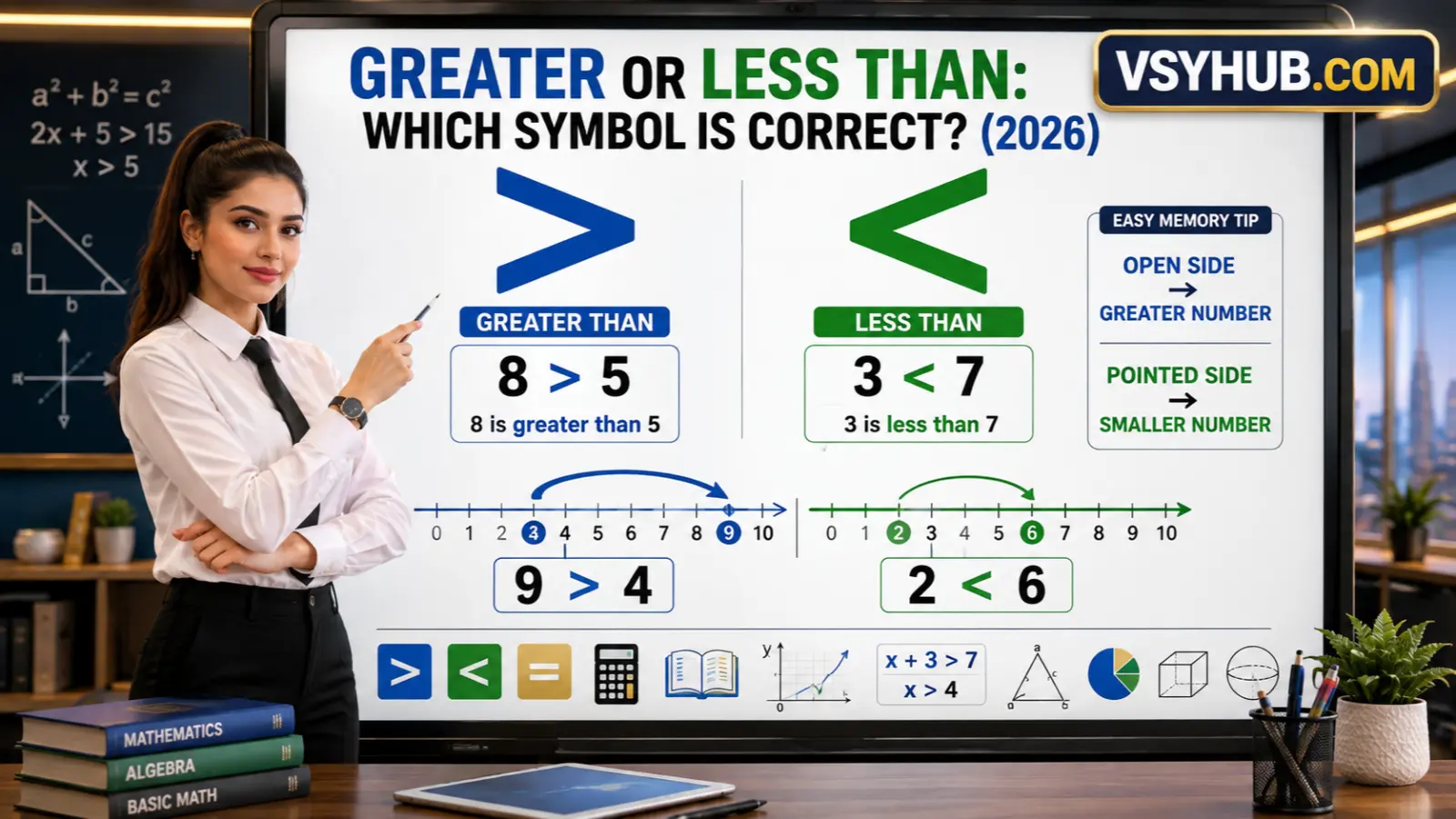
Greater than means a number has a higher value than another number.
👉 > = greater than
Less than means a number has a lower value than another number.
👉 < = less than
Simple Examples
8 > 5
Read it as: Eight is greater than five.
3 < 7
Read it as: Three is less than seven.
10 > 2
Read it as: Ten is greater than two.
Easy Memory Trick
Think of the symbol as a hungry mouth:
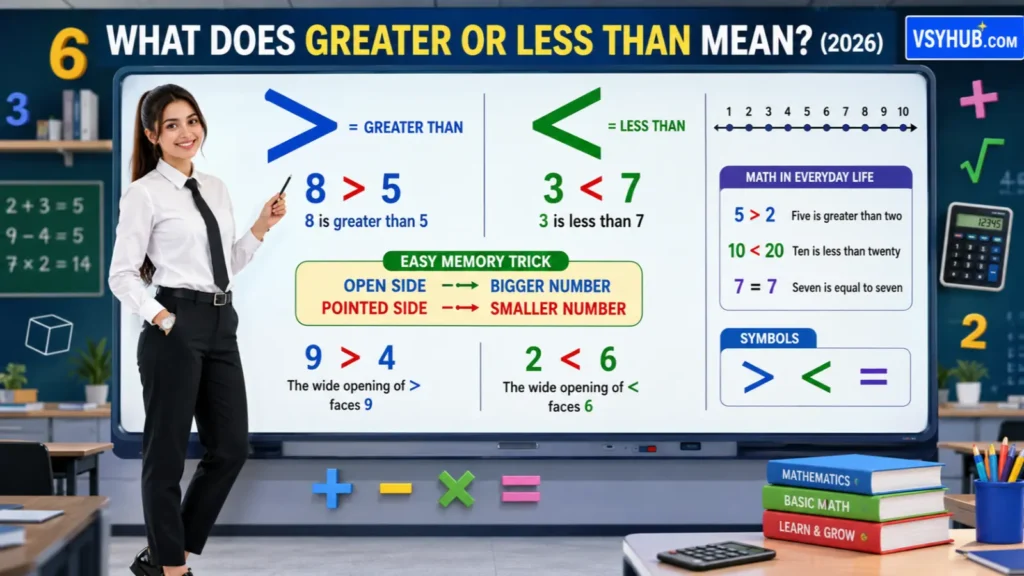
👉 The wide, open side always faces the greater number.
So:
9 > 4
The open side faces 9 because 9 is greater.
What Does Greater or Less Than Mean?
The phrase greater or less than is used when comparing two numbers, amounts, values, measurements, or quantities.
If one value is bigger, we say it is greater than another value.
For example:
15 > 10
This means 15 has a higher value than 10.
If one value is smaller, we say it is less than another value.
For example:
6 < 12
This means 6 has a lower value than 12.
Synonyms
Greater than can be understood as:
- Bigger than.
- More than.
- Higher than.
- Larger than.
Less than can be understood as:
- Smaller than.
- Lower than.
- Fewer than.
- Under.
Opposites
The main opposites are:
- Greater than ↔ Less than.
- More than ↔ Less than.
- Larger than ↔ Smaller than.
- Higher than ↔ Lower than.
Related Terms
You may also see equal to (=), greater than or equal to (≥), and less than or equal to (≤).
These symbols help compare numbers more precisely.
The Origin of Greater or Less Than
The mathematical symbols > and < were introduced in the 17th century. English mathematician Thomas Harriot is commonly credited with introducing these comparison symbols in his mathematical work.
The symbols made mathematical comparisons shorter and easier to write.
Instead of writing:
Eight is greater than five
we can simply write:
8 > 5
Likewise:
4 < 9
quickly tells us that 4 is less than 9.
Today, these symbols are used worldwide in mathematics, science, statistics, programming, spreadsheets, and technology.
How to Pronounce Greater or Less Than
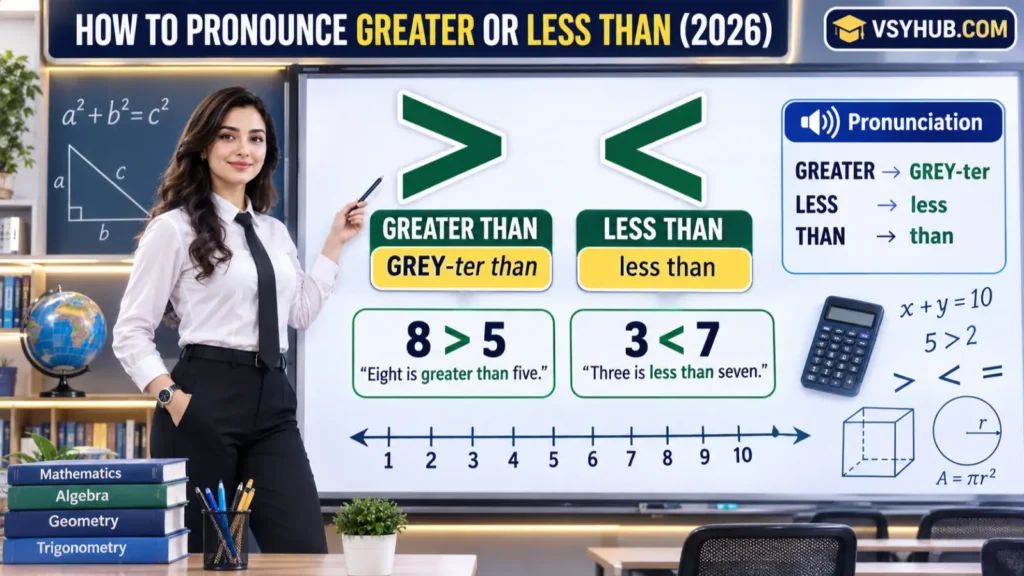
The phrase greater than is pronounced approximately:
GREY-ter than
The phrase less than is pronounced:
LESS than
The symbols themselves are usually read aloud using their mathematical names.
For example:
7 > 3
Read:
Seven is greater than three.
And:
2 < 6
Read:
Two is less than six.
Common Pronunciation Mistake
Some beginners know the symbols but struggle when reading them aloud. Remember that > is called greater than, while < is called less than.
British English vs American English Usage
There is no major difference between British and American English when using greater than and less than in mathematics.
| Feature | British English | American English | Notes |
|---|---|---|---|
| Greater than | Used | Used | Same meaning |
| Less than | Used | Used | Same meaning |
| > symbol | Used | Used | Same mathematical symbol |
| < symbol | Used | Used | Same mathematical symbol |
| Equal to | Used | Used | Same meaning |
| Mathematical usage | Standard | Standard | No major difference |
The mathematical rules are international, so students in the UK, US, India, Pakistan, Canada, and Australia generally learn the same comparison symbols.
Which One Should You Use?
Use > when the number on the left is greater.
12 > 8
Use < when the number on the left is smaller.
5 < 11
Use = when both values are exactly the same.
7 = 7
For professional, academic, and mathematical writing, always use the correct symbol and make sure the comparison is logically accurate.
Quick Usage Table
| Statement | Correct Symbol |
|---|---|
| 9 is greater than 4 | 9 > 4 |
| 3 is less than 8 | 3 < 8 |
| 6 equals 6 | 6 = 6 |
| 20 is greater than 15 | 20 > 15 |
| 2 is less than 5 | 2 < 5 |
Common Mistakes With Greater or Less Than
Mistake 1: Reversing the Symbols
❌ 3 > 9
✔ 3 < 9
Three is smaller than nine, so the open side must face 9.
Mistake 2: Thinking the Pointed Side Faces the Bigger Number
❌ Thinking the sharp point always faces the greater number.
✔ The wide opening faces the greater number.
Mistake 3: Reading the Symbol Backward
❌ 8 < 2 means “eight is greater than two.”
✔ 8 > 2 means eight is greater than two.
Read from left to right.
Mistake 4: Confusing Less Than With Greater Than
❌ “Five is greater than ten.”
✔ “Five is less than ten.”
Compare the actual values before choosing a symbol.
Mistake 5: Forgetting Zero
Beginners sometimes think zero is always the smallest number.
For example:
0 < 4
is correct, but:
0 > -3
is also correct because zero is greater than negative three.
Mistake 6: Comparing Digits Instead of Numbers
Consider:
25 > 9
Although 9 is a single digit, 25 is still the greater number.
Always compare the complete numbers.
Greater or Less Than in Everyday Examples
Work
A company may compare sales:
$5,000 > $3,000
This means $5,000 in sales is greater than $3,000.
School
A teacher may write:
18 > 12
Students learn that 18 is greater than 12.
Social Media
Someone may compare followers:
10,000 > 7,500
The first account has more followers.
Daily Life
If one box weighs 8 kg and another weighs 5 kg:
8 kg > 5 kg
Emails
A business report might say:
“Last month’s sales were greater than this month’s sales.”
Text Messages
Someone might casually write:
20 > 15 😂
meaning 20 is bigger or better in the comparison being discussed.
Online Content
Websites, calculators, educational apps, and quizzes often use >, <, and = to compare values.
Conversations
You might hear:
“Is 100 greater than 75?”
Yes. 100 > 75.
Greater or Less Than in Different Contexts
Education
Greater-than and less-than symbols are basic parts of elementary mathematics. Students use them when comparing whole numbers, decimals, fractions, and measurements.
Business
Businesses compare prices, revenue, sales, costs, profits, and performance.
For example:
Revenue > Costs
can show that revenue is higher than costs.
Technology and Programming
Comparison operators are also important in programming.
A programmer may use conditions such as:
age > 18
This can mean the program should check whether the value of age is greater than 18.
Programming languages may use symbols such as >, <, >=, and <=.
Writing and Communication
In normal writing, it is often clearer to say greater than or less than when explaining a comparison to beginners.
In mathematical work, symbols are faster and more compact.
Greater or Less Than – Google Trends and Usage Data
People search for greater or less than because the symbols can look very similar, especially when students first learn them.
Common searches include:
- What does greater than mean?
- What does less than mean?
- Which symbol means greater than?
- Which symbol means less than?
- Is 5 greater than 3?
- How do you remember greater than and less than?
- What does the sideways V mean in math?
- How do you read > and <?
These questions can come from students, parents, teachers, and adult learners.
Search interest is also naturally connected with school mathematics and online homework. Users in the US, UK, India, Pakistan, Canada, and Australia may search similar questions because the basic mathematical symbols are widely used internationally.
Comparison Table: Greater or Less Than
| Feature | Greater Than | Less Than |
|---|---|---|
| Symbol | > | < |
| Meaning | Higher value | Lower value |
| Example | 9 > 4 | 4 < 9 |
| Read as | Greater than | Less than |
| Open side | Faces greater number | Faces greater number |
| Pointed side | Faces smaller number | Faces smaller number |
| School usage | Very common | Very common |
| Professional usage | Common | Common |
| Programming usage | Common | Common |
| Main confusion | Symbol direction | Symbol direction |
Greater or Less Than in Professional Life
These symbols are useful beyond school.
Businesses use comparisons when working with:
- Sales figures.
- Budgets.
- Prices.
- Employee numbers.
- Website traffic.
- Marketing results.
- Customer data.
- Financial reports.
- Performance statistics.
For example:
Website traffic this month > website traffic last month
means traffic increased compared with the previous value.
In professional writing, accuracy matters because reversing a comparison can completely change the meaning of a report.
Greater or Less Than for Students and Beginners
Beginners often struggle because > and < look almost identical.
The easiest solution is not to memorize the shapes separately. Instead, remember the rule:
The open mouth faces the greater number.
For example:
2 < 9
The opening faces 9.
9 > 2
The opening still faces 9.
This works even when the numbers change.
Fractions and Decimals
The same idea works with decimals and fractions.
0.8 > 0.5
And:
1/4 < 3/4
The important thing is to compare the actual values.
Signs, Characteristics, and Common Uses Related to Greater or Less Than
You will commonly see these symbols when:
- Comparing two numbers.
- Comparing prices.
- Comparing measurements.
- Solving math problems.
- Reading statistics.
- Writing inequalities.
- Studying algebra.
- Checking age requirements.
- Working with percentages.
- Writing computer conditions.
- Analyzing business data.
- Comparing test scores.
The symbols can appear in textbooks, worksheets, calculators, spreadsheets, websites, apps, and software.
Simple Trick to Remember Greater or Less Than
Here is the easiest trick:
Imagine the symbol is a hungry alligator.
The alligator wants to eat the bigger number.
So:
8 > 3
The mouth opens toward 8.
And:
3 < 8
The mouth still opens toward 8.
Think of It This Way
Wide opening = greater number.
Point = smaller number.
You do not actually need to remember an alligator. Just remember that the open side faces the larger value.
Expert Tips for Greater or Less Than
Tip 1: Read the Whole Sentence
Do not look at the symbol alone. Read the comparison from left to right.
Tip 2: Compare Before Choosing
Ask yourself:
“Which number is bigger?”
Then place the opening toward that number.
Tip 3: Practice With Small Numbers
Start with:
2 and 5
Then try:
7 and 3
After that, practice with decimals, fractions, and negative numbers.
Tip 4: Check Your Answer
If you write 4 > 10, stop and check it. Since 4 is smaller, the correct statement is 4 < 10.
Tip 5: Remember Equal
Not every comparison is greater or less.
If both values are the same:
6 = 6
Related Searches People Also Ask
What does the greater-than symbol mean?
The > symbol means the number on the left is greater than the number on the right.
What does the less-than symbol mean?
The < symbol means the number on the left is smaller than the number on the right.
Which way does the greater-than sign point?
The open side faces the greater number, while the pointed side faces the smaller number.
Is 5 greater than 3?
Yes. 5 > 3 because 5 has a higher value than 3.
Is 2 less than 7?
Yes. 2 < 7 because 2 has a lower value than 7.
What does ≥ mean?
It means greater than or equal to.
What does ≤ mean?
It means less than or equal to.
How can I remember > and <?
Remember that the wide opening faces the greater number.
FAQs
Is greater than the same as more than?
In many basic number comparisons, yes. For example, 10 is greater than 6 means 10 is more than 6.
What is the difference between greater than and less than?
Greater than describes a higher value, while less than describes a lower value.
How do you read 7 < 12?
You read it as seven is less than twelve.
How do you read 15 > 9?
You read it as fifteen is greater than nine.
Can greater than and less than be used with decimals?
Yes. For example, 2.5 > 1.8.
Can these symbols be used with negative numbers?
Yes. For example, -2 > -5 because -2 is closer to zero and therefore has the greater value.
What is the easiest way to remember the symbols?
Let the open side face the bigger number. The pointed side faces the smaller number.
Are the symbols the same in British and American English?
Yes. The mathematical symbols > and < have the same meaning in both varieties of English.
Final Verdict
Greater than = >
Less than = <
Equal to = =
The easiest rule is:
👉 The wide opening faces the greater number.
For example:
10 > 4
and:
4 < 10
Both statements express the same comparison.
Conclusion
Understanding greater or less than becomes easy once you stop trying to memorize the symbols separately. First compare the two values, decide which one is bigger, and then point the open side toward the greater number.
Remember the simple trick: the open side faces the bigger number, and the point faces the smaller number. With a little practice, you will quickly recognize >, <, and = in schoolwork, business data, technology, and everyday comparisons.

Mk Azam is a Master’s graduate, content writer, and contributor at VsyHub.com. He enjoys creating clear, engaging, and informative content across a variety of topics. With a strong focus on accuracy and readability, he helps readers find practical insights and easy-to-understand information. His goal is to deliver valuable content that informs, educates, and inspires.