When you see ≥ in a math problem, online lesson, or spreadsheet, it can look confusing at first.
Many beginners wonder what the greater than or equal sign means and how to read it correctly.
This symbol is common in school mathematics, statistics, programming, business, science, and everyday data.
People usually search for: keyword meaning, definition, examples, usage, grammar difference, and how to type the symbol.
In this guide, you’ll learn the meaning, pronunciation, examples, usage, grammar rules, common mistakes, expert tips, and simple explanations in easy English.
Greater Than or Equal Sign – Quick Answer
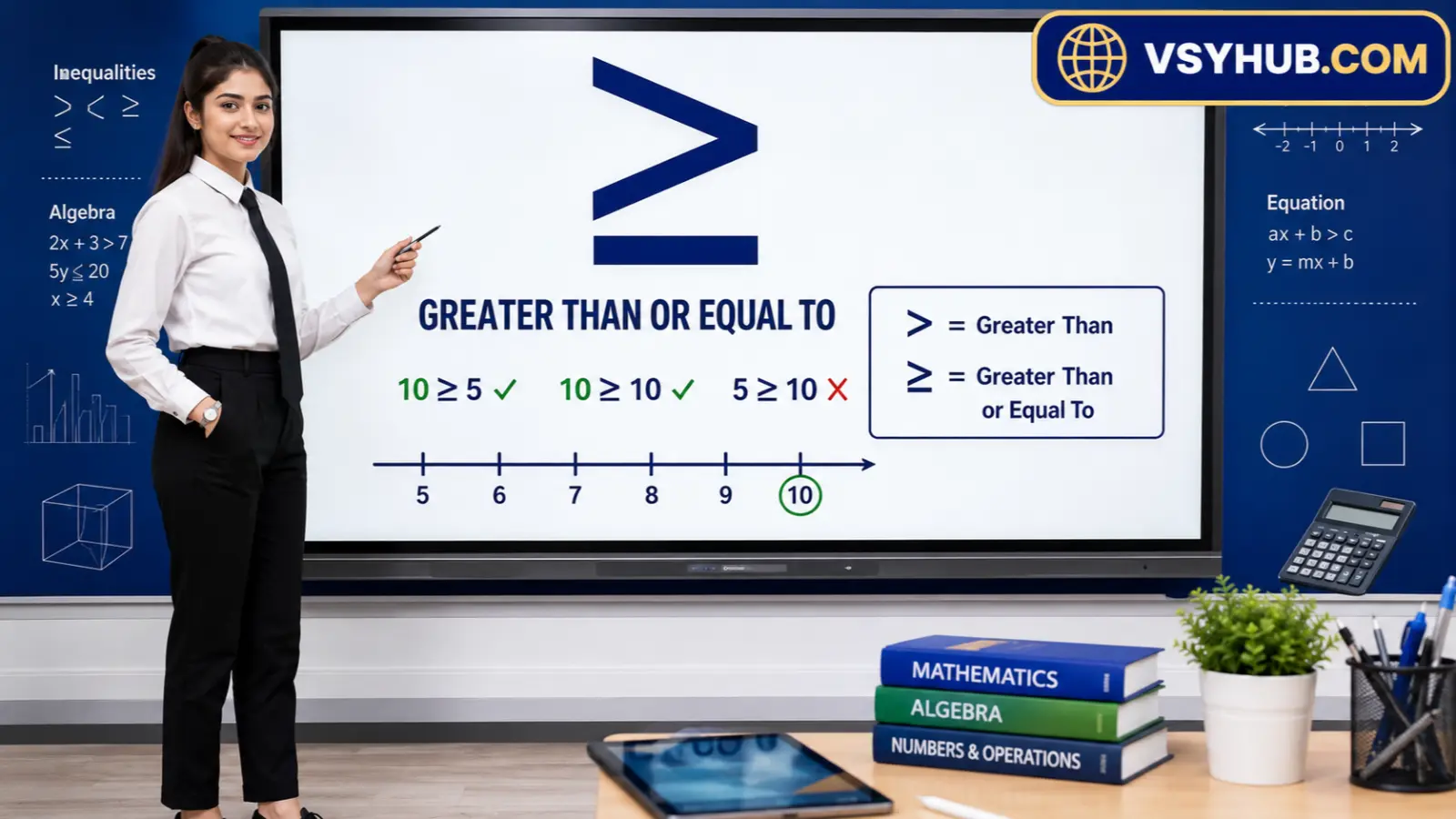
The greater than or equal sign (≥) means that one number or value is greater than another value or exactly the same as it.
👉 ≥ = greater than or equal to
For example:
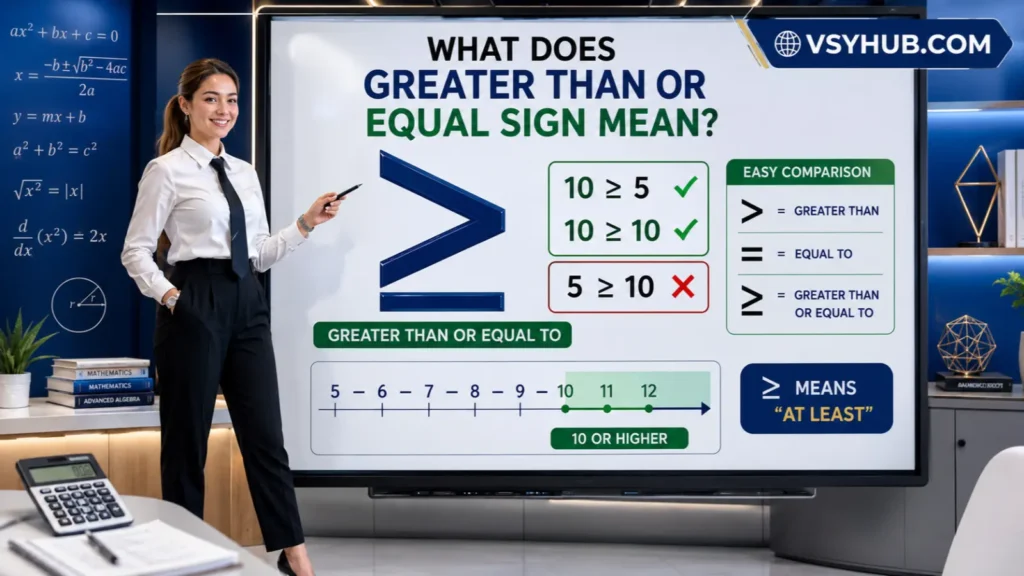
8 ≥ 5 means 8 is greater than 5. ✅
8 ≥ 8 means 8 is equal to 8. ✅
5 ≥ 8 is false because 5 is not greater than or equal to 8. ❌
Simple Rule
The symbol ≥ includes two ideas:
- > means greater than.
- = means equal to.
- ≥ means greater than or equal to.
Easy Memory Trick
Look at the symbol as an open mouth pointing toward the larger value. The extra horizontal line underneath means “or equal.”
So, whenever you see ≥, think:
“Greater than, or exactly the same.”
What Does Greater Than or Equal Sign Mean?
The greater than or equal sign is a mathematical comparison symbol. It tells us that the value on the left side is greater than or equal to the value on the right side.
For example:
10 ≥ 7
This is true because 10 is greater than 7.
Now consider:
10 ≥ 10
This is also true because both numbers are equal.
The important point is that ≥ allows equality. This makes it different from the simple greater than sign >.
Synonyms
There are several ways to express the same idea in words:
- Greater than or equal to
- At least
- No less than
- Equal to or greater than
- Minimum of
For example, x ≥ 20 can mean “x is at least 20.”
Opposites
The opposite comparison is generally expressed with ≤, which means less than or equal to.
Related Terms
Common mathematical symbols related to ≥ include:
- > greater than
- < less than
- = equal to
- ≤ less than or equal to
- ≠ not equal to
Common Variations
In plain text, people may write:
>=
This is commonly used in programming and computer systems to represent ≥.
The Origin of Greater Than or Equal Sign
The greater than and less than symbols developed from mathematical notation used to compare quantities. The basic > and < symbols became widely used in mathematics after their introduction in the seventeenth century.
The equal sign = was introduced earlier in the development of modern mathematical notation.
The combined symbol ≥ developed as mathematicians needed a simple way to express both conditions: a value could be larger or exactly equal.
Today, ≥ is widely used in algebra, geometry, statistics, economics, science, engineering, programming, and data analysis.
How to Pronounce Greater Than or Equal Sign
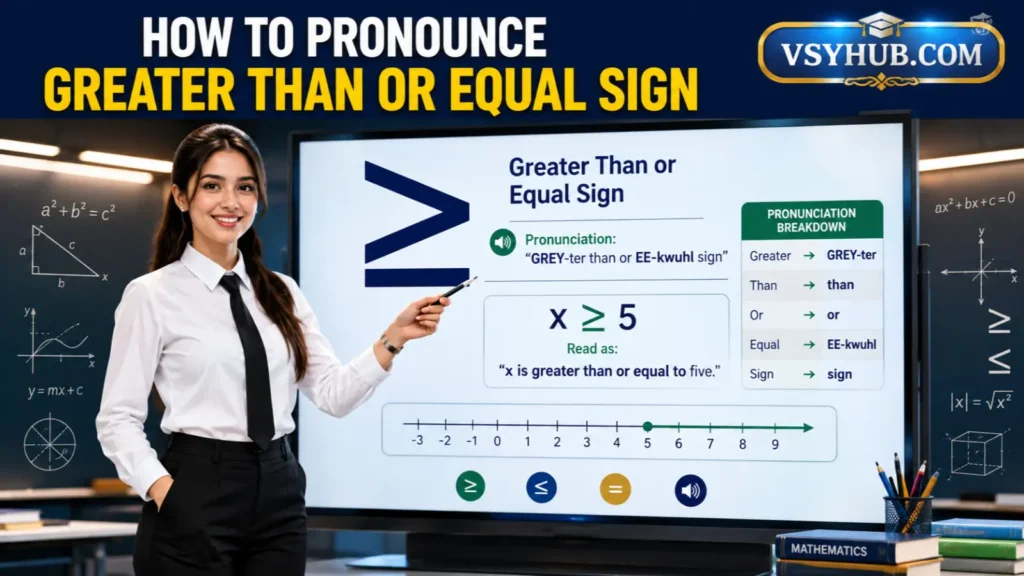
The symbol ≥ is pronounced:
“greater than or equal to”
For example:
x ≥ 5
Read it as:
“x is greater than or equal to five.”
You can also say:
“x is at least five.”
Easy Speaking Trick
Break the phrase into three parts:
greater + than + or equal to
Do not pronounce the symbol as simply “greater than.” The bottom line is important because it adds the equal to condition.
A common mistake is reading ≥ as “greater or equal.” In casual speech this may be understood, but “greater than or equal to” is the standard mathematical expression.
British English vs American English Usage
There is no major British-American difference in the meaning of ≥. The mathematical symbol works the same way in both forms of English.
| Feature | British English | American English | Notes |
|---|---|---|---|
| Symbol | ≥ | ≥ | Same symbol |
| Meaning | Greater than or equal to | Greater than or equal to | Same |
| Pronunciation | Greater than or equal to | Greater than or equal to | Same |
| Short phrase | At least | At least | Same |
| Academic use | Very common | Very common | Same |
| Professional use | Common | Common | Same |
The symbol has the same mathematical meaning worldwide.
Which One Should You Use?
Use ≥ when you need to show that a value can be larger than another value or exactly the same.
In academic writing
Use the standard symbol when working with equations, inequalities, statistics, and mathematical formulas.
Example:
Students must score ≥ 70% to pass.
In professional writing
The symbol is useful in reports, charts, spreadsheets, and technical documents.
Example:
A minimum age of ≥ 18 years is required.
In texting or plain typing
If the symbol is difficult to type, >= may be used in digital systems.
Example:age >= 18
However, in polished mathematical writing, ≥ is usually clearer.
Common Mistakes With Greater Than or Equal Sign
Mistake 1
❌ 5 ≥ 10
✔ This statement is false because 5 is less than 10.
Correction tip: Check the value on the left before deciding whether the comparison is true.
Mistake 2
❌ Reading ≥ as only “greater than.”
✔ Read it as “greater than or equal to.”
The bottom line matters.
Mistake 3
❌ Thinking ≥ means “equal only.”
✔ It allows two possibilities: greater than or equal to.
Mistake 4
❌ Confusing ≥ with ≤.
✔ ≥ points toward the greater side, while ≤ means less than or equal to.
Mistake 5
❌ Saying 7 ≥ 7 is false.
✔ It is true because the two values are equal.
Mistake 6
❌ Treating > and ≥ as exactly the same.
✔ > does not allow equality. ≥ does.
Mistake 7
❌ Writing the symbol backward.
✔ Remember that the wider opening faces the larger value, while the horizontal line adds the idea of equality.
Greater Than or Equal Sign in Everyday Examples
The symbol is not limited to classroom math. You can find it in many real-life situations.
Work
A company might write:
Experience ≥ 3 years
This means applicants need at least three years of experience.
School
A teacher may write:
Score ≥ 80%
This means a student needs a score of 80% or higher.
Social Media
A content creator could describe a goal as:
Followers ≥ 10,000
This means the target is 10,000 followers or more.
Daily Life
A sign might state:
Age ≥ 18
This means people must be 18 or older.
Emails
A technical email might say:
“Please select a file size ≥ 10 MB.”
This means 10 MB or larger.
Text Messages
Someone might write:
“Need a score ≥ 90 to qualify.”
This means a score of 90 or higher is required.
Online Content
Websites often use ≥ when explaining prices, requirements, measurements, or technical specifications.
Conversations
People may translate the symbol into simple words:
“You need at least five points.”
That has the same basic meaning as points ≥ 5.
Greater Than or Equal Sign in Different Contexts
Education
In mathematics, ≥ is used to teach inequalities. Students learn that a comparison can include equality as well as a larger value.
Business
Businesses use it for minimum requirements, sales targets, employee experience, budgets, and performance standards.
Example:
Revenue ≥ $50,000 means revenue must be $50,000 or higher.
Technology and Programming
Programmers commonly use:
>=
instead of ≥ because programming languages usually use keyboard-friendly operators.
For example:
if age >= 18
means the condition is true when age is 18 or greater.
Statistics
Researchers use ≥ to describe ranges and conditions.
Example:
Age ≥ 65 means people aged 65 and above.
Finance
Financial reports may use the symbol to describe minimum investment amounts, interest rates, or financial thresholds.
Greater Than or Equal Sign – Google Trends and Usage Data
People search for greater than or equal sign when they encounter the symbol ≥ in homework, spreadsheets, programming, calculators, mathematical formulas, or online lessons.
Common long-tail searches include:
- What does ≥ mean?
- What is the greater than or equal sign?
- How do you type the greater than or equal symbol?
- How do you use ≥ in math?
- What does ≥ mean in an equation?
- Greater than or equal to examples
- Greater than or equal sign in keyboard
- Greater than or equal sign in Excel
- Greater than or equal sign in programming
Searches can come from students, teachers, programmers, office workers, and beginners in countries such as the US, UK, India, Pakistan, Canada, and Australia.
Voice searches often sound like:
“What does the greater than or equal sign mean?”
or
“How do I read this symbol in math?”
Comparison Table: Greater Than or Equal Sign
| Feature | Greater Than or Equal Sign |
|---|---|
| Symbol | ≥ |
| Plain-text version | >= |
| Meaning | Greater than or equal to |
| Allows equality? | Yes |
| Allows greater values? | Yes |
| Pronunciation | Greater than or equal to |
| Opposite symbol | ≤ |
| Mathematical role | Inequality |
| Programming version | >= |
| Common use | Math, science, business, statistics |
| Beginner phrase | At least |
Greater Than or Equal Sign in Professional Life
Understanding ≥ can help in professional communication because many workplaces use numbers, targets, conditions, and minimum requirements.
For example:
Salary ≥ $50,000
means the salary is $50,000 or more.
Performance ≥ 90%
means performance must reach at least 90%.
In business reports, spreadsheets, data dashboards, engineering documents, and technical writing, these symbols can make information shorter and easier to scan.
The main rule is simple: make sure your audience understands the symbol. In general business communication, writing “at least 90%” may be clearer for non-technical readers.
Greater Than or Equal Sign for Students or Beginners
Beginners often struggle because the symbols >, <, ≥, and ≤ look similar.
Start by learning these four:
- > = greater than
- < = less than
- ≥ = greater than or equal to
- ≤ = less than or equal to
Then practice with simple numbers.
9 ≥ 4 → True.
9 ≥ 9 → True.
4 ≥ 9 → False.
The easiest shortcut is to remember that ≥ includes the equal line.
Common Uses of Greater Than or Equal Sign
You will commonly see ≥ in:
- Algebra equations
- Inequalities
- Statistics
- Science formulas
- School assignments
- Business reports
- Financial calculations
- Data analysis
- Engineering
- Research papers
- Technical documentation
- Computer programming
- Spreadsheets
- Online calculators
The symbol is especially useful when describing a minimum value or threshold.
Simple Trick to Remember Greater Than or Equal Sign
Think of ≥ as saying:
“The number must reach this point or go higher.”
For example:
Age ≥ 18
Think:
18 or older.
Score ≥ 80
Think:
80 or higher.
Price ≥ $100
Think:
$100 or more.
Think of it this way
The first part of ≥ says greater than, while the horizontal line says equal is also allowed.
That gives you the complete meaning:
Greater + equal = greater than or equal to.
Expert Tips for Using Greater Than or Equal Sign
A useful proofreading trick is to replace ≥ with the words “at least.”
If the sentence still makes sense, you probably understand the symbol correctly.
For example:
x ≥ 25
becomes:
x is at least 25.
Another helpful tip is to check the equality case. Ask yourself:
“Would this statement still be true if both numbers were exactly the same?”
If yes, ≥ may be appropriate.
In programming, remember that >= normally represents the same comparison.
Related Searches People Also Ask
What does ≥ mean?
It means greater than or equal to.
What is another way to say ≥?
You can often say “at least” or “no less than.”
Is ≥ greater than or equal to?
Yes. The symbol means the first value is greater than or equal to the second value.
What is the difference between > and ≥?
The > symbol means greater than only. The ≥ symbol also allows the two values to be equal.
What does x ≥ 5 mean?
It means x is 5 or greater.
What is the opposite of ≥?
The opposite comparison is ≤, meaning less than or equal to.
How do you read ≥?
Read it as “greater than or equal to.”
What does >= mean?
In plain text and programming, >= commonly represents the same idea as ≥.
Can equal numbers use ≥?
Yes. For example, 6 ≥ 6 is true.
Why is the equal line under the symbol?
The horizontal line shows that equality is included in the comparison.
FAQs
Is the greater than or equal sign ≥?
Yes. ≥ is the standard greater than or equal sign.
How do I remember the greater than or equal sign?
Remember that the extra horizontal line means “equal is allowed.”
Is 10 greater than or equal to 10?
Yes. 10 ≥ 10 is true because the values are equal.
Is 10 greater than or equal to 12?
No. 10 ≥ 12 is false because 10 is smaller than 12.
What does ≥ mean in algebra?
It creates an inequality showing that one expression is greater than or equal to another.
What does ≥ mean in programming?
In many programming languages, the keyboard version >= means greater than or equal to.
Is “at least” the same as ≥?
Usually, yes. For example, at least 50 means 50 or more, which can be written as ≥ 50.
What is the difference between ≥ and =?
= means the two values are equal. ≥ means the first value can be greater than the second or equal to it.
Final Verdict
The greater than or equal sign (≥) means “greater than or equal to.” It allows the value on the left to be larger than the value on the right or exactly the same.
The easiest memory rule is:
≥ = greater than + equal to = at least
So x ≥ 10 means x is 10 or higher.
Conclusion
The greater than or equal sign may look like a small mathematical symbol, but it has an important job. It helps us compare numbers while allowing equality. You will see ≥ in mathematics, schoolwork, statistics, business, science, finance, spreadsheets, and programming.
Remember the simple rule: ≥ means “greater than or equal to.” If you can replace it with “at least,” you will usually understand its meaning correctly.
The final memory trick is easy: the open side points toward the greater value, and the bottom line says equal is allowed.

Mk Azam is a Master’s graduate, content writer, and contributor at VsyHub.com. He enjoys creating clear, engaging, and informative content across a variety of topics. With a strong focus on accuracy and readability, he helps readers find practical insights and easy-to-understand information. His goal is to deliver valuable content that informs, educates, and inspires.