When someone says, “I’m working hard,” they mean they are putting in a lot of effort. But “I’m hardly working” can mean almost the opposite.
This small word change often confuses English learners because both phrases look very similar.
You may see them at work, in school, in emails, texting, social media, or funny internet posts.
People usually search for the working hard or hardly working meaning, grammar difference, examples, pronunciation, and correct usage.
In this guide, you’ll learn the meaning, pronunciation, examples, usage, grammar rules, common mistakes, expert tips, and simple explanations in easy English.
Working Hard or Hardly Working – Quick Answer
👉 Working hard = putting a lot of effort into your work.
👉 Hardly working = working very little or almost not working.
The difference comes from hard and hardly.
Example:
“She is working hard to finish the project.” ✅
She is putting in a lot of effort.
Example:
“He is hardly working today.” ✅
He is doing very little work.
Simple Rule:
1👉 Hard = with great effort.
2👉 Hardly = almost not.
Easy Memory Trick
Think of hard as strong effort and hardly as almost not.
If your boss says, “You are working hard,” that is usually praise. If someone jokes, “You are hardly working,” they may be saying you are not doing much.

What Does Working Hard or Hardly Working Mean?
Working hard means making a strong effort to complete a task, reach a goal, solve a problem, or improve something.
For example:
- “Sarah is working hard for her exams.”
- “Our team is working hard on the new website.”
- “He has been working hard all week.”
Hardly working means working very little, almost not working, or doing less work than expected.
For example:
- “I was so tired that I was hardly working.”
- “He spends more time on his phone than working.”
- “The employee was hardly working during the afternoon.”
The phrase hardly working can also be humorous. A person relaxing at their desk might post a picture with the caption, “Hard at work—or hardly working?”
Synonyms
For working hard:
- making an effort
- working diligently
- putting in effort
- being productive
- working seriously
For hardly working:
- doing very little
- barely working
- almost not working
- being unproductive
- slacking off
Opposites
The opposite of working hard can be hardly working in the right context.
Other related terms include working efficiently, staying productive, putting in effort, taking a break, slacking, and being busy.
The Origin of Working Hard or Hardly Working
The word hard has been used in English for centuries to describe something difficult, strong, or requiring effort. Over time, it also developed the meaning of doing something with great effort.
The word hardly developed differently. In modern English, hardly is an adverb meaning almost not or barely.
This is why hard and hardly cannot normally be treated as simple forms of the same word.
The phrase “hardly working” became especially popular in humorous workplace language. It is often used as a joke when someone looks busy but is actually relaxing, chatting, browsing the internet, or avoiding work.
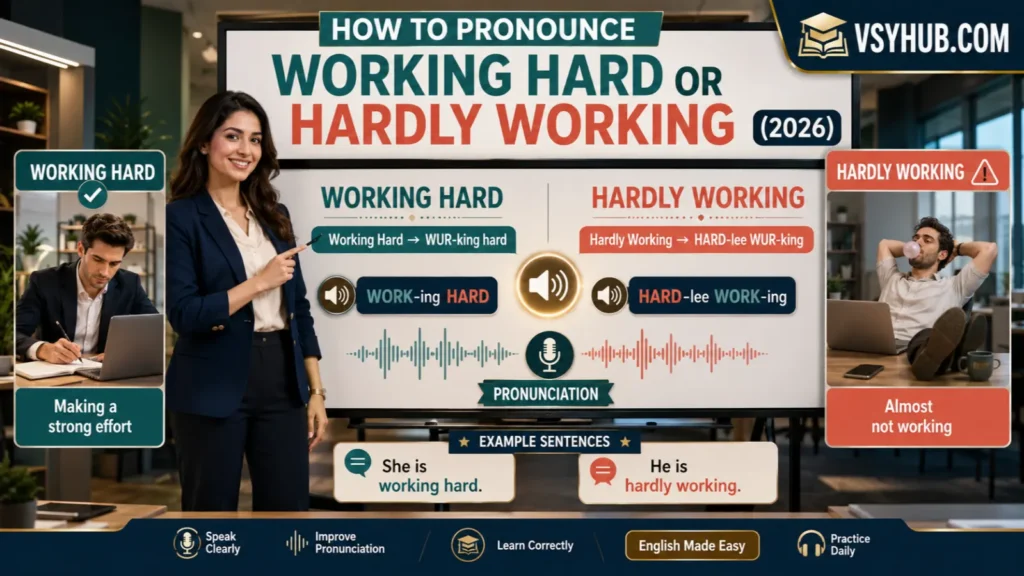
How to Pronounce Working Hard or Hardly Working
The pronunciation is fairly simple.
Working → WUR-king
Hard → hard
Hardly → HARD-lee
So:
Working hard → WUR-king hard
Hardly working → HARD-lee WUR-king
A common mistake is to pronounce hardly as if it simply means “hard.” Remember that hardly has an extra -lee sound.
British English vs American English Usage
The difference between working hard and hardly working is basically the same in British and American English.
| Feature | British English | American English | Notes |
|---|---|---|---|
| Working hard | Common | Common | Means making a lot of effort |
| Hardly working | Common | Common | Means doing very little work |
| Meaning | Same | Same | No major difference |
| Pronunciation | Slight variation | Slight variation | Meaning stays clear |
| Workplace use | Common | Common | Context determines tone |
| Informal use | Very common | Very common | Often humorous |
There is no major spelling difference between British and American English here.
Which One Should You Use?
Use working hard when you want to say that someone is making a serious effort.
- “I’m working hard to meet the deadline.”
- “She is working hard at school.”
- “They are working hard on the project.”
Use hardly working when you mean someone is doing almost no work.
- “He is hardly working today.”
- “The old machine is hardly working.”
- “I was hardly working because I felt exhausted.”
Quick Usage Guide
| Situation | Best phrase |
|---|---|
| Praising someone | Working hard |
| Talking about effort | Working hard |
| Saying someone does little work | Hardly working |
| Workplace joke | Hardly working |
| Professional report | Working hard |
| Casual social media caption | Either, depending on meaning |
Common Mistakes With Working Hard or Hardly Working
Mistake 1: Treating “hardly” as “very hard”
❌ “She hardly studied, so she prepared very well.”
✔ “She studied hard, so she prepared very well.”
Explanation: Hardly means almost not, so it does not mean “very hard.”
Correction tip: Replace hardly with almost not in your mind.
Mistake 2: Using “hardly” to praise effort
❌ “You are hardly working! Great job!”
✔ “You are working hard! Great job!”
Explanation: Working hard shows strong effort. Hardly working suggests little effort.
Mistake 3: Confusing “hard” with “hardly”
❌ “I have hardly worked all day.”
✔ “I have worked hard all day.”
The first sentence can suggest you did almost no work. The second clearly says you worked with effort.
Mistake 4: Assuming “hardly” is just a stronger form of “hard”
It is not. Hardly changes the meaning completely.
Mistake 5: Using “hardly working” in a serious compliment
“Hardly working” normally does not praise productivity. In a professional setting, use working hard when you mean strong effort.
Working Hard or Hardly Working in Everyday Examples
Work
“I’m working hard to finish this report before Friday.”
School
“Ali is working hard for his final exams.”
Social Media
“Monday morning and I’m hardly working. I need coffee!”
Daily Life
“I was hardly working because I was feeling sick.”
“Our team is working hard to complete the requested changes.”
Text Message
“Are you working hard or hardly working today?”
Online Content
The phrase is often used in memes, captions, and humorous workplace posts.
Conversation
“Looks like you’re working hard!”
“Actually, I’m hardly working today!”
Working Hard or Hardly Working in Different Contexts
Workplace Communication
Working hard is useful when discussing effort, deadlines, projects, and performance.
Example: “The development team is working hard to launch the product.”
Hardly working is usually informal and can sound critical or playful.
Education
Students can say they are working hard when studying, practicing, or preparing for exams.
“Maria is working hard to improve her English.”
Social Media
“Hardly working” is popular in funny captions because it creates a contrast between looking busy and actually doing little.
Relationships and Daily Communication
Friends may use the phrase jokingly:
“You said you were working hard, but you’re watching movies!”
“Hey, I’m hardly working!”
The meaning depends heavily on tone and context.
Working Hard or Hardly Working – Google Trends and Usage
People search for this phrase because hard and hardly are easy to confuse. English learners often want to know if the phrases have the same meaning.
Common searches include:
- working hard or hardly working meaning
- working hard vs hardly working
- what does hardly working mean
- is hardly working correct English
- working hard meaning
- hardly working meaning
- hard vs hardly grammar
- working hard examples
- hardly working examples
- how to use hardly in a sentence
These searches can come from the US, UK, India, Pakistan, Canada, and Australia. The phrase is also common in online workplace humor and social media captions.
For voice search, people may ask, “What is the difference between working hard and hardly working?” The simplest answer is that working hard means making a lot of effort, while hardly working means doing almost no work.
Comparison Table: Working Hard or Hardly Working
| Feature | Working Hard | Hardly Working |
|---|---|---|
| Meaning | Making strong effort | Doing very little |
| Grammar | Verb + adverb | Adverb + verb |
| Tone | Positive | Often negative or humorous |
| Professional use | Very common | Usually informal |
| Academic use | Common | Less common |
| Social media | Common | Very common |
| Main idea | High effort | Little effort |
| Example | “She works hard.” | “She hardly works.” |
Working Hard or Hardly Working in Professional Life
In professional communication, working hard is normally the safer phrase.
You can write:
“Our team is working hard to meet the deadline.”
“The marketing department is working hard on the campaign.”
“Employees are working hard to improve customer service.”
Be careful with hardly working because it can suggest poor performance.
For example:
“He is hardly working on the project.”
This may sound like criticism. In a formal email or performance review, choose your words carefully.
Working Hard or Hardly Working for Students and Beginners
English learners often struggle with these phrases because adding -ly changes the meaning.
A useful shortcut is:
hard = strong effort
hardly = almost not
Compare:
“I work hard.” → I put in a lot of effort.
“I hardly work.” → I do very little work.
This tiny difference can completely change the message.
Common Uses and Patterns
You will commonly see working hard when talking about:
- exams
- careers
- projects
- deadlines
- business goals
- personal improvement
- fitness
- learning new skills
You will commonly see hardly working in:
- jokes
- memes
- casual conversations
- workplace humor
- social media captions
- playful messages
Simple Trick to Remember Working Hard or Hardly Working
Think of it this way:
Hard = MORE effort.
Hardly = ALMOST NO effort.
Imagine two workers.
Worker A is typing, planning, solving problems, and meeting deadlines. You can say:
“She is working hard.”
Worker B is watching videos, checking social media, and avoiding tasks. You might joke:
“He is hardly working.”
That mental picture makes the difference easy to remember.
Expert Tips for Using Working Hard or Hardly Working
1. Tip: Remember that hardly often has a negative meaning.
2. Tip: In professional writing, use working hard when describing strong effort.
3. Tip: Do not assume adding -ly simply makes an adjective stronger.
4. Tip: Read the complete sentence before choosing hard or hardly.
5. Tip: If you can replace the word with almost not, hardly is probably correct.
6. Tip: If you mean with great effort, use hard.
Related Searches People Also Ask
What does working hard mean?
It means putting a lot of effort into a task or goal.
What does hardly working mean?
It means working very little or almost not working.
Is hardly working grammatically correct?
Yes. It is grammatically correct when you mean someone or something is doing very little work.
Does hardly mean very hard?
No. Hardly usually means almost not or barely.
Is working hard positive?
Yes. It normally suggests effort, dedication, and productivity.
Is hardly working negative?
It can be negative because it suggests little effort, but it is also often used jokingly.
Can I use hardly working in an email?
You can, but it is usually better for informal communication. In professional emails, use clearer wording.
What is an easy way to remember the difference?
Remember: hard = lots of effort; hardly = almost no effort.
FAQs
Is “working hard” correct English?
Yes. “Working hard” is standard English and means making a strong effort.
Is “hardly working” correct English?
Yes. It means working very little or almost not working.
Which is better: working hard or hardly working?
Neither is always better. Working hard is positive, while hardly working describes little effort and can be humorous.
Why do hard and hardly have different meanings?
English words ending in -ly do not always have a simple “more” meaning. Hardly developed its own meaning: almost not.
Can “hardly working” describe a machine?
Yes. For example, “My old laptop is hardly working” means the laptop is barely functioning.
Can I say “I am working hardly”?
This is usually incorrect if you mean “I am working with great effort.” Say “I am working hard.”
What is the difference between “I work hard” and “I hardly work”?
“I work hard” means you put in a lot of effort. “I hardly work” means you do very little work.
Final Verdict
Working hard and hardly working have very different meanings.
👉 Working hard = putting in a lot of effort.
👉 Hardly working = doing almost no work.
The easiest memory rule is hard means strong effort, while hardly means almost not.
Conclusion
Working hard or hardly working can look like a small grammar difference, but the meaning changes completely. If you are talking about effort, productivity, studying, business, or reaching a goal, working hard is the phrase you usually want. If you mean someone is doing very little work, hardly working is correct.
Remember this simple trick: hard = a lot, hardly = almost not. Once you learn that difference, you can use both phrases confidently in conversations, emails, schoolwork, and social media.

Mk Azam is a Master’s graduate, content writer, and contributor at VsyHub.com. He enjoys creating clear, engaging, and informative content across a variety of topics. With a strong focus on accuracy and readability, he helps readers find practical insights and easy-to-understand information. His goal is to deliver valuable content that informs, educates, and inspires.