Have you ever seen someone write flakey while another person writes flaky and wondered which one is correct?
This confusion is common in school assignments, workplace emails, social media posts, online reviews, and daily conversations.
People usually search for flakey or flaky meaning, correct spelling, pronunciation, examples, usage, and grammar difference because they want to write confidently and avoid mistakes.
In this guide, you’ll learn the meaning, pronunciation, examples, usage, grammar rules, common mistakes, expert tips, and simple explanations in easy English.
Flakey or Flaky – Quick Answer
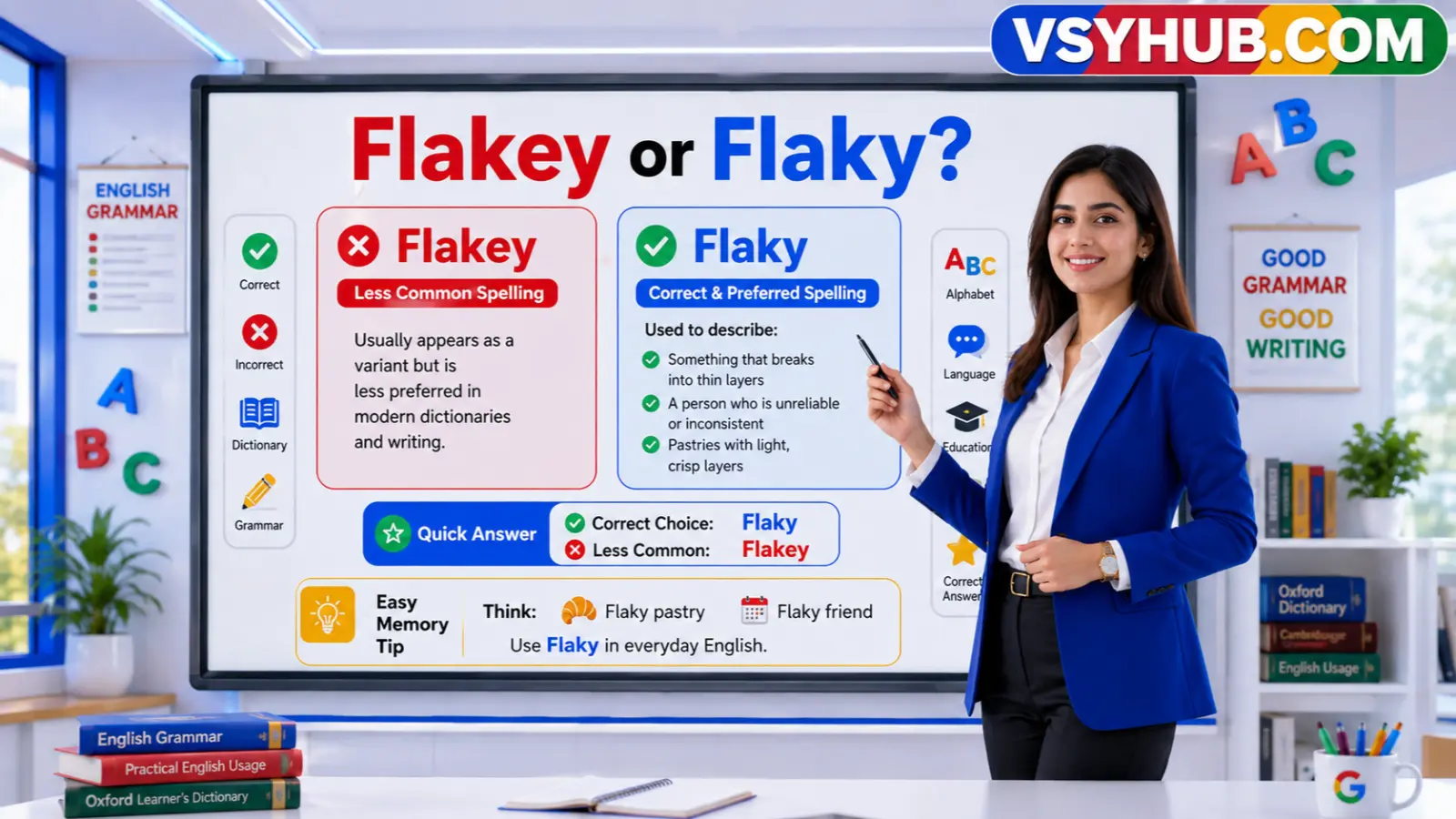
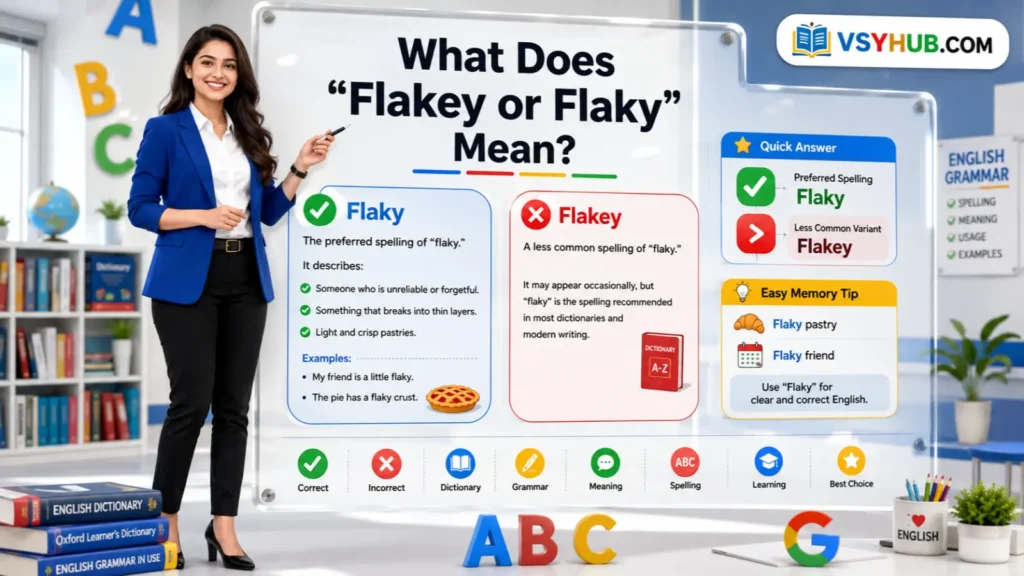
👉 Flaky = The standard and preferred spelling.
It describes someone or something that easily breaks into thin pieces or someone who is unreliable or inconsistent.
👉 Flakey = An accepted variant spelling, but it is much less common.
Most dictionaries recognize flakey as an alternative spelling, but flaky is preferred in modern English, especially in professional writing.
Examples
✅ The pie has a flaky crust.
✅ He is sometimes flaky and forgets appointments.
⚠️ The pie has a flakey crust. (Less common but accepted.)
Simple Rule
👉 Remember: “Flaky” is the spelling you’ll see most often in dictionaries, books, and professional writing.
What Does Flakey or Flaky Mean?
The word flaky has more than one meaning depending on the situation.
Physical Meaning
It describes something that easily separates into small, thin pieces.
Examples include:
- Flaky pastry
- Flaky paint
- Flaky skin
- Flaky snow
Personal Meaning
When describing a person, flaky means unreliable, forgetful, or inconsistent.
Example:
Sarah is talented, but she can be a little flaky about meeting deadlines.
Informal Meaning
In casual English, people also use flaky to describe someone who changes plans often or cannot be depended on.
Professional Meaning
In workplaces, calling someone flaky usually suggests they fail to keep promises or complete tasks consistently.
Synonyms
- Unreliable
- Inconsistent
- Unpredictable
- Forgetful
- Fragile
- Crumbly
- Brittle
Opposites
- Reliable
- Dependable
- Consistent
- Trustworthy
- Strong
- Stable
Related Terms
- Crispy
- Crumbly
- Brittle
- Dependable
- Responsible
- Consistent
Common Variations
- Flaky skin
- Flaky scalp
- Flaky pastry
- Flaky friend
- Flaky employee
- Flaky behavior
The Origin of Flakey or Flaky
The word flake has existed in English for hundreds of years and originally referred to a small, thin piece that breaks away from a larger object.
The adjective flaky developed from this noun by adding the suffix -y, meaning “full of flakes” or “having flakes.”
Later, English speakers began using flaky metaphorically to describe people whose behavior was inconsistent or unreliable.
The spelling flakey appeared later as an alternative form, but flaky became the dominant spelling in newspapers, books, dictionaries, websites, and modern English.

How to Pronounce Flakey or Flaky
Pronunciation
Flaky
Phonetic: FLAY-kee
IPA: /ˈfleɪ.ki/
Syllables
Flay • kee
Easy Speaking Trick
Say “play”, then replace the P with FL.
Play → Flay → Flaky
Common Pronunciation Mistakes
❌ Flack-ee
✔ Flay-kee
British English vs American English Usage
| Feature | British English | American English | Notes |
|---|---|---|---|
| Preferred spelling | Flaky | Flaky | Same |
| Alternative spelling | Flakey (rare) | Flakey (rare) | Less common |
| Pronunciation | Same | Same | No major difference |
| Meaning | Same | Same | Identical usage |
Both British and American English strongly prefer flaky.
Which One Should You Use?
For almost every situation, choose flaky.
Use flaky for:
- Academic writing
- School assignments
- Business emails
- Workplace communication
- Professional reports
- News articles
- Blogs
- Social media
- Everyday conversations
Mini Usage Table
| Situation | Best Choice |
|---|---|
| School | Flaky |
| Workplace | Flaky |
| Business | Flaky |
| Social Media | Flaky |
| Text Messages | Flaky |
| Academic Writing | Flaky |
Common Mistakes With Flakey or Flaky
Mistake 1
❌ He is a flakey worker.
✔ He is a flaky worker.
People often choose flakey because it looks similar to words ending in -ey.
Mistake 2
❌ This bread is very flakey.
✔ This bread is very flaky.
Professional writing almost always prefers flaky.
Mistake 3
❌ Flakey is the only correct spelling.
✔ Flaky is preferred, while flakey is an accepted variant.
Some learners think only one spelling exists.
Mistake 4
❌ Flaky always means weak.
✔ Flaky can describe food, skin, paint, weather, or unreliable people.
The meaning changes with context.
Mistake 5
❌ Every dictionary rejects flakey.
✔ Many dictionaries list flakey as an alternative spelling.
However, flaky remains the recommended choice.
Mistake 6
❌ Flaky only describes food.
✔ It also describes behavior, personality, skin, paint, and many other things.
Flakey or Flaky in Everyday Examples
Work
Our manager thinks unreliable employees seem flaky.
School
The science project became flaky because the paint dried.
Social Media
That influencer is flaky about posting videos.
Daily Life
The pie has a flaky crust.
Emails
Thank you for confirming the meeting. I didn’t want to seem flaky.
Text Messages
Sorry! I know I’ve been flaky lately.
Online Content
Many beauty articles discuss flaky skin.
Conversations
Don’t worry. He’s friendly, just a little flaky sometimes.
Flakey or Flaky in Different Contexts
In Education
Teachers encourage students to use flaky because it is the standard spelling.
In Business
Calling a coworker flaky suggests they are unreliable, so use the word carefully and professionally.
In Health
Doctors often discuss flaky skin, flaky scalp, or flaky patches when explaining skin conditions.
In Food
Bakers love a flaky texture in pastries, biscuits, croissants, and pie crusts.
In Writing
Editors recommend using flaky for consistency and professionalism.
On Social Media
Users often describe people as flaky when they cancel plans repeatedly.
Flakey or Flaky – Google Trends & Usage Data
People search flakey or flaky because they are unsure which spelling is correct.
The confusion is especially common among English learners in the:
- United States
- United Kingdom
- India
- Pakistan
- Canada
- Australia
Popular searches include:
- Is flakey correct?
- Flaky meaning
- Flaky pronunciation
- Flaky vs flakey
- Flaky person meaning
- Flaky skin meaning
- How do you spell flaky?
- Why is flaky spelled this way?
The standard spelling flaky appears much more frequently in books, dictionaries, websites, and professional writing.
Comparison Table: Flakey or Flaky
| Feature | Flaky | Flakey |
|---|---|---|
| Standard spelling | Yes | No |
| Accepted variant | No | Yes |
| Dictionary recognition | Yes | Yes |
| Professional writing | Recommended | Less common |
| Academic writing | Recommended | Usually avoided |
| Everyday usage | Very common | Rare |
| Pronunciation | Same | Same |
| Meaning | Same | Same |
| Internet popularity | Much higher | Lower |
Flakey or Flaky in Professional Life
Professional communication depends on clear language.
Using flaky helps your writing look polished and trustworthy.
Examples:
- The project timeline looked flaky because information kept changing.
- Avoid describing coworkers as flaky unless it is necessary and appropriate.
- Product reviews often praise flaky pastries but criticize flaky service.
Choosing the preferred spelling also shows attention to detail.
Flakey or Flaky for Students or Beginners
Many beginners struggle because both spellings look reasonable.
Helpful tips include:
- Learn flaky first.
- Read books and articles using standard spelling.
- Practice writing example sentences.
- Notice how dictionaries list the word.
The more you read, the easier it becomes to remember.
Signs, Characteristics, or Common Uses Related to Flakey or Flaky
Common uses include:
- Flaky pastry
- Flaky biscuits
- Flaky skin
- Flaky scalp
- Flaky paint
- Flaky employee
- Flaky friend
- Flaky behavior
- Flaky schedule
- Flaky customer service
Common writing situations:
- Health articles
- Cooking blogs
- Business communication
- Product reviews
- Lifestyle magazines
- Social media posts
- School essays
Simple Trick to Remember Flakey or Flaky
Remember this easy rule:
Flake + Y = Flaky
Think of it this way:
A pie breaks into flakes, so it becomes flaky.
A person who keeps breaking promises can also be called flaky.
If you remember flake, you’ll naturally remember flaky.
Expert Tips
Many writers overlook these simple habits:
- Check a trusted dictionary when unsure.
- Use spelling tools, but verify suggestions.
- Read your work aloud to catch awkward wording.
- Create a personal list of commonly confused words.
- Keep flaky as your default spelling in formal writing.
- Learn words in complete sentences instead of memorizing lists.
- Read professionally edited books and articles to reinforce correct spelling.
Related Searches People Also Ask
Is flakey a real word?
Yes. It is an accepted alternative spelling, but flaky is preferred.
Why is flaky more common?
Because dictionaries, publishers, and style guides usually recommend it.
What does flaky person mean?
It describes someone who is unreliable or often changes plans.
What does flaky skin mean?
It means skin that sheds small dry pieces.
Is flaky formal?
Yes, but when describing a person’s behavior, it is usually informal and should be used carefully.
How do you pronounce flaky?
It is pronounced FLAY-kee.
Is flaky positive or negative?
It depends on context. For food, it is positive. For people, it is usually negative.
Can flaky describe food?
Yes. Flaky pastries, pie crusts, biscuits, and croissants are considered delicious.
Why do people confuse flakey and flaky?
Because both spellings look natural and sound exactly the same.
Which spelling should students learn?
Students should learn flaky because it is the standard spelling.
FAQs
Is flaky the correct spelling?
Yes. It is the preferred spelling in modern English.
Is flakey wrong?
No. It is an accepted variant but much less common.
Which spelling should I use in school?
Use flaky.
Which spelling is better for business writing?
Always choose flaky.
Do both words have the same pronunciation?
Yes. They are pronounced the same way.
Can flaky describe food?
Yes. It often describes pastries, biscuits, and pie crusts.
Can flaky describe people?
Yes. It means unreliable or inconsistent.
How can I remember the correct spelling?
Think of flake + y = flaky.
Final Verdict
The clear winner is flaky.
Although flakey appears in some dictionaries as an alternative spelling, flaky is the spelling used in modern English, professional writing, education, publishing, and everyday communication.
The easiest memory trick is:
Flake + Y = Flaky.
Whenever you’re unsure, choose flaky with confidence.
Conclusion
The confusion between flakey or flaky is understandable because both spellings exist, but they are not equally common. Flaky is the standard spelling you should use in school, work, emails, online writing, and daily conversations. Whether you’re describing a delicious pastry, dry skin, or an unreliable person, flaky is the safest and most professional choice. Just remember one simple trick: if it comes from “flake,” the best spelling is usually “flaky.”

Mk Azam is a Master’s graduate, content writer, and contributor at VsyHub.com. He enjoys creating clear, engaging, and informative content across a variety of topics. With a strong focus on accuracy and readability, he helps readers find practical insights and easy-to-understand information. His goal is to deliver valuable content that informs, educates, and inspires.