Imagine you are writing a school assignment, sending a work email, or posting on social media. You type “seel” but your spell checker suggests “seal.
This confuses many beginners because the two words look alike but have very different meanings.
People usually search for seel or seal meaning, correct spelling, pronunciation, examples, usage, definition, and grammar difference.
In this guide, you’ll learn the meaning, pronunciation, examples, usage, grammar rules, common mistakes, expert tips, and simple explanations in easy English.
Seel or Seal – Quick Answer
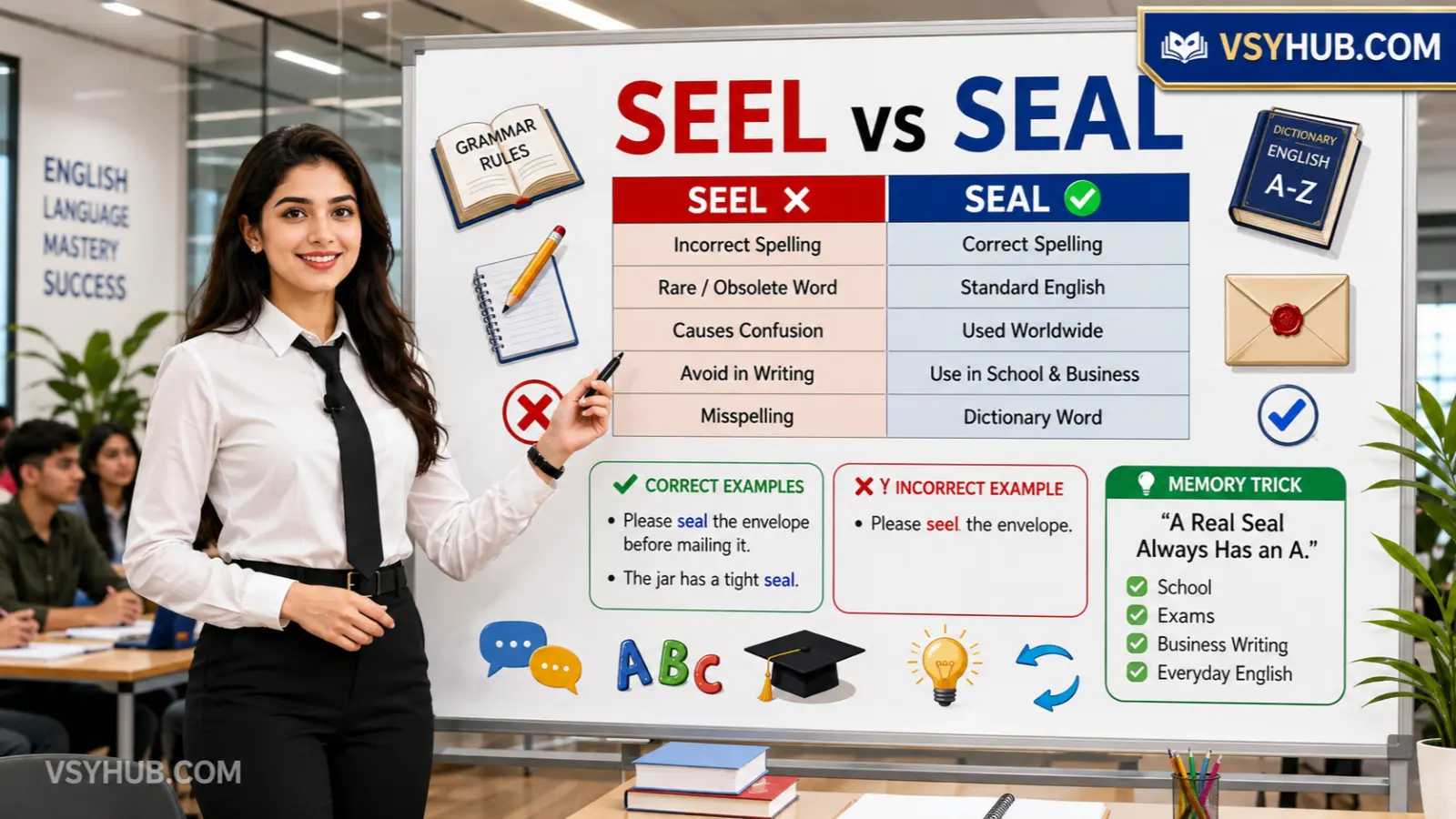
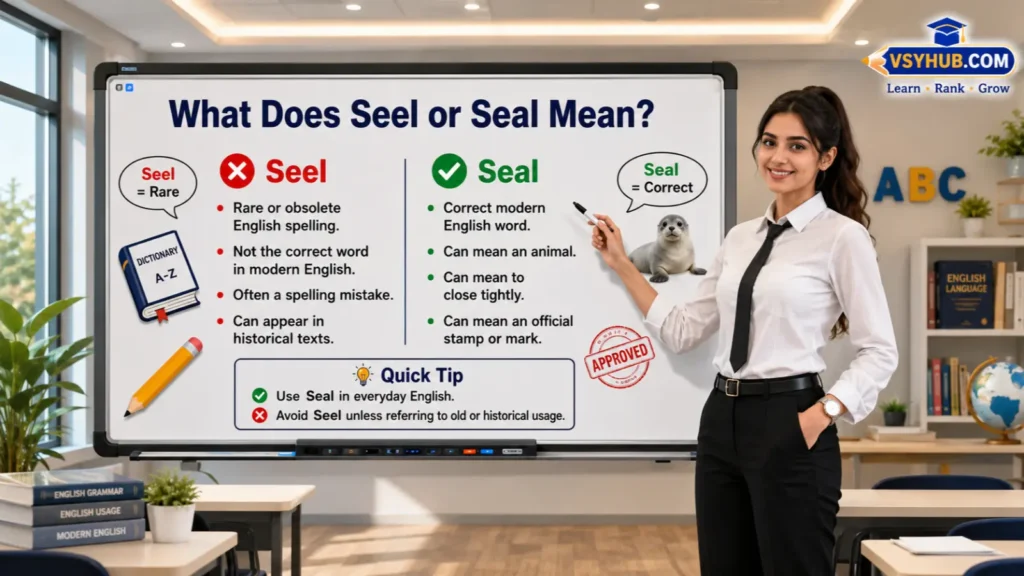
👉 Seal = The correct and common English word. It can mean an animal, a stamp, a tight closing, or the act of closing something securely.
👉 Seel = A rare and old English word. It means to close a bird’s eyes by sewing the eyelids together, a practice used centuries ago. It is almost never used in modern English.
Examples
- ✅ Please seal the envelope before mailing it.
- ✅ We saw a seal swimming in the ocean.
- ❌ I need to seel this package. (Incorrect)
- ✅ I need to seal this package. (Correct)
Simple Rule
👉 If you mean close tightly, protect, stamp, or the sea animal, always use seal.
Easy Memory Trick:
Seal has the letters “ea,” just like “eat.” A seal (the animal) eats fish, making it easier to remember the correct spelling.
What Does Seel or Seal Mean?
What Does “Seal” Mean?
The word seal has several meanings depending on the sentence.
It can mean:
- To close something tightly.
- A mark that shows something is official.
- A sea animal with flippers.
- A protective covering that prevents air or water from getting inside.
Everyday Meaning
People use seal every day when talking about:
- Sealing food containers
- Sealing letters
- Sealing business agreements
- Rubber seals on doors and windows
Professional Meaning
In business and legal writing, a seal can show that a document is official or approved.
Example:
“The company placed its official seal on the certificate.”
What Does “Seel” Mean?
Seel is an old English word that most people never use today.
Historically, it meant closing the eyelids of hunting birds to calm or train them. Today, you will mainly see this word in old books, historical texts, or literature.
For modern English writing, seel is almost always the wrong choice.
Synonyms of Seal
- Close
- Secure
- Fasten
- Lock
- Protect
- Stamp
- Certify
- Waterproof
Opposites of Seal
- Open
- Unseal
- Unlock
- Expose
- Uncover
Related Terms
- Sealed
- Sealing
- Sealant
- Official seal
- Wax seal
- Marine seal
- Harbor seal
Common Variations
- Seal the deal
- Seal of approval
- Sealed package
- Sealed envelope
- Rubber seal
- Security seal
The Origin of Seel or Seal
The word seal comes from Old English and has been used for hundreds of years. It developed from Germanic languages and later gained several meanings, including closing something securely and referring to the marine animal.
Over time, seal became common in everyday English because people needed a word for closing letters, containers, and important documents.
The word seel also comes from older English usage. It was borrowed from French and Latin influences and referred to an old falconry practice. As language changed, this meaning became outdated.
Today, nearly every English speaker uses seal, while seel survives only in historical writing and dictionaries.
How to Pronounce Seel or Seal
Interestingly, seel and seal are pronounced exactly the same.
Pronunciation
Seal: seel
Seel: seel
Phonetic Spelling
/siːl/
Syllables
One syllable
Easy Speaking Trick
Say the word “see”, then add a soft “l” sound.
See + l = Seal
Common Pronunciation Mistakes
People rarely pronounce these words incorrectly because they sound simple.
The real mistake is choosing the wrong spelling.
British English vs American English Usage
There is no spelling difference between British English and American English for seal.
| Feature | British English | American English | Notes |
|---|---|---|---|
| Correct spelling | Seal | Seal | Same worldwide |
| Pronunciation | /siːl/ | /siːl/ | Nearly identical |
| Everyday usage | Very common | Very common | Used in speech and writing |
| Official documents | Seal | Seal | Standard spelling |
| Rare word | Seel | Seel | Mostly historical |
Whether you write in the UK, the US, Canada, Australia, India, or Pakistan, seal is the correct spelling for modern English.
Which One Should You Use?
You should almost always use seal.
Use seal when you talk about:
- Closing an envelope
- Closing a package
- Protecting food
- An official stamp
- A legal document
- A sea animal
- Waterproofing
- Business agreements
Avoid seel unless you are writing about history, old literature, or falconry.
Quick Examples
- ✅ Seal the bottle.
- ✅ The seal is sleeping on the beach.
- ✅ Please seal the contract.
- ❌ Please seel the contract.
Mini Usage Table
| Situation | Correct Word |
|---|---|
| Envelope | Seal |
| Food container | Seal |
| Legal document | Seal |
| Ocean animal | Seal |
| Historical falconry | Seel |
Common Mistakes With Seel or Seal
Mistake 1
❌ Please seel this package.
✔ Please seal this package.
Why? Modern English always uses seal for closing something.
Tip: Think about keeping air out. You seal it.
Mistake 2
❌ I saw a cute seel at the zoo.
✔ I saw a cute seal at the zoo.
Why? The marine animal is always spelled seal.
Tip: Every zoo sign and science book uses seal.
Mistake 3
❌ The company added its official seel.
✔ The company added its official seal.
Why? Official stamps are called seals.
Tip: Business writing always uses seal.
Mistake 4
❌ Please seel the window before winter.
✔ Please seal the window before winter.
Why? Windows are sealed to stop air or water from entering.
Tip: Builders and repair workers always use seal.
Mistake 5
❌ The bottle is not seeled properly.
✔ The bottle is not sealed properly.
Why? The past tense and adjective come from seal, not seel.
Tip: Remember seal → sealed → sealing.
Mistake 6
❌ I bought a waterproof seel.
✔ I bought a waterproof seal.
Why? Products use seal to describe protection against leaks.
Tip: Product labels always use seal.
Seel or Seal in Everyday Examples
Work
“Please seal the shipping box before pickup.”
School
“The teacher asked us to seal the envelope.”
Social Media
“This phone case has a waterproof seal.”
Daily Life
“Always seal the food container after opening.”
Emails
“Please seal the signed documents in the provided envelope.”
Text Messages
“Don’t forget to seal the package before sending it!”
Online Content
“This bottle has a safety seal to protect the product.”
Conversations
A: “Did you close the bag?”
B: “Yes, I sealed it tightly.”
Seel or Seal in Different Contexts
Grammar and Writing
In grammar lessons and spelling quizzes, seal is the correct word for modern English. Students often confuse it with seel because both words sound the same, but only seal is used in everyday writing.
Business
Companies use the word seal when talking about official documents, security labels, product packaging, and quality assurance.
Example:
“The manager placed the company seal on the agreement.”
Education
Teachers encourage students to learn the difference because spelling mistakes can lower writing scores. Knowing that seel is an old word helps learners avoid confusion.
Technology
In technology, seal often describes protective parts that keep dust, air, or water out of devices. For example, smartphones and smartwatches may have waterproof seals.
Communication
Using the correct spelling makes your emails, reports, and messages look professional. Writing seal instead of seel helps readers understand your meaning immediately.
Seel or Seal – Google Trends & Usage Data
Many people search “seel or seal” because they hear the word but are unsure which spelling is correct. Since both words sound the same, search engines receive thousands of spelling-related questions from students, writers, and English learners.
Countries such as the United States, United Kingdom, India, Pakistan, Canada, and Australia commonly search for this topic, especially by beginners learning English or improving their writing.
People also search for long-tail phrases like:
- Is seel a real word?
- How do you spell seal?
- Seel vs seal meaning
- Seal pronunciation
- Seal examples in sentences
- Is seel correct in English?
- Difference between seel and seal
- How to use seal in a sentence
These searches show that users want quick, simple answers with clear examples, making this topic popular in grammar guides and spelling resources.
Comparison Table: Seel or Seal
| Feature | Seel | Seal |
|---|---|---|
| Modern English | Rare | Very common |
| Correct everyday spelling | ❌ No | ✅ Yes |
| Main meaning | An old falconry term | To close tightly, an official mark, or a sea animal |
| Pronunciation | /siːl/ | /siːl/ |
| Part of speech | Verb (archaic) | Noun and verb |
| Academic writing | Rarely used | Common |
| Professional writing | Not recommended | Recommended |
| Internet usage | Almost never | Very common |
| Common mistake | Using it instead of seal | Usually spelled correctly |
Seel or Seal in Professional Life
Using the correct spelling is important at work because it makes your writing clear and professional.
Many industries use the word seal every day.
Business
Companies use seal for:
- Official company seals
- Business contracts
- Product packaging
- Security labels
Example:
“The director placed the company seal on the certificate.”
Manufacturing
Factories talk about:
- Rubber seals
- Safety seals
- Air-tight seals
- Water-resistant seals
Example:
“Replace the damaged seal before using the machine.”
Shipping
Packages are sealed before delivery to protect their contents.
Example:
“Please seal every box before it leaves the warehouse.”
Healthcare
Medical products often have safety seals to keep them clean.
Example:
“Do not use the medicine if the safety seal is broken.”
Seel or Seal for Students or Beginners
Many English learners become confused because seel and seal sound exactly alike.
Here are a few simple tips:
- Learn that seal is the everyday word.
- Remember that seel is an old word found mainly in historical books.
- Read English articles and books to see how seal is used.
- Practice writing sentences with seal every day.
- Use a dictionary if you are unsure.
Beginner Shortcut
If you are writing about modern life, the answer is almost always seal.
Signs, Characteristics, or Common Uses Related to Seel or Seal
Common Uses of “Seal”
- Closing envelopes
- Protecting food packages
- Waterproofing doors and windows
- Official government documents
- Business certificates
- Shipping boxes
- Safety packaging
- Marine animals
Common Writing Situations
People use seal in:
- School assignments
- Office emails
- Legal documents
- News articles
- Product descriptions
- Instruction manuals
- Online blogs
- Social media posts
Online Usage Patterns
Searches for seal often include:
- Seal meaning
- Seal pronunciation
- Seal in a sentence
- Seal definition
- Seal spelling
- Seal animal
- Official seal
- Seal vs seel
Simple Trick to Remember Seel or Seal
The easiest way to remember the correct spelling is to connect the word with something familiar.
Seal has the letters “ea,” just like “sea.”
A seal lives in the sea, so the correct spelling is easy to remember.
Think of it this way:
- Sea → Seal
- Envelope → Seal
- Package → Seal
- Certificate → Official Seal
Whenever you think about closing, protecting, or the sea animal, choose seal.
Expert Tips Section
Here are some simple tips that professional writers and editors use.
Read Your Sentence
Ask yourself:
“Am I talking about closing something or the sea animal?”
If yes, use seal.
Use Spell Check
Modern spell checkers usually suggest seal because seel is extremely rare.
Learn Word Families
Practice these together:
- Seal
- Sealed
- Sealing
- Sealant
Learning related words helps you remember the correct spelling.
Read More English
Books, newspapers, websites, and magazines all use seal in modern writing. Seeing it often makes it easier to remember.
Proofread Before Publishing
Before sending an email or posting online, quickly check whether you accidentally typed seel instead of seal.
Related Searches People Also Ask
Is seel a real English word?
Yes. It is a real but very old English word that is rarely used today.
Which spelling is correct: seel or seal?
For almost every modern situation, seal is the correct spelling.
How do you pronounce seal?
It is pronounced /siːl/ and sounds like the word “see” followed by “l.”
Why do people confuse seel and seal?
They sound exactly the same, so many learners guess the spelling incorrectly.
Can I use seel in modern writing?
Usually no. Unless you are writing about history or falconry, use seal.
What does seal mean in grammar?
It is not a grammar term. It is a noun or verb used to describe closing something securely or referring to the marine animal.
What is a company seal?
A company seal is an official mark used to show that a document is genuine or approved.
What is a safety seal?
A safety seal protects products from being opened before purchase.
How can I remember the spelling?
Think: A seal lives in the sea. Both words use ea.
Is seal used in everyday English?
Yes. It is common in homes, schools, workplaces, businesses, and daily conversations.
FAQs
Is seal the correct spelling?
Yes. Seal is the correct spelling for almost every modern use.
Is seel wrong?
Not completely. It is an old English word, but it is rarely used today.
Are seal and seel pronounced the same?
Yes. Both are pronounced /siːl/.
Can seal be both a noun and a verb?
Yes. It can describe an animal or an official mark, and it can also mean to close something tightly.
How do I use seal in a sentence?
Example: Please seal the envelope before mailing it.
Why is seal more common?
Modern English replaced the old use of seel, making seal the standard spelling.
What is the easiest way to remember seal?
Remember: A seal lives in the sea. Both words share the letters ea.
Final Verdict
If you are choosing between seel and seal, the correct answer is almost always seal.
Use seal for envelopes, packages, documents, products, and the sea animal. Save seel only for discussions about old literature or historical falconry.
Easy Memory Rule:
Sea → Seal → Correct modern spelling.
Conclusion
The difference between seel and seal is simple once you know their meanings. Although both words sound the same, seal is the standard spelling used in modern English for closing something, protecting it, or referring to the marine animal. Seel is an old word that appears mainly in historical writing.
Whenever you write for school, work, or everyday communication, choose seal with confidence. One final trick to remember is: A seal lives in the sea, so both words share “ea.”

Aria Foster is a comparison and language writer who specializes in spelling differences, word meanings, grammar guides, and easy-to-understand language explanations. She creates clear, reader-friendly content that helps people understand commonly confused words and expressions.