Imagine you’re filling out a job application or writing an email, and you stop because you’re not sure whether to write licence or license.
It can feel confusing because both words look almost the same and are often used in schools, workplaces, government forms, websites, and daily conversations.
People usually search for Licence vs License meaning, correct spelling, pronunciation, examples, usage, definition, and grammar difference to avoid mistakes.
The good news is that both words are correct, but their use depends on the type of English you’re writing.
In this guide, you’ll learn the meaning, pronunciation, examples, usage, grammar rules, common mistakes, expert tips, and simple explanations in easy English.
Licence vs License – Quick Answer
If you’re looking for the fastest answer, here it is:
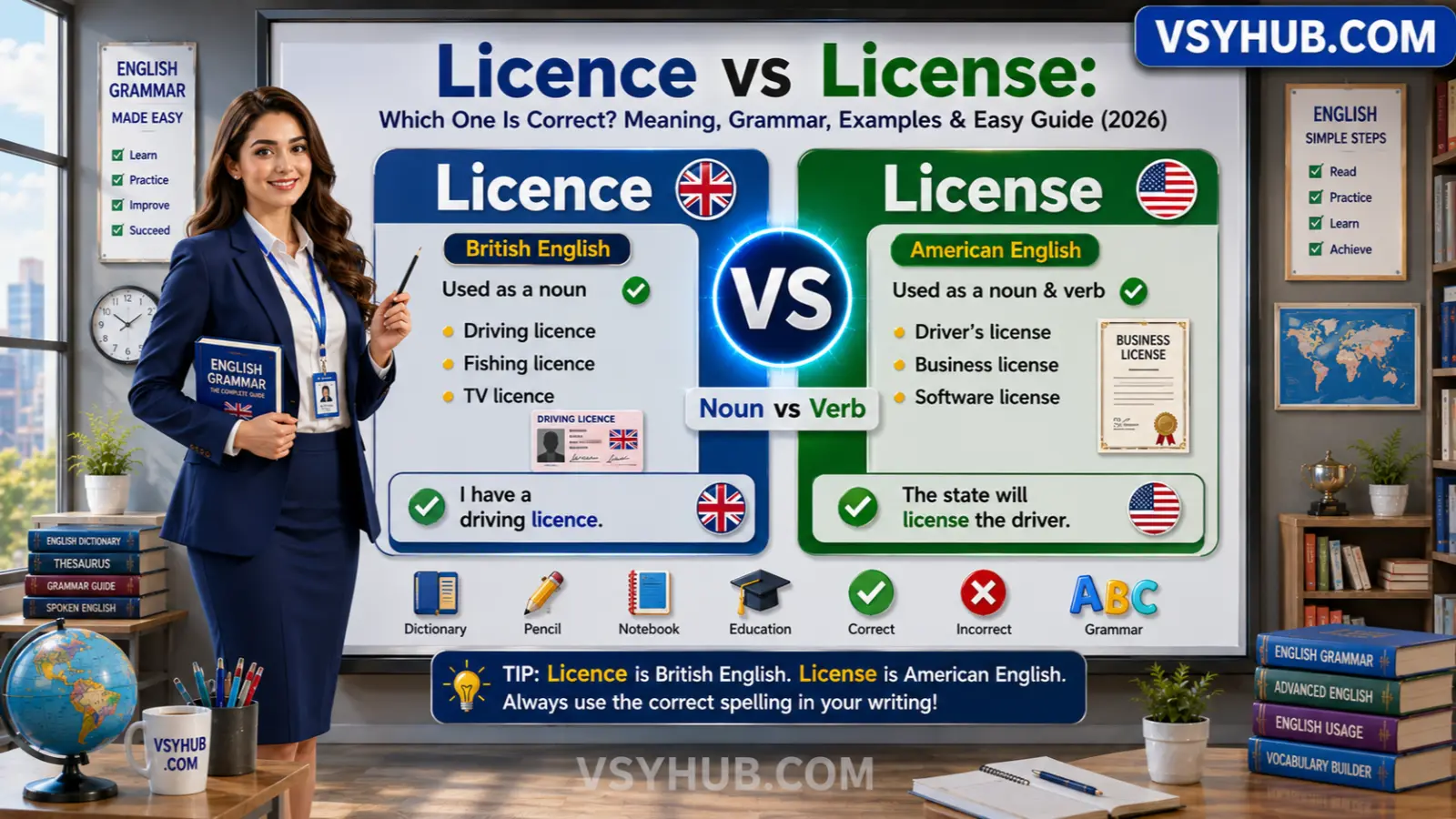
👉 Licence = The British English spelling of the noun, meaning official permission to do something.
👉 License = The American English spelling for both the noun and the verb. In British English, license is used only as a verb.
Simple Examples
- 🇬🇧 I renewed my driving licence yesterday. ✅
- 🇬🇧 The city will license the new taxi company. ✅
- 🇺🇸 She got her driver’s license last week. ✅
- 🇺🇸 The government will license the new business. ✅
- You need a fishing license in many US states. ✅
Simple Rule
- British English
- Licence = Noun
- License = Verb
- American English
- License = Noun and Verb
Easy Memory Trick
Think of it this way:
- C = Certificate
- Licence (noun) is the certificate or permission you receive.
- S = Start an Action
- License (verb) means giving permission or allowing someone to do something.
This simple trick helps you remember the British spelling in seconds.
What Does Licence vs License Mean?
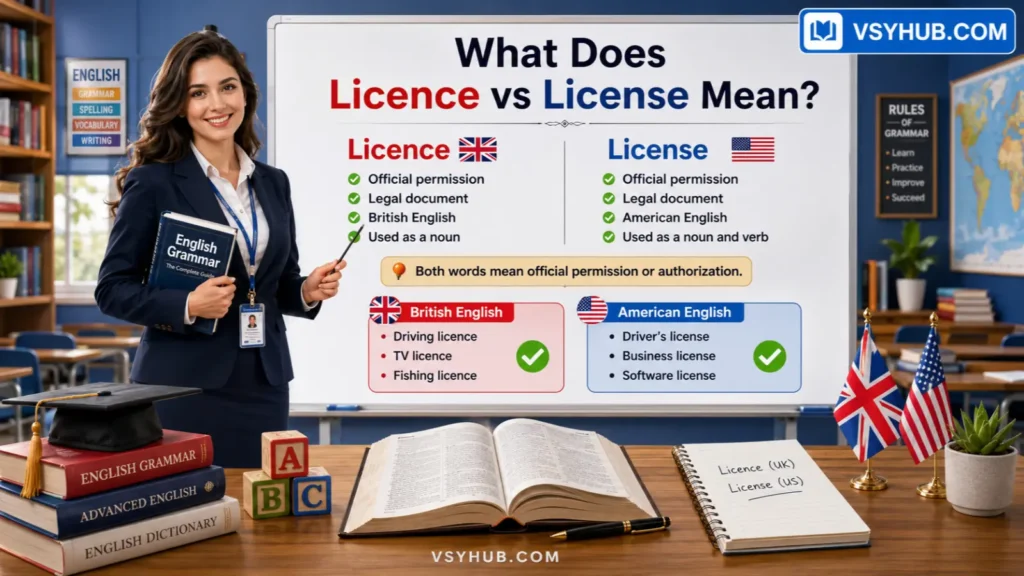
Although the spellings are different, licence and license are closely connected. Both relate to giving or receiving official permission.
The main difference is not the meaning but the type of English and sometimes the grammar role.
What Does Licence Mean?
In British English, licence is a noun.
It means an official document or legal permission that allows someone to do something.
Examples include:
- Driving licence
- TV licence
- Fishing licence
- Business licence (often written as “business licence” in UK English)
Example sentences:
- My driving licence expires next month.
- She has a restaurant licence.
- You need a firearm licence in many countries.
What Does License Mean?
In American English, license is used as both a noun and a verb.
As a noun:
It means official permission.
Example:
- I finally received my driver’s license.
As a verb:
It means to officially allow or authorize someone.
Example:
- The state will license new doctors this year.
Practical Meaning
A licence or license shows that a person, company, or organization has legal permission to perform a specific activity.
Common examples include:
- Driving
- Teaching
- Selling products
- Opening a business
- Broadcasting television
- Practicing medicine
- Owning certain animals
- Operating heavy machinery
Without the proper licence or license, many activities are illegal.
Why Is This Difference Important?
Using the correct spelling helps you:
- Write professionally.
- Match your audience’s English style.
- Avoid grammar mistakes.
- Improve academic writing.
- Communicate clearly in business documents.
- Pass English language exams more easily.
Synonyms
Depending on the situation, similar words include:
- Permit
- Authorization
- Approval
- Certification
- Accreditation
- Registration
- Clearance
- Permission
- Official document
- Legal approval
Opposites
Some common opposites are:
- Ban
- Refusal
- Restriction
- Prohibition
- Disapproval
- Denial
- Cancellation
- Suspension
- Revocation
Related Terms
Understanding these related words makes the topic easier.
- Driving licence
- Driver’s license
- Business licence
- Software license
- Professional licence
- Copyright licence
- Operating licence
- Trade licence
- Licensed
- Licensing
- Licensor
- Licensee
- Permit
- Certification
Common Variations
You may also see these forms:
- Licensed
- Licensing
- Unlicensed
- Licensee
- Licensor
- Multi-license software
- Driver’s license
- Driving licence
- Professional licence
- Software license agreement
Learning these variations will help you understand books, websites, contracts, business documents, and everyday English more easily.
The Origin of Licence vs License
The words licence and license have a long and interesting history.
Both come from the Latin word licentia, which means freedom, permission, or liberty.
Later, the word entered Old French as licence before becoming part of the English language hundreds of years ago.
For many years, English speakers used different spellings without strict rules. As British and American English developed separately, spelling became more standardized.
How British English Changed
British English gradually adopted two different spellings depending on grammar.
- Licence became the noun.
- License became the verb.
This pattern is similar to other British word pairs, such as:
- Advice (noun) → Advise (verb)
- Practice (noun) → Practise (verb)
Many learners notice that these words follow the same noun-and-verb spelling pattern.
How American English Changed
American English simplified the spelling.
Instead of using two spellings, American dictionaries accepted license for both the noun and the verb.
Today, this is the standard spelling throughout the United States.
Modern Usage
Today, both spellings remain correct.
The choice depends on the variety of English you are using.
You will commonly see:
- Licence in the United Kingdom, Ireland, Australia, and New Zealand for the noun.
- License in the United States for both meanings.
- Canadian English often follows American spelling but may also use British forms in some situations.
Because people communicate globally through the internet, many readers now encounter both spellings every day.
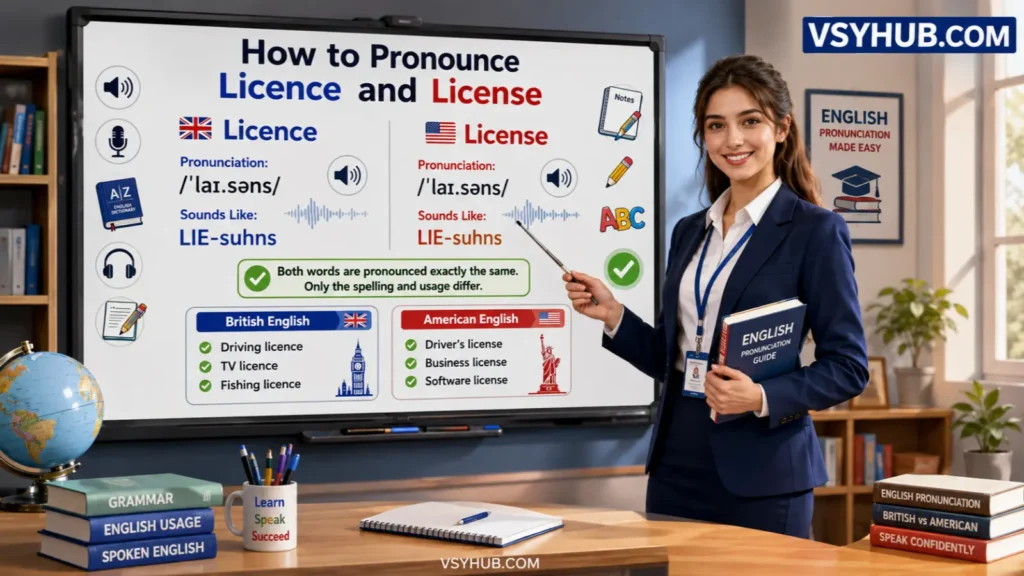
How to Pronounce Licence and License
The good news is that licence and license are pronounced exactly the same.
Only the spelling changes.
Pronunciation
Licence
Phonetic (UK): /ˈlaɪ.səns/
Easy pronunciation:
LY-suhns
License
Phonetic (US):
/ˈlaɪ.səns/
Easy pronunciation:
LY-suhns
Syllables
Both words have two syllables.
Li-cence
Li-cense
Stress is placed on the first syllable.
LI-suhns
Easy Speaking Trick
Say the word “lie” first.
Then add “suhns.”
Lie + suhns = license/licence
Common Pronunciation Mistakes
Many beginners accidentally say:
- Lie-see-ence ❌
- Lee-sense ❌
- Lick-ense ❌
The correct pronunciation is always:
LY-suhns ✅
Pronunciation Tip
Remember this simple rule:
The spelling may change, but the sound does not.
Whether you are speaking British English or American English, native speakers pronounce both words almost identically.
In the next part, we’ll cover British English vs American English usage, which one you should use, common mistakes, and plenty of real-life examples.
British English vs American English Usage
One of the biggest reasons people get confused about licence vs license is that British English and American English follow different spelling rules.
In British English, the spelling changes depending on whether the word is a noun or a verb. In American English, the spelling stays the same.
| Feature | British English | American English | Notes |
|---|---|---|---|
| Noun | Licence | License | Both mean official permission. |
| Verb | License | License | Same spelling in American English. |
| Pronunciation | LY-suhns | LY-suhns | Pronounced the same. |
| Meaning | Official permission | Official permission | No difference in meaning. |
| Grammar | Two spellings | One spelling | Main source of confusion. |
| Common Example | Driving licence | Driver’s license | Both are correct in their regions. |
British English Examples
- I renewed my driving licence yesterday.
- Every taxi driver needs a valid licence.
- The council will license the new restaurant.
- She applied for a TV licence.
American English Examples
- I renewed my driver’s license yesterday.
- The state will license a new pharmacy.
- His business license expires next month.
- You must have a fishing license.
Is One More Correct?
No.
Both spellings are correct. The right choice depends on your audience.
- Writing for the UK? Use licence (noun) and license (verb).
- Writing for the US? Use license for both.
- Writing for an international audience? Stay consistent throughout your document.
Which One Should You Use?
The answer depends on where your readers are and which type of English you’re using.
Use Licence When
- Writing in British English.
- Referring to the noun.
- Writing for UK schools or universities.
- Creating UK government documents.
- Writing for British companies.
- Following UK style guides.
Examples:
- My driving licence has expired.
- She has a business licence.
- You need a TV licence in the UK.
Use License When
- Writing in American English.
- Using the word as a verb in any variety of English.
- Writing for US readers.
- Preparing American legal or business documents.
- Following American dictionaries.
Examples:
- I received my driver’s license.
- The city will license new food trucks.
- The agency licenses medical professionals.
Quick Usage Table
| Situation | Correct Word |
|---|---|
| UK noun | Licence |
| UK verb | License |
| US noun | License |
| US verb | License |
| International audience | Choose one style and stay consistent |
Formal Writing
In formal writing, always follow the spelling style required by your organization or publication.
Examples include:
- Academic essays
- Government documents
- Legal contracts
- Business reports
- Professional emails
Informal Writing
In casual conversations, text messages, or social media, many people do not notice the difference.
However, using the correct spelling still shows strong writing skills.
Academic Writing
Students should follow the English style requested by their teacher or institution.
For example:
- A UK university usually expects licence as the noun.
- A US university expects license.
Workplace Communication
Professional writing should always match the company’s preferred style guide.
Examples include:
- HR documents
- Employee handbooks
- Training manuals
- Policy documents
- Business proposals
Branding and Marketing
International companies often choose one spelling for consistency.
For example:
- A British company may use Licence throughout its website.
- An American software company will usually write Software License.
Social Media and Texting
On social media, you’ll see both spellings.
Examples:
- “Just got my driver’s license!”
- “Passed my driving licence test today!”
Both are correct depending on the writer’s country.
Common Mistakes with Licence vs License
Many English learners make the same mistakes because both spellings look almost identical.
Here are the most common ones and how to avoid them.
Mistake 1: Using “Licence” as a Verb in British English
❌ The council will licence new restaurants.
✔ The council will license new restaurants.
Explanation: In British English, license is always the verb.
Beginner Tip: If the word shows an action, use license.
Mistake 2: Using “License” as a Noun in British English Exams
❌ I forgot my driving license. (British English test)
✔ I forgot my driving licence.
Explanation: UK English uses licence for the noun.
Beginner Tip: Remember that the document is a licence.
Mistake 3: Mixing British and American Spellings
❌ My driver’s licence expires tomorrow. (American document)
✔ My driver’s license expires tomorrow.
Explanation: Stay with one variety of English.
Beginner Tip: Don’t switch spelling styles in the same document.
Mistake 4: Assuming One Spelling Is Always Wrong
❌ Licence is incorrect.
✔ Both spellings are correct in different forms of English.
Explanation: The difference is regional and grammatical.
Beginner Tip: Think about who will read your writing.
Mistake 5: Forgetting the Verb Rule
❌ The government will licence more hospitals. (UK style)
✔ The government will license more hospitals.
Explanation: British English uses license as the verb.
Beginner Tip: Action word = license.
Mistake 6: Using AutoCorrect Without Checking
❌ Accepting whatever your spell checker changes.
✔ Check whether your document uses British or American English.
Explanation: Your device may be set to US or UK English.
Beginner Tip: Always review spelling before submitting important work.
Mistake 7: Copying Different Sources
❌ Mixing spellings copied from different websites.
✔ Follow one style consistently.
Explanation: Consistency improves readability and professionalism.
Beginner Tip: Decide on British or American English before you begin writing.
Licence vs License in Everyday Examples
Seeing real-life examples makes the difference much easier to remember.
At Work
British English:
- Every employee must carry a security licence.
American English:
- Every employee must have a security license.
At School
Teacher:
- Remember to use licence if you’re writing British English.
Student:
- I’ll check which English style my assignment requires.
On Social Media
UK User:
- Finally passed my driving licence test!
US User:
- I finally got my driver’s license today!
Daily Life
- She renewed her fishing licence before the holiday.
- He forgot to bring his driver’s license.
Emails
British English:
Please attach a copy of your operating licence.
American English:
Please attach a copy of your operating license.
Text Messages
- Did you remember your driver’s license?
- My driving licence came in the mail today!
Online Content
You’ll often find:
- Software License Agreement
- Open-Source Software License
- Creative Commons License
Even many international technology companies use the American spelling because software development often follows US English conventions.
Licence vs License in Different Contexts
In Education
Students often encounter this topic while learning British and American English.
Teachers explain that the difference is mainly about regional spelling and grammar.
Example:
- UK textbook: Driving licence
- US textbook: Driver’s license
In Business
Businesses need many different licences or licenses depending on their location.
Examples include:
- Business licence
- Food licence
- Import licence
- Trade licence
- Professional license
- Software license
Using the correct regional spelling in contracts and official documents helps maintain professionalism.
In Government and Law
Government agencies issue licences and licenses for activities that require legal approval.
Examples include:
- Driving
- Teaching
- Medicine
- Construction
- Aviation
- Broadcasting
- Firearms
- Environmental permits
Legal documents should always follow the country’s official spelling standards.
In Technology
The technology industry frequently uses the word license, especially in American English.
Common terms include:
- Software License
- License Key
- License Agreement
- Enterprise License
- User License
- Open-Source License
These phrases appear in apps, websites, operating systems, and software contracts.
In Marketing and Branding
Companies choose one spelling to maintain brand consistency.
For example:
- A UK business may advertise Business Licence Services.
- A US company may promote Business License Solutions.
Consistent spelling strengthens trust and creates a more professional image.
In Grammar Learning
English learners often compare licence vs license with other British noun-and-verb spelling pairs, such as:
- Advice → Advise
- Practice → Practise (British English)
- Device → Devise
Recognizing these patterns makes it easier to remember the correct spelling.
Licence vs License – Google Trends & Usage Data
Many people search for Licence vs License because they see both spellings online and are unsure which one is correct. This confusion is common among students, job seekers, business owners, writers, and English learners.
Search interest stays high throughout the year because people need the correct spelling for school assignments, government forms, business documents, software agreements, and driving-related applications.
Why Do People Search for Licence vs License?
People usually want answers to questions like:
- Is licence or license correct?
- What is the difference between licence and license?
- Is licence British English?
- Is license American English?
- How do you pronounce licence?
- Which spelling should I use in an email?
- Is software license or software licence correct?
These questions show that users want a quick, simple explanation with real-life examples.
Search Popularity Around the World
Interest in this topic comes from many English-speaking countries, including:
- United States – Most searches use license because American English uses this spelling for both the noun and the verb.
- United Kingdom – People often search to understand when to use licence and license correctly.
- Canada – Both spellings appear, depending on the organization or style guide.
- Australia – British English rules are common, so licence is usually the noun.
- India – Learners often compare British and American English spellings.
- Pakistan – Students preparing for exams and professionals writing formal documents frequently search for the difference.
Related Search Topics
People also explore related terms, such as:
- Driving licence vs driver’s license
- Business licence vs business license
- Software license meaning
- License as a verb
- Licence noun and license verb
- British vs American spelling differences
- Common English spelling differences
- Grammar rules for licence and license
Voice Search Questions
Many users now ask voice assistants questions like:
- “What’s the difference between licence and license?”
- “How do you pronounce licence?”
- “Which spelling is correct in British English?”
- “Is license a noun or a verb?”
- “Can I use licence in American English?”
Writing clear answers to these questions helps readers and also improves search visibility.
Comparison Table: Licence vs License
| Feature | Licence | License |
|---|---|---|
| Primary English Variety | British English | American English and British verb |
| Part of Speech | Noun | Noun (US), Verb (UK & US) |
| Meaning | Official permission or document | Official permission or the act of giving permission |
| Pronunciation | LY-suhns | LY-suhns |
| Used in UK | Yes (noun) | Yes (verb) |
| Used in US | Rare | Yes (noun and verb) |
| Used in Australia | Yes (noun) | Yes (verb) |
| Used in Canada | Sometimes | Very common |
| Professional Writing | Correct in UK documents | Correct in US documents |
| Academic Writing | Depends on the English style | Depends on the English style |
| Common Mistake | Using it as a verb | Using it as a UK noun |
| Easy Memory Rule | Document = Licence | Action = License |
Licence vs License in Professional Life
Using the correct spelling is more important than many people realize. In professional communication, small spelling mistakes can affect how polished and trustworthy your writing appears.
Business Communication
Companies often use the word in:
- Business registration documents
- Contracts
- Service agreements
- Employee manuals
- Legal notices
Examples:
British English:
- The company received its operating licence.
American English:
- The company received its operating license.
Professional Emails
Correct spelling helps create a professional impression.
Example (UK):
Please send a copy of your contractor licence before Monday.
Example (US):
Please send a copy of your contractor license before Monday.
Government Documents
Government departments issue many types of official permissions, such as:
- Driving licences
- Business licences
- Import licences
- Building licences
- Medical licenses
- Professional licenses
Always follow the official spelling used by the issuing authority.
Software and Technology
Technology companies usually write:
- Software License
- License Agreement
- End User License Agreement (EULA)
- License Key
These terms are recognized worldwide, even in countries that normally use British English.
Branding Matters
If you’re creating a website, blog, or business, choose one spelling style and use it consistently.
For example:
- A UK-focused website should consistently use licence for the noun.
- A US-focused website should consistently use license.
Consistency improves readability and builds trust with your audience.
Licence vs License for Students or Beginners
Many beginners struggle with licence vs license because both words have the same meaning and pronunciation.
The key is to focus on where you’re writing and how the word is being used.
Why Beginners Get Confused
Common reasons include:
- Both words sound exactly alike.
- Many websites use different spellings.
- British and American English follow different rules.
- Spell-check tools may automatically change the spelling.
- School textbooks may use different English varieties.
Easy Learning Tips
- Learn British and American English separately.
- Read books from your target English variety.
- Notice whether the word is a noun or a verb.
- Practice writing complete sentences.
- Keep a personal vocabulary notebook.
Beginner Shortcuts
Remember these simple rules:
- UK noun = Licence
- UK verb = License
- US noun = License
- US verb = License
Writing these four lines a few times makes the pattern easy to remember.
Signs, Characteristics, and Common Uses Related to Licence vs License
You will commonly see these words in situations involving official permission.
Common Uses
- Driving documents
- Business registration
- Professional certifications
- Software agreements
- Government approvals
- Import and export permits
- Broadcasting permission
- Educational institutions
Common Writing Situations
- School essays
- University assignments
- Job applications
- Professional emails
- Legal documents
- Business proposals
- Website content
- News articles
Online Usage Patterns
On the internet, you’ll often notice:
- American websites prefer license.
- British government websites prefer licence for the noun.
- Software companies almost always use license.
- International blogs may use either spelling depending on their audience.
Industries That Frequently Use the Term
- Transportation
- Healthcare
- Law
- Education
- Government
- Information Technology
- Finance
- Construction
- Aviation
- Hospitality
Understanding where these words are commonly used makes it much easier to choose the correct spelling in real-life situations.
In the final part, you’ll learn an easy memory trick, expert writing tips, related searches people also ask, FAQs, the final verdict, conclusion, and an SEO-friendly meta description.
Simple Trick to Remember Licence vs License
Many learners remember the rule once they connect the spelling with its job.
Easy Memory Rule
- Licence = Thing (Noun in British English)
- License = Action (Verb in British English)
For American English, the rule is even simpler:
- License = Noun + Verb
Think of It This Way
Imagine you are learning to drive.
- The card in your wallet is your driving licence (UK) or driver’s license (US).
- The government licenses you to drive.
The first is something you have.
The second is something the government does.
Quick Memory Shortcut
Remember this sentence:
“I have a licence, but the government licenses me.”
If you’re writing in American English, simply replace licence with license.
Expert Tips for Using Licence vs License Correctly
Many articles stop after explaining the spelling difference, but these practical tips will help you avoid mistakes in real writing.
Match Your Audience
Before you start writing, decide whether you’re using British English or American English.
For example:
- UK company → British English
- US company → American English
Stay Consistent
Never switch between licence and license in the same document unless you’re explaining the difference.
Consistency makes your writing look more professional.
Check Your Spell Checker
Your computer or phone may be set to:
- English (United States)
- English (United Kingdom)
- English (Australia)
- English (Canada)
The language setting can automatically change the spelling.
Follow Official Documents
If you’re writing about a government form, business permit, or legal document, use the spelling shown by the issuing authority.
Read More in Your Preferred English Style
Reading books, newspapers, and trusted websites from your target country helps you remember the correct spelling naturally.
Practice with Sentences
Instead of memorizing rules, write your own examples.
For example:
- My driving licence expires next month.
- The state will license new teachers.
- I renewed my driver’s license yesterday.
Writing real sentences builds confidence much faster than memorizing definitions.
Related Searches People Also Ask
Here are some questions people frequently search online about Licence vs License.
Is licence or license correct?
Both are correct. Licence is the British English noun, while license is used for the verb in British English and for both the noun and verb in American English.
Why are there two spellings?
British and American English developed different spelling conventions over time. The meanings remain the same.
Is driver’s licence correct?
Yes. It is correct in British English.
Is driver’s license correct?
Yes. It is the standard spelling in American English.
What is the difference between licence and permit?
A licence is official permission granted by an authority. A permit is also permission, but it is usually issued for a specific activity or limited period.
Is software license correct?
Yes. The technology industry almost always uses software license, even internationally.
How do you pronounce licence?
Both licence and license are pronounced LY-suhns.
Can I use license in British English?
Yes. In British English, license is the correct verb.
Which spelling should students use?
Students should follow the English style required by their school, college, university, or examination board.
Why do spell-checkers change licence to license?
Your device may be using American English as the default language.
Is licence used in Australia?
Yes. Australian English generally follows British spelling, so licence is commonly used as the noun.
Which spelling is better for international websites?
Choose the spelling that matches your target audience and use it consistently throughout the website.
Frequently Asked Questions (FAQs)
Is licence a noun?
Yes. In British English, licence is a noun.
Is license a verb?
Yes. In both British and American English, license is the verb.
Does American English use licence?
No. American English normally uses license for both the noun and the verb.
Are licence and license pronounced differently?
No. They have the same pronunciation.
Which spelling should I use in an email?
Use the spelling that matches the English style of your organization or recipient.
Is software licence wrong?
Not necessarily. However, software license is much more common because the technology industry mainly follows American English.
Why do exam questions ask about licence vs license?
They test your understanding of British and American spelling conventions.
Can I mix British and American spellings?
It is best not to. Choose one style and use it consistently.
Is licence used in legal writing?
Yes. In British legal writing, licence is the correct noun.
What is the easiest way to remember the difference?
Remember:
- UK: Licence = Noun, License = Verb
- US: License = Noun and Verb
Final Verdict
The answer is simple:
- Licence is the correct noun in British English.
- License is the correct verb in British English.
- License is both the noun and verb in American English.
The easiest memory rule is:
UK: Licence = Thing, License = Action.
US: License = Everything.
If you remember this one rule, you’ll rarely make a mistake.
Conclusion
Understanding Licence vs License is easier than it first appears. The two words share the same meaning and pronunciation, but their spelling depends on whether you’re writing in British or American English. In British English, licence is the noun and license is the verb. In American English, license is used for both.
Whenever you write an email, assignment, business document, or social media post, think about your audience first. Using the correct spelling shows attention to detail and makes your writing more professional.
One final memory trick is worth keeping:
UK: Licence = Permission you have. License = Permission you give.
US: License = Works for both.
Keeping this simple rule in mind will help you choose the correct spelling every time.

Aria Foster is a comparison and language writer who specializes in spelling differences, word meanings, grammar guides, and easy-to-understand language explanations. She creates clear, reader-friendly content that helps people understand commonly confused words and expressions.