Have you ever read a news article or filled out an immigration form and wondered whether to use emigrated or immigrated?
Many beginners get confused because both words talk about moving from one country to another.
However, they describe the move from different points of view. This confusion is common in school assignments, workplace documents, social media posts, travel blogs, family history records, and everyday conversations.
People usually search for the emigrated or immigrated meaning, correct usage, pronunciation, grammar difference, examples, and definition to avoid mistakes.
In this guide, you’ll learn the meaning, pronunciation, examples, usage, grammar rules, common mistakes, expert tips, and simple explanations in easy English.
Emigrated or Immigrated – Quick Answer
Here is the simple answer:
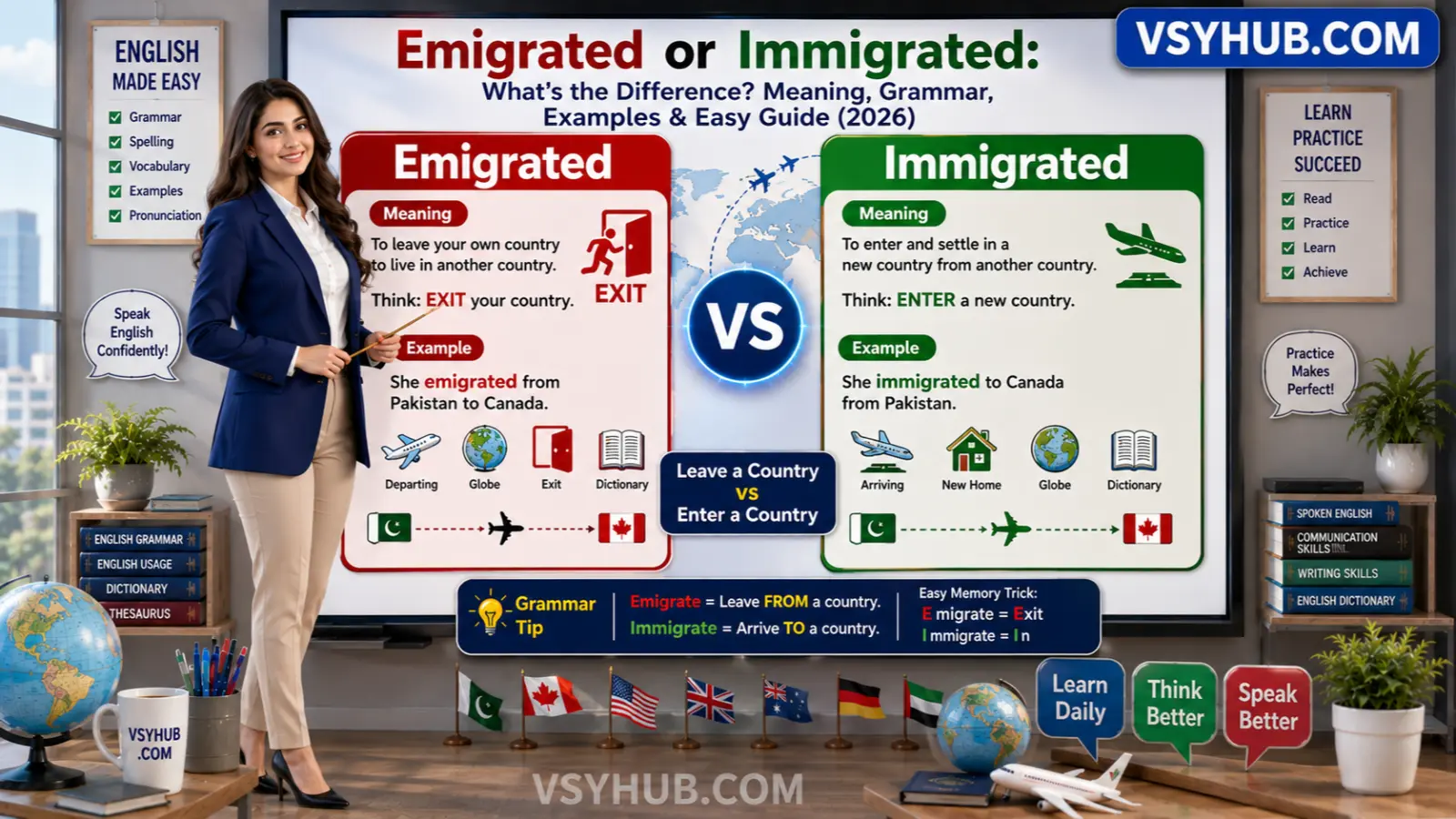
👉 Emigrated = Left your own country to live in another country.
👉 Immigrated = Entered a new country to live there permanently.
The same person can both emigrate and immigrate.
For example:
- Maria emigrated from Mexico.
- Maria immigrated to Canada.
- My grandparents emigrated from Italy in the 1950s.
- They immigrated to Australia for better opportunities.
- Thousands of families emigrate from one country and immigrate to another every year.
Simple Rule
Think of E in Emigrate as Exit.
Think of I in Immigrate as Into.
If someone is leaving, use emigrate.
If someone is arriving, use immigrate.
What Does Emigrated or Immigrated Mean?
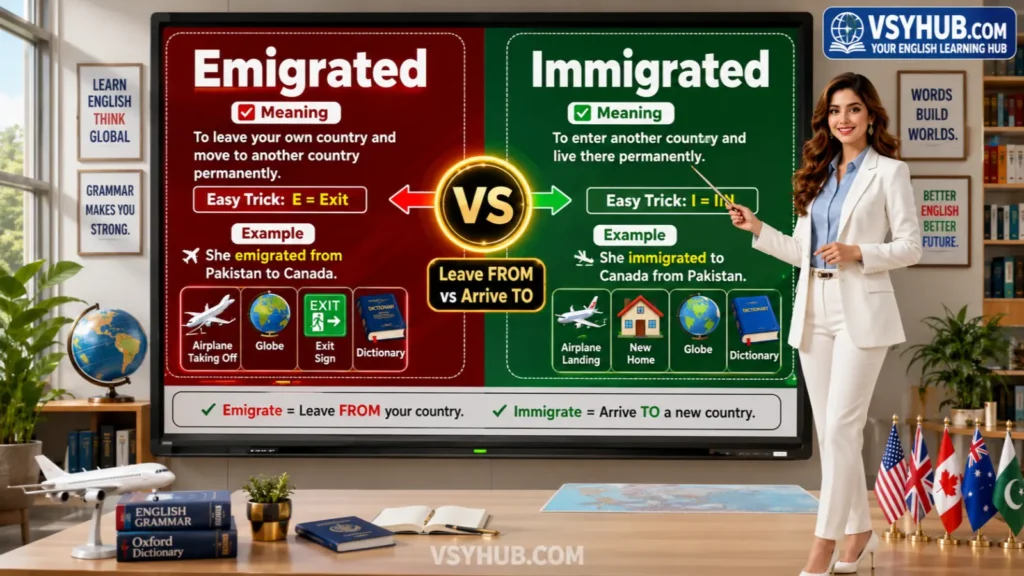
Although these words are closely related, they focus on different directions of the same journey.
What Does Emigrated Mean?
Emigrated is the past tense of emigrate.
It means someone left their home country to settle somewhere else.
The attention is on the country they departed from.
Examples:
- She emigrated from Pakistan in 2018.
- My uncle emigrated from India for work.
- Thousands of people emigrated from Europe during the last century.
What Does Immigrated Mean?
Immigrated is the past tense of immigrate.
It means someone entered another country to live there.
The attention is on the destination country.
Examples:
- She immigrated to Canada in 2018.
- His family immigrated to the United States.
- Many professionals immigrated to Australia for new careers.
The Same Journey Explained
Imagine Ahmed moves from Pakistan to Canada.
From Pakistan’s point of view:
Ahmed emigrated from Pakistan.
From Canada’s point of view:
Ahmed immigrated to Canada.
Both sentences are correct because they describe different sides of the same move.
Synonyms
Emigrated
- Left the country
- Moved abroad
- Relocated overseas
- Departed permanently
- Settled elsewhere
Immigrated
- Arrived in a new country
- Settled in
- Moved into another country
- Became a new resident
- Relocated internationally
Opposites
Emigrated
- Stayed
- Remained
- Returned home
Immigrated
- Left
- Departed
- Emigrated
Related Terms
These words often appear together in articles about migration:
- Emigrate
- Immigrate
- Migration
- Migrant
- Immigration
- Emigration
- Immigration law
- Citizenship
- Permanent residency
- Visa
- Refugee
- Asylum seeker
- Border control
- Naturalization
- International relocation
Common Variations
You may also see these forms:
- Emigrate
- Emigrates
- Emigrating
- Emigration
- Emigrant
And:
- Immigrate
- Immigrates
- Immigrating
- Immigration
- Immigrant
Understanding these word families makes reading easier and improves your English vocabulary.
The Origin of Emigrated or Immigrated
The words emigrate and immigrate have been used for hundreds of years and both come from the Latin word migrare, which means to move.
The prefixes explain the difference.
Origin of Emigrate
The prefix e- or ex- means out of.
So emigrate literally means to move out of a country.
Over time, English speakers used the word to describe people leaving their homeland to begin life elsewhere.
Origin of Immigrate
The prefix im- means into.
So immigrate literally means to move into another country.
Today, governments, schools, businesses, and news organizations use this word when discussing newcomers entering a country to live permanently.
How These Words Evolved
As international travel became easier, both words became common in newspapers, government documents, history books, and education.
Today, they appear frequently in:
- Immigration forms
- Travel websites
- Government announcements
- History lessons
- News reports
- Family ancestry research
- Social media discussions
- Academic writing
Because both words describe the same journey from different viewpoints, learners often confuse them.

How to Pronounce Emigrated or Immigrated
Correct pronunciation helps you sound more natural when speaking English.
Emigrated
Phonetic pronunciation:
EM-ih-gray-tid
IPA:
/ˈem.ɪ.ɡreɪ.tɪd/
Syllables:
Em • i • grat • ed
Speaking tip:
Say “EM”, then “ih”, then “gray”, and finish with “tid.”
Immigrated
Phonetic pronunciation:
IM-ih-gray-tid
IPA:
/ˈɪm.ɪ.ɡreɪ.tɪd/
Syllables:
Im • mi • grat • ed
Speaking tip:
Start with “IM”, then “ih”, then “gray”, and end with “tid.”
Easy Pronunciation Trick
The biggest difference is the first sound.
- Emigrated begins with EM.
- Immigrated begins with IM.
The rest of both words sounds almost exactly the same.
Common Pronunciation Mistakes
❌ Saying ee-migrated instead of EM-ih-gray-tid
✔ Stress the first syllable.
❌ Dropping the middle vowel sound.
✔ Pronounce each syllable clearly.
❌ Mixing the first sound of emigrated and immigrated.
✔ Remember:
- EM = Exit.
- IM = Into.
Reading the words aloud several times helps build confidence and improves your spoken English.
British English vs American English Usage
Good news for English learners: there is no spelling difference between British English and American English for emigrated and immigrated. Both countries use the same spellings and nearly the same grammar rules.
The main difference is usually the speaker’s accent, not the words themselves.
| Feature | British English | American English | Notes |
|---|---|---|---|
| Spelling | Emigrated / Immigrated | Emigrated / Immigrated | Identical spelling |
| Meaning | Same | Same | No difference in definition |
| Grammar | Same | Same | Used with “from” and “to” in the same way |
| Pronunciation | Slightly different accent | Slightly different accent | The first syllable may sound a little different |
| Everyday Usage | Very common | Very common | Used in schools, news, and official documents |
| Government Documents | Frequently used | Frequently used | Standard legal and immigration vocabulary |
| Academic Writing | Preferred formal terms | Preferred formal terms | Accepted worldwide |
| International English | Same usage | Same usage | Recognized globally |
Whether you’re writing for readers in the UK, US, Canada, Australia, Pakistan, India, or anywhere else, the grammar rules remain the same:
- Emigrated from a country.
- Immigrated to a country.
Using the correct preposition is just as important as choosing the correct verb. This simple rule helps your writing sound clear, accurate, and professional.
Which One Should You Use?
The correct word depends on which side of the journey you are talking about.
Use emigrated when talking about the country a person left.
Use immigrated when talking about the country a person entered.
Quick Rules
- Use emigrated from + country.
- Use immigrated to + country.
- One person can both emigrate and immigrate.
- The meaning changes based on the point of view.
- These words are suitable for both formal and informal English.
Quick Examples
- ✔ She emigrated from India.
- ✔ She immigrated to Canada.
- ✔ My grandparents emigrated from Italy after World War II.
- ✔ They immigrated to Australia for a better future.
- ✔ Thousands of families emigrate from one nation every year.
Usage by Situation
| Situation | Best Word | Example |
|---|---|---|
| Talking about leaving a country | Emigrated | He emigrated from Pakistan. |
| Talking about entering a country | Immigrated | He immigrated to Canada. |
| School essays | Both, depending on context | People emigrated from Europe and immigrated to America. |
| News reports | Both | Many workers emigrated from their homeland and immigrated to neighboring countries. |
| Government forms | Both | Immigration records often mention where someone emigrated from. |
| Family history | Both | Our ancestors emigrated from Ireland and immigrated to the United States. |
Formal Usage
Both words are correct in:
- Academic writing
- Government documents
- History books
- Immigration records
- Business reports
- Newspapers
- Legal documents
Example:
“The family emigrated from Germany in 1985 and immigrated to Canada shortly afterward.”
Informal Usage
These words also appear naturally in everyday conversations.
Examples:
- “My cousin immigrated to New Zealand last year.”
- “Their family emigrated from Egypt many years ago.”
Social Media Usage
People often use these words while sharing personal stories.
Examples:
- “We finally immigrated to Australia!”
- “My grandparents emigrated from Poland decades ago.”
Workplace Usage
Companies with international employees frequently use these words.
Example:
“Our newest employee immigrated to the UK five years ago.”
Academic Usage
Teachers expect students to use the correct word based on the direction of movement.
Example:
Correct:
“Millions emigrated from Europe during the nineteenth century.”
Also correct:
“Many immigrants immigrated to the United States during that period.”
Common Mistakes With Emigrated or Immigrated
Many English learners understand the meanings but accidentally use the wrong word in sentences. Here are the most common mistakes and how to avoid them.
Mistake 1: Using Emigrated Instead of Immigrated
❌ Incorrect:
She emigrated to Canada.
✔ Correct:
She immigrated to Canada.
Explanation:
Canada is the destination country, so use immigrated.
Beginner Tip:
Think Into = Immigrated.
Mistake 2: Using Immigrated Instead of Emigrated
❌ Incorrect:
He immigrated from Pakistan.
✔ Correct:
He emigrated from Pakistan.
Explanation:
Pakistan is the country he left.
Beginner Tip:
Think Exit = Emigrated.
Mistake 3: Forgetting the Correct Preposition
❌ Incorrect:
She emigrated to England from.
✔ Correct:
She emigrated from England.
✔ Correct:
She immigrated to England.
Explanation:
Always remember:
- Emigrated from
- Immigrated to
Mistake 4: Thinking They Mean Different Journeys
❌ Incorrect Thinking:
These words describe different events.
✔ Correct Explanation:
They describe the same journey from different viewpoints.
Example:
Ali emigrated from Pakistan.
Ali immigrated to Canada.
Mistake 5: Using “Immigrant” and “Immigrate” Incorrectly
❌ Incorrect:
He is an immigrate.
✔ Correct:
He is an immigrant.
Explanation:
- Immigrate is the verb.
- Immigrant is the person.
Mistake 6: Mixing Up Emigrant and Immigrant
❌ Incorrect:
She became an emigrant in Canada.
✔ Correct:
She became an immigrant in Canada.
Explanation:
Once someone arrives in a new country, they are generally called an immigrant there.
Mistake 7: Avoiding the Words Completely
Many learners replace these words with “moved.”
While “moved” is correct, emigrated and immigrated are more precise and professional.
Example:
Instead of:
“They moved.”
Write:
“They emigrated from Brazil and immigrated to Portugal.”
Emigrated or Immigrated in Everyday Examples
Seeing these words in real-life situations makes them much easier to remember.
At Work
“My manager immigrated to Canada before joining our company.”
“Our director emigrated from Germany twenty years ago.”
At School
“Students learned why many families emigrated from Europe.”
“The history teacher explained how immigrants immigrated to America.”
On Social Media
“We finally immigrated to Australia after months of paperwork.”
“My grandparents emigrated from Italy, and I’m proud of our family history.”
In Daily Life
“Our neighbors immigrated from South Korea.”
“His family emigrated from Lebanon many years ago.”
In Emails
“She immigrated to New Zealand in 2022.”
“Our clients emigrated from Spain before opening their business.”
In Text Messages
“We immigrated last year.”
“My uncle emigrated from India.”
In Online Articles
“Thousands of skilled workers immigrated to Canada.”
“Many citizens emigrated from the country during the economic crisis.”
In Everyday Conversations
“Where did your grandparents emigrate from?”
“When did your family immigrate to Australia?”
Emigrated or Immigrated in Different Contexts
Understanding different situations helps you use these words naturally.
In Education
Students often study migration in geography and history classes.
Example:
“Many Europeans emigrated from their countries during the 1800s.”
“The immigrants immigrated to North America seeking better opportunities.”
In Business
International companies often hire talented workers from around the world.
Example:
“Our software engineer immigrated to Canada after receiving a job offer.”
Businesses also use these words when discussing global talent, relocation, and workforce diversity.
In Workplace Communication
Human resources departments may record an employee’s immigration history for legal paperwork.
Example:
“The employee immigrated to Australia in 2019.”
In Government Documents
Government agencies carefully distinguish between emigration and immigration.
Examples include:
- Immigration applications
- Citizenship forms
- Permanent residency records
- Visa documents
- Population statistics
In Family History
Many people researching their ancestors see these words in historical records.
Example:
“My great-grandfather emigrated from Ireland and immigrated to the United States.”
In News Reporting
Journalists use these words when covering global events.
Example:
“Thousands emigrated from the region because of conflict.”
“Many families immigrated to neighboring countries.”
In Travel and Relocation
Although tourists travel temporarily, emigrants and immigrants move to live permanently.
Example:
“They immigrated to Canada rather than visiting as tourists.”
In English Grammar
These verbs are commonly followed by prepositions.
- Emigrate from
- Immigrate to
Learning these word pairs improves both grammar and writing accuracy.
Emigrated or Immigrated – Google Trends & Usage Data
The search term “emigrated or immigrated” has become increasingly popular because people want to communicate accurately about international migration.
Many users search for these words after reading:
- News articles
- Immigration websites
- School textbooks
- History lessons
- Visa guides
- Government documents
- Genealogy websites
People often search because they are unsure which word fits their sentence.
Why People Search This Keyword
Common reasons include:
- Understanding the grammar difference.
- Learning the correct meaning.
- Writing school assignments.
- Preparing immigration documents.
- Improving English vocabulary.
- Avoiding writing mistakes.
- Reading family history records.
Search Popularity Around the World
This keyword is commonly searched in:
- United States
- United Kingdom
- Canada
- Australia
- India
- Pakistan
These countries receive many searches because English learners, students, travelers, and immigrants frequently encounter these words.
Long-Tail Searches People Use
Many users type questions like:
- What is the difference between emigrated and immigrated?
- When should I use emigrated?
- When should I use immigrated?
- Emigrated vs immigrated examples.
- Is it emigrated from or immigrated from?
- Do you immigrate to or emigrate from a country?
- Easy way to remember emigrated and immigrated.
- Emigrated or immigrated grammar rules.
- Emigrated vs immigrated pronunciation.
- Difference between immigrant and emigrant.
Voice Search Questions
Many voice searches sound like this:
- “What’s the difference between emigrated and immigrated?”
- “How do you use emigrated in a sentence?”
- “Do you immigrate to a country or from a country?”
- “Which word is correct, emigrated or immigrated?”
- “How do I remember emigrated and immigrated?”
These conversational searches show why clear, beginner-friendly explanations are so valuable. By remembering Exit = Emigrate and Into = Immigrate, you can answer most questions correctly and avoid one of the most common English grammar mistakes.
Comparison Table: Emigrated or Immigrated
| Feature | Emigrated | Immigrated |
|---|---|---|
| Basic Meaning | Left a country to live elsewhere | Entered a new country to live permanently |
| Direction | Out of a country | Into a country |
| Common Preposition | From | To |
| Grammar Role | Past tense verb | Past tense verb |
| Focus | Country someone left | Country someone entered |
| Formal Usage | Yes | Yes |
| Academic Writing | Very common | Very common |
| Business Writing | Frequently used | Frequently used |
| Government Documents | Standard term | Standard term |
| News Articles | Common | Common |
| Social Media | Used in personal stories | Used in personal stories |
| Beginner Confusion | Often confused with immigrated | Often confused with emigrated |
| Memory Trick | E = Exit | I = Into |
Emigrated or Immigrated in Professional Life
Using emigrated and immigrated correctly is important in many careers. These words appear in legal documents, business reports, employee records, research papers, and government forms. Choosing the right word makes your writing accurate and professional.
Workplace Communication
Companies with international employees often discuss relocation and immigration history.
Examples:
- “Our project manager immigrated to Canada in 2020.”
- “She emigrated from Germany before joining the company.”
Business Communication
Businesses may use these words when preparing reports or introducing international team members.
Example:
“The engineer emigrated from Brazil and later immigrated to Australia for work.”
Human Resources
HR departments often record an employee’s country of origin and immigration status.
Example:
“The employee immigrated to the United Kingdom after receiving a skilled worker visa.”
Journalism and Media
News reporters regularly write about migration.
Example:
“Thousands of families emigrated from the region because of economic challenges.”
Academic Research
Researchers studying history, economics, or population growth use these terms frequently.
Example:
“Many Europeans emigrated during the nineteenth century.”
Using the correct word helps readers understand exactly what happened.
Emigrated or Immigrated for Students or Beginners
Many students struggle because both words describe the same journey. The difference is simply the direction you are describing.
Why Beginners Get Confused
- Both words look almost the same.
- Both involve moving between countries.
- Their pronunciation is very similar.
- Many people focus on the movement instead of the direction.
Easy Learning Tips
- Learn emigrate and immigrate together.
- Always ask, “Am I talking about leaving or arriving?”
- Practice writing your own examples.
- Read news articles about migration.
- Remember the prepositions:
- Emigrated from
- Immigrated to
Beginner Shortcut
Imagine a person moving from India to Canada.
Looking at India:
“He emigrated from India.”
Looking at Canada:
“He immigrated to Canada.”
The journey is the same, but the viewpoint changes.
Signs, Characteristics, or Common Uses Related to Emigrated or Immigrated
These words commonly appear in the following situations:
Common Uses
- Immigration forms
- Citizenship applications
- Passport services
- Visa documents
- History books
- Geography lessons
- Family history research
- International news
- Business relocation
- Population studies
Common Writing Patterns
You’ll often see phrases like:
- emigrated from England
- emigrated from Pakistan
- immigrated to Canada
- immigrated to Australia
- immigrated to the United States
- emigrated after the war
- immigrated for work
- immigrated with family
Common Grammar Patterns
✔ Emigrated from + country
✔ Immigrated to + country
Examples:
- She emigrated from Italy.
- They immigrated to New Zealand.
Industries That Frequently Use These Words
- Education
- Government
- Law
- Immigration services
- Travel
- Journalism
- Human resources
- Research
- International business
- Genealogy
Simple Trick to Remember Emigrated or Immigrated
The easiest way to remember these words is to focus on the first letter.
Memory Rule
E = Exit
If someone exits their home country, they emigrate.
I = Into
If someone moves into a new country, they immigrate.
This simple trick works almost every time.
Think of It This Way
Imagine your friend leaves Pakistan and moves to Canada.
From Pakistan’s point of view:
“He emigrated from Pakistan.”
From Canada’s point of view:
“He immigrated to Canada.”
One journey.
Two correct words.
Different viewpoints.
Whenever you’re unsure, ask yourself:
“Am I talking about leaving or arriving?”
Your answer tells you which word to use.
Expert Tips
Here are a few practical tips that many grammar guides don’t mention.
Read the Preposition First
If you see from, the answer is usually emigrated.
If you see to, the answer is usually immigrated.
Picture the Journey
Visualize an arrow.
Country A ➜ Country B
Leaving Country A?
Use emigrated.
Entering Country B?
Use immigrated.
Learn Word Families Together
Instead of memorizing one word, learn related forms.
Emigrate Family
- emigrate
- emigrated
- emigrating
- emigration
- emigrant
Immigrate Family
- immigrate
- immigrated
- immigrating
- immigration
- immigrant
Practice With Real Sentences
Reading newspapers, history books, and immigration stories helps you remember these words naturally.
Proofreading Tip
Before submitting an essay or email, check these questions:
- Am I describing someone leaving a country?
- Am I describing someone entering a country?
- Did I use from and to correctly?
These quick checks prevent common mistakes.
Related Searches People Also Ask
Here are some common questions people search online.
What is the difference between emigrated and immigrated?
The difference is direction. Emigrated means leaving a country, while immigrated means entering another country.
Is it emigrated from or immigrated from?
Use emigrated from. For immigrated, use to.
How do I remember emigrated and immigrated?
Remember:
- E = Exit
- I = Into
Can one person both emigrate and immigrate?
Yes. A person emigrates from one country and immigrates to another.
Is emigrated a formal word?
Yes. It is widely used in academic, legal, historical, and professional writing.
Is immigrated used in everyday English?
Yes. It appears in conversations, news, schools, and social media.
What’s the difference between immigrant and emigrant?
An immigrant arrives in a country. An emigrant leaves a country.
Are emigrated and immigrated synonyms?
Not exactly. They describe the same move but from different viewpoints.
Which prepositions go with these words?
Use emigrated from and immigrated to.
Why do English learners confuse these words?
Because they look and sound very similar while describing the same journey.
FAQs
Is emigrated or immigrated correct?
Both are correct. Use emigrated for leaving a country and immigrated for entering another country.
What does emigrated mean?
It means someone left their home country to live somewhere else.
What does immigrated mean?
It means someone entered a new country to live there permanently.
Can I say immigrated from?
Normally, no. Use emigrated from and immigrated to.
Which word is used in history books?
Both words are common because historians describe both departure and arrival.
Are these words used in British and American English?
Yes. Both varieties of English use the same spelling and meaning.
How are emigrated and immigrated pronounced?
Emigrated: EM-ih-gray-tid
Immigrated: IM-ih-gray-tid
Which word should students use in essays?
Use the word that matches your meaning. If discussing departure, use emigrated. If discussing arrival, use immigrated.
What’s the easiest way to avoid mistakes?
Remember:
E = Exit
I = Into
Can one sentence contain both words?
Yes.
Example:
“My grandparents emigrated from Italy and immigrated to Canada.”
Final Verdict
The difference between emigrated and immigrated is simple once you know the direction of travel.
- Emigrated = Left a country.
- Immigrated = Entered a new country.
The easiest memory rule is:
- E = Exit
- I = Into
Whenever you’re writing or speaking, ask yourself whether you’re talking about leaving or arriving. That single question will help you choose the correct word every time.
Conclusion
Understanding emigrated or immigrated doesn’t have to be difficult. These two words describe the same journey from different perspectives. If someone leaves their home country, they emigrate. When they arrive in a new country to live there, they immigrate.
By remembering “E = Exit” and “I = Into,” you can avoid one of the most common English grammar mistakes. With regular practice and real-life examples, you’ll use both words confidently in school, at work, in conversations, and in professional writing.

Aria Foster is a comparison and language writer who specializes in spelling differences, word meanings, grammar guides, and easy-to-understand language explanations. She creates clear, reader-friendly content that helps people understand commonly confused words and expressions.