Have you ever seen the words Devine and Divine and wondered which one is correct? Many people get confused because these words look almost the same and sometimes appear in books, social media posts, school assignments, business writing, and online searches.
People usually search for Devine or Divine meaning, correct spelling, pronunciation, examples, usage, and grammar difference because they want to avoid mistakes in writing and speaking.
The good news is that the answer is simple once you understand how each word is used.
In this guide, you’ll learn the meaning, pronunciation, examples, usage, grammar rules, common mistakes, expert tips, and simple explanations in easy English.
Devine or Divine – Quick Answer
The words Devine and Divine are not usually interchangeable.
👉 Divine = A correct English word that means relating to God, heavenly, holy, or extremely beautiful and wonderful.
👉 Devine = Usually a surname (family name) or part of a business or place name. It is not the standard spelling of divine.
Examples
. The sunset looked divine.
. She has a divine singing voice.
. Many people believe in divine guidance.
. Mr. Devine is our new history teacher.
. Sarah Devine wrote the article.
Simple Rule
If you are talking about something holy, heavenly, beautiful, or excellent, use divine.
If Devine is someone’s last name or a proper name, keep the spelling Devine.
Easy Memory Trick
Think of the letter “I” in Divine as standing for In Heaven.
Divine = Holy or wonderful.
Devine = Usually a person’s name.

What Does Devine or Divine Mean?
Although these words look alike, they have different meanings and uses.
What Does Divine Mean?
Divine is an adjective and sometimes a noun. It describes something connected with God, heaven, or something amazingly beautiful or perfect.
People also use divine to praise food, music, art, nature, or someone’s appearance.
Examples:
- The cake tasted divine.
- The child believed in divine protection.
- Everyone admired the divine beauty of the mountains.
- Her performance was simply divine.
In everyday English, divine often means excellent, perfect, or wonderful, even when religion is not part of the conversation.
What Does Devine Mean?
Devine is generally not an English vocabulary word with the same meaning as divine. Instead, it is most commonly:
- A family name
- A company name
- A town or place name
- A brand name
Examples:
- Emily Devine won the writing competition.
- The meeting was led by Mr. Devine.
- They visited Devine, Texas.
If you write Devine when you actually mean divine, it is considered a spelling mistake.
Divine in Everyday Language
People often use divine to describe:
- Delicious food
- Beautiful scenery
- Amazing music
- Wonderful perfume
- Elegant clothing
- Inspiring moments
- Religious beliefs
- Spiritual experiences
Examples:
- This chocolate cake is divine.
- The perfume smells divine.
- We enjoyed a divine holiday by the sea.
- The choir sang with divine beauty.
Divine in Religion
In religious writing, divine has a special meaning. It refers to:
- God
- Heavenly power
- Sacred wisdom
- Holy authority
- Spiritual guidance
Examples:
- Many believers trust in divine mercy.
- The book speaks about divine love.
- They prayed for divine protection.
Divine in Literature
Writers often use divine to make descriptions more powerful and emotional.
Examples:
- Her smile had a divine glow.
- The palace looked almost divine under the moonlight.
- The music created a divine atmosphere.
Synonyms of Divine
Depending on the sentence, divine can mean:
- Heavenly
- Holy
- Sacred
- Blessed
- Angelic
- Glorious
- Magnificent
- Wonderful
- Excellent
- Perfect
- Beautiful
- Splendid
- Superb
- Marvelous
Opposites of Divine
Some common opposites include:
- Ordinary
- Common
- Plain
- Earthly
- Human
- Inferior
- Unpleasant
- Ugly
- Evil
- Sinful
Related Terms
Several words are closely related to divine:
- Divinity
- Divinely
- Divine power
- Divine guidance
- Divine intervention
- Divine love
- Divine wisdom
- Divine blessing
- Sacred
- Spiritual
- Heavenly
These related terms help you understand the wider meaning of the word and often appear in books, religious discussions, and inspirational writing.
Common Variations
You may come across these forms:
| Word | Meaning |
|---|---|
| Divine | Holy, heavenly, wonderful |
| Divinely | In a divine way |
| Divinity | The state of being divine or God-like |
| Divine guidance | Help believed to come from God |
| Divine intervention | Belief that God directly influences events |
| Devine | Usually a surname or proper name |
The Origin of Devine or Divine
Understanding where these words come from makes their difference much easier to remember.
The Origin of Divine
The word divine comes from the Latin word divinus, which means of a god, godlike, or heavenly. It is related to the Latin word deus, meaning God.
The word later entered Old French as divin before becoming divine in Middle English. Over hundreds of years, its meaning expanded beyond religion. Today, English speakers also use divine to describe something exceptionally beautiful, delicious, elegant, or impressive.
The Origin of Devine
Devine has a different history. It is mainly an Irish surname with roots connected to old Gaelic family names. Over time, people with the surname Devine settled in many countries, including Ireland, the United Kingdom, the United States, Canada, Australia, and New Zealand.
Because the spelling is so close to divine, many learners accidentally confuse the two.
Why People Mix Them Up
People often confuse these words because:
- They look almost identical.
- They sound very similar.
- Spell-check may not catch the mistake if Devine is a valid surname.
- Social media posts sometimes contain incorrect spellings.
- New English learners rely on pronunciation instead of meaning.
Remember that their meanings are completely different unless Devine is someone’s name.
How to Pronounce Devine or Divine
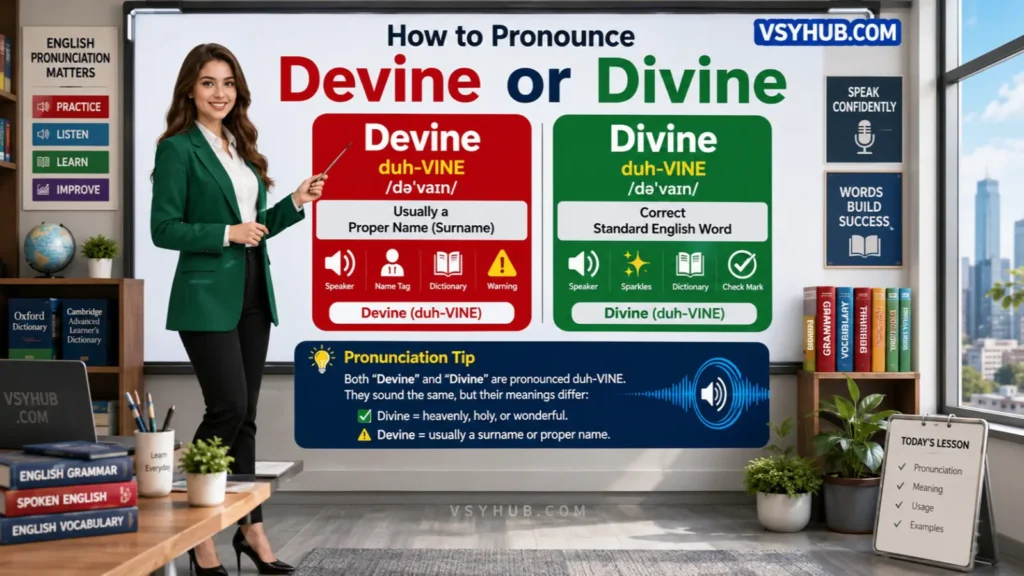
Both words sound almost the same in standard English.
Divine Pronunciation
Phonetic: /dɪˈvaɪn/
Easy pronunciation:
duh-VINE
The second syllable receives the strongest stress.
Break it into syllables:
Di • vine
Say it slowly:
duh + VINE
Devine Pronunciation
When used as a surname, Devine is usually pronounced the same way:
duh-VINE
However, pronunciation can vary slightly depending on a family’s preference or regional accent.
Easy Speaking Trick
Think of the word vine.
Simply add a soft di sound before it.
Di + vine = Divine
Common Pronunciation Mistakes
Incorrect:
- dee-vin
- dih-veen
- deh-vin
Correct:
- duh-VINE
Practice Sentences
- The flowers look divine today.
- We asked for divine guidance.
- Ms. Devine teaches English.
- The dessert tasted absolutely divine.
- I read a book written by James Devine.
Practice saying these sentences aloud to build confidence and improve your pronunciation naturally.
British English vs American English Usage
The good news is that there is no spelling difference between British English and American English for the word divine. It is written the same way in both varieties of English.
| Feature | British English | American English | Notes |
|---|---|---|---|
| Correct spelling | Divine | Divine | Same spelling worldwide |
| Pronunciation | duh-VINE | duh-VINE | Very similar in both accents |
| Meaning | Holy, heavenly, wonderful | Holy, heavenly, wonderful | Same meaning |
| Grammar | Adjective and noun | Adjective and noun | Same grammar rules |
| Formal writing | Divine | Divine | Widely accepted |
| Everyday speech | Common | Common | Frequently used |
| Religious writing | Very common | Very common | Used in both traditions |
| Devine | Usually a surname | Usually a surname | Not a replacement for divine |
Both British and American dictionaries recognize divine as the standard English word. If you see Devine in a sentence, it is almost always a proper name rather than an alternative spelling.
Which One Should You Use?
In almost every piece of writing, divine is the correct choice when you mean something holy, heavenly, beautiful, or exceptionally good.
Use divine when:
- Talking about God or religion.
- Describing something beautiful.
- Praising food or drinks.
- Writing essays or assignments.
- Creating professional documents.
- Posting on social media.
- Writing blogs or books.
- Sending emails.
- Having everyday conversations.
Examples:
- The view from the mountain was divine.
- She prepared a divine dinner.
- They believed in divine wisdom.
Use Devine only when:
- It is someone’s surname.
- It is the official name of a business.
- It is the name of a town or place.
- It is part of a registered brand or organization.
Quick Usage Table
| Situation | Correct Word |
|---|---|
| Talking about God | Divine |
| Describing amazing food | Divine |
| Complimenting beauty | Divine |
| Academic writing | Divine |
| Business communication | Divine |
| Text messages | Divine |
| Social media captions | Divine |
| Someone’s last name | Devine |
Common Mistakes With Devine or Divine
Many English learners confuse these words because they look and sound similar. Here are the most common mistakes and how to avoid them.
Mistake 1: Using Devine Instead of Divine
❌ The food was Devine.
✔ The food was divine.
Why it happens: People spell the word the way it sounds.
Tip: If you’re describing something wonderful or heavenly, always use divine.
Mistake 2: Thinking Devine Is an Alternative Spelling
❌ British English uses Devine.
✔ Both British and American English use divine.
Why it happens: Some learners assume regional spelling differences exist.
Tip: Remember that Devine is usually a proper name, not a spelling variation.
Mistake 3: Forgetting Capital Letters for a Surname
❌ john devine
✔ John Devine
Why it happens: Proper names must begin with capital letters.
Tip: Capitalize Devine whenever it refers to a person or place.
Mistake 4: Using Divine as a Person’s Name
❌ Mr. Divine is our new teacher. (unless that is actually his surname)
✔ Mr. Devine is our new teacher.
Why it happens: Writers replace the surname with the common dictionary word.
Tip: Check the correct spelling of names before writing them.
Mistake 5: Assuming Every Devine Means Holy
❌ Emily Devine means heavenly.
✔ Emily Devine is simply a person’s surname.
Why it happens: The words look alike.
Tip: Always read the sentence to understand whether the word is a name or a vocabulary word.
Mistake 6: Relying Only on Pronunciation
❌ I wrote Devine because both words sound the same.
✔ Choose the spelling based on the meaning, not just the sound.
Tip: Ask yourself, “Am I describing something wonderful, or am I writing someone’s name?”
Mistake 7: Ignoring Proofreading
❌ The report described the company’s devine service.
✔ The report described the company’s divine service.
Why it happens: Spell-check may not flag Devine because it is a valid surname.
Tip: Always proofread important writing and check whether the word fits the meaning.
Divine or Devine in Everyday Examples
The easiest way to remember the difference is by seeing both words in real-life situations. In almost every example below, divine is the correct choice because it describes something holy, beautiful, or wonderful. Devine only appears when it is a person’s name or a proper noun.
At Work
- Our manager gave us some divine advice before the presentation.
- The client said the hotel service was divine.
- Mr. Devine joined our marketing team last month.
- Everyone admired the divine design of the new office.
At School
- The teacher explained the meaning of divine in today’s lesson.
- Sarah wrote a paragraph about divine love.
- Mrs. Devine teaches English literature.
- The students learned that divine is the correct spelling for something heavenly.
On Social Media
- This sunset is absolutely divine! 🌅
- Your wedding dress looks divine.
- I just read a post by Emma Devine.
- That homemade pizza looks divine.
In Daily Life
- Grandma’s apple pie tastes divine.
- We enjoyed the divine view from the hill.
- Our neighbors are the Devine family.
- The fresh flowers smelled divine.
In Emails
Correct:
Thank you for preparing such a divine meal during yesterday’s event.
Correct:
Dear Mr. Devine, thank you for your quick response.
In Text Messages
Friend 1: How was the restaurant?
Friend 2: The food was divine!
Another example:
Friend 1: Who called you?
Friend 2: Mr. Devine from the office.
In Online Content
Blogs, websites, magazines, and news articles usually write:
- The beach offers divine scenery.
- The chef prepared a divine dessert.
- Author Michael Devine released a new book.
In Everyday Conversations
Person A: How was the concert?
Person B: It was absolutely divine.
Person A: Who is your new coach?
Person B: Coach Devine started this week.
Divine or Devine in Different Contexts
Understanding different contexts helps you choose the correct word naturally.
In Education
Students often confuse Devine and divine because they look almost identical.
Teachers usually explain that:
- Divine is a dictionary word.
- Devine is generally a surname.
Example:
“The poem describes divine beauty.”
In Grammar Learning
This is a classic spelling confusion.
Remember:
- Divine = adjective (sometimes noun)
- Devine = proper noun (name)
Grammar examples:
- The singer has a divine voice.
- Mr. Devine is our principal.
In Professional Writing
Professional documents should always use the correct spelling.
Examples:
✔ The customer received divine service.
✔ Ms. Devine approved the proposal.
Incorrect spelling can make business writing look unprofessional.
In Business Communication
Businesses often use divine in advertising because it creates a feeling of luxury and quality.
Examples:
- Experience our divine spa treatments.
- Enjoy divine handcrafted chocolates.
- Taste our divine coffee blends.
However, if a company’s name includes Devine, never change its spelling.
Example:
- Devine Construction Ltd.
- Devine Consulting
In Marketing
Marketers love using divine because it sounds positive and memorable.
Common phrases include:
- Divine beauty
- Divine skincare
- Divine fragrance
- Divine comfort
- Divine experience
- Divine luxury
These expressions make products sound premium.
In Religious Contexts
This is one of the oldest and most important uses of divine.
Examples include:
- Divine wisdom
- Divine mercy
- Divine power
- Divine blessing
- Divine justice
- Divine love
- Divine guidance
- Divine creation
Here, divine refers to God or something sacred.
In Literature
Authors often use divine to create vivid descriptions.
Example:
“The princess had a divine smile that brightened the room.”
This does not necessarily mean religious—it often means exceptionally beautiful.
In Relationships
People sometimes describe loved ones using divine as a compliment.
Examples:
- You look divine tonight.
- Your smile is absolutely divine.
- She prepared a divine anniversary dinner.
In Fashion
Fashion magazines frequently use divine.
Examples:
- A divine evening gown.
- Divine elegance.
- Divine style.
- Divine makeup.
In Beauty and Cosmetics
Beauty brands often use the word because it sounds luxurious.
Examples:
- Divine glow.
- Divine skin.
- Divine perfume.
- Divine lipstick collection.
In Food and Cooking
One of the most common modern uses of divine is describing delicious food.
Examples:
- The cheesecake was divine.
- This coffee tastes divine.
- Grandma’s cookies are simply divine.
- The pasta smells divine.
In Travel
Travel writers often describe beautiful places as divine.
Examples:
- Divine beaches.
- Divine mountain views.
- Divine sunsets.
- Divine gardens.
In Entertainment
Movie and music reviewers also use divine.
Examples:
- The actor gave a divine performance.
- Her voice sounds divine.
- The orchestra created a divine atmosphere.
In Social Media
On Instagram, Facebook, TikTok, Pinterest, and X, users commonly write:
- This outfit is divine.
- The vacation was divine.
- Your makeup looks divine.
- What a divine sunset!
These posts use divine to express admiration.
Devine or Divine – Google Trends & Usage Data
Many people search for Devine or Divine because the words sound almost identical but have different meanings. This spelling confusion appears frequently among English learners, students, bloggers, writers, and professionals.
People commonly search for:
- Is it Devine or Divine?
- How do you spell divine?
- What does divine mean?
- Is Devine a real word?
- Divine pronunciation.
- Divine meaning in English.
- Devine vs Divine difference.
- Divine examples in sentences.
Why Is This Keyword Popular?
The keyword is popular because:
- The words have nearly identical pronunciation.
- Many people accidentally type Devine instead of divine.
- Spell-checkers may not flag Devine because it is a valid surname.
- Students often encounter divine in literature and religious studies.
- Writers want to avoid spelling mistakes in blogs, emails, and assignments.
Countries Where People Frequently Search
This topic receives interest from English learners and native speakers in many countries, including:
- United States
- United Kingdom
- Canada
- Australia
- India
- Pakistan
The confusion is especially common among learners who are improving their English writing skills.
Long-Tail Search Variations
People also search using longer questions such as:
- What is the difference between Devine and Divine?
- Is Devine the correct spelling?
- How do you pronounce Divine?
- Can Devine mean holy?
- Divine meaning with examples.
- Divine in a sentence.
- Divine pronunciation in American English.
- Divine pronunciation in British English.
- Why do people spell Divine as Devine?
- Is Devine a surname?
These conversational searches reflect voice-search behavior and help explain why this topic remains popular.
Comparison Table: Devine vs Divine
| Feature | Divine | Devine |
|---|---|---|
| Correct English vocabulary word | ✅ Yes | ❌ No (generally a proper name) |
| Main meaning | Holy, heavenly, wonderful | Usually a surname or proper noun |
| Part of speech | Adjective (sometimes noun) | Proper noun |
| Pronunciation | duh-VINE | Usually duh-VINE |
| Used in dictionaries | ✅ Yes | Listed mainly as a surname or place name |
| Used in academic writing | Frequently | Only as a name |
| Used in business writing | Frequently | Only when referring to a specific person or company |
| Used in religion | Very common | No |
| Used in advertising | Very common | Only as a brand name |
| Common learner mistake | Confusing it with Devine | Using it instead of Divine |
| British English | Divine | Same surname spelling |
| American English | Divine | Same surname spelling |
Divine or Devine in Professional Life
Correct spelling matters in professional communication. Using Devine when you mean divine can make reports, emails, or presentations appear careless.
Workplace Communication
Examples:
✔ Our customers enjoyed a divine dining experience.
✔ Mr. Devine will lead today’s meeting.
Professional Writing
Always proofread words that sound alike.
Examples include:
- Business proposals.
- Reports.
- Marketing materials.
- Website content.
- Product descriptions.
- Company newsletters.
Using divine correctly improves clarity and professionalism.
Branding and Advertising
Many luxury brands use divine because it creates positive emotions.
Examples:
- Divine Collection.
- Divine Beauty.
- Divine Jewelry.
- Divine Desserts.
- Divine Resorts.
The word suggests elegance, excellence, beauty, and premium quality.
If a business is officially named Devine, never change its spelling, as it is part of the brand identity.
Divine or Devine for Students or Beginners
Many beginners struggle with these words because they focus on pronunciation instead of meaning.
Here are some easy learning tips:
- Learn the meaning before memorizing the spelling.
- Remember that divine is the everyday English word.
- Think of Devine as someone’s last name.
- Read example sentences every day.
- Practice writing both words in context.
- Proofread your homework and emails.
- Use a dictionary when you’re unsure.
With regular practice, choosing the correct word becomes natural.
Signs, Characteristics, or Common Uses Related to Divine
Common Uses of Divine
- Describing God or heaven.
- Talking about religion.
- Complimenting beauty.
- Praising delicious food.
- Describing outstanding music.
- Appreciating nature.
- Reviewing hotels and restaurants.
- Marketing luxury products.
Common Uses of Devine
- Family names.
- Author names.
- Teacher names.
- Company names.
- Place names.
- Brand names.
Writing Situations Where Divine Is Common
- School essays.
- Religious articles.
- Lifestyle blogs.
- Food reviews.
- Travel writing.
- Fashion magazines.
- Beauty websites.
- Marketing campaigns.
- Business communication.
- Inspirational quotes.
Online Usage Patterns
People often use divine in captions and reviews to express admiration, while Devine usually appears only when referring to a specific individual, business, or location. Understanding this pattern makes it much easier to choose the correct spelling in everyday writing.
Simple Trick to Remember Devine or Divine
Learning one easy memory trick can help you avoid this spelling mistake forever.
Easy Memory Rule
- Divine = Something holy, heavenly, beautiful, or amazing.
- Devine = Usually a person’s surname or a proper name.
Notice the “I” in Divine.
You can remember it like this:
I = Inspiration from above.
If you’re talking about something wonderful or connected with God, Divine is almost always the correct spelling.
Think of It This Way
Imagine you’re looking at a breathtaking sunset.
You say:
“The view is divine.”
Now imagine you’re introducing your teacher.
You say:
“This is Mr. Devine.”
One word describes something beautiful. The other identifies a person.
Quick Memory Shortcut
Ask yourself one question:
“Am I describing something, or am I writing someone’s name?”
- Describing beauty, excellence, or holiness? → Divine
- Referring to a person’s last name? → Devine
This simple question will help you choose the correct spelling almost every time.
Expert Tips
Many articles explain the difference, but these practical tips will help you avoid mistakes in real writing.
Read the Whole Sentence
Don’t focus on the word alone. Read the complete sentence to understand its meaning.
Example:
- The dessert tasted divine.
- Mrs. Devine teaches science.
The context immediately tells you which spelling is correct.
Don’t Trust Spell Check Completely
Spell check may not highlight Devine because it is a real surname.
Always check whether the word fits the meaning of your sentence.
Learn Common Word Partners
The word divine often appears with:
- Divine love
- Divine beauty
- Divine guidance
- Divine wisdom
- Divine power
- Divine grace
- Divine inspiration
- Divine mercy
- Divine design
- Divine intervention
Learning these phrases makes correct usage much easier.
Read More English Content
Books, newspapers, blogs, and magazines use divine correctly. Reading regularly helps you remember the spelling naturally.
Practice With Your Own Sentences
Write a few sentences like:
- The music sounded divine.
- Mr. Devine greeted the class.
Creating your own examples improves long-term memory.
Proofread Before Publishing
Before sending an email, publishing a blog, or submitting homework, search for words that sound alike. A quick review can prevent embarrassing spelling mistakes.
Related Searches People Also Ask
Here are some common questions people search for online.
Is it Devine or Divine?
Divine is the correct English word for something holy, heavenly, or wonderful. Devine is usually a surname.
Is Devine a real word?
It is generally used as a proper name, such as a family name, business name, or place name—not as a replacement for divine.
What does Divine mean?
It means relating to God, heaven, or something exceptionally beautiful, excellent, or inspiring.
How do you pronounce Divine?
It is pronounced duh-VINE (/dɪˈvaɪn/).
Why do people spell Divine as Devine?
Because both words sound almost the same, many people accidentally type Devine instead of divine.
Is Divine an adjective?
Yes. It is mainly an adjective, although it can also be used as a noun in certain religious contexts.
Can Divine describe food?
Yes. People often say delicious food tastes divine.
Is Divine used in religion only?
No. While it has religious origins, it is also commonly used to describe beauty, excellence, luxury, and quality.
Can Divine be used in formal writing?
Yes. It is appropriate for academic writing, business communication, books, articles, and professional documents.
Why is Divine popular in advertising?
Because it suggests elegance, luxury, perfection, and a premium experience.
Is Devine ever correct?
Yes. It is correct when referring to someone’s surname, a company, or a place officially named Devine.
How can I remember the difference?
Think: Divine describes; Devine identifies.
Frequently Asked Questions
Is Divine the correct spelling?
Yes. Divine is the correct spelling when referring to something holy, heavenly, beautiful, or excellent.
Is Devine wrong?
Not always. Devine is correct when it is someone’s surname or part of an official name. It is incorrect if you mean divine.
What part of speech is Divine?
It is mainly an adjective, but it can also be used as a noun in some religious contexts.
Can Divine describe people?
Yes. You can say someone looks divine or has a divine voice.
Are Divine and Devine pronounced differently?
Usually, no. Both are commonly pronounced duh-VINE.
Is there a British spelling of Divine?
No. British English and American English both use divine.
Can I use Divine in business writing?
Yes. It is suitable when describing exceptional quality or excellence.
Why do English learners confuse these words?
Because they have nearly identical pronunciation and very similar spelling.
Is Divine a positive word?
Yes. It usually has a very positive meaning and expresses admiration, beauty, perfection, or holiness.
What’s the easiest way to remember the correct spelling?
Remember: Divine describes something wonderful. Devine is usually someone’s name.
Final Verdict
The answer is simple:
- Divine is the correct English word when you mean holy, heavenly, beautiful, excellent, or wonderful.
- Devine is generally a surname or proper name, not an alternative spelling.
Final Memory Rule
Divine = Description
Devine = Name
If you’re complimenting food, nature, music, people, or referring to religious ideas, choose divine.
If you’re referring to a person, company, or place named Devine, keep that exact spelling.
Conclusion
Although Devine and Divine look and sound similar, they serve very different purposes. Divine is the standard English word used to describe something sacred, heavenly, beautiful, or outstanding, while Devine is most often a surname or part of a proper name.
Whenever you’re unsure, think about the meaning of your sentence. If you’re describing quality, beauty, or something related to God, the correct choice is divine. If you’re writing someone’s official name, use Devine.
A final memory trick is simple: Divine describes, Devine identifies. Keep this rule in mind, and you’ll confidently choose the correct spelling every time.

Aria Foster is a comparison and language writer who specializes in spelling differences, word meanings, grammar guides, and easy-to-understand language explanations. She creates clear, reader-friendly content that helps people understand commonly confused words and expressions.