Have you ever heard someone described as blonde or brunette and wondered what those words really mean?
Many English learners become confused because these terms describe hair color, but they also have grammar and usage rules that are not always obvious.
People usually search for blonde or brunette meaning, correct usage, pronunciation, examples, definition, and grammar differences because they see these words in movies, fashion, school, social media, beauty blogs, and everyday conversations.
Understanding the difference helps you describe people naturally and avoid common mistakes.
In this guide, you’ll learn the meaning, pronunciation, examples, usage, grammar rules, common mistakes, expert tips, and simple explanations in easy English.
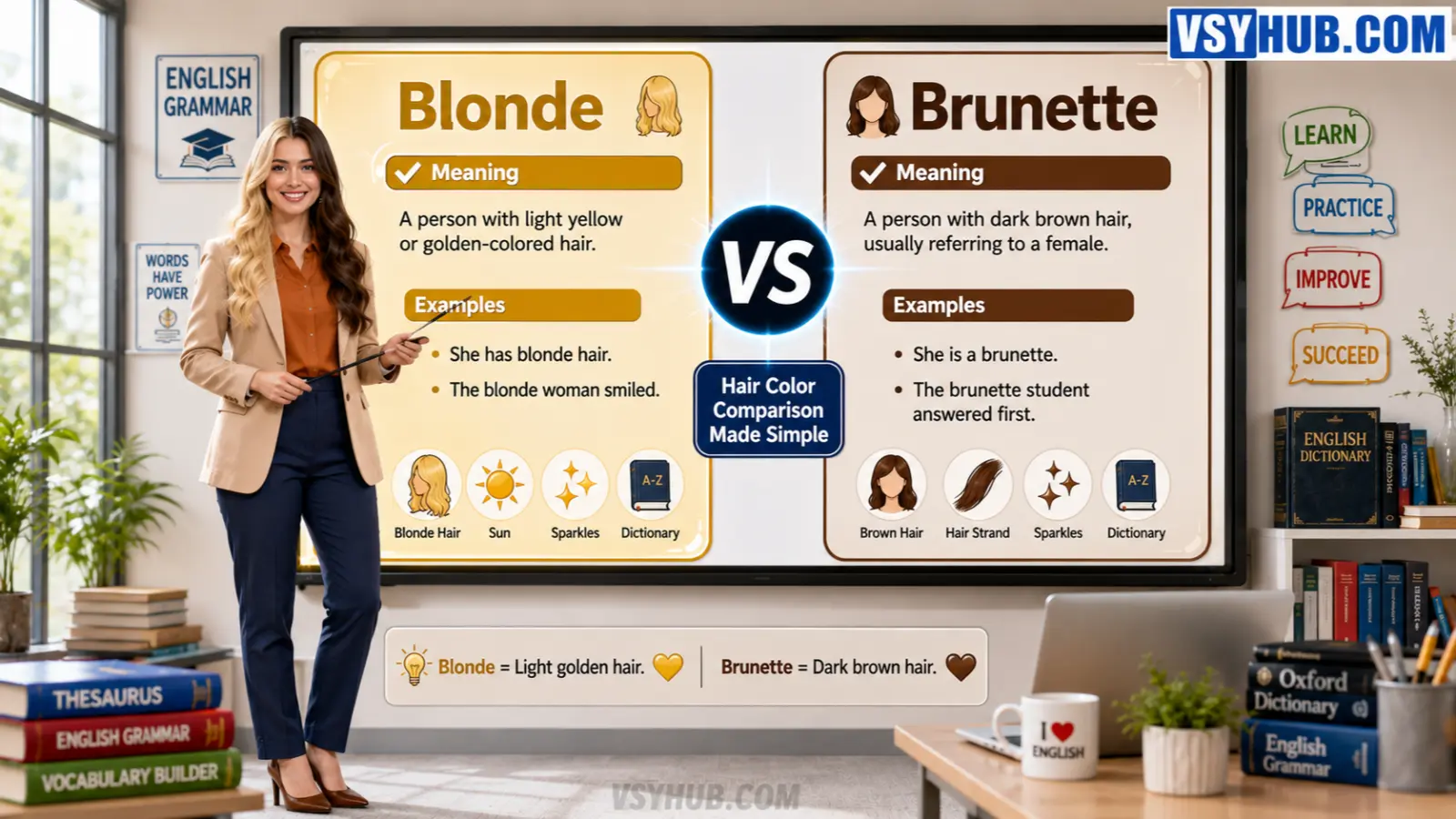
Blonde or Brunette – Quick Answer
Blonde and brunette are not synonyms. They describe different hair colors.
👉 Blonde = A person (traditionally a woman) with light yellow or golden hair, or the hair color itself.
👉 Brunette = A woman or girl with brown hair.
For men, English traditionally uses:
- Blond = A man with light-colored hair.
- Brunet = A man with brown hair (rare in modern English).
Today, many people simply use blonde for both men and women in everyday English, while brunette is still commonly used for women.
Examples
- ✅ She has long blonde hair.
- ✅ My sister is a brunette.
- ✅ The blonde woman smiled at us.
- ✅ He is blond, but many people also write “blonde.”
- ✅ The brunette actress won the award.
Simple Rule
- Blonde = Light hair.
- Brunette = Brown hair.
Easy Memory Trick
Think of it this way:
Blonde = Bright like the sun.
Brunette = Brown like tree bark.
What Does Blonde or Brunette Mean?
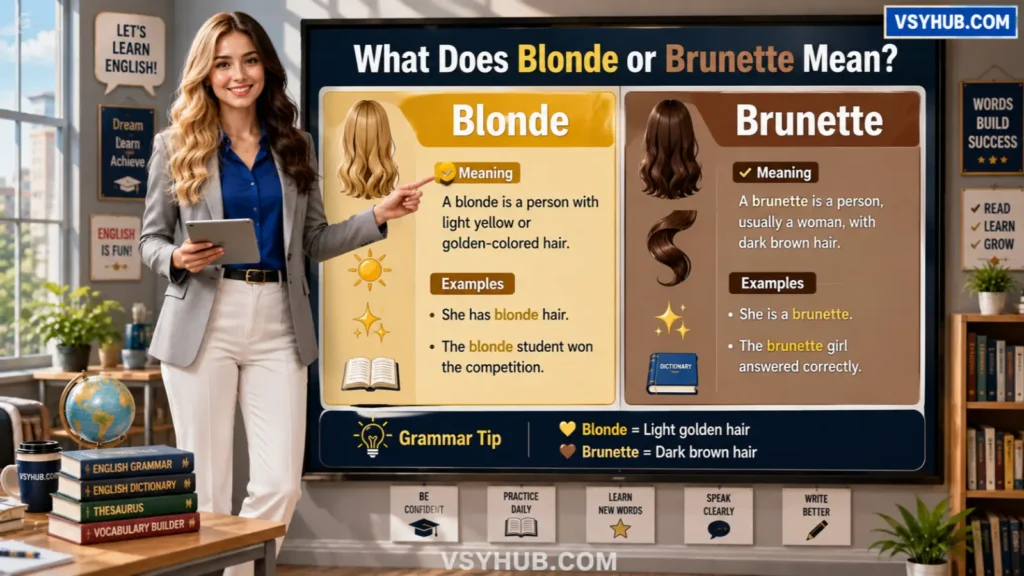
Both words describe hair color, but they refer to different shades.
Blonde refers to hair that is very light. It may be golden, yellow, ash, platinum, honey, or sandy in color.
Brunette refers to brown hair. The shade can range from light brown to very dark brown.
These words are commonly used when describing people in conversations, books, magazines, movies, fashion, and beauty industries.
Blonde Meaning
A blonde person has naturally or artificially light-colored hair.
Examples:
- She has beautiful blonde curls.
- The little boy has blond hair.
- Her blonde highlights look natural.
Brunette Meaning
A brunette has brown hair.
Examples:
- She is a brunette with shoulder-length hair.
- My cousin changed from blonde to brunette.
- The brunette model appeared on the magazine cover.
Can Men Be Called Brunette?
Traditionally, brunette describes women.
The masculine form is brunet, but modern English rarely uses it.
Instead, people often say:
- He has brown hair.
- He is a brown-haired man.
Synonyms
For Blonde
- Fair-haired
- Golden-haired
- Light-haired
- Honey-haired
- Platinum-haired
- Ash blonde
- Sandy-haired
For Brunette
- Brown-haired
- Chestnut-haired
- Dark-haired
- Chocolate-haired
- Auburn-haired (reddish brown in some contexts)
Opposites
Blonde
- Brunette
- Black-haired
- Dark-haired
Brunette
- Blonde
- Fair-haired
- Light-haired
Related Terms
- Hair color
- Blonde hair
- Brown hair
- Hair dye
- Highlight
- Platinum blonde
- Dirty blonde
- Auburn
- Black hair
- Redhead
Common Variations
Blonde
- Blond
- Dirty blonde
- Platinum blonde
- Ash blonde
- Honey blonde
- Golden blonde
Brunette
- Dark brunette
- Light brunette
- Chocolate brunette
- Medium brunette
- Chestnut brunette
The Origin of Blonde or Brunette
Both blonde and brunette come from the French language.
The word blond originally meant light-colored or fair. French later developed two forms:
- Blond (masculine)
- Blonde (feminine)
English borrowed these words hundreds of years ago. Over time, many English speakers began using blonde for women and blond for men, although today blonde is commonly accepted for both genders in everyday writing.
The word brunette also comes from French.
It comes from brun, meaning brown.
Originally, brunette described a woman with brown hair or a darker complexion. Today, it almost always refers to a woman with brown hair.
Fashion magazines, beauty brands, Hollywood films, and social media have made both words popular around the world.
How to Pronounce Blonde or Brunette
Blonde
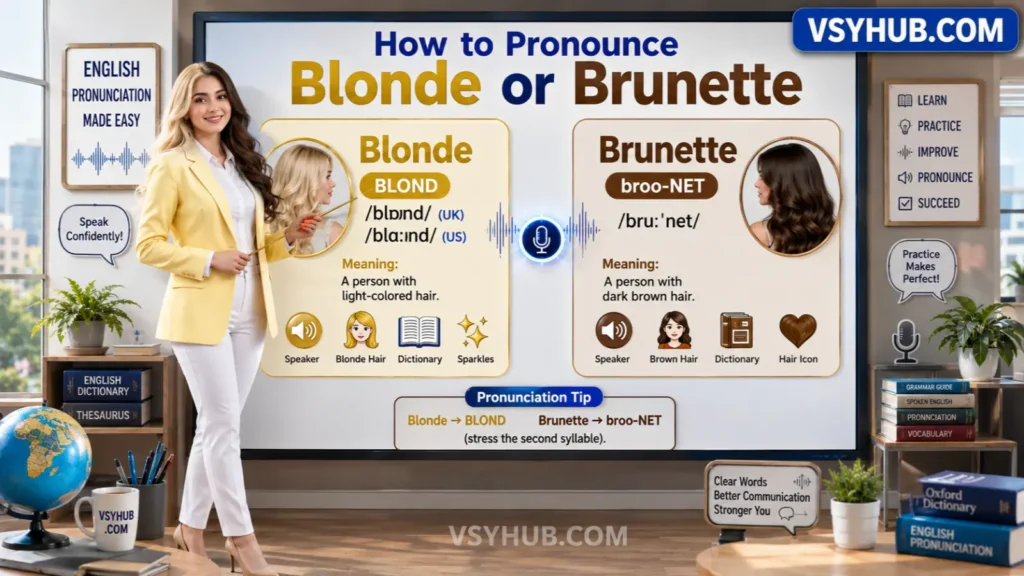
Blonde (blond)
Phonetic: /blɒnd/ (UK), /blɑːnd/ (US)
Easy pronunciation:
BLOND
The final e is silent.
Brunette
Brunette (broo-NET)
Phonetic: /bruːˈnet/
Easy pronunciation:
broo-NET
The stress is on the second syllable.
Syllables
| Word | Syllables |
|---|---|
| Blonde | 1 |
| Brunette | 2 |
Common Pronunciation Mistakes
❌ Bluhn-day
✔ Blond
❌ Broon-ette
✔ Broo-NET
❌ Brun-net
✔ Broo-NET
Speaking Trick
- Blonde rhymes with pond, beyond the “bl” sound.
- Brunette sounds like broo-NET.
Practice:
- She is a blonde.
- My best friend is a brunette.
British English vs American English Usage
Both British English and American English use blonde and brunette, although there are small style differences.
| Feature | British English | American English | Notes |
|---|---|---|---|
| Blonde (women) | Yes | Yes | Standard |
| Blond (men) | More common | Less common | Traditional spelling |
| Blonde (men) | Increasingly accepted | Common in everyday writing | Informal style |
| Brunette | Yes | Yes | Standard |
| Brunet | Rare | Very rare | Mostly historical or literary |
| Pronunciation | Slight accent differences | Slight accent differences | Meaning stays the same |
| Formal writing | Blonde/Blond distinction sometimes kept | Blonde commonly used | Style guide dependent |
Whether you’re writing in the UK, the US, Canada, Australia, India, or Pakistan, everyone understands blonde and brunette.
Which One Should You Use?
The correct choice depends on the person’s hair color—not on which word sounds better.
Use Blonde When
- Hair is light yellow or golden.
- Describing a blonde woman.
- Referring to blonde hair.
- Writing beauty or fashion content.
Examples:
- She has blonde hair.
- The blonde actress smiled.
- I dyed my hair blonde.
Use Brunette When
- A woman has brown hair.
- Describing brown-haired female characters.
- Writing about fashion, beauty, or appearance.
Examples:
- My cousin is a brunette.
- The brunette model appeared on the runway.
- She changed from blonde to brunette.
Mini Usage Table
| Situation | Blonde | Brunette |
|---|---|---|
| Light hair | ✅ | ❌ |
| Brown hair | ❌ | ✅ |
| Fashion articles | ✅ | ✅ |
| Beauty blogs | ✅ | ✅ |
| School writing | ✅ | ✅ |
| Social media | ✅ | ✅ |
| Professional writing | ✅ | ✅ |
Common Mistakes With Blonde or Brunette
Many learners know both words but use them incorrectly. Here are the most common mistakes.
Mistake 1: Thinking Blonde and Brunette Mean the Same Thing
❌ She has brown hair, so she is blonde.
✔ She has brown hair, so she is a brunette.
Why it happens: Beginners think both words simply describe hair.
Beginner Tip: Blonde = light hair. Brunette = brown hair.
Mistake 2: Calling Every Light Hair Color Platinum Blonde
❌ She has light brown hair, so she’s platinum blonde.
✔ Platinum blonde is an extremely light shade of blonde.
Why it happens: People don’t realize there are many blonde shades.
Mistake 3: Using Brunette for Black Hair
❌ She has jet-black hair, so she’s brunette.
✔ Brunette usually means brown hair, not pure black hair.
Beginner Tip: Black hair and brunette are not always the same.
Mistake 4: Forgetting That Blonde Can Describe Hair Color
❌ She has blonde.
✔ She has blonde hair.
✔ She is blonde.
Why it happens: Learners confuse the adjective with the noun.
Mistake 5: Confusing Blond and Blonde
❌ Every man must be called blonde.
✔ Traditionally:
- Blond = man
- Blonde = woman
However, modern English often accepts blonde for everyone.
Beginner Tip: If unsure, “blonde hair” is always safe.
Mistake 6: Using Brunette for Men in Formal Writing
❌ He is a brunette.
✔ He has brown hair.
✔ He is a brunet. (Correct but uncommon.)
Why it happens: Modern English rarely uses brunet, so people naturally choose brunette.
Mistake 7: Believing Hair Dye Changes the Word
❌ She dyed her hair blonde, so she isn’t blonde.
✔ If someone currently has blonde hair, it is natural to describe them as blonde, regardless of whether the color is natural or dyed.
Blonde or Brunette in Everyday Examples
Learning through real-life examples makes these words much easier to remember. Here are natural examples showing how blonde and brunette are used in different situations.
At Work
- The blonde receptionist welcomed every visitor with a smile.
- Our new manager is a brunette with short brown hair.
- The company photographer asked the blonde employee to stand near the window for better lighting.
- The brunette designer presented the new fashion collection.
At School
- The blonde student answered every question correctly.
- My best friend is a brunette who loves reading books.
- The teacher asked the blonde girl to help decorate the classroom.
- The brunette boy won the science competition.
On Social Media
- She posted a picture of her new blonde hairstyle.
- Everyone loved her fresh brunette makeover.
- Should I stay blonde or become a brunette?
- The influencer changed from blonde to brunette, and her followers loved the new look.
In Daily Life
- My sister has naturally blonde hair.
- My mother has beautiful brunette hair.
- The little girl has bright blonde curls.
- He prefers dating brunettes, while his friend likes blondes.
In Emails
Professional example:
The model selected for the campaign has long blonde hair.
Another example:
We are looking for a brunette model for tomorrow’s photo shoot.
Text Messages
- I finally dyed my hair blonde!
- I think I’m going back to brunette next month.
- Which looks better on me, blonde or brunette?
- She was blonde last year but is brunette now.
Online Articles
- Blonde hair trends are becoming popular this summer.
- Brunette hairstyles remain a timeless fashion choice.
- Experts recommend choosing a hair color that matches your skin tone.
In Everyday Conversations
Friend 1: Is your sister blonde?
Friend 2: No, she’s a brunette.
Another conversation:
“She used to be blonde, but now she’s brunette.”
Blonde or Brunette in Different Contexts
The meaning stays the same, but the way people use these words changes depending on the situation.
In Everyday English
This is the most common use.
People simply describe someone’s hair color.
Examples:
- A blonde girl
- A brunette woman
- Blonde hair
- Brunette curls
In Fashion
Fashion magazines frequently use these words to describe models and beauty trends.
Examples:
- Blonde hairstyles for summer
- Brunette hair color ideas
- Blonde highlights
- Rich brunette shades
In Beauty Salons
Hairdressers use these words every day.
Examples:
- Do you want to stay blonde?
- Would you like a darker brunette shade?
- Platinum blonde is very popular this year.
- Chocolate brunette suits your skin tone.
In Movies and Television
Characters are often described by their appearance.
Examples:
- The blonde detective solved the mystery.
- The brunette actress played the lead role.
- The blonde hero appeared in every episode.
In Literature
Authors use these words to help readers imagine characters.
Example:
“The tall blonde woman entered the room while the brunette waited outside.”
In Social Media
Influencers often ask followers:
- Blonde or brunette?
- Which hair color suits me better?
- Team Blonde or Team Brunette?
These polls are common on Instagram, TikTok, Facebook, and YouTube.
In Relationships
People sometimes describe their preferences.
Examples:
- He prefers brunettes.
- She likes blondes.
- Hair color isn’t important to me.
In Marketing
Beauty companies use these words to advertise products.
Examples:
- Shampoo for blonde hair
- Conditioner for brunettes
- Blonde color protection
- Brunette shine treatment
In Entertainment
Celebrities often change between blonde and brunette hairstyles for movie roles, fashion shows, or personal style.
Examples:
- The actress surprised fans with a blonde makeover.
- The singer returned to her natural brunette hair.
In Education
Teachers explain these words as adjectives and nouns.
Examples:
- Blonde describes light-colored hair.
- Brunette describes brown-haired women.
- Blond is traditionally used for men, although modern English often accepts blonde for everyone.
Blonde or Brunette – Google Trends & Usage Data
People search for blonde or brunette throughout the year because hair color is a popular topic in fashion, beauty, entertainment, and English learning.
Students, writers, English learners, hairstylists, and social media users frequently want to know the difference.
Common searches include:
- Blonde vs brunette
- Blonde meaning
- Brunette meaning
- Blonde pronunciation
- Brunette pronunciation
- Blond or blonde
- Can men be called brunette?
- Blonde hair meaning
- Difference between blonde and brunette
Search Popularity
Both terms receive millions of searches because they are commonly used in:
- Beauty blogs
- Hair color guides
- Fashion magazines
- Celebrity news
- Movies
- Television
- Social media
- English learning websites
Countries Where People Commonly Search
People from many English-speaking and English-learning countries search for these words, including:
- United States
- United Kingdom
- Canada
- Australia
- India
- Pakistan
Many searches come from learners who want to improve their English vocabulary and understand common descriptions of appearance.
Long-Tail Searches
People also search for:
- What is the difference between blonde and brunette?
- Is blonde lighter than brunette?
- How do you pronounce brunette?
- Blonde vs blond
- Can a man be called blonde?
- What does brunette mean?
- What hair color is brunette?
- Is dirty blonde considered blonde?
- Can dyed hair still be called blonde?
- Which is more common, blonde or brunette?
These questions show that users are looking for simple, practical answers rather than complex grammar explanations.
Comparison Table: Blonde vs Brunette
| Feature | Blonde | Brunette |
|---|---|---|
| Hair color | Light yellow or golden | Brown |
| Dictionary word | ✅ Yes | ✅ Yes |
| Pronunciation | BLOND | Broo-NET |
| Common gender use | Mostly women (also used for men today) | Mostly women |
| Traditional masculine form | Blond | Brunet |
| Fashion industry | Very common | Very common |
| Beauty salons | Frequently used | Frequently used |
| Academic writing | Correct | Correct |
| Social media | Very common | Very common |
| Common mistake | Confused with blond | Confused with black hair |
Blonde or Brunette in Professional Life
Hair color descriptions are common in many professions where appearance matters. Using the correct term helps your writing sound accurate and professional.
In Workplace Communication
Most office jobs rarely require these words, but they may appear when describing a person for identification.
Example:
“The blonde woman from the marketing team will lead today’s meeting.”
In Fashion
Fashion designers regularly describe models by their hair color.
Examples:
- Looking for a blonde model.
- Casting brunette models for the new campaign.
In Beauty Industry
Hairdressers use these words every day.
Examples:
- Blonde color correction.
- Brunette hair treatment.
- Blonde highlights.
- Brunette balayage.
In Journalism
News reporters may identify someone by hair color if it helps readers recognize a person.
Example:
“Witnesses described the woman as blonde with shoulder-length hair.”
Why Correct Usage Matters
Using the correct word helps you:
- Communicate clearly.
- Avoid confusion.
- Sound more natural in English.
- Improve descriptive writing.
- Build confidence in speaking and writing.
Blonde or Brunette for Students or Beginners
Many English learners mix these words because they focus only on appearance instead of hair color.
Here are simple ways to remember them.
Why Beginners Get Confused
- Movies use both words frequently.
- Fashion magazines introduce many hair color names.
- Some celebrities change hair color often.
- Blond and blonde look almost identical.
Beginner Learning Tips
- Remember the color first, not the word.
- Practice describing family members.
- Read simple English stories.
- Notice how magazines describe celebrities.
Easy Learning Shortcut
Blonde = Light hair
Brunette = Brown hair
If you’re unsure, imagine a traffic light:
- Yellow = Blonde
- Brown tree = Brunette
That simple picture helps many learners remember the difference.
Signs, Characteristics, or Common Uses Related to Blonde or Brunette
1 Common Uses of Blonde
- Golden hair
- Platinum hair
- Ash blonde
- Honey blonde
- Sandy blonde
- Blonde highlights
- Bleached hair
- Fair-haired appearance
2 Common Uses of Brunette
- Brown hair
- Chocolate brown hair
- Chestnut hair
- Dark brown hair
- Medium brown hair
- Rich brunette shades
- Natural brunette
- Brunette hairstyle
3 Common Situations Where These Words Are Used
- Fashion magazines
- Beauty salons
- Hair product advertisements
- Celebrity interviews
- Movies and TV shows
- School reading materials
- Online beauty blogs
- Social media hairstyle posts
Industries That Frequently Use These Terms
- Beauty and cosmetics
- Hair salons
- Fashion
- Entertainment
- Modeling
- Photography
- Journalism
- Advertising
Simple Trick to Remember Blonde or Brunette
Remembering the difference is easy once you connect each word with a familiar color.
Easy Memory Rule
- Blonde = Light, golden, or yellow hair.
- Brunette = Brown hair.
If you’re describing someone’s hair in school, at work, or in everyday conversation, simply think about the hair color first.
Think of It This Way
Imagine standing outside on a sunny day.
- The bright sunshine reminds you of blonde hair.
- The brown trunk of a tree reminds you of brunette hair.
This simple picture can help you remember the difference every time.
Memory Shortcut
Blonde = Bright
Brunette = Brown
Whenever you’re unsure, ask yourself:
“Is the hair light or brown?”
The answer will tell you which word to use.
Expert Tips
Many articles explain the meanings of blonde and brunette, but here are a few practical tips that will help you use them confidently in real life.
Learn Hair Color Families
Hair color has many shades. Knowing a few common ones makes your vocabulary stronger.
Blonde Shades
- Platinum blonde
- Ash blonde
- Honey blonde
- Golden blonde
- Sandy blonde
- Dirty blonde
Brunette Shades
- Light brunette
- Medium brunette
- Dark brunette
- Chocolate brunette
- Chestnut brunette
Remember the Traditional Gender Rule
Traditionally:
- Blond = A man with light hair.
- Blonde = A woman with light hair.
Today, many English speakers use blonde for both men and women, especially in everyday conversation.
Don’t Guess Hair Colors
Hair color can change because of:
- Hair dye
- Highlights
- Lighting
- Camera filters
If you’re unsure, simply say:
- Brown-haired person
- Light-haired person
Practice with Descriptions
Describe people around you.
Examples:
- My sister is blonde.
- My aunt is a brunette.
- My friend has dark brown hair.
- The actor has dirty blonde hair.
The more you practice, the more natural these words become.
Read Beauty and Fashion Articles
Beauty magazines and salon websites use these terms correctly. Reading them helps you become familiar with natural English usage.
Use the Right Word for the Situation
Formal writing:
- Blonde hair
- Brown hair
- Brunette woman
Casual conversation:
- She’s blonde.
- She’s a brunette.
Both sound natural.
Related Searches People Also Ask
Here are some common questions people search for about blonde and brunette, along with simple answers.
What is the difference between blonde and brunette?
Blonde describes light-colored hair, while brunette describes brown hair.
Is blonde lighter than brunette?
Yes. Blonde hair is much lighter than brunette hair.
Can a man be called blonde?
Yes. Although blond is the traditional masculine spelling, blonde is widely accepted today.
What does brunette mean?
It describes a woman or girl with brown hair.
What is dirty blonde?
Dirty blonde is a darker shade of blonde that contains light brown or ash tones.
Is brunette the same as brown hair?
Yes. Brunette generally means brown-haired.
Can someone change from blonde to brunette?
Yes. Hair can be dyed from blonde to brunette or from brunette to blonde.
Which hair color is more common?
Worldwide, brunette hair is more common than natural blonde hair.
Are blonde and brunette only used for women?
Traditionally, yes, but modern English often uses blonde for everyone. Brunette is still mainly used for women.
Why do people search for blonde or brunette?
Because these words appear often in movies, beauty blogs, fashion magazines, celebrity news, and English learning materials.
Is black hair considered brunette?
Usually no. Brunette refers to brown hair, while black hair is often described separately.
How do I remember the difference?
Think:
Bright sun = Blonde
Brown tree = Brunette
Frequently Asked Questions
Is blonde a hair color?
Yes. Blonde is a light hair color that ranges from golden to platinum shades.
What does brunette mean?
Brunette means a woman or girl with brown hair.
Is blonde lighter than brunette?
Yes. Blonde hair is lighter than brunette hair.
Can men be called blonde?
Yes. Although blond is traditional, blonde is commonly used today.
What is the difference between blond and blonde?
Traditionally, blond refers to men and blonde refers to women. In modern English, many people use blonde for both.
Is brunette used for black hair?
Not usually. Brunette generally refers to brown hair.
Can dyed hair still be called blonde?
Yes. If someone’s current hair color is blonde, it’s natural to describe them as blonde.
Which word should students use?
Use blonde for light hair and brunette for brown hair.
Are blonde and brunette adjectives?
Yes. They can describe hair color, and they can also be used as nouns to describe people.
What is the easiest way to remember them?
Remember this simple phrase:
Blonde = Bright
Brunette = Brown
Final Verdict
The difference between blonde and brunette is simple once you focus on the hair color.
- Blonde means light or golden hair.
- Brunette means brown hair.
Both words are correct, but they describe different appearances.
If you’re writing for school, work, social media, or everyday conversation, choosing the correct word makes your English sound more natural and accurate.
Conclusion
Understanding the difference between blonde and brunette helps you describe people clearly and confidently. While blonde refers to light-colored hair, brunette refers to brown hair. These words are widely used in fashion, beauty, entertainment, and everyday conversations, so learning them will improve both your speaking and writing skills.
Whenever you forget the difference, remember this easy trick:
Bright sunshine = Blonde
Brown tree = Brunette
That simple image will help you choose the correct word every time.
Aria Foster is a comparison and language writer who specializes in spelling differences, word meanings, grammar guides, and easy-to-understand language explanations. She creates clear, reader-friendly content that helps people understand commonly confused words and expressions.