Have you ever filled out a college application, updated your resume, or written a LinkedIn profile and wondered whether to write master or masters?
Many English learners and even native speakers get confused because both words look similar but are used in different ways. You may also see different versions on school websites, job advertisements, social media, and online articles, making the choice even harder.
People usually search for: master or masters meaning, correct spelling, pronunciation, examples, usage, definition, grammar difference, master’s degree or masters degree, and when to use master vs masters.
In this guide, you’ll learn the meaning, pronunciation, examples, usage, grammar rules, common mistakes, expert tips, and simple explanations in easy English.
Master or Masters – Quick Answer
The correct word depends on what you want to say.
👉 Master = one person who has control, great skill, or an advanced academic title in some situations.
👉 Masters = the plural form of master or part of some proper names. By itself, it is not usually the correct way to refer to an academic degree.
👉 Master’s = the possessive form of master and the correct form in master’s degree.
Examples
She earned a master’s degree in Computer Science.
He is a master of chess.
Several masters attended the art exhibition.
The Masters Tournament is one of the biggest golf events.
❌ She has a masters degree. (Informal and often considered incorrect in formal writing.)
✔ She has a master’s degree.
Simple Rule
If you’re talking about an academic degree, remember:
Degree belongs to a master → master’s degree.
Think of the apostrophe as showing possession.
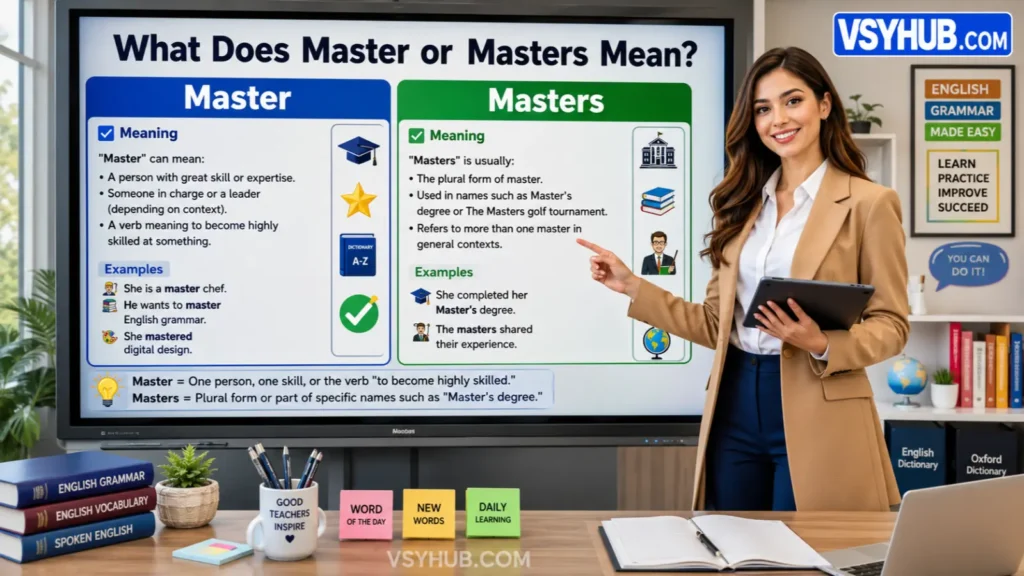
What Does Master or Masters Mean?
The words master and masters have several meanings depending on the context. Understanding the situation is the easiest way to choose the correct form.
What Does Master Mean?
The word master is usually singular. It can describe a person, a skill level, or something that has authority.
Common meanings include:
- Someone who is highly skilled at something.
- Someone who has control or authority.
- A person who has fully learned a subject.
- An advanced academic level in certain expressions.
- The main or original version of something.
Examples
- She is a master painter.
- He became a master chef after years of training.
- This is the master copy of the document.
- The engineer mastered every part of the project.
What Does Masters Mean?
Masters is generally the plural form of master.
Examples include:
- The old masters created famous paintings.
- Chess masters competed from around the world.
- The school invited several music masters.
It also appears as part of official names.
Examples:
- The Masters Tournament
- Masters Swimming
- Masters Athletics
What Does Master’s Mean?
This is where many learners become confused.
Master’s is the possessive form and is the standard form used for an academic degree.
Examples:
- master’s degree
- master’s program
- master’s thesis
- master’s student
This is the preferred form in universities, academic writing, resumes, and professional documents.
Synonyms
Depending on the meaning, master can mean:
- Expert
- Specialist
- Professional
- Authority
- Leader
- Skilled person
- Champion
- Mentor
Opposites
Possible opposites include:
- Beginner
- Amateur
- Novice
- Learner
- Student
- Rookie
Related Terms
These related words often appear with master:
- Master’s degree
- Bachelor’s degree
- Doctorate
- Graduate school
- Postgraduate
- Expertise
- Professional qualification
- Certification
- Academic program
- Thesis
- Dissertation
Common Variations
You may see these forms:
| Word | Meaning |
|---|---|
| Master | Singular noun or adjective |
| Masters | Plural noun or official name |
| Master’s | Possessive form used for academic degrees |
| Mastered | Learned completely |
| Mastering | Becoming highly skilled |
| Mastery | Great skill or complete understanding |
The Origin of Master or Masters
The word master has a long history that goes back hundreds of years.
It comes from the Latin word magister, which meant teacher, chief, leader, or someone with authority. As the word moved through Old French into Middle English, its meaning expanded to include someone with great knowledge or skill.
Over time, English speakers began using master in many different ways.
For example:
- A master craftsman was someone with excellent skills.
- A schoolmaster was a teacher.
- A master copy became the original version of a document.
- A master musician was someone who had reached the highest level.
Later, universities adopted the term Master as an academic rank. This led to the phrase master’s degree, showing that the degree belongs to the level of Master.
Today, the word appears in many fields.
Education
- Master’s degree
- Master of Science (MS)
- Master of Arts (MA)
- Master of Business Administration (MBA)
Technology
- Master password
- Master file
- Master database
- Master settings
Business
- Master contract
- Master agreement
- Master plan
Sports
- The Masters Tournament
- Masters Athletics
Because the word has many meanings, readers must rely on context to understand it correctly.
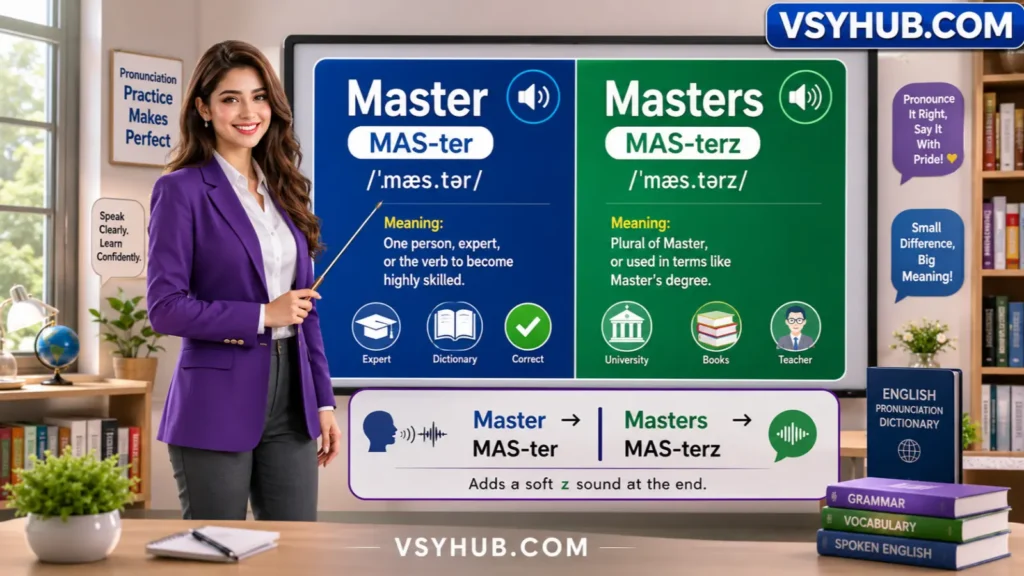
How to Pronounce Master or Masters
The pronunciation is simple once you break it into syllables.
Master
Phonetic pronunciation:
MAS-ter
Easy pronunciation:
mass-ter
It has 2 syllables.
Masters
Phonetic pronunciation:
MAS-terz
Easy pronunciation:
mass-terz
The ending sounds like “z.”
Master’s
Interestingly, master’s is pronounced almost exactly like masters in everyday speech.
Even though they sound alike, their spelling and grammar are different.
Easy Speaking Trick
Say:
“mass” + “ter”
Then add a soft “z” sound for masters or master’s.
Common Pronunciation Mistakes
❌ Saying “mah-ster.”
✔ Say “mass-ter.”
❌ Ignoring the ending sound in masters.
✔ Pronounce the final z sound clearly.
❌ Thinking masters and master’s sound different.
✔ They are usually pronounced the same, but their meanings are different in writing.
British English vs American English Usage
Both British English and American English generally follow the same grammar rules for master, masters, and master’s.
The biggest confusion is not between countries—it is between formal grammar and informal writing.
| Feature | British English | American English | Notes |
|---|---|---|---|
| Master | ✔ Common | ✔ Common | Same meaning |
| Masters | ✔ Plural form | ✔ Plural form | Same usage |
| Master’s degree | ✔ Preferred | ✔ Preferred | Formal and academic standard |
| Masters degree | Sometimes seen informally | Sometimes seen informally | Not preferred in formal writing |
| Pronunciation | Very similar | Very similar | Minor accent differences only |
In universities across the UK, the US, Canada, Australia, Pakistan, and many other English-speaking countries, master’s degree is the standard written form.
Even if you occasionally see masters degree online, it is best to use master’s degree in resumes, applications, academic papers, emails, and professional communication.
Which One Should You Use?
Choosing between master, masters, and master’s becomes easy once you know the purpose of each word.
Use Master when talking about one person, one thing, or one level.
Examples:
- She is a master photographer.
- He became a master carpenter.
- This is the master document.
- The company created a master plan.
Use Masters when talking about more than one master or when it is part of an official name.
Examples:
- The museum displayed paintings by the old masters.
- Several chess masters attended the competition.
- He watched The Masters Tournament on television.
Use Master’s when referring to an academic degree or something belonging to a master.
Examples:
- She completed a master’s degree in Psychology.
- His master’s thesis won an award.
- I am applying for a master’s program next year.
Quick Usage Guide
- ✔ master = one expert or one main item
- ✔ masters = more than one master
- ✔ master’s = academic degree or possessive form
Mini Usage Table
| Situation | Correct Form | Example |
|---|---|---|
| One skilled person | Master | She is a master musician. |
| Several skilled people | Masters | The masters shared their techniques. |
| Graduate degree | Master’s | He earned a master’s degree. |
| Original document | Master | Save the master copy first. |
| Famous golf event | Masters | The Masters begins this week. |
Common Mistakes with Master or Masters
Many people make the same grammar mistakes because these words sound alike. Here are the most common errors and how to avoid them.
Mistake 1: Writing “masters degree”
❌ I have a masters degree in Economics.
✔ I have a master’s degree in Economics.
Why it happens: People forget the apostrophe because the words sound the same.
Beginner Tip: Remember that the degree belongs to the level of Master, so use master’s degree.
Mistake 2: Using “master” when talking about several experts
❌ Many master attended the conference.
✔ Many masters attended the conference.
Why it happens: Learners forget to make the noun plural.
Beginner Tip: More than one person usually needs -s.
Mistake 3: Adding an apostrophe to a simple plural
❌ Three master’s entered the competition.
✔ Three masters entered the competition.
Why it happens: Apostrophes are often confused with plural forms.
Beginner Tip: Apostrophes usually show possession, not plural.
Mistake 4: Using “masters” for every graduate degree
❌ She is studying for her masters.
✔ She is studying for her master’s degree.
Why it happens: Informal speech sometimes drops the word degree.
Beginner Tip: In formal writing, write the complete phrase.
Mistake 5: Confusing “Master of Science” with “master’s degree”
❌ He completed a Master of Science, so he has a master.
✔ He completed a Master of Science, which is a master’s degree.
Explanation: “Master of Science” is the official degree title.
Mistake 6: Capitalizing “master’s degree” unnecessarily
❌ She earned a Master’s Degree in biology.
✔ She earned a master’s degree in biology.
Explanation: Use lowercase unless the official degree name is written.
Correct:
- Master of Science
- Master of Arts
General reference:
- master’s degree
- master’s program
Mistake 7: Forgetting the context
❌ He won the master’s tournament.
✔ He won The Masters Tournament.
Explanation: Official event names should be written correctly.
Master or Masters in Everyday Examples
Seeing real-life examples makes the grammar much easier to remember.
At Work
- She has a master’s degree in Finance.
- Our manager is a master at solving problems.
- The master schedule has been updated.
- Several department masters trained the new employees.
At School
- My teacher completed a master’s degree last year.
- He wants to study for a Master of Arts.
- The professor explained the difference between master and master’s.
On Social Media
- I finally finished my master’s degree!
- She’s a true master of photography.
- The old art masters still inspire millions.
In Daily Life
- My grandfather was a master carpenter.
- These paintings were created by famous masters.
- She hopes to begin a master’s program next semester.
In Emails
Correct
I recently completed my master’s degree and would like to apply for this position.
Correct
Please find my updated resume attached.
1 In Text Messages
- I finally got my master’s!
- She’s a master at baking cakes.
- Those chess masters were amazing.
2 In Online Content
- How long does a master’s degree take?
- Best universities for a master’s program
- Difference between master and master’s
- Is masters degree grammatically correct?
3 In Everyday Conversations
A Person : Are you going to graduate school?
Person B: Yes, I’m starting my master’s degree this fall.
Person A: Your uncle is great at woodworking.
B Person : Yes, he’s a real master craftsman.
Master or Masters in Different Contexts
The meaning changes depending on where you see the word.
Education
This is the most common source of confusion.
Examples:
- master’s degree
- master’s thesis
- master’s student
- master’s program
Universities almost always use the possessive form.
Business
Businesses use master to describe the main version of something.
Examples:
- master agreement
- master contract
- master budget
- master schedule
- master plan
Example sentence:
“The company approved the master budget before launching the project.”
Workplace Communication
Managers often use the word master for organization.
Examples:
- master spreadsheet
- master document
- master checklist
- master database
These terms refer to the primary or complete version.
Technology
Technology uses master in many systems.
Examples include:
- master password
- master key
- master file
- master server
- master control panel
These usually refer to the main source or controlling system.
Writing and Grammar
In grammar, learners often compare:
- master
- masters
- master’s
Understanding singular, plural, and possessive forms helps improve writing accuracy.
Communication
People use master to describe someone with exceptional ability.
Examples:
- a master speaker
- a master negotiator
- a master storyteller
Arts and Music
The word often refers to highly respected artists.
Examples:
- old masters
- master composer
- master artist
- master violinist
Sports
Some sporting events use Masters as part of their official title.
Examples:
- The Masters Tournament
- Masters Athletics
- Masters Swimming
Here, Masters is a proper noun and should be capitalized.
Professional Qualifications
Many careers value a master’s degree because it shows advanced education and specialized knowledge.
Examples include:
- Education
- Engineering
- Healthcare
- Business
- Computer Science
- Psychology
- Data Science
Employers often consider a master’s degree an advantage for leadership and specialized roles.
Master or Masters – Google Trends & Usage Data
The keyword “master or masters” is searched by thousands of people every month because it appears in education, grammar, professional writing, and everyday English. Most users are trying to find out whether they should write master, masters, or master’s in resumes, university applications, emails, and assignments.
Students, job seekers, teachers, and English learners often ask these questions before submitting important documents. Since grammar mistakes can leave a poor impression, people want to make sure they use the correct form.
Why People Search for “Master or Masters”
The most common reasons include:
- Confusion between master, masters, and master’s.
- Writing a resume or CV.
- Completing a university application.
- Updating a LinkedIn profile.
- Writing an academic paper.
- Preparing for English grammar exams.
- Improving professional writing.
Search Popularity Around the World
The topic is popular in many English-speaking and English-learning countries, including:
- United States – Students search before applying to graduate schools and jobs.
- United Kingdom – Common searches involve master’s degrees and university programs.
- India – Many learners look for grammar rules and higher education terminology.
- Pakistan – Students frequently search before writing CVs and admission applications.
- Canada – Common among university applicants and professionals.
- Australia – Popular with postgraduate students and skilled workers.
Common Long-Tail Searches
People also search using more detailed questions, such as:
- Is it master or master’s degree?
- Is masters degree grammatically correct?
- Should I write master’s on my resume?
- What is the difference between master, masters, and master’s?
- How do you pronounce master’s?
- Is Master of Science the same as a master’s degree?
- When should I capitalize Master?
- How do universities write master’s degree?
Voice Search Questions
Many users ask voice assistants questions like:
- “How do you spell master’s degree?”
- “Is masters degree correct?”
- “What’s the difference between master and master’s?”
- “Can I write masters without an apostrophe?”
- “How do you use master in a sentence?”
These conversational searches show why simple, beginner-friendly explanations are important.
Comparison Table: Master vs Masters vs Master’s
| Feature | Master | Masters | Master’s |
|---|---|---|---|
| Meaning | One expert or the main version of something | More than one master or part of an official name | Possessive form, mainly used for academic degrees |
| Grammar Role | Singular noun or adjective | Plural noun | Possessive noun |
| Pronunciation | MAS-ter | MAS-terz | MAS-terz |
| Academic Usage | Limited | Rare by itself | ✔ Standard form |
| Professional Usage | Very common | Less common | Very common |
| Formal Writing | ✔ Correct | ✔ Correct when plural | ✔ Correct for degrees |
| Resume Usage | Depends on context | Usually not | ✔ Preferred |
| Internet Usage | Very common | Common | Very common |
| Common Mistake | Using it instead of master’s | Using it instead of master’s | Forgetting the apostrophe |
| Example | He is a master chef. | The masters met today. | She earned a master’s degree. |
Master or Masters in Professional Life
Using the correct form is important in professional communication. Employers, recruiters, universities, and clients often notice grammar mistakes, especially in resumes, cover letters, emails, and official documents.
A small error like writing masters degree instead of master’s degree can make your writing appear less polished, even if your qualifications are impressive.
On a Resume
Correct:
- Master’s Degree in Business Administration
- Master of Science in Computer Science
- Master of Arts in English Literature
Less preferred:
- Masters Degree in Business Administration
In Job Applications
Example:
I completed my master’s degree in Data Science in 2025 and have three years of professional experience.
This sentence is clear, professional, and grammatically correct.
In Business Emails
Correct example:
I recently completed my master’s program and would like to apply for the open position.
On LinkedIn
Most professionals write:
- Master’s Degree
- Master of Science (MS)
- Master of Arts (MA)
- Master of Business Administration (MBA)
These forms match university naming conventions and look professional.
In Official Documents
Government forms, university records, certificates, and academic transcripts almost always use the standard form master’s degree or the official degree title, such as Master of Science.
Master or Masters for Students or Beginners
This topic can feel confusing because the words look almost identical and are pronounced nearly the same. The good news is that one simple grammar rule solves most of the confusion.
Why Beginners Get Confused
Common reasons include:
- The words sound alike.
- The apostrophe is easy to miss.
- Different websites use different styles.
- Informal writing often ignores grammar rules.
- Official degree names use capitalization differently.
Easy Learning Tips
- Learn the difference between singular, plural, and possessive nouns.
- Read university websites to see correct usage.
- Pay attention to apostrophes in formal writing.
- Practice by writing your own example sentences.
- Proofread resumes and applications before sending them.
Beginner Shortcuts
Remember these three simple rules:
- Master = one expert.
- Masters = many experts.
- Master’s = academic degree.
Practice Examples
Choose the correct answer.
- She completed her ______ degree in Biology.
✔ master’s
- The chess ______ competed in the final round.
, masters
- He is a ______ of digital marketing.
✔ master
Signs, Characteristics, or Common Uses Related to Master or Masters
Here are the most common situations where these words appear.
. Common Uses of Master
- Describing an expert.
- Referring to the main copy of a document.
- Naming a leader or skilled professional.
- Talking about advanced knowledge.
- Referring to a primary plan or schedule.
. Common Uses of Masters
- Talking about several experts.
- Referring to famous artists.
- Naming sporting events.
- Describing groups of highly skilled people.
Uses of Master’s
- Academic degrees.
- Graduate programs.
- University admissions.
- Research papers.
- Student resumes.
- Scholarship applications.
- Professional profiles.
- Graduation announcements.
Common Writing Patterns
You will often see:
- master’s degree
- master’s thesis
- master’s student
- master’s program
- master schedule
- master copy
- master plan
- chess masters
- old masters
- The Masters Tournament
Learning these common combinations will help you choose the correct form naturally in everyday writing.
Simple Trick to Remember Master or Masters
One easy memory trick can help you choose the correct word every time.
- Master = One expert or one main thing.
- Masters = More than one master.
- Master’s = Something that belongs to a master, including an academic degree.
Think of It This Way
Imagine three people:
- 👨 One expert = master
- 👨👨 Several experts = masters
- 🎓 One graduate earning an advanced degree = master’s degree
A simple way to remember it is:
One expert = master. Many experts = masters. Graduate degree = master’s.
If you’re talking about education, ask yourself:
“Am I referring to a degree?”
If the answer is yes, the correct choice is almost always master’s degree.
Another easy shortcut is:
- Master → one
- Masters → many
- Master’s → degree
This quick check can save you from one of the most common grammar mistakes in English.
Expert Tips
Many articles simply tell you the answer, but these practical tips will help you remember it and avoid mistakes in real-life writing.
Always Use Official University Names
If your degree certificate says Master of Science or Master of Arts, copy that exact wording on your resume or LinkedIn profile.
Don’t Guess the Apostrophe
If you mean an academic degree, use master’s degree. The apostrophe is part of the standard grammatical form.
Read Your Sentence Aloud
If the sentence sounds like you’re talking about education, master’s is usually the correct choice.
Example:
✔ She completed her master’s degree.
Check Reliable Sources
When writing academic or professional documents, compare your wording with a university website or official style guide.
Learn Common Word Pairs
Instead of memorizing single words, remember common phrases such as:
- master’s degree
- master’s thesis
- master’s program
- master plan
- master copy
- chess masters
Learning word pairs improves both grammar and vocabulary.
Proofread Before Sending
Before submitting a resume, scholarship application, or university form, search for the word masters. If it refers to your degree, it probably needs to be master’s.
Remember Official Degree Titles
Official names are written differently.
Examples:
- Master of Science (MS)
- Master of Arts (MA)
- Master of Business Administration (MBA)
These are official degree titles, so capitalize them.
Related Searches People Also Ask
Here are some common questions people search online along with simple answers.
Is it master’s degree or masters degree?
The correct formal expression is master’s degree because it uses the possessive form.
What is the difference between master and master’s?
Master usually refers to one expert or the main version of something, while master’s is commonly used for an academic degree.
Can I write masters on my resume?
It is better to write master’s degree or the official degree name, such as Master of Science.
Why is there an apostrophe in master’s degree?
The apostrophe shows possession. Historically, the degree belongs to the level of Master.
Is masters degree accepted in informal writing?
Some people write it informally, but master’s degree is preferred in formal, academic, and professional writing.
How do you pronounce master’s?
It is commonly pronounced MAS-terz, almost the same as masters.
Should master’s degree be capitalized?
Use lowercase when speaking generally.
Example:
✔ master’s degree
Capitalize official degree titles.
Example:
✔ Master of Science
What is the plural of master?
The plural form is masters.
Is Master of Science the same as a master’s degree?
Yes. A Master of Science (MS) is one type of master’s degree.
Is master’s correct in British and American English?
Yes. Both British and American English generally use master’s degree in formal writing.
Can master be used as a verb?
Yes. As a verb, master means to learn or become highly skilled at something.
Example:
She mastered the new software in just two weeks.
Why do so many people search for master or masters?
Because the words look and sound similar, many learners are unsure which form is correct in academic and professional writing.
FAQs
Is it master or master’s degree?
The correct form is master’s degree.
Is masters degree grammatically correct?
In formal English, master’s degree is preferred.
What does master mean?
A master is someone with great skill or the main version of something.
What does masters mean?
Masters is the plural of master or part of certain official names.
Why is there an apostrophe in master’s?
It shows possession and is the standard grammatical form for the degree.
How do you pronounce master’s?
It is usually pronounced MAS-terz.
Can I write Master’s Degree with capital letters?
Only if it is part of an official degree title. Otherwise, use lowercase.
Is Master of Arts a master’s degree?
Yes. A Master of Arts (MA) is a type of master’s degree.
Is Master of Science different from master’s degree?
No. It is simply one specific kind of master’s degree.
Which form should I use on my CV or resume?
Use master’s degree or the official degree title provided by your university.
Final Verdict
The difference between master, masters, and master’s is simple once you understand their grammar.
- Master refers to one expert or one main item.
- Masters is the plural form or part of some official names.
- Master’s is the correct form for an academic degree.
The Easiest Memory Rule
One expert = master. Many experts = masters. Graduate degree = master’s.
Whenever you’re writing about your education, remember that master’s degree is the correct choice in formal English.
Conclusion
Understanding the difference between master, masters, and master’s will help you write with confidence in school, at work, and in everyday communication. Although the words sound almost the same, they have different meanings and grammar rules. The most common mistake is writing masters degree instead of master’s degree, but this is easy to avoid once you remember the possessive form.
Whether you’re updating your resume, applying to a university, writing an email, or improving your English, choosing the correct word makes your writing clearer and more professional.
One final memory trick is worth keeping:
One expert = master. More than one = masters. An academic qualification = master’s degree.
Keep this simple rule in mind, and you’ll choose the correct form every time.

Aria Foster is a comparison and language writer who specializes in spelling differences, word meanings, grammar guides, and easy-to-understand language explanations. She creates clear, reader-friendly content that helps people understand commonly confused words and expressions.