Have you ever paused while writing an email, school assignment, social media post, or text message because you weren’t sure whether to write Mondays or Monday’s? You’re not alone.
Many English learners and even native speakers get confused because one word shows possession while the other shows a plural. This small punctuation mark can completely change the meaning of your sentence.
People usually search for: Mondays or Monday’s meaning, correct spelling, pronunciation, examples, usage, definition, and grammar difference.
Learning the difference helps you write more clearly and confidently in everyday life.
In this guide, you’ll learn the meaning, pronunciation, examples, usage, grammar rules, common mistakes, expert tips, and simple explanations in easy English.
Mondays or Monday’s – Quick Answer
The difference is simple:
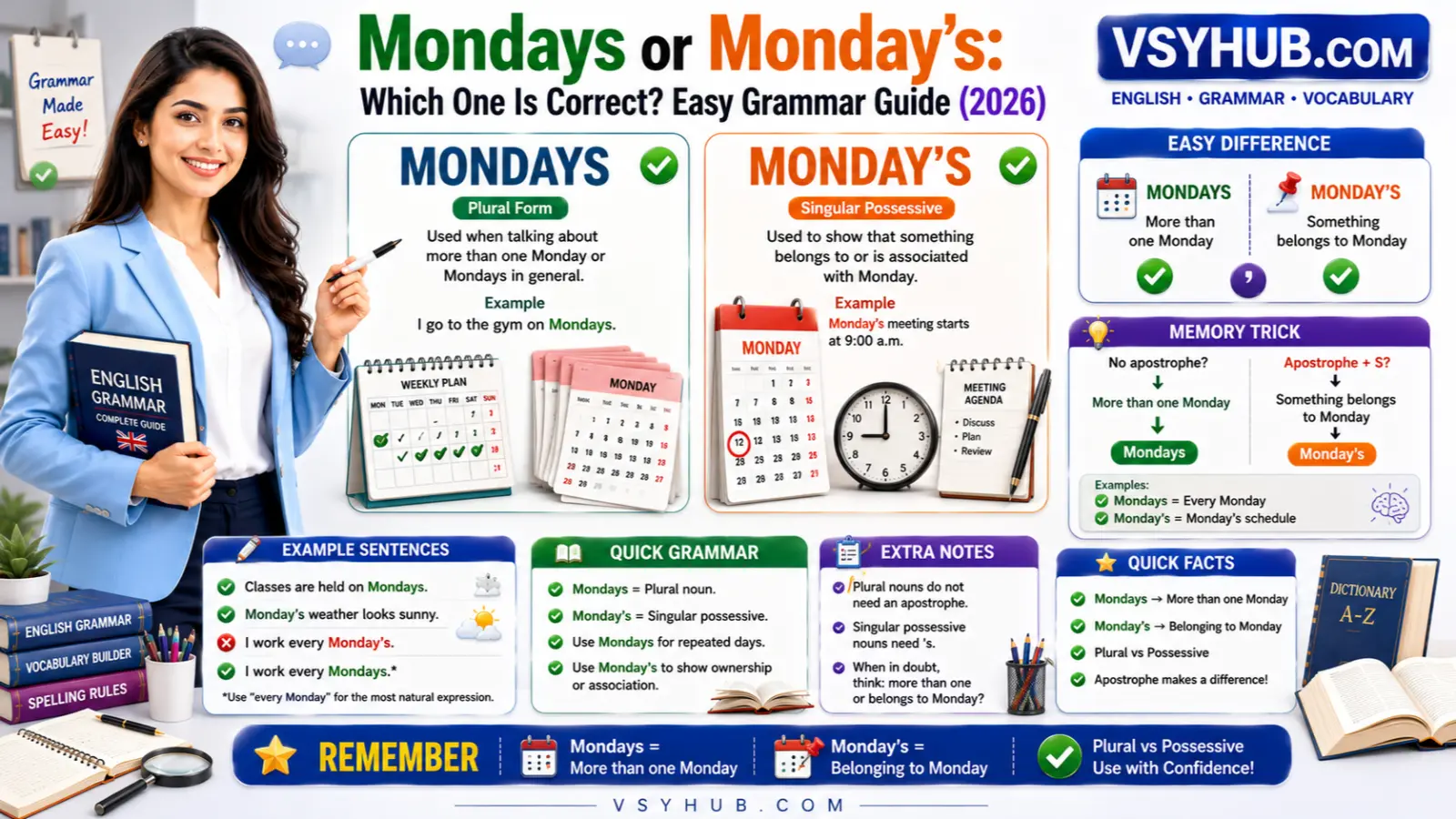
👉 Mondays = The plural form of Monday. It means more than one Monday.
👉 Monday’s = The singular possessive form of Monday. It means something belongs to or is connected with Monday.
Examples
- ✅ I usually exercise on Mondays.
- ✅ Monday’s meeting has been postponed.
- ✅ Schools are closed on some Mondays.
- ✅ Monday’s weather looks sunny.
- ✅ We always feel busy on Mondays.
Simple Rule
- Use Mondays when talking about several Mondays.
- Use Monday’s when something belongs to Monday or happens on Monday.
Easy Memory Trick:
If you can replace it with “belongs to Monday,” use Monday’s.
If you simply mean more than one Monday, use Mondays.
What Does Mondays or Monday’s Mean?
Although these words look almost the same, they serve different grammar purposes.
What Does “Mondays” Mean?
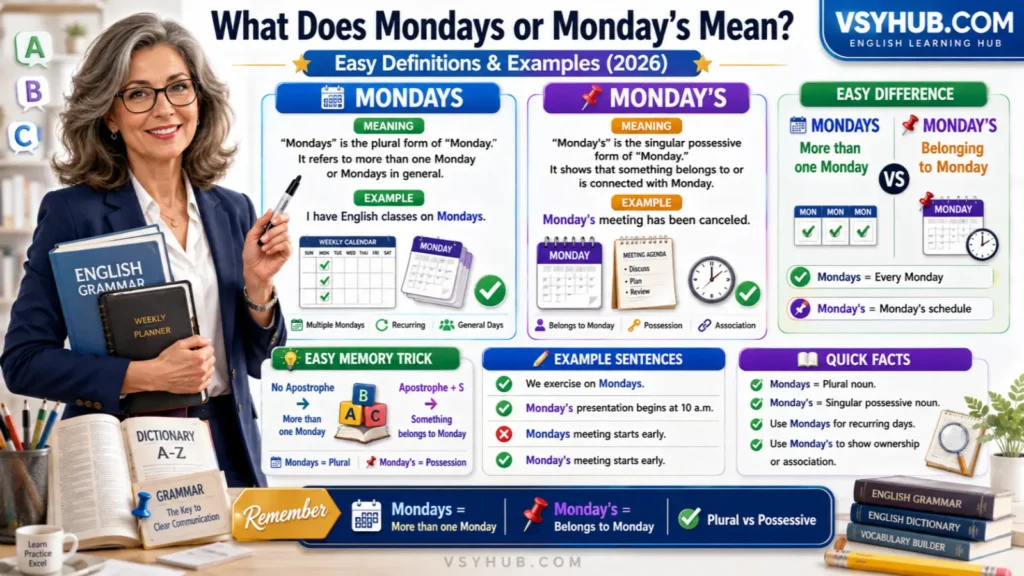
Mondays is the plural form of Monday. It refers to multiple Mondays or a regular activity that happens every Monday.
Examples:
- I have piano lessons on Mondays.
- Our office opens early on Mondays.
- Many people dislike Mondays.
This form is common when talking about routines, schedules, habits, or repeated events.
What Does “Monday’s” Mean?
Monday’s is the possessive form of Monday.
It shows that something belongs to Monday or is scheduled for Monday.
Examples:
- Monday’s presentation starts at 9 a.m.
- We are preparing for Monday’s exam.
- Did you read Monday’s newspaper?
In these examples, the event or object is connected to Monday.
Synonyms
For Mondays
- Every Monday
- Weekly Monday schedule
- Monday mornings
- Monday afternoons
- Mondays each month
For Monday’s
- Scheduled for Monday
- Happening on Monday
- Belonging to Monday
- Monday event
- Monday activity
Opposites
Depending on the sentence:
- Tuesday
- Weekend
- Saturday
- Sunday
- Another day of the week
Related Terms
- Monday
- Weekdays
- Weekend
- Calendar
- Schedule
- Appointment
- Meeting
- Workweek
- School week
- Business day
Common Variations
Understanding these forms makes writing much easier.
| Word | Meaning |
|---|---|
| Monday | One day of the week |
| Mondays | More than one Monday |
| Monday’s | Something belonging to Monday |
| Mondays’ | Something belonging to multiple Mondays (rare) |
For example:
- Mondays’ schedules were updated.
Although Mondays’ is grammatically correct, it is much less common in everyday English.
The Origin of Mondays or Monday’s
The word Monday has a long history. It comes from Old English Monandæg, which means Moon’s day. The name was inspired by ancient traditions that linked each day of the week with a celestial body.
As English developed, the names of the days stayed mostly the same. Writers later added grammar rules for plurals and possessives.
This gave us:
- Monday = one day
- Mondays = several Mondays
- Monday’s = belonging to Monday
- Mondays’ = belonging to several Mondays
Today, these forms appear in books, newspapers, websites, business emails, calendars, schools, and everyday conversations.
Because apostrophes can be confusing, many people accidentally write Monday’s when they actually mean Mondays.
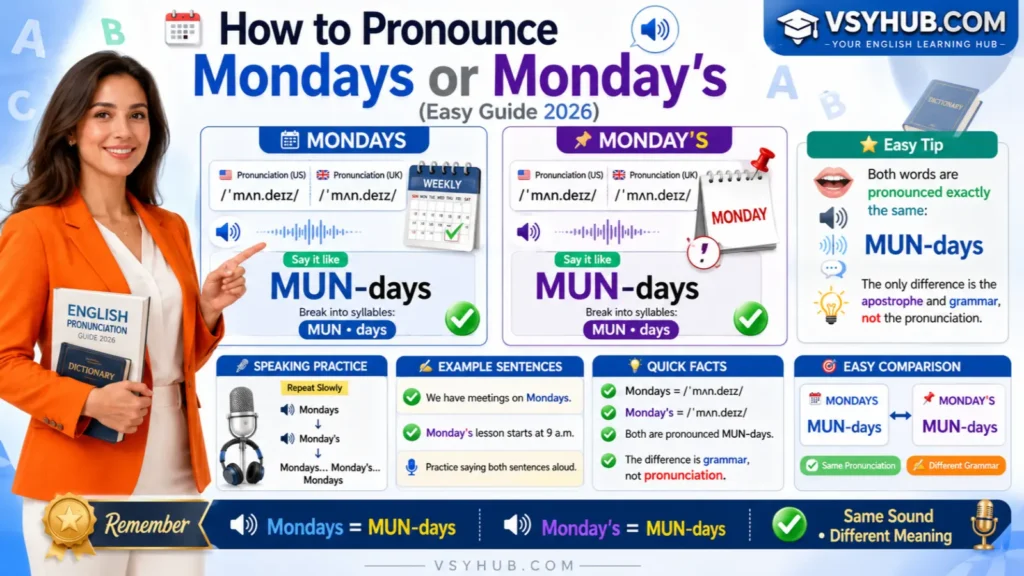
How to Pronounce Mondays or Monday’s
The good news is that Mondays and Monday’s are pronounced exactly the same.
Pronunciation
Monday
Phonetic: /ˈmʌn.deɪ/
Easy pronunciation:
MUN-day
Syllables
Mon • day
Two syllables.
Speaking Trick
Say:
MUN + DAY
Stress the first syllable.
Common Pronunciation Mistakes
Some learners say:
- Mon-day (with too much emphasis on “Mon”)
- Moon-day
- Mun-die
The natural pronunciation is:
MUN-day
Remember that Mondays and Monday’s sound identical. The difference exists only in writing and grammar.
British English vs American English Usage
Both British English and American English use Monday, Mondays, and Monday’s in exactly the same way.
There is no spelling difference between the two varieties of English.
| Feature | British English | American English | Notes |
|---|---|---|---|
| Monday | ✔ | ✔ | Same spelling |
| Mondays | ✔ | ✔ | Same plural form |
| Monday’s | ✔ | ✔ | Same possessive form |
| Pronunciation | Nearly identical | Nearly identical | Minor accent differences only |
| Grammar Rules | Same | Same | Apostrophe rules are identical |
Whether you’re writing in the UK, the US, Canada, Australia, India, or Pakistan, the grammar rule stays the same.
Which One Should You Use?
Choosing the correct form depends on what you want to say.
Use Mondays When:
- Talking about repeated weekly events.
- Referring to more than one Monday.
- Describing habits or routines.
- Discussing schedules.
- Talking about work or school every Monday.
Examples:
- I work from home on Mondays.
- We have football practice on Mondays.
- Stores are quieter on Mondays.
- My classes begin early on Mondays.
Use Monday’s When:
- Something belongs to Monday.
- Referring to an event scheduled for Monday.
- Talking about something connected with Monday.
Examples:
- Monday’s interview starts at 10 a.m.
- We finished Monday’s homework.
- Monday’s sales report looks excellent.
- Everyone is preparing for Monday’s meeting.
Quick Usage Table
| Situation | Correct Word | Example |
|---|---|---|
| More than one Monday | Mondays | We meet on Mondays. |
| Weekly routine | Mondays | I study on Mondays. |
| Monday meeting | Monday’s | Monday’s meeting is important. |
| Monday homework | Monday’s | Finish Monday’s homework tonight. |
| Monday weather | Monday’s | Monday’s forecast predicts rain. |
Using the correct form makes your writing look more professional and helps readers understand your meaning immediately.
Common Mistakes With Mondays or Monday’s
Even experienced writers sometimes confuse Mondays and Monday’s. Most mistakes happen because people think every word ending in -s needs an apostrophe. It doesn’t. Let’s look at the most common errors and learn how to avoid them.
Mistake 1: Using Monday’s Instead of Mondays
❌ Incorrect: I always go to the gym on Monday’s.
✅ Correct: I always go to the gym on Mondays.
Why?
The sentence talks about a weekly habit, not something that belongs to Monday.
Beginner Tip:
If you can replace it with every Monday, use Mondays, not Monday’s.
Mistake 2: Forgetting the Apostrophe for Possession
❌ Incorrect: Mondays meeting starts at 9 a.m.
✅ Correct: Monday’s meeting starts at 9 a.m.
Why?
The meeting belongs to or is scheduled for Monday.
Beginner Tip:
Ask yourself, “Is this event connected to Monday?” If yes, use Monday’s.
Mistake 3: Thinking Apostrophes Make Words Plural
❌ Incorrect: The office is closed on Monday’s.
✅ Correct: The office is closed on Mondays.
Why?
Apostrophes do not make nouns plural. They usually show possession.
Beginner Tip:
Plural = add -s.
Possession = add ‘s.
Mistake 4: Mixing Up Habit and Possession
❌ Incorrect: Monday’s are always busy.
✅ Correct: Mondays are always busy.
Why?
You are talking about all Mondays, not something owned by Monday.
Beginner Tip:
If the sentence means all Mondays, choose Mondays.
Mistake 5: Using Mondays for a Scheduled Event
❌ Incorrect: Mondays meeting was canceled.
✅ Correct: Monday’s meeting was canceled.
Why?
The meeting is connected with Monday.
Beginner Tip:
Events happening on one Monday usually need Monday’s.
Mistake 6: Adding an Apostrophe Everywhere
❌ Incorrect: School starts every Monday’s.
✅ Correct: School starts every Monday.
OR
✅ School starts on Mondays.
Why?
Neither sentence needs possession.
Mistake 7: Confusing Mondays’
❌ Incorrect: I enjoy Mondays’.
✅ Correct: I enjoy Mondays.
Why?
Mondays’ is the plural possessive form. It is only used when something belongs to several Mondays, which is uncommon.
Example:
✅ The Mondays’ schedules changed every month.
Mondays or Monday’s in Everyday Examples
Here are real-life examples that show how each word is used naturally.
At Work
- We hold team meetings on Mondays.
- Monday’s presentation impressed everyone.
- Most reports are due on Mondays.
- Please prepare Monday’s agenda before leaving.
At School
- Our science class is on Mondays.
- Monday’s homework is due tomorrow.
- Students often feel sleepy on Mondays.
- Monday’s quiz covers Chapter 5.
On Social Media
- I need extra coffee on Mondays. ☕
- Monday’s motivation: Never give up!
- Why are Mondays so difficult?
- Looking forward to Monday’s announcement.
* In Daily Life
- Grocery stores are less crowded on Mondays.
- We usually clean the house on Mondays.
- Monday’s weather looks perfect for a picnic.
- I always start new goals on Mondays.
* In Emails
- Let’s meet on Monday afternoon.
- Please review Monday’s report.
- We normally send updates on Mondays.
- Thank you for attending Monday’s workshop.
Text Messages
- Are you free on Monday?
- I hate early Mondays.
- Don’t forget Monday’s appointment.
- See you next Monday!
* In Online Content
- New articles are published on Mondays.
- Monday’s blog post received thousands of views.
- We upload videos every Monday.
- Read Monday’s newsletter for updates.
In Conversations
1 Person A: Do you work on Mondays?
2 Person B: Yes, but Monday’s schedule is usually lighter.
3 Person A: Are we meeting next week?
4 Person B: Yes, during Monday’s team meeting.
Mondays or Monday’s in Different Contexts
Understanding the context makes choosing the correct word much easier.
Education
Students often write about class schedules, homework, and exams.
Examples:
- We have math on Mondays.
- Monday’s test will cover three chapters.
- Teachers collect assignments on Mondays.
Business and Workplace
Professionals use both forms in emails, reports, and calendars.
Examples:
- Sales meetings happen every Monday.
- Monday’s financial report is complete.
- Staff training takes place on Mondays.
Using the correct form helps your writing look polished and professional.
Grammar Learning
This is one of the first apostrophe rules many English learners study.
Remember:
- Mondays = plural noun.
- Monday’s = singular possessive noun.
Understanding this rule also helps with words like:
- Tuesday’s
- Wednesday’s
- Friday’s
- Sunday’s
Writing
Whether you’re writing an essay, blog post, email, or story, choosing the correct form improves clarity.
Example:
- Incorrect punctuation can confuse readers.
- Correct grammar builds trust.
Communication
Good communication depends on clear grammar.
Compare:
- We meet on Mondays. ✅
- Monday’s meeting begins at noon. ✅
Both are correct, but they have different meanings.
Social Media
People often post phrases like:
- Monday Motivation
- Happy Monday
- I love lazy Mondays.
- Monday’s quote of the day.
Short captions sometimes skip punctuation, but proper grammar is still best in professional content.
Mondays or Monday’s – Google Trends & Usage Data
Every year, thousands of people search online to understand the difference between Mondays and Monday’s. The confusion usually comes from apostrophe rules rather than spelling.
Many searches increase during:
- Back-to-school seasons.
- English grammar lessons.
- Job application periods.
- Business writing courses.
- Exam preparation.
People in the United States, United Kingdom, Canada, Australia, India, and Pakistan frequently search for grammar topics like this because English is widely used in education, workplaces, and online communication.
Common Reasons People Search
- They want the correct grammar.
- They are writing an email.
- They are preparing school assignments.
- They are editing business documents.
- They want to improve spoken and written English.
Popular Long-Tail Searches
People often search using questions like:
- Is it Mondays or Monday’s?
- When should I use Monday’s?
- What is the difference between Mondays and Monday’s?
- Is Monday’s meeting correct?
- How do you write every Mondays?
- Do weekdays need apostrophes?
- How do you use apostrophes with days of the week?
These conversational searches reflect how people naturally ask grammar questions using voice search and search engines.
Comparison Table: Mondays or Monday’s
| Feature | Mondays | Monday’s |
|---|---|---|
| Grammar Role | Plural noun | Singular possessive noun |
| Meaning | More than one Monday | Something belonging to Monday |
| Pronunciation | MUN-dayz | MUN-dayz |
| Correct for Weekly Habits | ✔ Yes | ✘ No |
| Correct for Possession | ✘ No | ✔ Yes |
| Professional Writing | ✔ Yes | ✔ Yes |
| Academic Writing | ✔ Yes | ✔ Yes |
| Social Media | ✔ Common | ✔ Common |
| Common Mistake | Adding an unnecessary apostrophe | Forgetting the apostrophe |
| Example | We meet on Mondays. | Monday’s meeting starts at 10. |
Mondays or Monday’s in Professional Life
Using the correct form matters in professional communication because small grammar mistakes can affect how your writing is perceived.
Business Emails
Correct:
- Please review Monday’s report before noon.
- Our team meets on Mondays.
Workplace Communication
Managers often write:
- Monday’s agenda is attached.
- Training sessions are held on Mondays.
Calendars and Schedules
Examples:
- Staff meetings are every Monday.
- Monday’s workshop begins at 2 p.m.
- Reports are submitted on Mondays.
Correct grammar helps colleagues understand schedules quickly and reduces confusion.
Mondays or Monday’s for Students or Beginners
Many learners struggle because apostrophes seem confusing at first. The easiest way to remember the rule is to focus on the meaning of the sentence instead of the punctuation.
Why Beginners Get Confused
- Apostrophes look similar to plural endings.
- Teachers often introduce plurals before possessives.
- Both words sound exactly the same when spoken.
Easy Learning Tips
- Learn the plural rule first.
- Practice with short sentences.
- Read books and newspapers to see real examples.
- Proofread your writing before submitting it.
- Ask, “Does this belong to Monday?” before adding an apostrophe.
Signs, Characteristics, and Common Uses Related to Mondays or Monday’s
Understanding when each form is used will help you avoid mistakes in everyday writing.
Common Uses of Mondays
- Talking about weekly routines.
- Describing repeated events.
- Discussing work schedules.
- Mentioning school timetables.
- Referring to regular appointments.
- Talking about habits that happen every Monday.
Examples:
- I volunteer on Mondays.
- We publish new articles on Mondays.
- The library opens early on Mondays.
Common Uses of Monday’s
- Talking about a meeting scheduled for Monday.
- Referring to Monday’s weather.
- Mentioning Monday’s homework.
- Discussing Monday’s news.
- Talking about Monday’s events or activities.
Examples:
- Monday’s forecast predicts sunshine.
- We finished Monday’s assignment.
- Don’t forget Monday’s interview.
Writing Situations Where They Appear
You may see these words in:
- School assignments.
- Business emails.
- Office calendars.
- Meeting agendas.
- News articles.
- Blog posts.
- Social media captions.
- Event schedules.
- Text messages.
- Family planners.
Simple Trick to Remember Mondays or Monday’s
Here’s an easy trick that works almost every time.
- Mondays = Think many Mondays.
- Monday’s = Think Monday owns something.
Think of It This Way
Imagine Monday is a person.
If Monday owns something, use Monday’s.
- Monday’s meeting.
- Monday’s homework.
- Monday’s weather.
If you’re talking about many Mondays or something that happens every Monday, use Mondays.
- I exercise on Mondays.
- Schools are busy on Mondays.
- We have music lessons on Mondays.
This simple picture in your mind makes the rule much easier to remember.
Expert Tips
Many grammar articles stop after explaining the basic rule. Here are some extra tips that professional writers, teachers, and editors use.
1. Look for Ownership
Ask yourself:
Does something belong to Monday?
If yes, write Monday’s.
Example:
- Monday’s presentation.
- Monday’s schedule.
2. Replace It with “Every Monday”
If your sentence still makes sense, you probably need Mondays.
Example:
- We meet every Monday.
- We meet on Mondays.
3. Read the Sentence Aloud
Although both words sound the same, reading the whole sentence often helps you notice whether you’re talking about a routine or possession.
4. Proofread Slowly
Many apostrophe mistakes happen because writers type too quickly.
Before sending an email or submitting homework, check:
- Is this plural?
- Is this possessive?
5. Learn the Same Rule for Other Days
Once you understand Monday, the same rule applies to every day of the week.
Examples:
- Tuesdays
- Tuesday’s
- Wednesdays
- Wednesday’s
- Fridays
- Friday’s
- Sundays
- Sunday’s
Master one day, and you’ve learned them all.
Related Searches People Also Ask (Bonus SEO)
Here are some common questions people search for, along with simple answers.
Is it Mondays or Monday’s?
Use Mondays for the plural form and Monday’s for the singular possessive form.
Is Monday’s meeting grammatically correct?
Yes. The meeting is connected with Monday, so Monday’s meeting is correct.
How do you write every Monday?
Use every Monday when referring to one recurring day, or on Mondays when talking about a regular weekly activity.
Do weekdays need apostrophes?
Only when showing possession.
Example:
- Friday’s deadline.
- Thursday’s report.
Why do people confuse Mondays and Monday’s?
Because both words sound exactly the same, and apostrophe rules can be confusing.
What is the plural of Monday?
The plural form is Mondays.
What is the possessive form of Monday?
The singular possessive form is Monday’s.
Is Mondays’ a real word?
Yes. It is the plural possessive form, but it is rarely used.
How can I remember the difference?
Think:
- Mondays = many Mondays
- Monday’s = belongs to Monday
Are the rules the same in British and American English?
Yes. Both varieties follow the same grammar rules.
Frequently Asked Questions
Is Mondays a correct word?
Yes. It is the plural form of Monday.
Is Monday’s grammatically correct?
Yes. It is correct when showing possession or referring to something scheduled for Monday.
Which is more common, Mondays or Monday’s?
Both are common, but they are used in different situations.
How do I know which one to use?
Ask whether you are talking about more than one Monday or something belonging to Monday.
Do Mondays and Monday’s sound different?
No. They are pronounced the same.
Can I use Monday’s to mean every Monday?
No. Use Mondays or every Monday instead.
Is Monday’s meeting correct?
Yes. The meeting belongs to or takes place on Monday.
Is on Mondays correct?
Yes. It describes something that happens regularly every Monday.
Can I write Mondays meeting?
No. It should be Monday’s meeting because it shows possession.
What is the easiest way to remember the rule?
Remember:
- Mondays = plural
- Monday’s = possessive
Final Verdict
The correct choice depends on your sentence.
- Use Mondays when talking about more than one Monday or a regular weekly activity.
- Use Monday’s when referring to something that belongs to Monday or happens on Monday.
Easiest Memory Rule
No apostrophe = more than one Monday.
Apostrophe + s = something belongs to Monday.
If you remember this one rule, you’ll avoid most grammar mistakes involving these words.
Conclusion
The difference between Mondays and Monday’s is simple once you understand the purpose of the apostrophe. Mondays is the plural form and is used for routines, schedules, and repeated events. Monday’s is the possessive form and is used when something belongs to or is connected with Monday, such as Monday’s meeting or Monday’s homework.
Whenever you’re unsure, ask yourself one question: Am I talking about many Mondays or something that belongs to Monday? The answer will tell you which form to use. With a little practice, you’ll use both words correctly and write with greater confidence in school, at work, and in everyday conversations.

Aria Foster is a comparison and language writer who specializes in spelling differences, word meanings, grammar guides, and easy-to-understand language explanations. She creates clear, reader-friendly content that helps people understand commonly confused words and expressions.