Have you ever written a message like “your so funny” and then stopped for a second thinking something feels wrong? You are not alone.
Many students, writers, and even native speakers get confused between your or you’re in daily writing.
This small grammar mistake often shows up in school assignments, workplace emails, social media posts, texting, and online chats.
People usually search for:
your or you’re meaning, correct spelling, grammar difference, usage examples, and how to use your and you’re correctly in sentences.
This confusion happens because both words sound the same when spoken, but they have totally different meanings in English Grammar. One is a possession word, and the other is a contraction.
In this guide, you’ll learn the meaning, pronunciation, examples, usage, grammar rules, common mistakes, expert tips, and simple explanations in easy English.
Your or You’re – Quick Answer
👉 Your = shows possession (something belongs to you)
👉 You’re = short form of “you are”
Simple Examples
👉 Your bag is on the table. (The bag belongs to you)
👉 You’re very kind. (You are very kind)
👉 Is this your phone?
👉 You’re going to love this movie.
Easy Memory Trick
👉 If you can replace it with “you are,” use you’re
👉 If not, use your
Example test:
“You’re / Your happy” → “You are happy” ✔ so you’re

What Does Your or You’re Mean?
Understanding your or you’re is simple when you break them down.
👉 YOUR
- Shows ownership
- Means something belongs to “you”
- Used before a noun
Example:
- Your car is fast.
- Your idea is great.
👉 YOU’RE
- Short form of “you are”
- Used before adjectives or verbs
- Used in actions or descriptions
Example:
- You’re amazing. (You are amazing)
- You’re learning fast. (You are learning fast)
Emotional Meaning
This small grammar choice can change how your message feels. Using the wrong word can make writing look careless, especially in emails or job applications.
Synonyms
- Your → belonging to you
- You’re → you are
Related Terms
- Possessive pronouns
- Contractions
- Subject + verb agreement
Common Variations
- your / you’re / yours
- you’re = you are
- your = possessive adjective
The Origin of Your or You’re
The word your comes from Old English “ēower,” which was used to show possession. Over time, it became “your” in modern English.
The word you’re is a contraction, meaning it is a shortened form. English speakers started combining “you are” into “you’re” to make speech and writing faster and smoother.
With the rise of texting, social media, and digital communication, this contraction became even more common.
Today, both words are widely used across countries like the US, UK, India, Pakistan, Canada, and Australia.
How to Pronounce Your or You’re
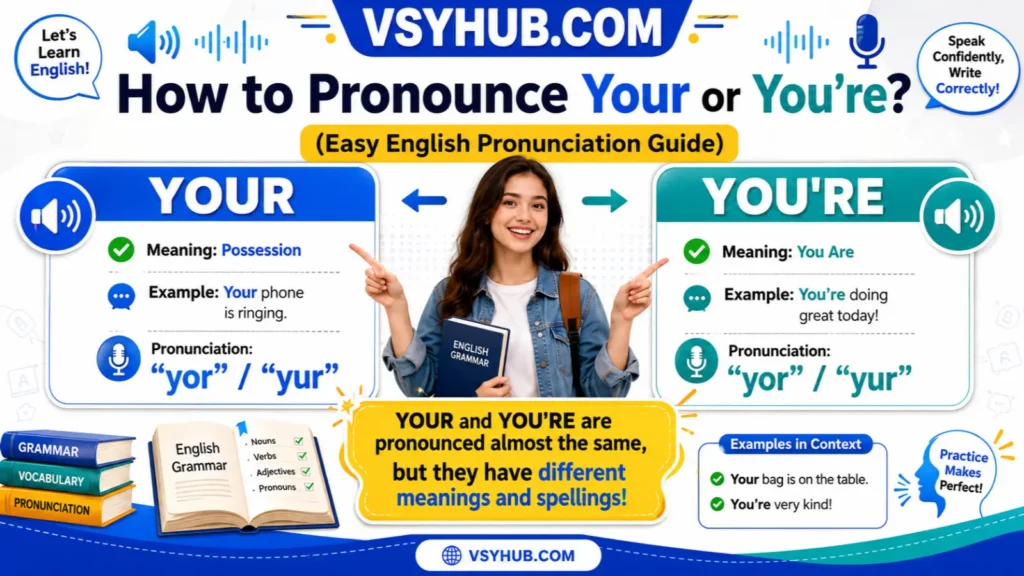
Good news: your and you’re sound the same
Pronunciation Breakdown
- Your → /jɔːr/ (yor)
- You’re → /jʊr/ or /jɔːr/ (same sound in speech)
Easy Speaking Trick
Say “yore” quickly.
Common Mistake
People think they should pronounce them differently, but in real life speaking, they sound identical.
British English vs American English Usage
Even though pronunciation is similar, usage rules stay the same worldwide.
| Feature | British English | American English | Notes |
|---|---|---|---|
| Your | Same usage | Same usage | Possession |
| You’re | Same usage | Same usage | Contraction of you are |
| Meaning | Same | Same | No difference |
| Writing style | Formal in exams | Formal in exams | Must be correct |
👉 Both forms follow the same grammar rules in all English-speaking countries.
Which One Should You Use?
Choosing between your or you’re depends on meaning, not style.
Use YOUR when:
- Showing possession
- Before a noun
- Talking about ownership
Examples:
- Your phone is ringing.
- Your work is impressive.
- I like your dress.
Use YOU’RE when:
- You mean “you are”
- Describing someone
- Talking about actions
Examples:
- You’re late today.
- You’re doing well.
- You’re my best friend.
Quick Usage Table
| Situation | Correct Word |
|---|---|
| Ownership | Your |
| Description | You’re |
| Action | You’re |
| Belonging | Your |
Common Mistakes with Your or You’re
Mistake 1
❌ Your awesome
✔ You’re awesome
👉 Explanation: You mean “you are awesome”
👉 Tip: Try replacing with “you are”
Mistake 2
❌ You’re book is nice
✔ Your book is nice
👉 Explanation: Book belongs to you
👉 Tip: Possession = your
Mistake 3
❌ Your going home
✔ You’re going home
👉 Explanation: You are going
👉 Tip: Action words need “you’re”
Mistake 4
❌ Your welcome
✔ You’re welcome
👉 Explanation: Correct phrase is “you are welcome”
👉 Tip: Fixed expression
Mistake 5
❌ Is this you’re phone?
✔ Is this your phone?
👉 Explanation: Asking ownership
👉 Tip: Questions about things = your
Mistake 6
❌ You’re bag is heavy
✔ Your bag is heavy
👉 Explanation: Bag belongs to you
👉 Tip: If noun comes after, use your
Mistake 7
❌ I like you’re style
✔ I like your style
👉 Explanation: Style belongs to you
👉 Tip: Possession rule
Your or You’re in Everyday Examples
Work
- Your report is ready.
- You’re selected for the interview.
School
- Your homework is missing.
- You’re doing great in class.
Social Media
- You’re trending today!
- Your post got many likes.
Daily Life
- Your bag is heavy.
- You’re looking tired.
Emails
- Your request has been approved.
- You’re invited to the meeting.
Text Messages
- You’re funny 😂
- Is this your number?
Online Content
- You’re watching the best tutorial.
- Your account is secure.
Conversations
- You’re my best friend.
- Your idea makes sense.
Your or You’re in Different Contexts
Education Context
Students often confuse these words in exams. Teachers focus on grammar accuracy, especially in writing tests.
Business Context
Incorrect usage in emails can reduce professionalism.
Example:
- You’re invited to the meeting ✔
- Your invited ❌
Social Media Context
Fast typing leads to mistakes like:
- your amazing ❌
- you’re amazing ✔
Technology Context
Autocorrect sometimes fixes mistakes, but not always.
Communication Context
Correct usage improves clarity and confidence.
Your or You’re – Google Trends & Usage Data
Searches for your or you’re are very high globally because:
- Students learn it in early English classes
- Social media increases writing mistakes
- People want quick grammar answers
- Voice search questions like “your or you’re difference” are common
Countries with high searches:
- US
- UK
- India
- Pakistan
- Canada
- Australia
Related Searches
- your vs you’re difference
- how to use your and you’re
- your or you’re examples
- your or you’re grammar rules
- why your and you’re are confusing
Comparison Table: Your or You’re
| Feature | Your | You’re |
|---|---|---|
| Meaning | Belonging to you | You are |
| Grammar Role | Possessive adjective | Contraction |
| Usage | Before noun | Before adjective/verb |
| Example | Your car | You’re happy |
| Mistakes | Very common | Very common |
| Formal Writing | Required correctly | Required correctly |
| Texting | Often used | Often used |
| Clarity | Shows ownership | Shows action/description |
Your or You’re in Professional Life
In professional communication, using the correct form is very important.
Workplace Writing
- Your document is attached.
- You’re scheduled for a meeting.
Business Emails
Incorrect grammar can reduce trust.
Branding Impact
Clear grammar improves credibility in content writing, marketing, and communication.
Real-Life Example
A job email saying “your selected” instead of “you’re selected” can look unprofessional.
Your or You’re for Students or Beginners
Many beginners struggle because:
- Both words sound identical
- Fast typing causes mistakes
- Grammar rules are not remembered clearly
Easy Trick
👉 Think:
- your = belonging
- you’re = you are
Shortcut
If you cannot replace it with “you are,” it must be “your.”
Signs and Common Uses
Common Uses
- Ownership statements
- Descriptions
- Actions
- Greetings
Writing Patterns
- your + noun
- you’re + adjective/verb
Online Usage
- Social media captions
- Comments
- Chat messages
Simple Trick to Remember Your or You’re
👉 Imagine this:
- YOUR has the word “OUR” inside → something belongs
- YOU’RE has an apostrophe → means missing letters (you are)
Think of it this way:
If someone says:
“You are smart” → you’re smart ✔
“My phone” → your phone ✔
Expert Tips Section
- Always read the sentence out loud
- Replace “you’re” with “you are” to check
- Look for nouns after the word
- Practice with daily texting
- Proofread emails before sending
- Use grammar apps for training
- Learn through real-life examples
Related Searches People Also Ask
- how to use your or you’re correctly
- difference between your and you’re
- your or you’re examples in sentences
- why your and you’re confuse people
- your vs you’re grammar rules explained
- easy trick for your and you’re
- common mistakes with your and you’re
- is your or you’re correct
- your or you’re in texting
- your or you’re simple explanation
FAQs
1. What is the difference between your and you’re?
Your shows possession, you’re means you are.
2. Is you’re short for you are?
Yes, you’re is a contraction of you are.
3. Can your and you’re be used interchangeably?
No, they have different meanings.
4. Why do people confuse your and you’re?
Because they sound the same.
5. What is an easy trick to remember them?
If you can say “you are,” use you’re.
6. Is your used before nouns?
Yes, your is always followed by a noun.
7. Is you’re formal or informal?
It is used in both, but more common in informal speech.
8. What is a common mistake with your?
Using your instead of you’re in sentences like “your amazing.”
9. Can I use you’re in writing emails?
Yes, if it correctly means “you are.”
10. What happens if I use the wrong one?
It can make writing look unprofessional.
Final Verdict
The difference is simple:
👉 your = belongs to you
👉 you’re = you are
The easiest memory rule is:
If you can replace it with “you are,” use you’re.
Conclusion
Understanding your or you’re is one of the easiest ways to improve your English writing instantly. This small grammar rule helps you sound more confident, clear, and professional in every message you write.
Just remember one simple idea:
👉 possession = your
👉 you are = you’re
Once you practice this a few times, it becomes natural in texting, school work, emails, and everyday conversations.