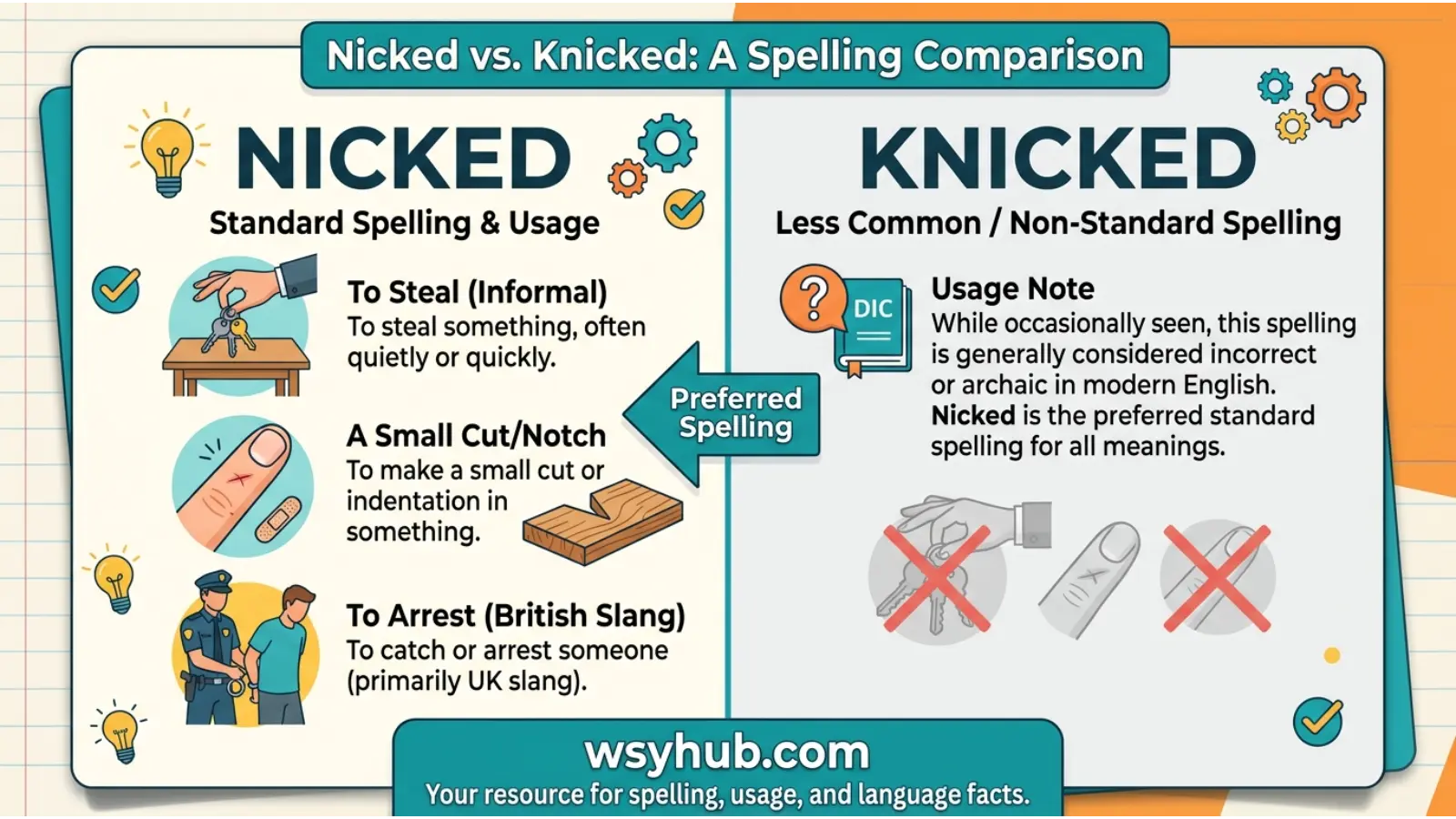
You are typing a sentence and suddenly stop: is it nicked or knicked? This is a common spelling confusion because both forms sound the same when spoken. You may see the word in British conversations, books, messages, schoolwork, or online discussions. People usually search for the keyword meaning, correct spelling, pronunciation, examples, usage, definition, and grammar difference. In this guide, you’ll learn the meaning, pronunciation, examples, usage, grammar rules, common mistakes, expert tips, and simple explanations in easy English.
Nicked or Knicked – Quick Answer
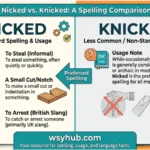
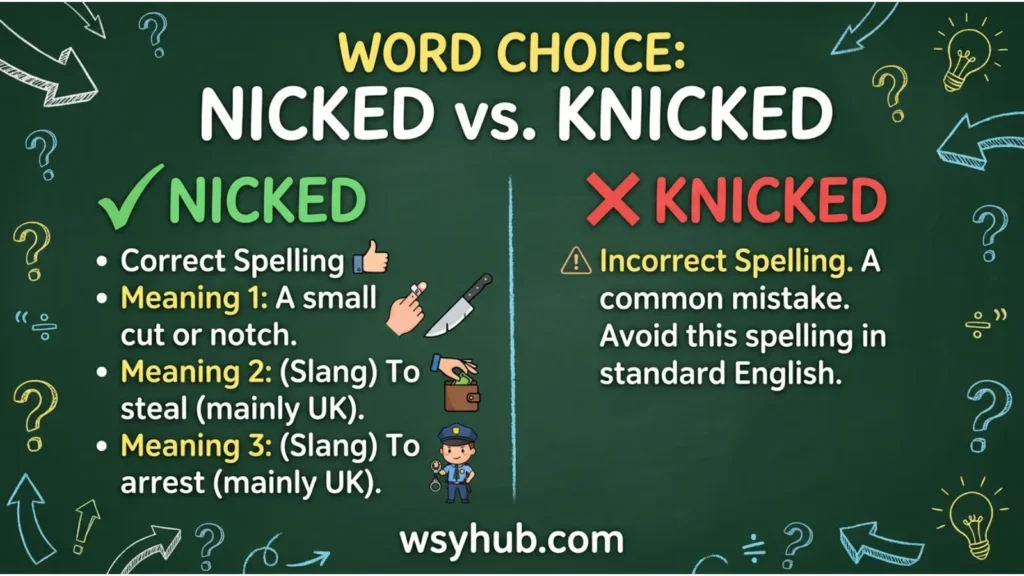
👉 Nicked = the standard and correct spelling in modern English.
👉 Knicked = generally not the standard spelling when you mean the past tense of “nick.”
Nicked is the past tense and past participle of nick. Depending on context, it can mean to make a small cut, steal something informally, or arrest someone in British slang. Major dictionaries such as Cambridge, Oxford, and Merriam-Webster list nicked as the past form of nick.
Examples:
- I nicked my finger while cooking.
- Someone nicked my phone.
- The police nicked him for speeding.
Simple Rule:
👉 Start with nick and simply add -ed: nick + ed = nicked.
A Small Historical Note About “Knicked”
There is a useful nuance here. Some historical or specialist word sources record knick as an alternative spelling of nick in the narrow sense of making a notch. However, knicked is not the normal modern spelling expected in everyday standard English.
For school, workplace, academic, and professional writing, use nicked.
What Does Nicked or Knicked Mean?
Nicked has several meanings, so context matters.
The most literal meaning is to make a small cut, mark, notch, or wound.
For example:
I nicked my finger while opening the package.
Here, the person made a small cut.
In informal British English, nicked can also mean stolen.
Someone nicked my bike.
This means someone stole the bike. Cambridge and Oxford both recognize this informal British use.
Another British slang meaning is arrested.
He was nicked for speeding.
This means the police arrested or caught him for the offense.
Synonyms
Depending on the meaning, synonyms include:
- Cut.
- Scratched.
- Chipped.
- Notched.
- Stolen.
- Taken.
- Arrested.
- Caught.
Opposites
For the cutting sense, possible opposites include:
- Repaired.
- Smoothed.
- Restored.
- Unmarked.
For the stealing sense, possible opposites include:
- Returned.
- Recovered.
- Given.
- Restored.
Related Terms
Common related forms include nick, nicks, nicking, and nicked.
The phrase “in the nick of time” is also very common and means just in time, often at the last possible moment.
The Origin of Nicked or Knicked
The word nick has a long history in English. Merriam-Webster traces the noun to Middle English nyke, with its first known use dating to the 15th century. Its deeper origin is uncertain.
The original idea was connected with a small notch, cut, or mark. Over time, the verb developed the meaning “to make a small cut.”
Other meanings appeared later. The informal British sense of steal developed centuries ago, while the sense connected with arresting someone also became established in British slang.
So, nicked is not a modern internet invention. It is an established English word with several meanings.
How to Pronounce Nicked or Knicked
Both nicked and the commonly written knicked are normally intended to sound like “nik-t.”
The standard pronunciation of nicked is:
/nɪkt/
Think of it as:
nick + t = nicked
It has one syllable.
The base word nick is pronounced /nɪk/, and the -ed ending sounds like /t/ because the base word ends with the /k/ sound. Oxford gives the pronunciation of nicked as /nɪkt/.
Common Pronunciation Mistake
Do not try to pronounce the beginning like “nicked” with a separate k sound. There is no extra sound.
Think:
NIKT
British English vs American English Usage
| Feature | British English | American English | Notes |
|---|---|---|---|
| Standard spelling | Nicked | Nicked | Same spelling |
| Pronunciation | /nɪkt/ | /nɪkt/ | Essentially the same |
| Small cut | Common | Common | Standard meaning |
| Stolen | Common informal slang | Less common | Strongly associated with British usage |
| Arrested | Common British slang | Less common | Context matters |
| Formal writing | Nicked for literal meanings | Nicked for literal meanings | Slang may be avoided |
| “Knicked” | Not standard modern spelling | Not standard modern spelling | Avoid it in normal writing |
The biggest difference is meaning and slang frequency, not spelling. Oxford identifies “steal” and “arrest” as British informal uses, while the small-cut meaning is standard English.
Which One Should You Use?
Use nicked when you mean the past tense or past participle of nick.
- Academic writing: Use nicked when the word is needed.
- Workplace writing: Use nicked, but avoid slang meanings if a clearer word such as “stolen” or “arrested” is better.
- Professional writing: Prefer precise language.
- Texting: “Nicked” is fine when the context is clear.
- Social media: “Nicked” is common in informal British-style writing.
- Schoolwork: Use nicked, not knicked.
- Formal documents: Choose clearer alternatives such as “stolen,” “cut,” or “arrested” when appropriate.
Common Mistakes With Nicked or Knicked
Mistake 1: Writing “knicked” for the normal past tense
❌ I knicked my finger.
✔ I nicked my finger.
The standard past form is nicked.
Mistake 2: Adding an unnecessary “k”
❌ Someone knicked my wallet.
✔ Someone nicked my wallet.
Remember the base word is nick, not “knick.”
Mistake 3: Assuming every “kn-” word follows the same pattern
Words such as knife, knee, and knock begin with “kn,” but that does not mean every word with a similar sound needs a silent k.
✔ nick
✔ nicked
✔ nicking
Mistake 4: Thinking “nicked” has only one meaning
❌ “Nicked” always means cut.
✔ Context can make it mean cut, stolen, or arrested.
Mistake 5: Using British slang in a formal sentence
❌ The customer’s laptop was nicked.
✔ The customer’s laptop was stolen.
The first sentence can be understood, but “stolen” is clearer in formal business writing.
Mistake 6: Confusing “nicked” with “knicked”
❌ The edge was knicked.
✔ The edge was nicked.
For standard modern English, choose nicked.
Nicked or Knicked in Everyday Examples
Work
“The corner of the desk was slightly nicked.”
School
“I accidentally nicked my finger while cutting paper.”
Social Media
“Someone nicked my idea and posted it first.”
Daily Life
“I nicked the paint on the door while moving the sofa.”
Emails
“The package arrived with a nicked corner.”
Text Messages
“Someone nicked my charger again!”
Online Content
“The article says the table was nicked during shipping.”
Conversation
“Who nicked my pen?”
In British English, that last sentence normally means, “Who stole my pen?” Cambridge specifically gives nick as an informal British verb meaning to steal.
Nicked or Knicked in Different Contexts
Grammar Learning
For English learners, the main lesson is simple: nicked is the normal past form of nick.
The verb pattern is:
nick → nicked → nicking
Business Communication
In business writing, clarity is more important than slang. If a product was stolen, say stolen. If an item has a small mark, nicked may be appropriate.
British Slang
In British informal speech, nicked can mean stolen or arrested.
“You’re nicked!” is a well-known slang expression meaning that someone has been arrested.
Writing and Proofreading
If you see knicked in ordinary English writing, check the intended meaning. In most cases, the writer probably means nicked.
Nicked or Knicked – Google Trends and Usage Data
People search nicked or knicked mainly because the two spellings sound alike. This is a classic spelling-confusion query rather than a topic where the two forms have equal status.
Searchers may also use longer questions such as:
- Is nicked spelled with a k?
- Is knicked a word?
- How do you spell nicked?
- What does nicked mean?
- How do you pronounce nicked?
- Is nicked British slang?
- Does nicked mean stolen?
- Does nicked mean arrested?
- Nicked vs knicked spelling.
The question can appear among English learners and online users in the US, UK, India, Pakistan, Canada, and Australia. British usage receives particular attention because nicked has established slang meanings related to stealing and arresting. Oxford and Cambridge both label these meanings as British informal or slang usage.
Comparison Table: Nicked or Knicked
| Feature | Nicked | Knicked |
|---|---|---|
| Standard modern spelling | Yes | Generally no |
| Base word | Nick | Knick |
| Pronunciation intended | /nɪkt/ | Usually intended as /nɪkt/ |
| Meaning: small cut | Yes | Avoid in standard writing |
| Meaning: stolen | Yes, British informal | No standard use |
| Meaning: arrested | Yes, British slang | No standard use |
| Academic usage | Acceptable when relevant | Avoid |
| Professional usage | Acceptable with context | Avoid |
| Texting usage | Common | Often a spelling mistake |
| Best choice | Nicked | Avoid |
Nicked or Knicked in Professional Life
A small spelling mistake can make professional writing look less polished. If you are writing an email, report, website, product description, or business document, nicked is the safer standard form.
For example:
❌ “The surface was knicked during delivery.”
✔ “The surface was nicked during delivery.”
If you mean theft, an even clearer professional sentence is:
✔ “The equipment was stolen during delivery.”
This removes any possible confusion caused by informal slang.
Nicked or Knicked for Students and Beginners
Beginners often remember the sound before they remember the spelling. That can create the temptation to add a k, especially because English contains familiar kn- words such as know, knee, knife, and knock.
The best shortcut is to learn the base word first:
NICK → NICKED
Do not build the word from its sound. Build it from its spelling.
Signs, Characteristics, and Common Uses of Nicked
You will most often see nicked when:
- Something has a small cut or mark.
- Someone has been informally described as stealing something.
- British slang is being used for an arrest.
- Someone describes a damaged edge or surface.
- A casual conversation uses British vocabulary.
- A text message uses informal language.
- Someone says “in the nick of time.”
- A writer is describing a small shaving or cutting accident.
Simple Trick to Remember Nicked or Knicked
Think of the word as a simple two-part formula:
NICK + ED = NICKED
There is no extra k at the beginning.
Think of it this way:
Imagine the word nick written on a small label. When you want the past tense, simply attach -ed.
nick → nicked
Do not add anything before the n.
A quick memory sentence is:
“Nick gets ED, not KN.”
That tiny rule can prevent the spelling mistake.
Expert Tips for Using Nicked Correctly
- Remember the base word nick.
- Add -ed to form nicked.
- Do not rely only on pronunciation.
- Check the context before interpreting the meaning.
- Use “stolen” instead of slang “nicked” in formal writing when clarity matters.
- Use “arrested” instead of “nicked” in formal reports.
- Remember that British English gives nicked several informal meanings.
- Proofread words that sound simple but have confusing spellings.
- When unsure, check the base form first.
The strongest spelling strategy is simple: learn word families rather than isolated words.
Related Searches People Also Ask
Is “knicked” the correct spelling?
Usually no. For the normal English verb nick, the standard past form is nicked.
How do you spell nicked?
It is spelled N-I-C-K-E-D.
What does nicked mean in British English?
It can mean stolen or arrested in British informal usage.
Does nicked mean cut?
Yes. It can mean that something was cut or marked slightly.
How do you pronounce nicked?
It is pronounced approximately “nik-t”, /nɪkt/.
Why do people spell it knicked?
The mistake may come from confusion with words beginning with kn-, such as knife and knee.
Is nicked formal English?
The literal cutting meaning is standard, while meanings such as “stolen” and “arrested” are informal British uses.
Is nicked used in American English?
Yes, especially for meanings related to cutting or marking. The British slang meanings are less central in American English.
FAQs
Is nicked or knicked correct?
Nicked is the standard modern spelling when you mean the past tense of nick.
Is knicked ever a word?
Some historical or specialist sources record knick as an alternative spelling of nick in a narrow sense, but knicked is not the normal spelling expected in modern standard English.
What does nicked mean?
It can mean cut slightly, marked, stolen, or arrested, depending on context.
Is nicked British slang?
It can be. In British informal English, nicked can mean stolen or arrested.
What is the pronunciation of nicked?
It is pronounced /nɪkt/, approximately “nik-t.”
Can I use nicked in formal writing?
Yes for its standard literal meanings, but use clearer words such as stolen or arrested when discussing those informal slang meanings.
What is the easiest way to remember nicked?
Remember:
nick + ed = nicked
Never add an extra k before the n.
Final Verdict
The correct choice for normal modern English is nicked.
Nicked = standard spelling.
Knicked = generally avoid in standard English.
The word nicked can mean slightly cut, stolen, or arrested, depending on context. British English especially uses the last two meanings informally.
The easiest memory rule is:
👉 NICK + ED = NICKED
Conclusion
The nicked or knicked confusion is easy to solve once you remember the base word. Nicked is the standard spelling used for the past tense and past participle of nick. It can describe a small cut or mark, while British informal English also uses it for something stolen or someone arrested.
If you are writing for school, work, a website, or a professional audience, choose nicked. When the meaning is slang, consider using a clearer word such as stolen or arrested if the audience may not know British expressions.
One final trick will help you remember it forever:
Nick + ed = nicked. No extra K.

Mk Azam is a Master’s graduate, content writer, and contributor at VsyHub.com. He enjoys creating clear, engaging, and informative content across a variety of topics. With a strong focus on accuracy and readability, he helps readers find practical insights and easy-to-understand information. His goal is to deliver valuable content that informs, educates, and inspires.