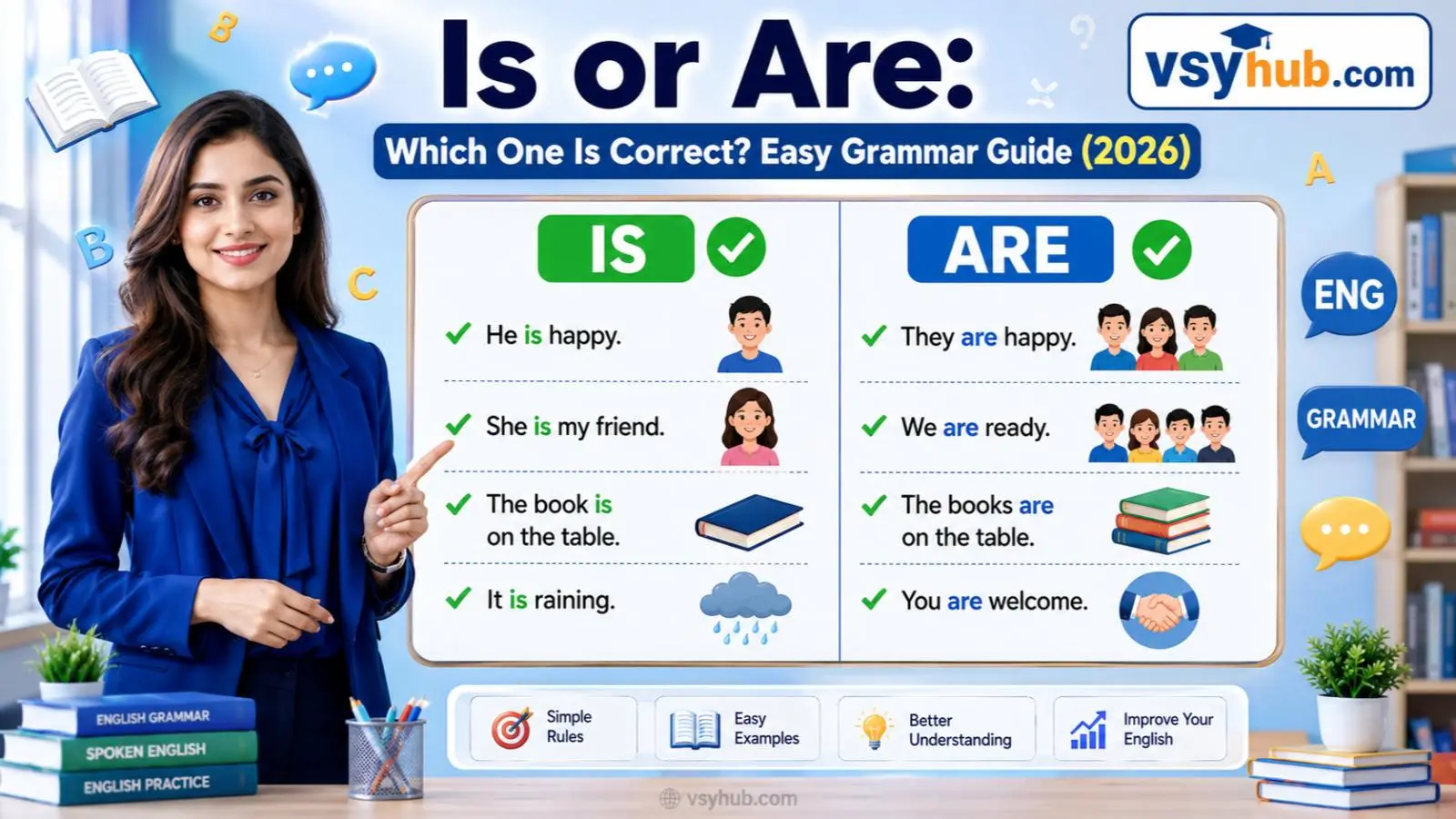
Have you ever stopped while writing a sentence and wondered whether to use is or are?
This is one of the most common grammar questions in English.
Students, professionals, content writers, social media users, and English learners often get confused because both words come from the verb to be.
People usually search for is or are meaning, correct usage, grammar difference, pronunciation, examples, and simple rules to avoid mistakes in speaking and writing.
Whether you’re writing a school assignment, an email at work, a social media post, or simply chatting with friends, using the correct form makes your English sound clear and professional.
In this guide, you’ll learn the meaning, pronunciation, examples, usage, grammar rules, common mistakes, expert tips, and simple explanations in easy English.
Is or Are – Quick Answer
Direct Answer:
Both is and are are forms of the verb to be.
👉 Is = used with singular nouns and singular subjects.
👉 Are = used with plural nouns and plural subjects.
Examples
The book is on the table.
She is happy today.
The students are in class.
They are ready for the meeting.
My friends are coming tomorrow.
Simple Rule
👉 One person or thing = is
👉 More than one person or thing = are
Easy Memory Trick
Think:
- One = is
- Many = are
Example:
- One cat is sleeping.
- Three cats are sleeping.
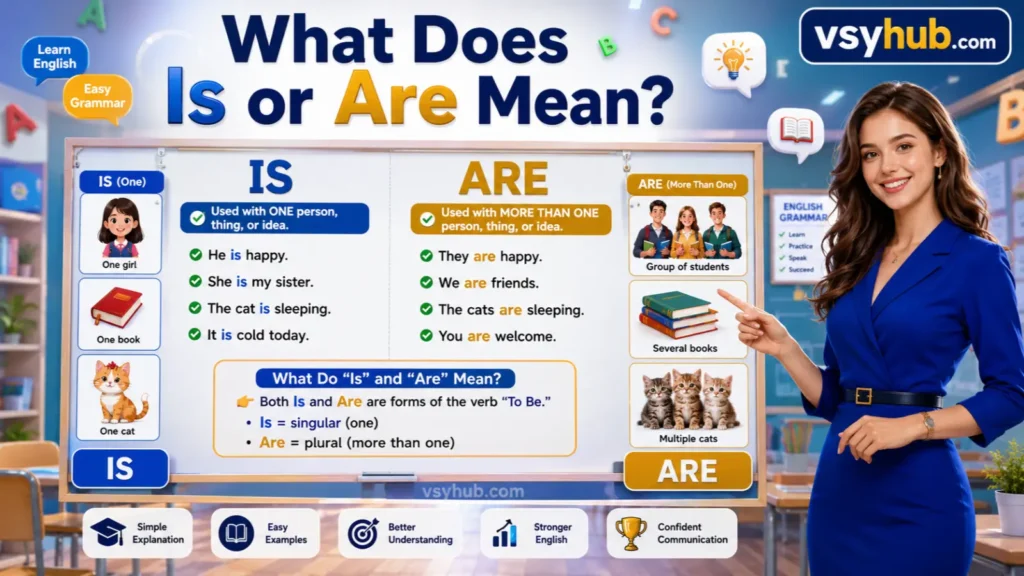
What Does Is or Are Mean?
The words is and are are helping verbs and linking verbs. They connect the subject of a sentence to information about that subject.
Meaning of Is
Is describes the state, condition, identity, or location of one person, animal, place, or thing.
Examples:
- The car is new.
- My brother is at home.
- The weather is nice.
Meaning of Are
Are describes the state, condition, identity, or location of more than one person, place, animal, or thing.
Examples:
- The cars are new.
- My brothers are at home.
- The children are happy.
Synonyms
Depending on context:
- Exists
- Remains
- Appears
- Becomes
- Stays
Opposites
In grammar, there is no direct opposite, but negative forms include:
- Is not (isn’t)
- Are not (aren’t)
Related Terms
- Am
- Was
- Were
- Be
- Being
- Been
- Subject-verb agreement
- Linking verb
Common Variations
- Is not
- Are not
- Isn’t
- Aren’t
- There is
- There are
The Origin of Is or Are
The words is and are come from the ancient English verb be, one of the oldest verbs in the language.
Their roots can be traced back to:
- Old English
- Germanic languages
- Proto-Indo-European languages
Over hundreds of years, English developed different forms of the verb “to be” to match different subjects.
Examples:
- I am
- You are
- He is
- She is
- It is
- We are
- They are
Today, these forms remain among the most frequently used words in English.
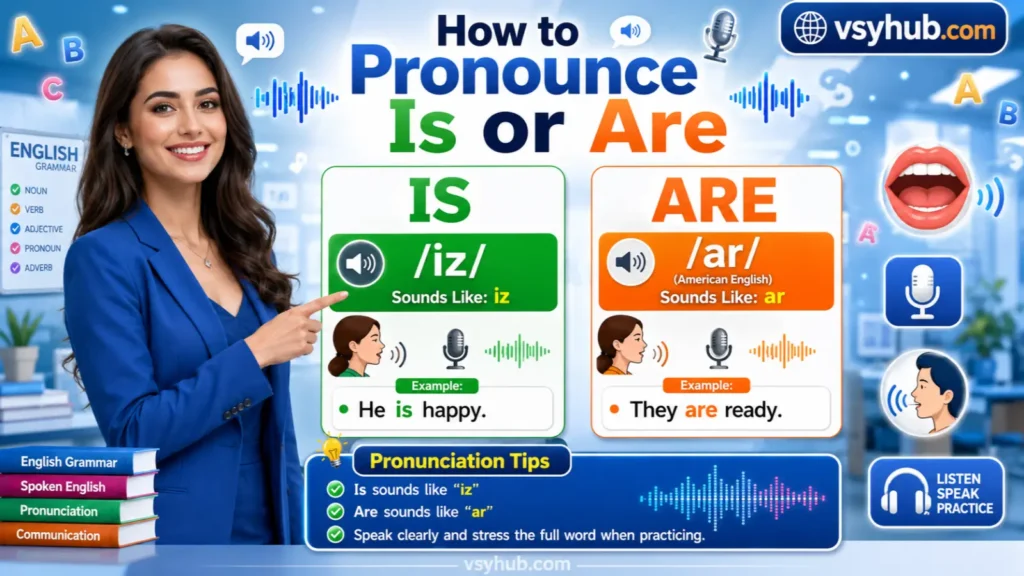
How to Pronounce Is or Are
Is
Phonetic pronunciation:
iz
Sounds like:
“izz”
Example:
- Is she here?
Are
Phonetic pronunciation:
ahr
In fast speech, it often sounds like:
“er”
Example:
- Are you ready?
Syllables
| Word | Syllables |
|---|---|
| Is | 1 |
| Are | 1 |
Common Pronunciation Mistakes
❌ Saying “air” instead of “are”
✔ Use a softer “ahr” sound.
❌ Overemphasizing “is”
✔ Keep it short and smooth.
Easy Speaking Trick
Practice:
- He is happy.
- They are happy.
Repeat both sentences aloud several times.
British English vs American English Usage
The grammar rules for is and are are mostly the same in both British and American English.
| Feature | British English | American English | Notes |
|---|---|---|---|
| Is Usage | Same | Same | Singular subjects |
| Are Usage | Same | Same | Plural subjects |
| Pronunciation | Slight accent difference | Slight accent difference | Meaning unchanged |
| Grammar Rules | Same | Same | Standard English |
| Formal Writing | Same | Same | Widely accepted |
Special Difference
British English sometimes treats collective nouns as plural.
Example:
British English:
- The team are playing well.
American English:
- The team is playing well.
Both can be correct depending on style.
Which One Should You Use?
Use Is When
- Talking about one person.
- Talking about one object.
- Referring to one place.
- Using singular subjects.
Examples:
- The teacher is here.
- My phone is broken.
- Pakistan is beautiful.
Use Are When
- Talking about multiple people.
- Talking about multiple things.
- Using plural subjects.
Examples:
- The teachers are here.
- My phones are broken.
- The cities are crowded.
Mini Usage Table
| Subject | Correct Verb |
|---|---|
| He | Is |
| She | Is |
| It | Is |
| John | Is |
| They | Are |
| We | Are |
| Students | Are |
| Parents | Are |
Common Mistakes With Is or Are
Mistake 1
❌ The students is studying.
✔ The students are studying.
Explanation:
“Students” is plural.
Mistake 2
❌ My friend are waiting.
✔ My friend is waiting.
Explanation:
“Friend” is singular.
Mistake 3
❌ There is many books.
✔ There are many books.
Explanation:
“Books” is plural.
Mistake 4
❌ The dogs is barking.
✔ The dogs are barking.
Explanation:
More than one dog.
Mistake 5
❌ They is coming tomorrow.
✔ They are coming tomorrow.
Explanation:
“They” always uses “are.”
Mistake 6
❌ We is ready.
✔ We are ready.
Explanation:
“We” takes “are.”
Mistake 7
❌ The children is playing.
✔ The children are playing.
Explanation:
“Children” is a plural noun.
Is or Are in Everyday Examples
Work
- The report is finished.
- The reports are finished.
School
- The teacher is teaching.
- The students are learning.
Social Media
- My post is trending.
- My videos are getting views.
Daily Life
- The food is delicious.
- The meals are delicious.
Emails
- Your order is confirmed.
- Your documents are attached.
Text Messages
- He is online.
- They are online.
Online Content
- This article is helpful.
- These articles are helpful.
Conversations
- My sister is busy.
- My cousins are busy.
Is or Are in Different Contexts
Is or Are in Education
Students often learn subject-verb agreement through is and are.
Examples:
- The lesson is easy.
- The lessons are easy.
Is or Are in Business
Professional communication requires correct grammar.
Examples:
- The project is complete.
- The projects are complete.
Is or Are in Workplace Communication
Incorrect usage can make writing appear less professional.
Example:
✔ The meeting is scheduled.
✔ The meetings are scheduled.
Is or Are in Writing
Writers use these verbs constantly.
Examples:
- The character is brave.
- The characters are brave.
Is or Are in Technology
Examples:
- The software is updated.
- The systems are updated.
Is or Are in Social Media
Examples:
- My account is active.
- My accounts are active.
Is or Are – Google Trends & Usage Data
The phrase is or are remains one of the most searched grammar topics worldwide.
People search for it because:
- English learners struggle with subject-verb agreement.
- Students prepare for exams.
- Professionals want error-free writing.
- Content creators need accurate grammar.
- Non-native speakers seek simple explanations.
Popular countries searching this topic include:
- United States
- United Kingdom
- India
- Pakistan
- Canada
- Australia
Common Related Searches
- Is or are grammar rules
- When to use is and are
- Is vs are examples
- Subject verb agreement rules
- Is or are for beginners
- There is or there are
- Which is correct is or are
- How to use is and are in sentences
Voice Search Examples
- When should I use is or are?
- What is the difference between is and are?
- Is students is correct?
- How do I know whether to use is or are?
Comparison Table: Is or Are
| Feature | Is | Are |
|---|---|---|
| Meaning | Singular form of be | Plural form of be |
| Grammar Role | Linking/helping verb | Linking/helping verb |
| Subject Type | Singular | Plural |
| Example | She is happy | They are happy |
| Academic Usage | Very common | Very common |
| Professional Usage | Very common | Very common |
| Social Media Usage | Common | Common |
| Pronunciation | iz | ahr |
| Common Mistake | Used with plural nouns | Used with singular nouns |
| Difficulty Level | Easy | Easy |
Is or Are in Professional Life
Correct grammar creates a stronger impression in professional settings.
Workplace Examples
✔1 The document is ready.
✔2 The documents are ready.
✔3 The employee is available.
✔ The employees are available.
Business Communication
Proper usage helps:
- Build credibility
- Improve clarity
- Reduce misunderstandings
- Strengthen professional writing
Branding and Marketing
Examples:
- Our product is trusted.
- Our products are trusted.
Small grammar details can influence how professional a brand appears.
Is or Are for Students or Beginners
Many beginners make mistakes because they focus on nearby words instead of the actual subject.
Example:
- The box of toys is heavy.
Some learners mistakenly use “are” because they notice “toys.”
Beginner Shortcut
Find the real subject first.
Ask:
“Who or what is the sentence about?”
Easy Learning Tips
- Singular = is
- Plural = are
- Read sentences aloud
- Practice daily examples
- Check the subject before choosing the verb
Signs, Characteristics, or Common Uses Related to Is or Are
Common Uses
- Describing people
- Identifying objects
- Giving information
- Showing location
- Expressing feelings
- Writing emails
- Creating content
Common Grammar Patterns
- He is
- She is
- It is
- They are
- We are
- You are
Writing Situations
- Essays
- Reports
- Blogs
- Emails
- Social media captions
- Business documents
Online Usage Patterns
- Grammar questions
- English learning apps
- Educational websites
- Classroom exercises
- Language learning videos
Simple Trick to Remember Is or Are
Easy Memory Rule
One = Is
More than One = Are
Think of It This Way
Imagine one apple on a table.
- The apple is red.
Now imagine five apples.
- The apples are red.
The moment the number becomes more than one, switch from is to are.
Visual Memory Shortcut
🟢 One person → is
🟢 Many people → are
Expert Tips Section
Tip 1: Find the Subject First
Always identify the subject before choosing the verb.
Tip 2: Ignore Extra Words
Example:
- The basket of apples is heavy.
The subject is “basket,” not “apples.”
Tip 3: Learn Common Pronouns
Memorize:
- He is
- She is
- It is
- We are
- They are
- You are
Tip 4: Read Aloud
Many grammar mistakes become obvious when spoken.
Tip 5: Practice Daily
Write five sentences using “is” and five using “are” every day.
Related Searches People Also Ask
What is the difference between is and are?
“Is” is singular, while “are” is plural.
When should I use is?
Use “is” with one person, thing, or idea.
When should I use are?
Use “are” with multiple people, things, or ideas.
Why do students confuse is and are?
Both words come from the verb “to be,” making them easy to mix up.
Is there a simple rule for is and are?
Yes. One = is. More than one = are.
What is subject-verb agreement?
It means the verb must match the subject in number.
Is “you is” correct?
No. Always say “you are.”
Why do collective nouns cause confusion?
Some collective nouns can be singular or plural depending on context.
Is grammar important in professional writing?
Yes. Correct grammar improves credibility and clarity.
How can beginners learn is and are quickly?
Practice short sentences and remember the one-versus-many rule.
FAQs
Is “there is” or “there are” correct?
Both are correct. Use “there is” for singular nouns and “there are” for plural nouns.
Is “you is” grammatically correct?
No. The correct phrase is “you are.”
Can I use is with names?
Yes. Example: Ahmed is my friend.
Can I use are with a group of people?
Yes. Example: The players are ready.
Why is English grammar difficult sometimes?
Many grammar rules have exceptions, which can confuse learners.
Is “children is” correct?
No. “Children” is plural, so use “children are.”
Are is and are helping verbs?
Yes. They can act as helping verbs and linking verbs.
Which is more common, is or are?
Both are extremely common because they are basic English verbs.
How do I avoid mistakes?
Check whether the subject is singular or plural.
Are these words important for exams?
Yes. Subject-verb agreement is a common exam topic.
Final Verdict
The answer is simple:
👉 Use is with singular subjects.
👉 Use are with plural subjects.
The easiest rule to remember is:
One = Is
More Than One = Are
If you identify the subject correctly, choosing between is and are becomes easy.
Conclusion
Understanding is or are is one of the most important grammar skills in English. These small words appear in school assignments, workplace communication, social media posts, emails, conversations, and professional writing every day.
The key takeaway is simple: use is for one person or thing and are for more than one person or thing. With regular practice, this rule becomes automatic.
Remember this final memory trick:
One apple is red. Five apples are red.
Once you remember that pattern, you’ll rarely make mistakes with is or are again.