
Have you ever seen the words analogue and analog and wondered if they mean the same thing? Maybe you noticed one spelling in a British textbook and another in an American website. This confusion is very common because both words refer to the same idea, but their spelling changes depending on where English is used.
People usually search for analogue or analog meaning, correct spelling, pronunciation, examples, usage, definition, and grammar difference when writing emails, studying technology, reading manuals, or creating professional content.
Understanding the difference can help you write more confidently in school, at work, online, and in daily communication.
In this guide, you’ll learn the meaning, pronunciation, examples, usage, grammar rules, common mistakes, expert tips, and simple explanations in easy English.
Analogue or Analog – Quick Answer
Direct Answer
👉 Analogue = British English spelling
👉 Analog = American English spelling
Both words have the same meaning.
They usually describe something that works using continuous physical signals rather than digital technology.
Examples
✅ The company still uses analogue recording equipment.
✅ The company still uses analog recording equipment.
✅ An analogue clock shows time with hands.
✅ An analog clock shows time with hands.
✅ Many photographers love analogue cameras.
Simple Rule
👉 If you write for the UK, Australia, or many Commonwealth countries, use analogue.
👉 If you write for the United States, use analog.
Easy Memory Trick
Think of it this way:
Analogue = UK spelling
Analog = US spelling
The meaning stays the same. Only the spelling changes.
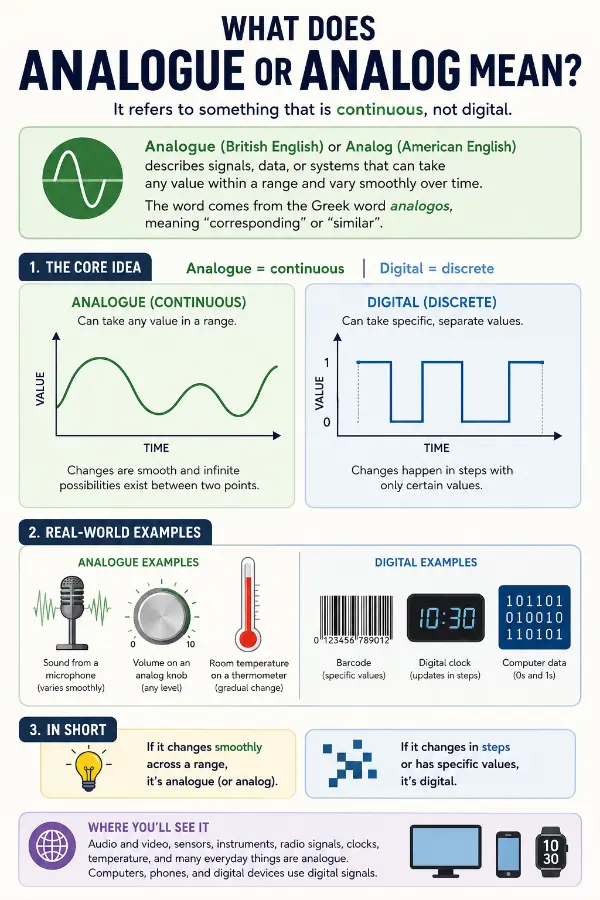
What Does Analogue or Analog Mean?
The words analogue and analog describe something that represents information using continuous signals or physical changes rather than digital numbers.
In simple English, analogue technology works in a smooth and continuous way, while digital technology works with electronic data and numbers.
Everyday Meaning
An analogue clock uses moving hands.
An analog radio receives continuous radio signals.
An analogue thermometer measures temperature through physical movement.
Technology Meaning
In technology, analogue or analog refers to systems that process information through continuous signals.
Examples include:
- Vinyl records.
- Cassette tapes.
- Film cameras.
- Traditional radios.
- Analog audio equipment.
Professional Meaning
Engineers, designers, musicians, and technology experts often use the term when discussing older or non-digital systems.
Synonyms
- Traditional.
- Non-digital.
- Physical.
- Continuous signal.
- Conventional.
Opposites
- Digital.
- Electronic data-based.
- Computerized.
- Binary.
Related Terms
- Digital technology.
- Analog signal.
- Analog recording.
- Analog electronics.
- Analog clock.
- Analog communication.
- Analog device.
Common Variations
- Analogue technology.
- Analog technology.
- Analogue signal.
- Analog signal.
- Analogue clock.
- Analog clock.
The Origin of Analogue or Analog
The word comes from the Greek word analogos, which means “proportionate” or “corresponding.”
Later, the term entered Latin and eventually English.
For many years, scientists used the word to describe things that matched or corresponded to something else.
As technology developed during the twentieth century, engineers began using analogue and analog to describe systems that represented information continuously rather than digitally.
When American English simplified some spellings, analog became common in the United States, while analogue remained standard in British English.
Today, both spellings are widely accepted depending on location.
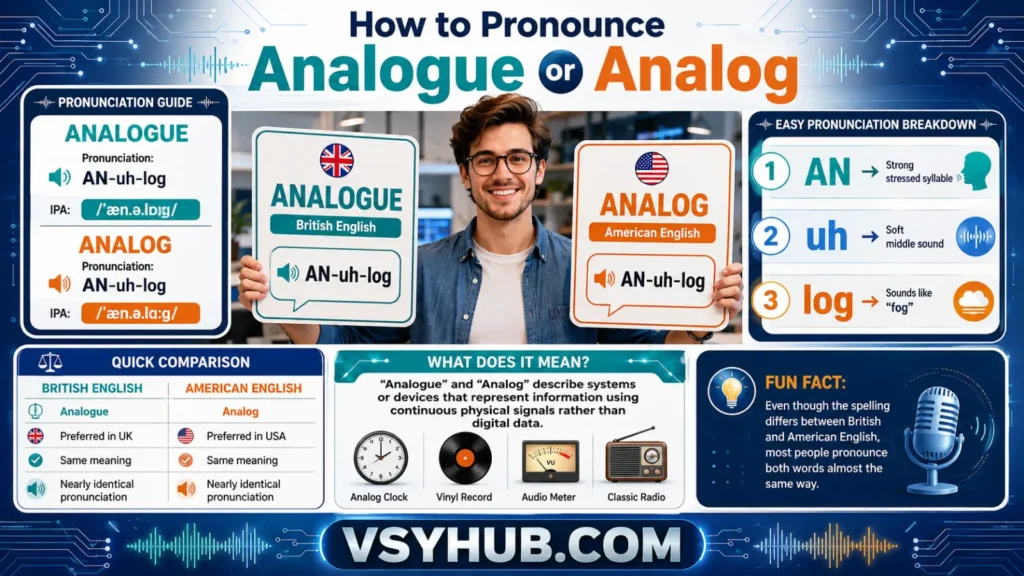
How to Pronounce Analogue or Analog
Analogue Pronunciation
British pronunciation:
AN-uh-log
Phonetic:
/ˈæn.ə.lɒɡ/
Analog Pronunciation
American pronunciation:
AN-uh-log
Phonetic:
/ˈæn.ə.lɑːɡ/
Syllables
An-a-log
Three syllables.
Easy Speaking Trick
Say:
“AN” + “uh” + “log”
Common Pronunciation Mistakes
❌ Ana-logue-gee
❌ Ana-loog
✔ AN-uh-log
The pronunciation is nearly identical in both British and American English.
British English vs American English Usage
| Feature | British English | American English | Notes |
|---|---|---|---|
| Preferred spelling | Analogue | Analog | Main difference |
| Meaning | Same | Same | No meaning change |
| Pronunciation | Similar | Similar | Small accent differences |
| Technology usage | Analogue camera | Analog camera | Both correct regionally |
| Academic writing | Analogue | Analog | Follow audience |
| Business writing | Analogue | Analog | Depends on country |
Which One Should You Use?
The correct choice depends on your audience.
Use Analogue When
- Writing for the UK.
- Writing for Australia.
- Writing for New Zealand.
- Following British English style guides.
- Publishing in Commonwealth countries.
Use Analog When
- Writing for the United States.
- Creating American marketing content.
- Publishing for American readers.
- Following American style guides.
Quick Usage Table
| Situation | Recommended |
|---|---|
| UK school essay | Analogue |
| US school essay | Analog |
| British website | Analogue |
| American website | Analog |
| Global audience | Either, stay consistent |
| Social media | Either |
Common Mistakes With Analogue or Analog
Mistake 1
❌ This analog device is common in British textbooks.
✔ This analogue device is common in British textbooks.
Explanation:
British publications usually prefer analogue.
Mistake 2
❌ The analogue equipment was reviewed by an American publication.
✔ The analog equipment was reviewed by an American publication.
Explanation:
American publications generally use analog.
Mistake 3
❌ Using both spellings randomly in one article.
✔ Choose one spelling and stay consistent.
Explanation:
Consistency looks professional.
Mistake 4
❌ Analog means different from analogue.
✔ Both words mean the same thing.
Explanation:
Only the spelling changes.
Mistake 5
❌ Analog is incorrect.
✔ Analog is correct in American English.
Explanation:
Many beginners think only analogue is correct.
Mistake 6
❌ Analogue is outdated.
✔ Analogue remains standard British English.
Explanation:
It is still widely used today.
Mistake 7
❌ Analog always refers to technology.
✔ Analog can also describe comparisons or similarities in some contexts.
Explanation:
The word has broader uses beyond technology.
Analogue or Analog in Everyday Examples
Work
“The company upgraded its analog recording system.”
School
“Our science teacher explained analogue signals.”
Social Media
“I love the look of analogue photography.”
Daily Life
“My grandfather still uses an analogue clock.”
Emails
“The analog equipment needs maintenance.”
Text Messages
“I prefer analogue watches over smartwatches.”
Online Content
“Many creators discuss analog versus digital sound.”
Conversations
“Do you like analogue cameras or digital cameras?”
Analogue or Analog in Different Contexts
Technology
This is the most common use.
Examples:
- Analog audio.
- Analog electronics.
- Analog recording.
Education
Students learn the difference between analog and digital systems in science and engineering courses.
Photography
Film photography is often called analogue photography because it does not rely on digital sensors.
Music Production
Many musicians prefer analog equipment because they enjoy its warm sound quality.
Engineering
Engineers use analog circuits in various electronic systems.
Marketing and Branding
Some brands use the word analogue to create a nostalgic or classic image.
Communication
Analog communication uses continuously changing signals.
Writing and Language
Sometimes analog means a comparison or equivalent idea between two things.
Analogue or Analog – Google Trends & Usage Data
The keyword remains popular because people often encounter both spellings online.
Why People Search It
- Spelling confusion.
- Technology discussions.
- Analog vs digital comparisons.
- Academic writing questions.
- Regional English differences.
Popular Countries
- United States.
- United Kingdom.
- Canada.
- Australia.
- India.
- Pakistan.
Common Related Searches
- analogue vs digital.
- analog meaning.
- analogue meaning.
- analog signal definition.
- analog clock meaning.
- analogue pronunciation.
- analog technology examples.
- analogue camera definition.
Voice Search Examples
- “Is analogue or analog correct?”
- “What is the difference between analogue and analog?”
- “How do you pronounce analogue?”
- “Should I use analog or analogue in business writing?”
Comparison Table: Analogue or Analog
| Feature | Analogue | Analog |
|---|---|---|
| Meaning | Continuous signal system | Continuous signal system |
| Correctness | Correct | Correct |
| English Type | British | American |
| Pronunciation | Similar | Similar |
| Academic Usage | UK preferred | US preferred |
| Professional Writing | UK preferred | US preferred |
| Technology Usage | Common | Common |
| Internet Usage | Moderate | Very common |
| Common Mistake | Seen as incorrect by Americans | Seen as incorrect by British users |
| Best For | UK audiences | US audiences |
Analogue or Analog in Professional Life
Choosing the right spelling can improve professional communication.
Workplace Communication
Use the spelling your company style guide follows.
Technical Documentation
Match the regional audience.
Marketing Content
American audiences expect “analog.”
British audiences expect “analogue.”
Business Example
A UK electronics company may advertise:
“Premium analogue audio systems.”
A US electronics company may advertise:
“Premium analog audio systems.”
Consistency builds trust and professionalism.
Analogue or Analog for Students or Beginners
Many learners struggle because both spellings appear correct.
Why Beginners Get Confused
- Both words mean the same thing.
- Both appear online.
- Different countries use different spellings.
Easy Learning Tip
Remember:
UK = Analogue
US = Analog
Beginner Shortcut
Check your audience before writing.
That simple step prevents most mistakes.
Signs, Characteristics, or Common Uses Related to Analogue or Analog
Common Uses
- Analog clocks.
- Analog watches.
- Analog radios.
- Analog audio.
- Analog photography.
- Analog electronics.
Common Patterns
- Often compared with digital technology.
- Frequently appears in engineering.
- Popular in photography communities.
- Common in music production.
Industries Using the Term
- Technology.
- Engineering.
- Electronics.
- Education.
- Broadcasting.
- Photography.
- Music production.
Simple Trick to Remember Analogue or Analog
Easy Memory Rule
Analogue = United Kingdom
Analog = United States
Think of It This Way
Imagine two cameras.
One is sold in London.
The label says:
“Analogue Camera”
The other is sold in New York.
The label says:
“Analog Camera”
Same camera.
Different spelling.
That’s the easiest way to remember it.
Expert Tips Section
Follow One Style Guide
Never switch between analogue and analog in the same article.
Match Your Audience
Use British spelling for UK readers and American spelling for US readers.
Use Browser Language Clues
Many spell-check tools automatically suggest the correct regional version.
Learn Related Pairs
Similar spelling differences include:
- Colour vs Color.
- Favourite vs Favorite.
- Centre vs Center.
- Catalogue vs Catalog.
Proofreading Tip
Search your document before publishing to ensure only one spelling appears.
Related Searches People Also Ask
Is analogue the same as analog?
Yes. The meaning is identical. Only the spelling differs.
What is an analogue signal?
An analogue signal changes continuously rather than using digital numbers.
What is an analog clock?
An analog clock uses hands to show time.
Why does Britain use analogue?
British English kept the traditional spelling.
Why does America use analog?
American English simplified many word endings.
Is analogue outdated?
No. It remains standard British English.
Is analog more common online?
Yes. American content often dominates online searches.
What is analogue photography?
Photography that uses film instead of digital sensors.
What is analog audio?
Audio recorded through continuous electrical signals.
Can I use either spelling?
Yes, as long as you remain consistent.
Is analogue used in engineering?
Yes. Engineers frequently discuss analogue systems.
Does pronunciation change?
Not significantly. Both are pronounced almost the same way.
FAQs
Is analogue or analog correct?
Both are correct. The choice depends on whether you use British or American English.
Which spelling is used in the UK?
Analogue.
Which spelling is used in the US?
Analog.
Do they have different meanings?
No. The meaning is the same.
How do you pronounce analogue?
AN-uh-log.
Is analogue used in technology?
Yes. It commonly describes non-digital systems.
What is an analogue clock?
A clock with moving hands.
What is an analog signal?
A continuously changing signal.
Which spelling should students use?
Use the version required by your school or audience.
Can I mix analogue and analog?
No. Choose one style and remain consistent.
Final Verdict
The answer is simple:
✅ Analogue is the preferred British English spelling.
✅ Analog is the preferred American English spelling.
Both words mean exactly the same thing.
The easiest memory rule is:
UK = Analogue
US = Analog
Choose the version that matches your audience and use it consistently.
Conclusion
The debate between analogue or analog is not really about right versus wrong. Both spellings are correct and widely accepted. The main difference is regional usage. British English prefers analogue, while American English prefers analog.
Whether you are writing a school assignment, business document, technology article, social media post, or professional email, the best approach is to match your audience and stay consistent throughout your writing.
One final memory trick: If you’re writing for Britain, add “ue” to make analogue. If you’re writing for America, keep it shorter with analog.

Aria Foster is a comparison and language writer who specializes in spelling differences, word meanings, grammar guides, and easy-to-understand language explanations. She creates clear, reader-friendly content that helps people understand commonly confused words and expressions.